
|
시장보고서
상품코드
1936653
P2G(Power to Gas) 시장 기회, 성장 촉진요인, 업계 동향 분석 및 예측(2026-2035년)Power to Gas Market Opportunity, Growth Drivers, Industry Trend Analysis, and Forecast 2026 - 2035 |
||||||

세계의 P2G(Power to Gas) 시장은 2025년에 4,260만 달러로 평가되었으며, 2035년까지 CAGR 6.2%로 성장하여 7,880만 달러에 달할 것으로 예측됩니다.
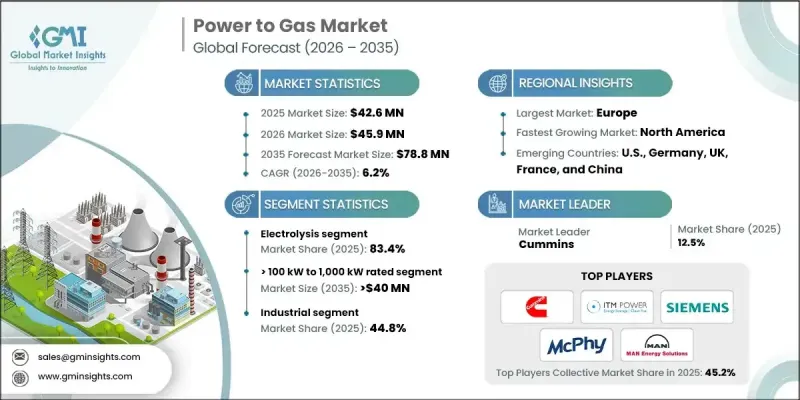
이러한 성장은 재생에너지 발전의 급속한 증가와 변동성 전원의 국가 전력망에 대한 통합 확대에 의해 뒷받침되고 있습니다. 에너지 시스템이 진화하는 가운데, P2G 기술은 수요와 공급의 균형을 맞추는 중요한 수단으로 점점 더 많은 주목을 받고 있습니다. 첨단 디지털 예측 도구, 지능형 전력 조정 시스템, 실시간 전해 장치 제어 기술이 시스템의 효율성과 신뢰성을 강화합니다. P2G(Power to Gas) 기술은 잉여 전력을 기체 에너지 캐리어로 변환하여 장기 저장, 계통 주입 및 부문 간 활용을 가능하게 합니다. 전력회사의 탈탄소화 전략과 수소 혼합 기준의 정합성은 인프라 구축의 가속화와 부문 결합의 개선을 촉진할 것입니다. 동시에 탄소 회수 통합 기술과 메탄화 공정 확장성의 발전은 순환형 탄소 경로를 실현하고 합성 가스 솔루션의 상업적 실현 가능성을 높이고 있습니다. 발전 억제 감소, 간헐성 관리, 산업 전기화, 저탄소 원료 수요에 대한 관심 증가가 수요를 촉진하는 한편, 열 시스템 개조 확대와 산업용 연료 전환이 진행됨에 따라 P2G(Power to Gas)의 적용 범위가 확대되고 있습니다.
| 시장 범위 | |
|---|---|
| 시작 연도 | 2025년 |
| 예측 연도 | 2026-2035 |
| 개시 금액 | 4,260만 달러 |
| 예측 금액 | 7,880만 달러 |
| CAGR | 6.2% |
전기분해 기반 P2G 기술 부문은 2025년 83.4%의 점유율을 차지했으며, 이는 현재 도입 전략에서 핵심적인 역할을 담당하고 있음을 반영합니다. 재생 가능 전력의 가용성 향상과 잉여 발전량의 증가로 전해장치의 도입이 가속화되고 있습니다. 그린 수소 개발과 국가 탈탄소화 목표에 대한 강한 의지가 첨단 전기분해 플랫폼의 보급을 촉진하고 있습니다. 동시에 재생 가능 전력 비용의 하락과 전해 장치 효율의 지속적인 개선으로 경제성이 향상되어 전해 구동식 전력-가스 솔루션의 장기적인 전망이 강화되고 있습니다.
100kW 초과-1,000kW급 시스템은 2025년 54.3%의 점유율을 차지하며 2035년까지 4,000만 달러 규모에 달할 것으로 예상됩니다. 이 용량 대역은 특히 온사이트 재생에너지 발전이 확대되고 있는 상업 및 산업 분야의 에너지 통합 프로그램과 잘 부합합니다. 배출량 감축 목표를 달성하기 위해 저탄소 에너지원을 찾는 조직에서 중규모의 P2G(Power to Gas) 시스템 도입이 증가하고 있습니다. 지역 에너지 공급 및 청정 난방 전략에 대한 수소 수요 증가는 이 전력 부문의 설비 도입 성장을 더욱 촉진하고 있습니다.
미국 P2G(Power to Gas) 시장은 2025년 74.9%의 점유율을 차지하며, 1,750만 달러 규모에 달할 것으로 예상됩니다. 이 나라의 시장 확대는 재생에너지 발전 용량의 급격한 성장과 에너지 규제 완화에 대한 요구로 인해 추진되고 있습니다. 청정 수소 개발 및 탈탄소화 의무에 대한 정책적 지원이 전해조 기반 인프라에 대한 투자를 촉진하고 있습니다. 재생에너지 허브의 광범위한 배치와 그리드 밸런싱 요구 사항의 증가는 미국 에너지 환경 전반에 걸쳐 전력-가스 기술의 통합을 더욱 가속화하고 있습니다.
자주 묻는 질문
목차
제1장 조사 방법과 범위
제2장 주요 요약
제3장 업계 인사이트
제4장 경쟁 구도
제5장 시장 규모 및 예측 : 기술별, 2022-2035
제6장 시장 규모 및 예측 : 용량별, 2022-2035
제7장 시장 규모 및 예측 : 용도별, 2022-2035
제8장 시장 규모 및 예측 : 지역별, 2022-2035
제9장 기업 개요
KSM 26.03.05The Global Power to Gas Market was valued at USD 42.6 million in 2025 and is estimated to grow at a CAGR of 6.2% to reach USD 78.8 million by 2035.
Growth is supported by the rapid increase in renewable electricity generation and the growing integration of variable power sources into national grids. As energy systems evolve, power to gas solutions are increasingly viewed as a critical mechanism for balancing supply and demand. Advanced digital forecasting tools, intelligent dispatch systems, and real-time electrolyzer control technologies are strengthening system efficiency and reliability. Power to gas technology enables the conversion of surplus electricity into gaseous energy carriers, allowing long-term storage, grid injection, and cross-sector utilization. Alignment between utility decarbonization strategies and hydrogen blending standards accelerate infrastructure readiness and improving sector coupling. In parallel, advancements in carbon capture integration and methanation scalability are enabling circular carbon pathways, enhancing the commercial viability of synthetic gas solutions. Growing emphasis on curtailment reduction, intermittency management, industrial electrification, and low-carbon feedstock requirements is reinforcing demand, while expanding thermal system retrofitting and industrial fuel switching are broadening the application scope of power to gas systems.
| Market Scope | |
|---|---|
| Start Year | 2025 |
| Forecast Year | 2026-2035 |
| Start Value | $42.6 Million |
| Forecast Value | $78.8 Million |
| CAGR | 6.2% |
The electrolysis-based power to gas technologies segment accounted for 83.4% share in 2025, reflecting its central role in current deployment strategies. Increasing availability of renewable electricity and higher volumes of surplus generation are accelerating electrolyzer installations. Strong commitments to green hydrogen development and national decarbonization objectives are supporting wider adoption of advanced electrolysis platforms. At the same time, declining renewable power costs and ongoing improvements in electrolyzer efficiency are enhancing economic feasibility, strengthening the long-term outlook for electrolysis-driven power to gas solutions.
The systems rated between greater than 100 kW and 1,000 kW represented 54.3% share in 2025 and are expected to reach USD 40 million by 2035. This capacity range aligns well with commercial and industrial energy integration programs, particularly where on-site renewable generation is expanding. Organizations seeking low-carbon energy inputs to meet emissions reduction commitments are increasingly deploying mid-scale power to gas systems. Rising hydrogen demand for localized energy distribution and clean heating strategies is further supporting the growth of installations within this power segment.
United States Power to Gas Market held 74.9% share, generating USD 7.5 million in 2025. Market expansion in the country is being driven by the rapid growth of renewable power capacity and the need to mitigate energy curtailment. Policy support for clean hydrogen development and decarbonization mandates is encouraging investment in electrolyzer-based infrastructure. Broader deployment of renewable energy hubs and increasing grid-balancing requirements are further accelerating integration of power to gas technologies across the U.S. energy landscape.
Key companies operating in the Global Power to Gas Market include Siemens Energy, Linde, Baker Hughes, Cummins, Thyssenkrupp, NEL, ITM Power, McPhy Energy, MAN Energy Solutions, Engie, John Cockerill, Kanadevia Inova, Hitachi Zosen Inova Schmack, Electrochaea, Phoenix Contact, GRTgaz, Terega, Ren-Gas, AquaHydrex, KROHNE, Krajete, and Power-to-Gas Hungary. Companies active in the power to gas market are strengthening their competitive position through technology advancement, strategic partnerships, and system optimization. Leading players are investing in higher-efficiency electrolyzers, modular system designs, and digital control platforms to improve performance and scalability. Collaboration with utilities, industrial customers, and infrastructure operators is enabling faster deployment and smoother grid integration. Many companies are expanding solution portfolios to support both hydrogen and synthetic gas pathways, enhancing flexibility across end-use applications.
Table of Contents
Chapter 1 Methodology & Scope
- 1.1 Research approach
- 1.2 Quality commitments
- 1.2.1 GMI AI policy & data integrity commitment
- 1.2.1.1 Source consistency protocol
- 1.2.1 GMI AI policy & data integrity commitment
- 1.3 Research trail & confidence scoring
- 1.3.1 Research trail components
- 1.3.2 Scoring components
- 1.4 Data collection
- 1.4.1 Partial list of primary sources
- 1.5 Data mining sources
- 1.5.1 Paid sources
- 1.5.1.1 Sources, by region
- 1.5.1 Paid sources
- 1.6 Base estimates and calculations
- 1.6.1 Base year calculation for any one approach
- 1.7 Market estimates & forecasts parameters
- 1.8 Forecast model
- 1.8.1 Quantified market impact analysis
- 1.8.1.1 Mathematical impact of growth parameters on forecast
- 1.8.1 Quantified market impact analysis
- 1.9 Research transparency addendum
- 1.9.1 Source attribution framework
- 1.9.2 Quality assurance metrics
- 1.9.3 Our commitment to trust
- 1.10 Market definitions
Chapter 2 Executive Summary
- 2.1 Industry synopsis, 2022 - 2035
- 2.2 Business trends
- 2.3 Technology trends
- 2.4 Capacity trends
- 2.5 Application trends
- 2.6 Regional trends
Chapter 3 Industry Insights
- 3.1 Industry ecosystem analysis
- 3.1.1 Raw material availability & sourcing analysis
- 3.1.2 Manufacturing capacity assessment
- 3.1.3 Supply chain resilience & risk factors
- 3.1.4 Distribution network analysis
- 3.2 Regulatory landscape
- 3.3 Industry impact forces
- 3.3.1 Growth drivers
- 3.3.2 Industry pitfalls & challenges
- 3.4 Growth potential analysis
- 3.5 Porter's analysis
- 3.5.1 Bargaining power of suppliers
- 3.5.2 Bargaining power of buyers
- 3.5.3 Threat of new entrants
- 3.5.4 Threat of substitutes
- 3.6 PESTEL analysis
- 3.6.1 Political factors
- 3.6.2 Economic factors
- 3.6.3 Social factors
- 3.6.4 Technological factors
- 3.6.5 Legal factors
- 3.6.6 Environmental factors
- 3.7 Cost structure analysis of power to gas
- 3.8 Price trend analysis
- 3.8.1 By technology
- 3.8.2 By region
- 3.9 Emerging opportunities & trends
- 3.10 Digitalization and IoT integration
Chapter 4 Competitive Landscape, 2026
- 4.1 Introduction
- 4.2 Company market share analysis, by region, 2025
- 4.2.1 North America
- 4.2.2 Europe
- 4.2.3 Asia Pacific
- 4.3 Strategic dashboard
- 4.3.1 Key partnerships & collaborations
- 4.3.2 Major M&A activities
- 4.3.3 Product innovations & launches
- 4.3.4 Market expansion strategies
- 4.4 Strategic initiatives
- 4.5 Competitive benchmarking
- 4.6 Innovation & technology landscape
Chapter 5 Market Size and Forecast, By Technology, 2022 - 2035 (USD Million & kW)
- 5.1 Key trends
- 5.2 Electrolysis
- 5.3 Methanation
Chapter 6 Market Size and Forecast, By Capacity, 2022 - 2035 (USD Million & kW)
- 6.1 Key trends
- 6.2 ≤ 100 kW
- 6.3 > 100 kW to 1,000 kW
- 6.4 > 1,000 kW
Chapter 7 Market Size and Forecast, By Application, 2022 - 2035 (USD Million & kW)
- 7.1 Key trends
- 7.2 Commercial
- 7.3 Utility
- 7.4 Industrial
Chapter 8 Market Size and Forecast, By Region, 2022 - 2035 (USD Million & kW)
- 8.1 Key trends
- 8.2 North America
- 8.2.1 U.S.
- 8.2.2 Canada
- 8.3 Europe
- 8.3.1 Germany
- 8.3.2 UK
- 8.3.3 France
- 8.3.4 Denmark
- 8.3.5 Netherlands
- 8.3.6 Switzerland
- 8.4 Asia Pacific
- 8.4.1 China
- 8.4.2 Japan
- 8.4.3 Australia
Chapter 9 Company Profiles
- 9.1 AquaHydrex
- 9.2 Baker Hughes
- 9.3 Cummins
- 9.4 Electrochaea
- 9.5 Engie
- 9.6 GRTgaz
- 9.7 Hitachi Zosen Inova Schmack
- 9.8 ITM Power
- 9.9 John Cockerill
- 9.10 Kanadevia Inova
- 9.11 Krajete
- 9.12 KROHNE
- 9.13 Linde
- 9.14 MAN Energy Solutions
- 9.15 McPhy Energy
- 9.16 NEL
- 9.17 Phoenix Contact
- 9.18 Power-to-Gas Hungary
- 9.19 Ren-Gas
- 9.20 Siemens
- 9.21 Terega
- 9.22 Thyssenkrupp