|
시장보고서
상품코드
1936664
자동차 에어백 시장 기회, 성장 촉진요인, 업계 동향 분석 및 예측(2026-2035년)Automotive Airbags Market Opportunity, Growth Drivers, Industry Trend Analysis, and Forecast 2026 - 2035 |
||||||

세계의 자동차 에어백 시장은 2025년에 664억 달러로 평가되었으며, 2035년까지 CAGR 7.1%로 성장하여 1,315억 달러에 달할 것으로 예측됩니다.
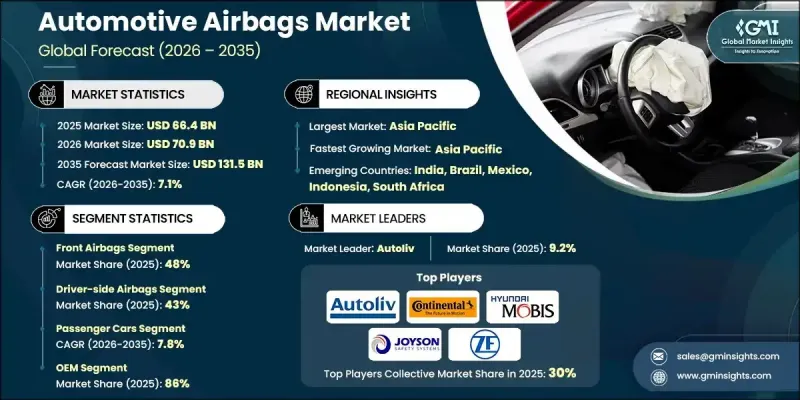
세계 각국의 정부 및 안전 기관은 승용차 및 상용차에 에어백의 표준 장착을 의무화하고 있으며, 각 차량마다 여러 종류의 에어백(사이드 에어백 및 커튼 에어백 포함)의 필요성을 점차 강조하고 있습니다. 이러한 변화로 인해 자동차 제조업체(OEM)는 보다 진보된 에어백 시스템 설계를 요구하고 있으며, 그 결과 전 세계적으로 보급률과 단위 수량에 대한 수요가 증가하고 있습니다. 도로 안전, 차량 안전 평가, 운전과 관련된 위험에 대한 소비자의 인식이 높아짐에 따라 구매 결정에 영향을 미치고 있으며, 구매자는 첨단 탑승자 보호 기능을 갖춘 차량을 점점 더 우선시하고 있습니다. 신차 평가 프로그램(NCAP)과 진화하는 충돌 테스트 프로토콜은 OEM이 안전 점수를 향상시키기 위해 추가 에어백을 통합하도록 유도하고 있습니다. 향상된 정면 충돌, 측면 충돌 및 전복 충돌 보호를 위해서는 혁신적인 에어백 전개 전략이 필요하며, 이를 통해 현대 차량에서 최적의 보호와 더 높은 안전 등급을 보장합니다.
| 시장 범위 | |
|---|---|
| 시작 연도 | 2025년 |
| 예측 연도 | 2026-2035 |
| 개시 금액 | 664억 달러 |
| 예측 금액 | 1,315억 달러 |
| CAGR | 7.1% |
프론트 에어백 부문은 2025년 48%의 점유율을 차지했으며, 2035년까지 연평균 6.2%의 성장률을 기록할 것으로 전망됩니다. 운전석과 조수석 탑승자를 보호하기 위해 설계된 이 에어백은 충돌 시 스티어링 휠과 대시보드에서 전개되어 충격력을 흡수하고 신체가 차량 내부 표면에 충돌하는 것을 방지합니다.
승용차 부문은 2025년 75% 점유율을 차지했으며, 2026년부터 2035년까지 CAGR 7.8%로 성장할 것으로 전망됩니다. 현대 승용차는 센서 및 ADAS와 통합된 첨단 운전석 에어백의 채택을 확대하고 있으며, 전개 타이밍과 힘을 최적화하여 안전성을 높이고 있습니다. 특히 캐빈 레이아웃이 빠르게 진화하고 있는 소형차나 전기자동차에서 두드러집니다.
미국 자동차 에어백 시장은 2025년 156억 달러에 달했습니다. 미국 도로교통안전국(NHTSA)과 보험 업계의 도로안전시험기관(IIHS)의 엄격한 시험기준으로 인해 다단계 스마트 에어백 시스템의 채택이 가속화되고 있습니다. 이러한 혁신 기술은 승용차와 상용차 모두에 도입되어 안전 기준을 개선하고 규제 요건을 충족하는 데 기여하고 있습니다.
자주 묻는 질문
목차
제1장 조사 방법
제2장 주요 요약
제3장 업계 인사이트
제4장 경쟁 구도
제5장 시장 추정 및 예측 : 에어백별, 2022-2035
제6장 시장 추정 및 예측 : 도입 형태별, 2022-2035
제7장 시장 추정 및 예측 : 차량별, 2022-2035
제8장 시장 추정 및 예측 : 소재별, 2022-2035
제9장 시장 추정 및 예측 : 판매 채널별, 2022-2035
제10장 시장 추정 및 예측 : 지역별, 2022-2035
제11장 기업 개요
KSM 26.03.05The Global Automotive Airbags Market was valued at USD 66.4 billion in 2025 and is estimated to grow at a CAGR of 7.1% to reach USD 131.5 billion by 2035.
Governments and safety organizations worldwide mandate airbags as standard equipment in passenger and commercial vehicles, and regulations have progressively emphasized the need for multiple airbag types per vehicle, including side and curtain airbags. This shift has compelled automotive manufacturers (OEMs) to design more sophisticated airbag systems, resulting in higher penetration and unit volume demand globally. Rising consumer awareness of road safety, vehicle safety ratings, and the risks associated with driving is influencing purchase decisions, with buyers increasingly prioritizing vehicles offering advanced occupant protection. New Car Assessment Programs (NCAP) and evolving crash test protocols are driving OEMs to integrate additional airbags to improve safety scores. Enhanced frontal, side, and rollover collision protection requires innovative airbag deployment strategies, ensuring optimal protection and higher safety ratings in modern vehicles.
| Market Scope | |
|---|---|
| Start Year | 2025 |
| Forecast Year | 2026-2035 |
| Start Value | $66.4 Billion |
| Forecast Value | $131.5 Billion |
| CAGR | 7.1% |
The front airbags segment held a 48% share in 2025 and is expected to grow at a CAGR of 6.2% through 2035. Designed to protect the driver and front-seat passenger, these airbags deploy from the steering wheel and dashboard, absorbing impact forces and preventing the body from striking interior surfaces during a collision.
The passenger car segment accounted for 75% share in 2025 and is projected to grow at a CAGR of 7.8% from 2026 to 2035. Modern passenger vehicles are increasingly adopting advanced driver airbags integrated with sensors and ADAS, optimizing deployment timing and force to enhance safety, particularly in compact and electric vehicles where cabin layouts are evolving rapidly.
US Automotive Airbags Market reached USD 15.6 billion in 2025. Strict testing standards by the National Highway Traffic Safety Administration (NHTSA) and the Insurance Institute for Highway Safety (IIHS) are accelerating the adoption of multi-stage, smart airbag systems. These innovations are being implemented across both passenger and commercial vehicles to elevate safety benchmarks and meet regulatory requirements.
Prominent companies operating in the Global Automotive Airbags Market include Joyson Safety Systems, Toyota Boshoku, ZF Friedrichshafen (TRW Automotive), Autoliv, Nippon Seiki, Continental, Hyundai Mobis, Toyoda Gosei, and Daicel. Market participants are strengthening their foothold by investing heavily in R&D to develop multi-stage and intelligent airbag systems that optimize deployment based on occupant size, position, and collision severity. Strategic partnerships with automakers ensure early integration into new vehicle platforms. Companies are expanding production facilities and enhancing global supply chains to meet rising demand. Innovation in sensor technology, ADAS compatibility, and lightweight airbag materials helps manufacturers differentiate products, while regulatory compliance and rigorous crash-test certification reinforce credibility. Additionally, firms are leveraging collaborations and co-development agreements to accelerate technology adoption and improve competitive positioning across passenger and commercial vehicle segments.
Table of Contents
Chapter 1 Methodology
- 1.1 Research approach
- 1.2 Quality commitments
- 1.3 GMI AI policy & data integrity commitment
- 1.4 Research trail & confidence scoring
- 1.4.1 Research trail components
- 1.4.2 Scoring components
- 1.5 Data collection
- 1.5.1 Partial list of primary sources
- 1.6 Data mining sources
- 1.6.1 Paid sources
- 1.7 Base estimates and calculations
- 1.7.1 Base year calculation
- 1.8 Forecast model
- 1.9 Research transparency addendum
Chapter 2 Executive Summary
- 2.1 Industry 3600 synopsis
- 2.2 Key market trends
- 2.2.1 Regional
- 2.2.2 Airbag
- 2.2.3 Deployment
- 2.2.4 Vehicle
- 2.2.5 Fabric
- 2.2.6 Sales channel
- 2.3 TAM analysis, 2026-2035
- 2.4 CXO perspectives: Strategic imperatives
- 2.4.1 Executive decision points
- 2.4.2 Critical success factors
- 2.5 Future outlook
- 2.6 Strategic recommendations
Chapter 3 Industry Insights
- 3.1 Industry ecosystem analysis
- 3.1.1 Supplier landscape
- 3.1.2 Profit margin
- 3.1.3 Cost structure
- 3.1.4 Value addition at each stage
- 3.1.5 Factor affecting the value chain
- 3.1.6 Disruptions
- 3.2 Industry impact forces
- 3.2.1 Growth drivers
- 3.2.1.1 Stringent vehicle safety regulations
- 3.2.1.2 Rising consumer awareness of occupant safety
- 3.2.1.3 Growth in global vehicle production
- 3.2.1.4 Increasing crash test and NCAP standards
- 3.2.2 Industry pitfalls and challenges
- 3.2.2.1 High product liability and recall risks
- 3.2.2.2 Pricing pressure from automotive OEMs
- 3.2.3 Market opportunities
- 3.2.3.1 Expansion in emerging automotive markets
- 3.2.3.2 Growth of electric and autonomous vehicles
- 3.2.3.3 Development of pedestrian protection airbags
- 3.2.3.4 Increasing aftermarket replacement demand
- 3.2.1 Growth drivers
- 3.3 Growth potential analysis
- 3.4 Regulatory landscape
- 3.4.1 North America
- 3.4.1.1 U.S. Department of Transportation (DOT) Standards
- 3.4.1.2 Occupational Safety and Health Administration (OSHA) Guidelines
- 3.4.1.3 U.S. Environmental Protection Agency (EPA)
- 3.4.2 Europe
- 3.4.2.1 EN ISO Container Standards
- 3.4.2.2 European Union Customs and Safety Regulations
- 3.4.2.3 BS EN / CEN Standards
- 3.4.2.4 National Standards (UNE, DIN, etc.)
- 3.4.3 Asia Pacific
- 3.4.3.1 China GB (Guobiao) Standards
- 3.4.3.2 Japan JIS Requirements
- 3.4.3.3 Korea KS Certification
- 3.4.3.4 Indian BIS Standards
- 3.4.3.5 Thai Industrial Standards Institute (TISI)
- 3.4.4 Latin America
- 3.4.4.1 INMETRO (National Institute of Metrology)
- 3.4.4.2 INTI certification (Instituto Nacional de Tecnologia Industrial)
- 3.4.4.3 NOM standards (Norma Official Mexicana)
- 3.4.5 Middle East & Africa
- 3.4.5.1 ESMA / Emirates Conformity Assessment Scheme (ECAS)
- 3.4.5.2 GCC technical regulations
- 3.4.5.3 SABS certification
- 3.4.1 North America
- 3.5 Porter's analysis
- 3.6 PESTEL analysis
- 3.7 Technology and innovation landscape
- 3.7.1 Current technological trends
- 3.7.2 Emerging technologies
- 3.8 Pricing analysis
- 3.8.1 Pricing by product
- 3.8.2 Pricing by region
- 3.9 Production statistics
- 3.9.1 Production hubs
- 3.9.2 Consumption hubs
- 3.9.3 Export and import
- 3.10 Cost breakdown analysis
- 3.11 Patent analysis
- 3.12 Sustainability and environmental aspects
- 3.12.1 Sustainable practices
- 3.12.2 Waste reduction strategies
- 3.12.3 Energy efficiency in production
- 3.12.4 Eco-friendly initiatives
- 3.12.5 Carbon footprint considerations
Chapter 4 Competitive Landscape, 2025
- 4.1 Introduction
- 4.2 Company market share analysis
- 4.2.1 North America
- 4.2.2 Europe
- 4.2.3 Asia Pacific
- 4.2.4 LATAM
- 4.2.5 MEA
- 4.3 Competitive analysis of major market players
- 4.4 Competitive positioning matrix
- 4.5 Strategic outlook matrix
- 4.6 Key developments
- 4.6.1 Mergers & acquisitions
- 4.6.2 Partnerships & collaborations
- 4.6.3 New product launches
- 4.6.4 Expansion plans and funding
Chapter 5 Market Estimates & Forecast, By Airbag, 2022 - 2035 ($Mn, Units)
- 5.1 Key trends
- 5.2 Front airbags
- 5.3 Side airbags
- 5.4 Curtain airbags
- 5.5 Knee airbags
- 5.6 Rear passenger airbags
- 5.7 Others (e.g., pedestrian protection airbags)
Chapter 6 Market Estimates & Forecast, By Deployment, 2022 - 2035 ($Mn, Units)
- 6.1 Key trends
- 6.2 Driver-side airbags
- 6.3 Passenger-side airbags
- 6.4 Multi-stage airbags
Chapter 7 Market Estimates & Forecast, By Vehicle, 2022 - 2035 ($Mn, Units)
- 7.1 Key trends
- 7.2 Passenger cars
- 7.2.1 Hatchback
- 7.2.2 Sedan
- 7.2.3 SUV
- 7.3 Commercial vehicle
- 7.3.1 LCV (Light commercial vehicle)
- 7.3.2 MCV (Medium commercial vehicle)
- 7.3.3 HCV (Heavy commercial vehicle)
Chapter 8 Market Estimates & Forecast, By Fabric, 2022 - 2035 ($Mn, Units)
- 8.1 Key trends
- 8.2 Nylon fabric
- 8.3 Polyester fabric
Chapter 9 Market Estimates & Forecast, By Sales Channel, 2022 - 2035 ($Mn, Units)
- 9.1 Key trends
- 9.2 OEM
- 9.3 Aftermarket
Chapter 10 Market Estimates & Forecast, By Region, 2022 - 2035 ($Mn, Units)
- 10.1 Key trends
- 10.2 North America
- 10.2.1 US
- 10.2.2 Canada
- 10.3 Europe
- 10.3.1 Germany
- 10.3.2 UK
- 10.3.3 France
- 10.3.4 Italy
- 10.3.5 Spain
- 10.3.6 Nordics
- 10.3.7 Russia
- 10.3.8 Poland
- 10.3.9 Romania
- 10.4 Asia Pacific
- 10.4.1 China
- 10.4.2 India
- 10.4.3 Japan
- 10.4.4 South Korea
- 10.4.5 ANZ
- 10.4.6 Vietnam
- 10.4.7 Indonesia
- 10.5 Latin America
- 10.5.1 Brazil
- 10.5.2 Mexico
- 10.5.3 Argentina
- 10.6 MEA
- 10.6.1 South Africa
- 10.6.2 Saudi Arabia
- 10.6.3 UAE
Chapter 11 Company Profiles
- 11.1 Global companies
- 11.1.1 Autoliv
- 11.1.2 Autoneum (select airbag systems segment)
- 11.1.3 Continental
- 11.1.4 Daicel
- 11.1.5 Hyundai Mobis
- 11.1.6 Joyson Safety Systems
- 11.1.7 Nippon Seiki
- 11.1.8 Toyoda Gosei
- 11.1.9 Toyota Boshoku
- 11.1.10 ZF Friedrichshafen (TRW Automotive)
- 11.2 Regional players
- 11.2.1 Aisin Seiki
- 11.2.2 Bharat Seats
- 11.2.3 Coagent Automotive
- 11.2.4 Delphi Technologies
- 11.2.5 Hangzhou Silian Airbag
- 11.2.6 Hyunmi Safety Systems
- 11.2.7 Juki
- 11.2.8 Minda
- 11.3 Emerging players
- 11.3.1 Calsonic Kansei
- 11.3.2 Lite-On Automotive Airbags
- 11.3.3 Mando
- 11.3.4 Shandong Lilang Automotive Safety
- 11.3.5 Toray Advanced Materials
- 11.3.6 Zhejiang Geely Auto Airbag Division