

|
시장보고서
상품코드
1936667
가스 미터 시장 기회, 성장 촉진요인, 업계 동향 분석 및 예측(2026-2035년)Gas Meters Market Opportunity, Growth Drivers, Industry Trend Analysis, and Forecast 2026 - 2035 |
||||||

세계의 가스 미터 시장은 2025년에 96억 달러로 평가되었으며, 2035년까지 CAGR 14.5%로 성장하여 370억 달러에 달할 것으로 예측됩니다.
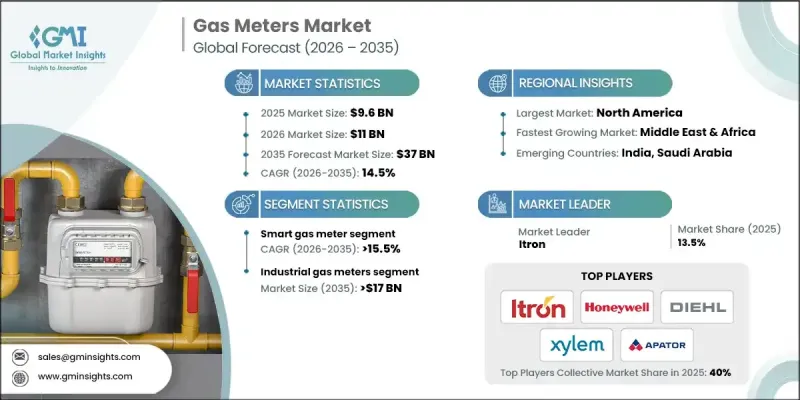
에너지 안보에 초점을 맞춘 투자 증가가 수요를 주도하고 있으며, 유틸리티 사업자는 세계 가스 공급 부족에 대응하기 위해 보다 정밀하고 상세한 데이터를 필요로 하고 있습니다. 멀티유틸리티 디지털 플랫폼의 통합으로 시장을 재구성하고, 서비스 전반의 가시성, 프로세스 자동화, 고객 참여 강화를 실현하고 있습니다. 규제 당국의 시행과 야심찬 도입 목표에 힘입어, 상세한 사용량 데이터를 제공하고 운영을 효율화하기 위해 디지털 계측 인프라 도입이 확대되고 있습니다. 2세대 첨단 계측 인프라(AMI)는 사이버 보안, 세분화된 간격 데이터, 원격 모니터링 등의 강화된 기능을 도입하고, 장치의 상호운용성을 촉진하고 업계 표준을 형성하고 있습니다. 정확한 네트워크 데이터에 대한 관심이 높아짐에 따라, 유틸리티 사업자들은 기존 시스템을 현대화하고 운영 효율성과 에너지 관리 인사이트를 제공하는 스마트 계측 솔루션에 대한 투자를 추진하고 있습니다.
| 시장 범위 | |
|---|---|
| 시작 연도 | 2025년 |
| 예측 연도 | 2026-2035 |
| 개시 금액 | 96억 달러 |
| 예측 금액 | 370억 달러 |
| CAGR | 14.5% |
스마트 가스 계량기 시장은 2035년까지 CAGR 15.5%로 성장할 것으로 예상됩니다. 이 장치들은 마이크로컨트롤러, 정밀 센서, 통신 모듈을 통합하여 계량기와 유틸리티 시스템 간의 자동화된 양방향 데이터 전송을 가능하게 합니다. 스마트 계량기는 유선 네트워크, 셀룰러 연결, 차량 이동 검침 등 다양한 데이터 수집 방식을 지원하여 수동 개입을 줄이고 유틸리티 회사와 최종 사용자 모두에게 거의 실시간에 가까운 소비량 정보를 제공합니다. 이를 도입하면 운영 효율성을 강화하고 에너지 절약 조치를 촉진하는 동시에 진화하는 규제 요건을 준수할 수 있습니다.
산업용 가스 계량기 분야는 2025년 46.7%의 점유율을 차지했으며, 2035년까지 170억 달러 규모에 이를 것으로 전망됩니다. 이 계량기는 제조, 화학 생산, 정제, 발전, 식품 가공과 같은 고 유량 산업 분야에 적합하도록 설계되었습니다. 터빈식 계량기와 같은 첨단 기술은 광범위한 유량 범위(대부분 시간당 500-10,000 입방미터 이상)에서 정밀한 계측을 실현하여 중요한 산업 환경에서 신뢰성과 성능을 보장합니다.
미국 가스 계량기 시장은 2025년 24억 달러로 평가되며, 지속적인 현대화, 갱신 주기, 유틸리티의 디지털화 확산이 성장을 견인할 것으로 예상됩니다. 배출량 모니터링과 네트워크 보안 강화에 대한 규제 압력이 증가하고 정부 주도의 환경 가이드라인이 강화되면서 첨단 측정 솔루션의 도입이 가속화되고 있습니다. 정확한 누출 감지 및 컴플라이언스 중심의 측정 장비에 대한 수요가 미국 전역의 시장 확대를 가속화하고 있습니다.
자주 묻는 질문
목차
제1장 조사 방법 및 범위
제2장 주요 요약
제3장 업계 인사이트
- 생태계 분석
- 원재료 가용성 및 조달 분석
- 제조 능력 평가
- 공급망의 회복력 및 리스크 요인
- 유통 네트워크 분석
- 규제 상황
- 업계에 미치는 영향요인
- 성장 촉진요인
- 업계의 잠재적 위험 및 과제
- 성장 가능성 분석
- Porter's Five Forces 분석
- 정치적 요인
- 경제적 요인
- 사회적 요인
- 기술적 요인
- 법적 요인
- 환경적 요인
- 가스 미터 비용 구조 분석
- 투자 분석 및 향후 전망
제4장 경쟁 구도
제5장 시장 규모 및 예측 : 기술별(2022-2035년)
- 스마트
- 기존 방식
제6장 시장 규모 및 예측 : 제품별(2022-2035년)
- 다이어프램 미터
- 회전 미터
- 터빈 미터
- 초음파 측정기
- 코리올리 미터
제7장 시장 규모 및 예측 : 최종 용도별(2022-2035년)
- 주택용
- 상업용
- 산업용
제8장 시장 규모 및 예측 : 지역별(2022-2035년)
- 북미
- 미국
- 캐나다
- 유럽
- 독일
- 영국
- 이탈리아
- 프랑스
- 아시아태평양
- 중국
- 일본
- 한국
- 인도
- 호주
- 중동 및 아프리카
- 사우디아라비아
- 아랍에미리트(UAE)
- 남아프리카
- 라틴아메리카
- 브라질
- 멕시코
- 아르헨티나
제9장 기업 개요
- ABB
- Aclara
- AKG Acoustics
- Apator SA
- Badger Meter
- Diehl Stiftung
- Edmi Limited
- Elster Group
- Emerson Electrics
- Honeywell International
- Itron
- Pietro Fiorentini
- LUMEL
- Schneider Electric
- Siemens
- Suntront
- Raychem RPG
- RMG
- Romet
- Xylem
- ZENNER
The Global Gas Meters Market was valued at USD 9.6 billion in 2025 and is estimated to grow at a CAGR of 14.5% to reach USD 37 billion by 2035.
Rising investments focused on energy security are driving demand as utilities increasingly require precise, granular data to manage a tighter global gas supply. The integration of multi-utility digital platforms is reshaping the market, enabling cross-service visibility, process automation, and enhanced customer engagement. Digital metering infrastructure is increasingly adopted to provide detailed usage data and streamline operations, supported by regulatory enforcement and ambitious rollout targets. Second-generation advanced metering infrastructures are introducing enhanced functions, including cybersecurity, granular interval data, and remote monitoring, while promoting device interoperability and shaping industry standards. The growing focus on accurate, networked data is encouraging utilities to modernize existing systems and invest in smart metering solutions that deliver operational efficiency and energy management insights.
| Market Scope | |
|---|---|
| Start Year | 2025 |
| Forecast Year | 2026-2035 |
| Start Value | $9.6 Billion |
| Forecast Value | $37 Billion |
| CAGR | 14.5% |
The smart gas meters segment is expected to grow at 15.5% CAGR through 2035. These devices integrate microcontrollers, precision sensors, and communication modules, enabling automated, two-way data transfer between meters and utility systems. Smart meters support multiple data collection methods, including fixed networks, cellular connectivity, and drive-by readings, reducing manual interventions and providing near real-time consumption visibility for both utilities and end-users. Their deployment strengthens operational efficiency and facilitates energy conservation initiatives while ensuring compliance with evolving regulatory requirements.
The industrial gas meters segment accounted for 46.7% share in 2025 and is projected to reach USD 17 billion by 2035. These meters are designed to accommodate high-volume industrial applications, including manufacturing, chemical production, refining, power generation, and food processing. Advanced technologies such as turbine meters provide precise measurement across a wide range of flow rates, often handling 500 to over 10,000 cubic meters per hour, ensuring reliability and performance in critical industrial environments.
U.S. Gas Meters Market was valued at USD 2.4 billion in 2025, fueled by ongoing modernization, replacement cycles, and widespread utility digitalization. Increasing regulatory pressure to monitor emissions and enhance network safety, coupled with government-led environmental guidelines, is driving the adoption of advanced metering solutions. The demand for accurate leak detection and compliance-focused measurement devices continues to accelerate market expansion across the country.
Key players active in the Global Gas Meters Market include Itron, Emerson Electrics, ABB, Xylem, Badger Meter, Pietro Fiorentini, Schneider Electric, Diehl Stiftung, Suntront, Elster Group, Romet, AKG Acoustics, Edmi Limited, RMG, Siemens, Raychem RPG, ZENNER, Apator SA, Honeywell International, and Aclara. Companies in the gas meters market are strengthening their position through continuous technological innovation, product diversification, and strategic partnerships. Manufacturers are investing in smart meter development with advanced communication capabilities, cybersecurity features, and real-time analytics. Expanding service networks and providing comprehensive maintenance solutions improve customer retention. Companies are also focusing on integrating meters with broader energy management platforms and multi-utility digital ecosystems to enhance operational intelligence. Geographic expansion into emerging markets, coupled with flexible deployment options for industrial and residential applications, supports a long-term market foothold.
Table of Contents
Chapter 1 Methodology & Scope
- 1.1 Research design
- 1.1.1 Research approach
- 1.1.2 Data collection methods
- 1.2 Base estimates and calculations
- 1.2.1 Base year calculation
- 1.2.2 Market estimates & forecast parameters
- 1.3 Forecast
- 1.3.1 Key trends for market estimates
- 1.3.2 Quantified market impact analysis
- 1.3.2.1 Mathematical impact of growth parameters on forecast
- 1.3.3 Scenario analysis framework
- 1.4 Primary research and validation
- 1.4.1 Some of the primary sources (but not limited to)
- 1.5 Data mining sources
- 1.5.1 Paid Sources
- 1.5.2 Sources, by region
- 1.6 Research trail & scoring components
- 1.6.1 Research trail components
- 1.6.2 Scoring components
- 1.7 Research transparency addendum
- 1.7.1 Source attribution framework
- 1.7.2 Quality assurance metrics
- 1.7.3 Our commitment to trust
- 1.8 Market definitions
Chapter 2 Executive Summary
- 2.1 Industry synopsis, 2022 - 2035
- 2.1.1 Business trends
- 2.1.2 Technology trends
- 2.1.3 Product trends
- 2.1.4 End use trends
- 2.1.5 Regional trends
Chapter 3 Industry Insights
- 3.1 Industry ecosystem analysis
- 3.1.1 Raw material availability & sourcing analysis
- 3.1.2 Manufacturing capacity assessment
- 3.1.3 Supply chain resilience & risk factors
- 3.1.4 Distribution network analysis
- 3.2 Regulatory landscape
- 3.3 Industry impact forces
- 3.3.1 Growth drivers
- 3.3.2 Industry pitfalls & challenges
- 3.4 Growth potential analysis
- 3.5 Porter's analysis
- 3.5.1 Bargaining power of suppliers
- 3.5.2 Bargaining power of buyers
- 3.5.3 Threat of new entrants
- 3.5.4 Threat of substitutes
- 3.6 PESTEL analysis
- 3.6.1 Political factors
- 3.6.2 Economic factors
- 3.6.3 Social factors
- 3.6.4 Technological factors
- 3.6.5 Legal factors
- 3.6.6 Environmental factors
- 3.7 Cost structure analysis of gas meters
- 3.8 Emerging opportunities & trends
- 3.9 Investment analysis & future prospects
Chapter 4 Competitive Landscape, 2025
- 4.1 Introduction
- 4.2 Company market share analysis, by region, 2025
- 4.2.1 North America
- 4.2.2 Europe
- 4.2.3 Asia Pacific
- 4.2.4 Middle East & Africa
- 4.2.5 Latin America
- 4.3 Strategic dashboard
- 4.4 Strategic initiatives
- 4.4.1 Key partnerships & collaborations
- 4.4.2 Major M&A activities
- 4.4.3 Product innovations & launches
- 4.4.4 Market expansion strategies
- 4.5 Competitive benchmarking
- 4.6 Innovation & sustainability landscape
Chapter 5 Market Size and Forecast, By Technology, 2022 - 2035 (USD Million)
- 5.1 Key trends
- 5.2 Smart
- 5.3 Conventional
Chapter 6 Market Size and Forecast, By Product, 2022 - 2035 (USD Million)
- 6.1 Key trends
- 6.2 Diaphragm meters
- 6.3 Rotary meters
- 6.4 Turbine meters
- 6.5 Ultrasonic meters
- 6.6 Coriolis meters
Chapter 7 Market Size and Forecast, By End Use, 2022 - 2035 (USD Million)
- 7.1 Key trends
- 7.2 Residential
- 7.3 Commercial
- 7.4 Industrial
Chapter 8 Market Size and Forecast, By Region, 2022 - 2035 (USD Million)
- 8.1 Key trends
- 8.2 North America
- 8.2.1 U.S.
- 8.2.2 Canada
- 8.3 Europe
- 8.3.1 Germany
- 8.3.2 UK
- 8.3.3 France
- 8.3.4 Italy
- 8.3.5 Spain
- 8.4 Asia Pacific
- 8.4.1 China
- 8.4.2 Japan
- 8.4.3 India
- 8.4.4 South Korea
- 8.4.5 Australia
- 8.5 Middle East & Africa
- 8.5.1 Saudi Arabia
- 8.5.2 UAE
- 8.5.3 South Africa
- 8.6 Latin America
- 8.6.1 Brazil
- 8.6.2 Mexico
- 8.6.3 Argentina
Chapter 9 Company Profiles
- 9.1 ABB
- 9.2 Aclara
- 9.3 AKG Acoustics
- 9.4 Apator SA
- 9.5 Badger Meter
- 9.6 Diehl Stiftung
- 9.7 Edmi Limited
- 9.8 Elster Group
- 9.9 Emerson Electrics
- 9.10 Honeywell International
- 9.11 Itron
- 9.12 Pietro Fiorentini
- 9.13 Schneider Electric
- 9.14 Siemens
- 9.15 Suntront
- 9.16 Raychem RPG
- 9.17 RMG
- 9.18 Romet
- 9.19 Xylem
- 9.20 ZENNER


