

|
시장보고서
상품코드
1959270
당분 저감용 식이섬유 원료 시장 기회, 성장요인, 업계 동향 분석 및 예측(2026-2035년)Fiber Ingredients for Sugar Reduction Market Opportunity, Growth Drivers, Industry Trend Analysis, and Forecast 2026 - 2035 |
||||||

세계의 당분 저감용 식이섬유 원료 시장은 2025년에 53억 달러로 평가되었고, 2035년까지 연평균 복합 성장률(CAGR) 8.7%로 성장하여 121억 달러에 이를 것으로 예측되고 있습니다.
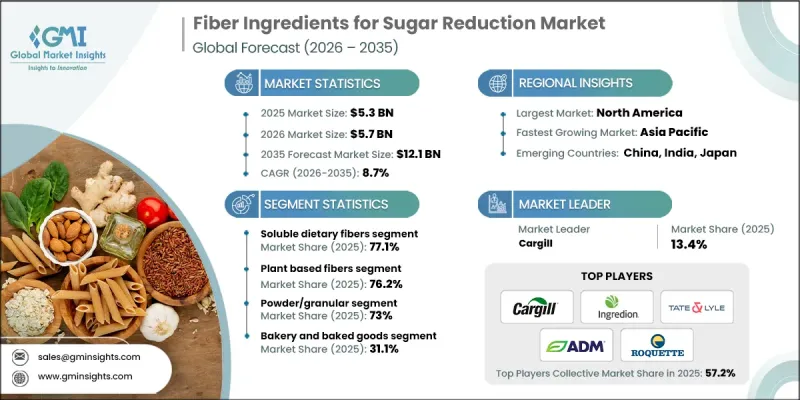
시장 성장은 전 세계적으로 건강에 대한 관심이 높아지고 과도한 설탕 섭취의 부작용에 대한 인식이 높아짐에 따라 주도되고 있습니다. 소비자들은 영양가 손실 없이 단맛과 식감을 살린 제품을 점점 더 많이 찾고 있습니다. 식이섬유 기반 원료는 입맛을 개선하고, 단맛을 균형 있게 조절하며, 전반적인 감각적 품질을 향상시키면서 최소한의 칼로리와 저혈당 효과를 제공하기 때문에 효과적인 당류 저감화 솔루션으로 널리 채택되고 있습니다. 이러한 원료들은 소화기 건강 유지, 대사 균형, 체중 관리 등의 목표에 부합하는 기능성 식품 개발에도 기여합니다. 인공감미료를 사용하지 않고도 클린 라벨 배합을 실현할 수 있는 특성은 음료 및 식품 제조업체에게 특히 매력적입니다. 가공식품의 당 함량 감소에 대한 규제 압력이 높아지면서 수요가 더욱 가속화되고 있으며, 지속적인 배합 기술 혁신으로 다양한 제품 카테고리에서 적용 가능성이 확대되고 있습니다.
| 시장 범위 | |
|---|---|
| 개시 연도 | 2025년 |
| 예측 연도 | 2026-2035년 |
| 개시 금액 | 53억 달러 |
| 예측 금액 | 121억 달러 |
| CAGR | 8.7% |
수용성 식이섬유 부문은 2025년 77.1%의 점유율을 차지할 것으로 예상되며, 2035년까지 연평균 8.7%의 성장률을 보일 것으로 전망됩니다. 이 부문 수요는 건강 지향적 영양 섭취와 예방 의학에 대한 소비자의 관심 증가로 뒷받침되고 있습니다. 수용성 식이섬유는 콜레스테롤 관리, 혈당 조절, 소화기 계통의 균형 유지에 도움을 주기 때문에 기능성 식품, 음료, 영양을 중시하는 배합 제품에 널리 사용되고 있습니다. 기능적 다양성과 다양한 배합에 대한 적합성이 업계 전반의 높은 채택률을 지속적으로 견인하고 있습니다.
식물 유래 섬유 부문은 2025년 76.2%의 점유율을 차지할 것으로 예상되며, 2026년부터 2035년까지 연평균 복합 성장률(CAGR) 8.8%를 나타낼 것으로 예측됩니다. 곡물, 콩류, 과일, 근채류에서 얻은 섬유의 광범위한 가용성과 기능성으로 인해 시장에서 선도적인 위치를 유지하고 있습니다. 특히 프리바이오틱 기능과 천연 유래의 단맛을 가진 섬유에 대한 수요가 증가하면서 영양과 감각적 이점을 모두 제공하는 섬유에 대한 수요가 증가하고 있습니다. 이러한 다양한 식물 유래 원료를 통해 제조업체는 다양한 배합 요구를 충족시키면서 자연스럽고 인식 가능한 원료를 원하는 소비자의 기대에 부응할 수 있습니다.
북미 당류 저감용 식이섬유 원료 시장은 2025년 36%의 점유율을 차지할 것으로 예측됩니다. 영양에 대한 소비자의 높은 인식과 강력한 기능성 음료 및 식품 부문이 결합되어 지역적 확장을 뒷받침하고 있습니다. 첨단 가공 능력과 지속적인 제품 혁신은 미국 및 캐나다 전역 시장 발전을 더욱 강화하고 있습니다.
자주 묻는 질문
목차
제1장 조사 방법과 범위
제2장 주요 요약
제3장 업계 인사이트
제4장 경쟁 구도
제5장 시장 추산·예측 : 섬유 유형별, 2022-2035년
제6장 시장 추산·예측 : 원료별, 2022-2035년
제7장 시장 추산·예측 : 형태별, 2022-2035년
제8장 시장 추산·예측 : 용도별, 2022-2035년
제9장 시장 추산·예측 : 지역별, 2022-2035년
제10장 기업 개요
LSH 26.03.26The Global Fiber Ingredients for Sugar Reduction Market was valued at USD 5.3 billion in 2025 and is estimated to grow at a CAGR of 8.7% to reach USD 12.1 billion by 2035.
Market growth is driven by a strong global shift toward healthier eating habits and rising awareness of the negative effects of excess sugar consumption. Consumers are increasingly seeking products that deliver sweetness and texture without compromising nutritional value. Fiber-based ingredients are gaining widespread adoption as effective sugar-reduction solutions because they enhance mouthfeel, balance sweetness perception, and improve overall sensory quality while contributing minimal calories and low glycemic impact. These ingredients also support the development of functional food products aligned with digestive wellness, metabolic balance, and weight management goals. Their ability to deliver clean-label formulations without artificial sweeteners makes them particularly attractive to food and beverage manufacturers. Growing regulatory pressure to reduce sugar levels in packaged foods is further accelerating demand, while continuous formulation innovation is expanding application potential across a broad range of product categories.
| Market Scope | |
|---|---|
| Start Year | 2025 |
| Forecast Year | 2026-2035 |
| Start Value | $5.3 Billion |
| Forecast Value | $12.1 Billion |
| CAGR | 8.7% |
The soluble dietary fibers segment accounted for 77.1% share in 2025 and is expected to grow at a CAGR of 8.7% through 2035. Demand for this segment is supported by increasing consumer focus on wellness-oriented nutrition and preventive health. Soluble fibers are widely incorporated into functional foods, beverages, and nutrition-focused formulations due to their role in supporting cholesterol management, blood sugar regulation, and digestive balance. Their functional versatility and compatibility with diverse formulations continue to drive strong adoption across the industry.
The plant-based fibers segment held a 76.2% share in 2025 and is forecast to grow at a CAGR of 8.8% from 2026 to 2035. Market leadership is sustained by the broad availability and functionality of fibers sourced from grains, legumes, fruits, and root crops. Demand is rising for fibers that deliver both nutritional and sensory benefits, particularly those offering prebiotic functionality and naturally derived sweetness. This diversity of plant-based sources enables manufacturers to address varying formulation needs while meeting consumer expectations for natural and recognizable ingredients.
North America Fiber Ingredients for Sugar Reduction Market held 36% share in 2025. High consumer awareness around nutrition, coupled with a strong functional food and beverage sector, supports regional expansion. Advanced processing capabilities and continuous product innovation further strengthen market development across the United States and Canada.
Key companies operating in the Global Fiber Ingredients for Sugar Reduction Market include Tate & Lyle, ADM, Ingredion, Cargill, BENEO, Roquette, Kerry Group, Nexira, Sensus, and BioNeutra. Companies in the fiber ingredients for sugar reduction market are strengthening their market foothold through sustained investment in research and development aimed at improving taste, texture, and formulation performance. Many players are expanding their portfolios with clean-label and multifunctional fiber solutions to meet evolving consumer and regulatory demands. Strategic collaborations with food and beverage manufacturers are being used to accelerate innovation and application development. Capacity expansion, supply chain optimization, and sourcing transparency are also key priorities. Firms are increasingly focusing on sustainability initiatives and regulatory compliance to enhance brand trust, while geographic expansion into high-growth regions supports long-term competitive positioning.
Table of Contents
Chapter 1 Methodology & Scope
- 1.1 Market scope and definition
- 1.2 Research design
- 1.2.1 Research approach
- 1.2.2 Data collection methods
- 1.3 Data mining sources
- 1.3.1 Global
- 1.3.2 Regional/Country
- 1.4 Base estimates and calculations
- 1.4.1 Base year calculation
- 1.4.2 Key trends for market estimation
- 1.5 Primary research and validation
- 1.5.1 Primary sources
- 1.6 Forecast model
- 1.7 Research assumptions and limitations
Chapter 2 Executive Summary
- 2.1 Industry 360° synopsis
- 2.2 Key market trends
- 2.2.1 Regional
- 2.2.2 Fiber type
- 2.2.3 Sources
- 2.2.4 Form
- 2.2.5 Application
- 2.3 TAM Analysis, 2026-2035
- 2.4 CXO perspectives: Strategic imperatives
- 2.4.1 Executive decision points
- 2.4.2 Critical success factors
- 2.5 Future Outlook and Strategic Recommendations
Chapter 3 Industry Insights
- 3.1 Industry ecosystem analysis
- 3.1.1 Supplier landscape
- 3.1.2 Profit margin
- 3.1.3 Value addition at each stage
- 3.1.4 Factor affecting the value chain
- 3.1.5 Disruptions
- 3.2 Industry impact forces
- 3.2.1 Growth drivers
- 3.2.2 Industry pitfalls and challenges
- 3.2.3 Market opportunities
- 3.3 Growth potential analysis
- 3.4 Regulatory landscape
- 3.4.1 North America
- 3.4.2 Europe
- 3.4.3 Asia Pacific
- 3.4.4 Latin America
- 3.4.5 Middle East & Africa
- 3.5 Porter's analysis
- 3.6 PESTEL analysis
- 3.7 Price trends
- 3.7.1 By region
- 3.7.2 By type
- 3.8 Future market trends
- 3.9 Technology and Innovation landscape
- 3.9.1 Current technological trends
- 3.9.2 Emerging technologies
- 3.10 Patent Landscape
- 3.11 Trade statistics (HS code)
- 3.11.1 Major importing countries
- 3.11.2 Major exporting countries
- 3.12 Sustainability and environmental aspects
- 3.12.1 Sustainable practices
- 3.12.2 Waste reduction strategies
- 3.12.3 Energy efficiency in production
- 3.12.4 Eco-friendly initiatives
- 3.13 Carbon footprint consideration
Chapter 4 Competitive Landscape, 2025
- 4.1 Introduction
- 4.2 Company market share analysis
- 4.2.1 By region
- 4.2.1.1 North America
- 4.2.1.2 Europe
- 4.2.1.3 Asia Pacific
- 4.2.1.4 LATAM
- 4.2.1.5 MEA
- 4.2.1 By region
- 4.3 Company matrix analysis
- 4.4 Competitive analysis of major market players
- 4.5 Competitive positioning matrix
- 4.6 Key developments
- 4.6.1 Mergers & acquisitions
- 4.6.2 Partnerships & collaborations
- 4.6.3 New Product Launches
- 4.6.4 Expansion Plans
Chapter 5 Market Estimates and Forecast, By Fiber Type, 2022-2035 (USD Billion) (Kilo Tons)
- 5.1 Key trends
- 5.2 Soluble dietary fibers
- 5.3 Insoluble dietary fibers
Chapter 6 Market Estimates and Forecast, By Source, 2022-2035 (USD Billion) (Kilo Tons)
- 6.1 Key trends
- 6.2 Plant-based fibers
- 6.2.1 Cereal-derived fibers
- 6.2.2 Legume-derived fibers
- 6.2.3 Root & tuber-derived fibers
- 6.2.4 Fruit-derived fibers
- 6.2.5 Others
- 6.3 Synthetic/modified fibers
- 6.3.1 Polydextrose
- 6.3.2 Resistant maltodextrin
- 6.4 Enzymatically-produced fibers
- 6.4.1 Galactooligosaccharides (GOS)
- 6.4.2 Fructooligosaccharides (FOS)
- 6.4.3 Others
Chapter 7 Market Estimates and Forecast, By Form, 2022-2035 (USD Billion) (Kilo Tons)
- 7.1 Key trends
- 7.2 Powder/granular
- 7.3 Liquid/syrup
Chapter 8 Market Estimates and Forecast, By Application, 2022-2035 (USD Billion) (Kilo Tons)
- 8.1 Key trends
- 8.2 Bakery & baked goods
- 8.2.1 Breads & rolls
- 8.2.2 Cakes & pastries
- 8.2.3 Cookies & biscuits
- 8.2.4 Cereal bars & snack bars
- 8.3 Beverages
- 8.4 Dairy & frozen desserts
- 8.5 Confectionery
- 8.5.1 Chocolate & chocolate confectionery
- 8.5.2 Sugar confectionery & gummies
- 8.6 Specialized nutrition
- 8.6.1 Dietary supplements
- 8.6.2 Medical nutrition
- 8.6.3 Sports nutrition
- 8.6.4 Weight management products
- 8.7 Others
Chapter 9 Market Estimates and Forecast, By Region, 2022-2035 (USD Billion) (Kilo Tons)
- 9.1 Key trends
- 9.2 North America
- 9.2.1 U.S.
- 9.2.2 Canada
- 9.3 Europe
- 9.3.1 Germany
- 9.3.2 UK
- 9.3.3 France
- 9.3.4 Spain
- 9.3.5 Italy
- 9.3.6 Rest of Europe
- 9.4 Asia Pacific
- 9.4.1 China
- 9.4.2 India
- 9.4.3 Japan
- 9.4.4 Australia
- 9.4.5 South Korea
- 9.4.6 Rest of Asia Pacific
- 9.5 Latin America
- 9.5.1 Brazil
- 9.5.2 Mexico
- 9.5.3 Argentina
- 9.5.4 Rest of Latin America
- 9.6 Middle East and Africa
- 9.6.1 Saudi Arabia
- 9.6.2 South Africa
- 9.6.3 UAE
- 9.6.4 Rest of Middle East and Africa
Chapter 10 Company Profiles
- 10.1 ADM
- 10.2 BENEO
- 10.3 BioNeutra
- 10.4 Cargill
- 10.5 Ingredion
- 10.6 Kerry Group
- 10.7 Nexira
- 10.8 Roquette
- 10.9 Sensus
- 10.10 Tate & Lyle


