|
시장보고서
상품코드
1959282
자동차용 eSIM 관리 시장 기회, 성장요인, 업계 동향 분석 및 예측(2026-2035년)Automotive eSIM Management Market Opportunity, Growth Drivers, Industry Trend Analysis, and Forecast 2026 - 2035 |
||||||

세계의 자동차용 eSIM 관리 시장은 2025년에 13억 달러로 평가되었고, 2035년까지 연평균 복합 성장률(CAGR) 15.9%로 성장하여 54억 달러에 이를 것으로 예측됩니다.
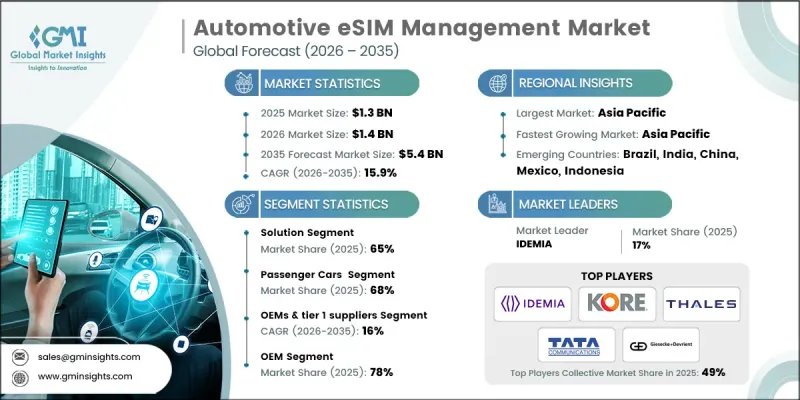
이러한 시장 확대는 차량에서 안전하고 원격으로 관리할 수 있는 셀룰러 연결에 대한 수요 증가에 힘입은 것입니다. 기존의 탈착식 SIM 카드와 달리 eSIM은 텔레매틱스 제어 장치 내에 내장되어 있어 물리적 조작 없이도 모바일 네트워크 프로파일을 업데이트, 활성화 및 전환할 수 있습니다. 차량용 eSIM 관리 플랫폼은 현대 차량 커넥티비티에 필수적인 요소로, OEM 제조업체, 차량 사업자, 모빌리티 서비스 제공업체를 위해 텔레매틱스, 무선 업데이트(OTA), 인포테인먼트, 긴급 통신, V2X(차량 간 통신) 서비스 등을 지원합니다. 등을 지원합니다. ADAS(첨단 운전자 보조 시스템) 및 자율주행 기술의 급속한 성장으로 인해 실시간 센서 데이터, 클라우드 기반 의사결정, 고해상도 지도 업데이트를 위해 끊김 없는 고대역폭의 셀룰러 연결이 필수적입니다. 규제 요건, 원활한 차량 내 연결에 대한 소비자 기대치 증가, 자동차 생태계의 디지털 전환이 시장 성장의 주요 요인으로 작용하고 있습니다. 중국, 일본, 한국의 높은 자동차 생산량과 더불어 5G 네트워크의 확대와 스마트 모빌리티 구상의 발전으로 아시아태평양은 가장 크고 빠르게 성장하는 지역 시장으로 부상하고 있습니다.
| 시장 범위 | |
|---|---|
| 개시 연도 | 2025년 |
| 예측 연도 | 2026-2035년 |
| 개시 금액 | 13억 달러 |
| 예측 금액 | 54억 달러 |
| CAGR | 15.9% |
솔루션 부문은 2025년 65%의 점유율을 차지할 것으로 예상되며, 2035년까지 연평균 16.6%의 성장률을 보일 것으로 전망됩니다. 이 부문에는 eSIM 관리 소프트웨어 플랫폼, 보안 하드웨어 요소, 통합 프로비저닝 시스템, eSIM 관리 소프트웨어 플랫폼, 보안 하드웨어 요소, 통합 프로비저닝 시스템이 포함됩니다. 솔루션 도입률이 높은 배경에는 엔터프라이즈급 eSIM 관리 플랫폼 도입에 따른 막대한 비용(전 세계 OEM 대상 라이선스 비용 500만-1,500만 달러)이 있습니다. 이 플랫폼은 구독 관리, 원격 SIM 프로비저닝 서버, 프로파일 생성, 자동차 백엔드 시스템과의 미들웨어 통합을 제공합니다. 개발 후 총이익률이 75-85%에 달하기 때문에 솔루션 제공업체는 강력한 벤더 경제 효과를 누리고 지속적인 수익을 창출하며 플랫폼의 지속적인 기능 강화를 촉진합니다.
승용차 부문은 2025년 68%의 점유율을 차지할 것으로 예상되며, 2035년까지 연평균 16.2%의 성장률을 유지할 것으로 전망됩니다. 승용차는 판매대수에서 시장을 주도하고 있으며, 안전 시스템, 인포테인먼트, 원격 차량 서비스, 자율주행 기능을 포함한 커넥티비티 기능의 조기 도입이 진행되고 있습니다. 특히 프리미엄 럭셔리 부문에서 스마트폰과 유사한 경험을 차량 내에서 원하는 소비자의 기대가 eSIM 도입을 촉진하고 있습니다. 긴급 신고 의무화를 포함한 승용차 안전 규제 강화도 신뢰할 수 있는 커넥티드 솔루션의 필요성을 높이고 있습니다.
중국의 자동차 eSIM 관리 시장은 2025년 1억 8,310만 달러에 달할 것으로 예상되며, 2035년까지 연평균 복합 성장률(CAGR) 16.2%를 나타낼 것으로 예측됩니다. 중국 시장 성장의 배경에는 커넥티드카 보급 확대, 정부 주도의 첨단 도로교통시스템(ITS) 추진, 5G 네트워크 확대, 디지털 차량 서비스에 대한 소비자 수요 증가 등이 있습니다. 연간 2,700만 대 이상의 자동차를 생산하는 중국 시장에서는 국내 기술 제공업체와 전기차(EV) 혁신가들의 지원을 받아 eSIM 지원 커넥티드 서비스 통합이 빠르게 진행되고 있습니다.
자주 묻는 질문
목차
제1장 조사 방법
제2장 주요 요약
제3장 업계 인사이트
제4장 경쟁 구도
제5장 시장 추산·예측 : 제공별, 2022-2035년
제6장 시장 추산·예측 : 차량별, 2022-2035년
제7장 시장 추산·예측 : 접속 방식별, 2022-2035년
제8장 시장 추산·예측 : 추진력별, 2022-2035년
제9장 시장 추산·예측 : 판매채널별, 2022-2035년
제10장 시장 추산·예측 : 최종 용도별, 2022-2035년
제11장 시장 추산·예측 : 지역별, 2022-2035년
제12장 기업 개요
LSH 26.03.26The Global Automotive eSIM Management Market was valued at USD 1.3 billion in 2025 and is estimated to grow at a CAGR of 15.9% to reach USD 5.4 billion by 2035.
The market expansion is fueled by the increasing demand for secure, remotely managed cellular connectivity in vehicles. Unlike traditional removable SIM cards, eSIMs are embedded within telematics control units, allowing mobile network profiles to be updated, activated, or switched without physical intervention. Automotive eSIM management platforms have become essential for modern vehicle connectivity, supporting telematics, over-the-air updates, infotainment, emergency communications, and vehicle-to-everything (V2X) services for OEMs, fleet operators, and mobility service providers. The rapid growth of advanced driver assistance systems (ADAS) and autonomous driving technologies further drives demand, as uninterrupted high-bandwidth cellular connectivity is required for real-time sensor data, cloud-based decision-making, and HD map updates. Regulatory mandates, increasing consumer expectations for seamless in-car connectivity, and the digital transformation of the automotive ecosystem are key forces shaping market growth. Asia Pacific emerges as the largest and fastest-growing regional market due to high vehicle production in China, Japan, and South Korea, alongside expanding 5G networks and smart mobility initiatives.
| Market Scope | |
|---|---|
| Start Year | 2025 |
| Forecast Year | 2026-2035 |
| Start Value | $1.3 Billion |
| Forecast Value | $5.4 Billion |
| CAGR | 15.9% |
The solution segment held a 65% share in 2025 and is expected to grow at a CAGR of 16.6% through 2035. This segment includes eSIM management software platforms, secure hardware elements, and integrated provisioning systems. Solution adoption is high due to the significant costs associated with deploying enterprise-grade eSIM management platforms, with licensing fees for global OEMs ranging from USD 5 million to USD 15 million. These platforms provide subscription management, remote SIM provisioning servers, profile generation, and middleware integration with automotive backend systems. With gross margins of 75-85% post-development, solution providers benefit from strong vendor economics, driving recurring revenue and incentivizing ongoing platform enhancements.
The passenger car segment accounted for 68% share in 2025 and is expected to maintain a 16.2% CAGR through 2035. Passenger vehicles dominate the market in terms of unit volume and early adoption of connectivity features, including safety systems, infotainment, remote vehicle services, and emerging autonomous capabilities. Consumer expectations for smartphone-like experiences in cars, particularly in premium and luxury segments, are driving eSIM adoption. Stricter safety regulations in passenger vehicles, including emergency call mandates, also reinforce the need for reliable connectivity solutions.
China Automotive eSIM Management Market reached USD 183.1 million in 2025 and is projected to grow at a CAGR of 16.2% through 2035. The market growth in China is driven by widespread connected vehicle adoption, government-backed intelligent transportation initiatives, 5G network expansion, and rising consumer demand for digital vehicle services. With over 27 million vehicles produced annually, China's automotive market is rapidly integrating eSIM-enabled connected services, supported by domestic technology providers and electric vehicle innovators.
Key players operating in the Global Automotive eSIM Management Market include Aeris Communications, AT&T, Deutsche Telekom, Giesecke+Devrient (G+D), IDEMIA, Kigen (Arm Company), KORE Wireless, Tata Communications, Thales, and Verizon Communications. Companies in the Automotive eSIM Management Market are strengthening their presence by investing in comprehensive eSIM platforms that support remote provisioning, network switching, and lifecycle management across global OEMs. Strategic partnerships with vehicle manufacturers, telecom operators, and cloud providers enable seamless integration of connectivity services and ensure compliance with regional regulations. Vendors are expanding their service portfolios to include subscription management, middleware integration, and analytics for connected services. Investments in R&D focus on improving scalability, security, and interoperability of eSIM platforms, while regional expansions target high-growth markets in Asia Pacific and Europe.
Table of Contents
Chapter 1 Methodology
- 1.1 Research approach
- 1.2 Quality commitments
- 1.3 Research trail and confidence scoring
- 1.3.1 Research trail components
- 1.3.2 Scoring components
- 1.4 Data collection
- 1.4.1 Partial list of primary sources
- 1.5 Data mining sources
- 1.5.1 Paid sources
- 1.6 Best estimates and calculations
- 1.6.1 Base year calculation for any one approach
- 1.7 Forecast model
- 1.8 Research transparency addendum
Chapter 2 Executive Summary
- 2.1 Industry 360° synopsis, 2022 - 2035
- 2.2 Key market trends
- 2.2.1 Regional
- 2.2.2 Offering
- 2.2.3 Vehicle
- 2.2.4 Connectivity
- 2.2.5 Propulsion
- 2.2.6 Sales Channel
- 2.2.7 End Use
- 2.3 TAM Analysis, 2026-2035
- 2.4 CXO perspectives: Strategic imperatives
Chapter 3 Industry Insights
- 3.1 Industry ecosystem analysis
- 3.1.1 Supplier landscape
- 3.1.2 Profit margin analysis
- 3.1.3 Cost structure
- 3.1.4 Value addition at each stage
- 3.1.5 Factor affecting the value chain
- 3.1.6 Disruptions
- 3.2 Industry impact forces
- 3.2.1 Growth drivers
- 3.2.1.1 Surge in connected & autonomous vehicle deployments
- 3.2.1.2 5G network infrastructure expansion
- 3.2.1.3 Regulatory mandates for vehicle connectivity (eCall, C-V2X)
- 3.2.1.4 OEM demand for remote subscription management
- 3.2.1.5 Cost optimization in global fleet operations
- 3.2.1.6 Enhanced vehicle cybersecurity requirements
- 3.2.2 Industry pitfalls and challenges
- 3.2.2.1 Legacy fleet management complexity
- 3.2.2.2 High initial implementation costs
- 3.2.2.3 Cybersecurity vulnerabilities & threat landscape
- 3.2.2.4 Inconsistent global regulatory frameworks
- 3.2.3 Market opportunities
- 3.2.3.1 Electric vehicle (EV) connectivity expansion
- 3.2.3.2 Fleet telematics digitalization
- 3.2.3.3 V2X communication ecosystem development
- 3.2.3.4 Aftermarket connectivity solutions growth
- 3.2.3.5 Emerging markets penetration (India, Southeast Asia)
- 3.2.1 Growth drivers
- 3.3 Growth potential analysis
- 3.4 Regulatory landscape
- 3.4.1 North America
- 3.4.1.1 US- Federal vehicle safety, emissions, and post-repair service regulations
- 3.4.1.2 Canada - Certified maintenance and EV servicing framework
- 3.4.2 Europe
- 3.4.2.1 Germany- EU vehicle safety regulations & national service standards
- 3.4.2.2 UK- Post-Brexit service compliance & connected vehicle guidance
- 3.4.2.3 France- National vehicle inspection & EV servicing policy
- 3.4.2.4 Italy- ITS pilots & smart-service regulations
- 3.4.3 Asia Pacific
- 3.4.3.1 China- MIIT vehicle servicing mandates & standards
- 3.4.3.2 India- Emerging automotive service & connectivity regulations
- 3.4.3.3 Japan- ITS connect & certified service policies
- 3.4.3.4 Australia- Technology neutral ITS policies
- 3.4.4 LATAM
- 3.4.4.1 Mexico- NOM vehicle safety standards
- 3.4.4.2 Argentina- National traffic law 24.449
- 3.4.5 MEA
- 3.4.5.1 South Africa- National road traffic act (1996)
- 3.4.5.2 Saudi Arabia- Traffic law & vision 2030 transport initiatives
- 3.4.1 North America
- 3.5 Porter’s analysis
- 3.6 PESTEL analysis
- 3.7 Technology and innovation landscape
- 3.7.1 Current technological trends
- 3.7.1.1 Remote SIM provisioning (RSP) technology
- 3.7.1.2 SM-DP+ architecture advancements
- 3.7.1.3 SM-SR security enhancements
- 3.7.2 Emerging technologies
- 3.7.2.1 Zero-touch provisioning (ZTP) innovations
- 3.7.2.2 In-factory profile provisioning (IFPP) emergence
- 3.7.2.3 Multi-mode connectivity solutions
- 3.7.1 Current technological trends
- 3.8 Patent analysis
- 3.9 Pricing analysis
- 3.9.1 Pricing models (per-device, subscription, hybrid)
- 3.9.2 Regional price variations
- 3.9.3 Price trend analysis
- 3.9.4 Cost structure breakdown
- 3.10 Use cases & success stories
- 3.11 Sustainability and environmental aspects
- 3.11.1 Sustainable practices
- 3.11.2 Waste reduction strategies
- 3.11.3 Energy efficiency in production
- 3.11.4 Eco-friendly Initiatives
- 3.11.5 Carbon footprint considerations
- 3.12 Security & privacy framework
- 3.12.1 Data encryption protocols
- 3.12.2 Secure OTA updates & remote provisioning
- 3.12.3 Compliance with global privacy regulations
- 3.12.4 Cyber threat mitigation strategies
- 3.13 Service & support infrastructure
- 3.13.1 Authorized service center readiness for eSIM and connected vehicles
- 3.13.2 Technician training & certification programs
- 3.13.3 Remote diagnostics & predictive maintenance support
- 3.13.4 Customer support & troubleshooting frameworks
- 3.14 OEM & Tier-1 Adoption Roadmap
Chapter 4 Competitive Landscape, 2025
- 4.1 Introduction
- 4.2 Company market share analysis
- 4.2.1 North America
- 4.2.2 Europe
- 4.2.3 Asia Pacific
- 4.2.4 LATAM
- 4.2.5 MEA
- 4.3 Competitive analysis of major market players
- 4.4 Competitive positioning matrix
- 4.5 Strategic outlook matrix
- 4.6 Key developments
- 4.6.1 Mergers & acquisitions
- 4.6.2 Partnerships & collaborations
- 4.6.3 New product launches
- 4.6.4 Expansion plans and funding
Chapter 5 Market Estimates & Forecast, By Offering, 2022 - 2035 ($Bn)
- 5.1 Key trends
- 5.2 Solution
- 5.2.1 Connectivity management platforms (CMP)
- 5.2.2 Subscription manager data preparation
- 5.2.3 Subscription manager secure routing (SM-SR)
- 5.2.4 Integrated RSP platforms
- 5.2.5 Security & authentication solutions
- 5.2.6 Others
- 5.3 Services
- 5.3.1 Managed services
- 5.3.2 Professional services
Chapter 6 Market Estimates & Forecast, By Vehicle, 2022 - 2035 ($Bn)
- 6.1 Key trends
- 6.2 Passenger cars
- 6.2.1 Hatchbacks
- 6.2.2 SUV
- 6.2.3 Sedan
- 6.3 Commercial vehicles
- 6.3.1 Light commercial vehicles (LCVs)
- 6.3.2 Medium commercial vehicles (MCVs)
- 6.3.3 Heavy commercial vehicles (HCVs)
Chapter 7 Market Estimates & Forecast, By Connectivity, 2022 - 2035 ($Bn)
- 7.1 Key trends
- 7.2 4G/LTE eSIM
- 7.3 5G eSIM
- 7.4 NB-IoT / LTE-M eSIM
- 7.5 Hybrid (4G + 5G) eSIM
Chapter 8 Market Estimates & Forecast, By Propulsion, 2022 - 2035 ($Bn)
- 8.1 Key trends
- 8.2 Battery electric vehicles (BEV)
- 8.3 Plug-in hybrid electric vehicles (PHEV)
- 8.4 Hybrid electric vehicles (HEV)
- 8.5 Internal combustion engine (ICE) vehicles
Chapter 9 Market Estimates & Forecast, By Sales Channel, 2022 - 2035 ($Bn)
- 9.1 Key trends
- 9.2 OEM embedded
- 9.3 Aftermarket
Chapter 10 Market Estimates & Forecast, By End Use, 2022 - 2035 ($Bn)
- 10.1 Key trends
- 10.2 OEMs & tier 1 suppliers
- 10.3 Fleet operators
- 10.4 Aftermarket service providers
Chapter 11 Market Estimates & Forecast, By Region, 2022 - 2035 ($Bn)
- 11.1 Key trends
- 11.2 North America
- 11.2.1 US
- 11.2.2 Canada
- 11.3 Europe
- 11.3.1 Germany
- 11.3.2 UK
- 11.3.3 France
- 11.3.4 Italy
- 11.3.5 Spain
- 11.3.6 Russia
- 11.3.7 Netherlands
- 11.3.8 Sweden
- 11.3.9 Denmark
- 11.3.10 Poland
- 11.4 Asia Pacific
- 11.4.1 China
- 11.4.2 India
- 11.4.3 Japan
- 11.4.4 Australia
- 11.4.5 South Korea
- 11.4.6 Singapore
- 11.4.7 Thailand
- 11.4.8 Indonesia
- 11.4.9 Vietnam
- 11.5 Latin America
- 11.5.1 Brazil
- 11.5.2 Mexico
- 11.5.3 Argentina
- 11.5.4 Colombia
- 11.6 MEA
- 11.6.1 South Africa
- 11.6.2 Saudi Arabia
- 11.6.3 UAE
- 11.6.4 Israel
Chapter 12 Company Profiles
- 12.1 Global Players
- 12.1.1 Aeris Communications
- 12.1.2 AT&T
- 12.1.3 Deutsche Telekom
- 12.1.4 Giesecke+Devrient (G+D)
- 12.1.5 IDEMIA
- 12.1.6 Kigen (Arm Company)
- 12.1.7 KORE Wireless
- 12.1.8 Tata Communications
- 12.1.9 Thales
- 12.1.10 Verizon Communications
- 12.2 Regional Players
- 12.2.1 Eseye
- 12.2.2 Infineon Technologies
- 12.2.3 NTT DOCOMO
- 12.2.4 NXP Semiconductors
- 12.2.5 Pelion
- 12.2.6 Qualcomm Technologies
- 12.2.7 Soracom
- 12.2.8 STMicroelectronics
- 12.2.9 Telefonica
- 12.2.10 Trasna Solutions
- 12.3 Emerging Players & Technology Enablers
- 12.3.1 1Global
- 12.3.2 Onomondo
- 12.3.3 Singapore Telecommunications (Singtel)
- 12.3.4 Valid
- 12.3.5 Wireless Logic