
|
시장보고서
상품코드
1959340
ADAS 구독 시장 기회, 성장요인, 업계 동향 분석 및 예측(2026-2035년)ADAS Subscription Market Opportunity, Growth Drivers, Industry Trend Analysis, and Forecast 2026 - 2035 |
||||||

세계의 ADAS 구독 시장은 2025년에 13억 달러로 평가되었고, 2035년까지 연평균 복합 성장률(CAGR) 19.1%로 성장하여 75억 달러에 이를 것으로 예측됩니다.
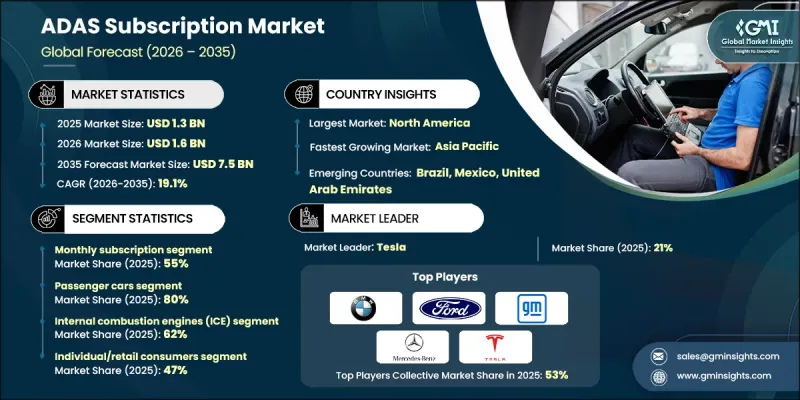
이러한 시장 성장은 자동차 산업의 구조적 변화를 반영하고 있으며, 수익원이 일회성 하드웨어 판매에서 지속적인 소프트웨어 기반 수익 창출로 전환되고 있습니다. 첨단운전자지원기능은 구매 시 영구적으로 활성화되는 것이 아니라, 구독 기반의 액세스를 통해 제공되는 경우가 증가하고 있습니다. 이러한 진화는 무선 업데이트(OTA)를 통해 차량 기능이 지속적으로 강화되는 소프트웨어 정의 차량의 부상과 밀접한 관련이 있습니다. 자동차 제조업체들은 판매 후 기능 활성화, 업그레이드, 커스터마이징이 가능한 중앙집중식 컴퓨팅과 유연한 전자 아키텍처에 많은 투자를 하고 있습니다. 차량 안전에 대한 규제가 더욱 가속화되고 있으며, 의무화된 기본 기능으로 인해 최소 요구 사항을 넘어서는 유료 업그레이드의 기회가 생겨나고 있습니다. 전기자동차는 소프트웨어 중심의 플랫폼과 통합된 디지털 생태계로 인해 구독 보급률이 높아지고 있습니다. 첨단 안전에 대한 소비자 수요, 규제 준수, 디지털 차량 전략이 맞물려 ADAS 구독 시장은 전 세계적으로 지속적으로 확대되고 있습니다.
| 시장 범위 | |
|---|---|
| 개시 연도 | 2025년 |
| 예측 연도 | 2026-2035년 |
| 개시 연도 가치 | 13억 달러 |
| 예측 금액 | 75억 달러 |
| CAGR | 19.1% |
이 시장은 승용차 및 상용차를 대상으로 월별 요금제, 연간 계약, 사용량 기반 요금제 등 정기적인 지불 구조를 통해 제공되는 표준 규제를 초과하는 고급 운전 지원 기능에 대한 유료 액세스를 제공합니다. 자동차 제조업체들은 중앙 집중식 소프트웨어 플랫폼에 의해 지원되는 기능 온디맨드 모델로 빠르게 전환하고 있습니다. 주요 지역의 정부 안전 규제로 인해 ADAS 하드웨어의 표준 장착이 증가하고 있으며, 이를 통해 제조업체는 구독을 통해 고기능을 수익화할 수 있습니다. 이러한 규제 주도의 하드웨어 보급은 소프트웨어 업그레이드와 지속적인 수익원을 위한 확장 가능한 기반을 구축하고 있습니다. 자동차 산업에서 유연한 소유 모델과 디지털 서비스에 대한 선호도가 높아짐에 따라 구독의 도입이 더욱 가속화되고 있습니다.
월간 구독 플랜 부문은 2025년 55%의 점유율을 차지할 것으로 예상되며, 2026년부터 2035년까지 연평균 복합 성장률(CAGR) 18.9%를 나타낼 것으로 예측됩니다. 이 가격 체계는 그 유연성과 소비자 친화성으로 인해 여전히 주류로 자리 잡고 있습니다. 월정액 요금제는 제조업체에게 지속적인 고객과의 교류와 예측 가능한 수익 흐름을 지원하는 동시에 지속적인 기능 강화와 가격 조정을 가능하게 합니다. 이러한 모델을 통해 자동차 제조업체는 사용자 행동과 참여 패턴을 분석하여 제공 내용을 정교화할 수 있습니다. 그러나 고객 유지가 여전히 과제로 남아있고, ADAS 구독의 연간 해지율이 15%에서 25%에 달하고, 일관된 가치 제공과 기능 차별화가 요구되고 있습니다.
승용차 부문은 2025년 80%의 점유율을 차지할 것으로 예상되며, 안전에 대한 인식 증가, 편의성에 대한 기대, 첨단 차량 탑재 기술에 대한 인식 가치에 힘입어 연평균 18.8%의 성장률을 보일 것으로 전망됩니다. 차량 가격대에 따라 채택률은 크게 다르며, 중급차나 엔트리 모델에 비해 고급차 모델에서 보급률이 높게 나타나고 있습니다. 이러한 차이는 소비자층의 특성, 구매력 및 ADAS 하드웨어의 표준 장착 상황의 차이를 반영합니다.
미국의 ADAS 구독 시장은 2025년 3억 7,400만 달러 규모에 달할 것으로 예상되며, 2026년부터 2035년까지 연평균 18%의 성장률을 보일 것으로 전망됩니다. 이러한 시장 선도적 위치는 차량 안전에 대한 강력한 규제적 초점, 첨단 도로 인프라, 첨단운전자보조시스템(ADAS)에 대한 소비자의 높은 수용성에 의해 뒷받침되고 있습니다. 첨단 안전 시스템을 장착한 차량은 안전 평가에서 좋은 평가를 받고 있으며, 이는 제조업체들이 구독 기반 기능 제공을 확대하는 원동력이 되고 있습니다. 장거리 운전의 추세도 첨단 운전 지원 기능에 대한 수요에 기여하고 있습니다.
자주 묻는 질문
목차
제1장 조사 방법
제2장 주요 요약
제3장 업계 인사이트
제4장 경쟁 구도
제5장 시장 추산 및 예측 : 구독 모델별, 2022-2035
제6장 시장 추산 및 예측 : 차종별, 2022-2035
제7장 시장 추산 및 예측 : ADAS 기능별, 2022-2035
제8장 시장 추산 및 예측 : 자율 레벨별, 2022-2035
제9장 시장 추산 및 예측 : 추진력별, 2022-2035
제10장 시장 추산 및 예측 : 최종 용도별, 2022-2035
제11장 시장 추산 및 예측 : 지역별, 2022-2035
제12장 기업 개요
LSH 26.03.18The Global ADAS Subscription Market was valued at USD 1.3 billion in 2025 and is estimated to grow at a CAGR of 19.1% to reach USD 7.5 billion by 2035.
Market growth reflects a structural transformation in the automotive industry, where revenue generation is shifting away from one-time hardware sales toward recurring, software-based monetization. Advanced driver assistance functions are increasingly delivered through subscription-based access rather than permanent activation at purchase. This evolution aligns closely with the rise of software-defined vehicles, where vehicle capabilities are continuously enhanced through over-the-air updates. Automakers are investing heavily in centralized computing and flexible electronic architectures that allow features to be activated, upgraded, or customized post-sale. Regulatory momentum around vehicle safety is further accelerating adoption, as mandated baseline features create opportunities for paid upgrades beyond minimum requirements. Electric vehicles demonstrate higher subscription penetration due to their software-centric platforms and integrated digital ecosystems. Together, consumer demand for advanced safety, regulatory alignment, and digital vehicle strategies is driving sustained expansion of the ADAS subscription market globally.
| Market Scope | |
|---|---|
| Start Year | 2025 |
| Forecast Year | 2026-2035 |
| Start Value | $1.3 Billion |
| Forecast Value | $7.5 Billion |
| CAGR | 19.1% |
The market covers paid access to advanced driver assistance functionalities beyond standard regulatory inclusions, offered through recurring payment structures such as monthly plans, annual agreements, and usage-based pricing across passenger and commercial vehicles. Automakers are rapidly transitioning to feature-on-demand models supported by centralized software platforms. Government safety regulations across major regions are increasing the standard installation of ADAS hardware, which in turn enables manufacturers to monetize higher-level features through subscriptions. This regulatory-driven hardware penetration is creating a scalable foundation for software upgrades and recurring revenue streams. Subscription adoption is further supported by the growing preference for flexible ownership models and digital services within the automotive sector.
The monthly subscription plans segment accounted for 55% share in 2025 and is expected to grow at a CAGR of 18.9% from 2026 to 2035. This pricing structure remains dominant due to its flexibility and familiarity among consumers. Monthly plans support ongoing customer interaction and predictable revenue flows for manufacturers while enabling continuous feature enhancements and pricing adjustments. These models also allow automakers to analyze user behavior and engagement patterns to refine offerings. However, retention remains a challenge, with annual churn rates for ADAS subscriptions ranging between 15% and 25%, requiring consistent value delivery and feature differentiation.
The passenger vehicles segment held 80% share in 2025 and is forecast to grow at a CAGR of 18.8%, driven by heightened safety awareness, convenience expectations, and the perceived value of advanced in-vehicle technology. Adoption rates vary significantly across vehicle price categories, with higher penetration in premium models compared to mid-range and entry-level segments. This variation reflects differences in consumer demographics, purchasing power, and the availability of pre-installed ADAS hardware.
United States ADAS Subscription Market generated USD 374 million in 2025 and is expected to grow at a CAGR of 18% from 2026 to 2035. Market leadership is supported by strong regulatory focus on vehicle safety, advanced road infrastructure, and high consumer acceptance of driver assistance technologies. Vehicles equipped with advanced safety systems receive favorable safety assessments, encouraging manufacturers to expand subscription-based feature offerings. Long-distance driving patterns also contribute to demand for enhanced driver assistance capabilities.
Key companies operating in the Global ADAS Subscription Market include Volkswagen, Mercedes-Benz, Ford Motor, General Motors, BMW, Hyundai Motor, Honda Motor, Nissan Motor, Mobileye, and Tesla. Companies in the ADAS subscription market are strengthening their competitive position by investing in software platforms that support scalable, feature-on-demand deployment. Many players are prioritizing centralized vehicle architectures to simplify updates and enable faster rollout of new capabilities. Strategic pricing models, bundled services, and tiered subscription offerings are being used to improve customer retention. Automakers are also focusing on data analytics to understand user behavior and optimize feature design. Partnerships with technology providers, investments in cybersecurity, and continuous enhancement of over-the-air update infrastructure further support long-term market presence and revenue growth.
Table of Contents
Chapter 1 Methodology
- 1.1 Research approach
- 1.2 Quality commitments
- 1.3 Research trail and confidence scoring
- 1.3.1 Research trail components
- 1.3.2 Scoring components
- 1.4 Data collection
- 1.4.1 Partial list of primary sources
- 1.5 Data mining sources
- 1.5.1 Paid sources
- 1.6 Best estimates and calculations
- 1.6.1 Base year calculation for any one approach
- 1.7 Forecast model
- 1.8 Research transparency addendum
Chapter 2 Executive Summary
- 2.1 Industry 360° synopsis, 2022 - 2035
- 2.2 Key market trends
- 2.2.1 Regional
- 2.2.2 Subscription Mode
- 2.2.3 Vehicles
- 2.2.4 ADAS Features
- 2.2.5 Autonomy Level
- 2.2.6 Propulsion
- 2.2.7 End Use
- 2.3 TAM Analysis, 2026-2035
- 2.4 CXO perspectives: Strategic imperatives
- 2.4.1 Executive decision points
- 2.4.2 Critical success factors
- 2.5 Future outlook and strategic recommendations
Chapter 3 Industry Insights
- 3.1 Industry ecosystem analysis
- 3.1.1 Supplier landscape
- 3.1.2 Profit margin analysis
- 3.1.3 Cost structure
- 3.1.4 Value addition at each stage
- 3.1.5 Factor affecting the value chain
- 3.1.6 Disruptions
- 3.2 Industry impact forces
- 3.2.1 Growth drivers
- 3.2.1.1 Rising demand for safety & autonomous features
- 3.2.1.2 Shift to software-defined vehicles (SDV)
- 3.2.1.3 OEM revenue diversification & recurring revenue models
- 3.2.1.4 Government mandates for advanced safety systems
- 3.2.1.5 Declining hardware costs & increased software value
- 3.2.2 Industry pitfalls and challenges
- 3.2.2.1 High consumer skepticism & perceived money-grab
- 3.2.2.2 Low market awareness
- 3.2.2.3 High expected pricing concerns
- 3.2.2.4 Cybersecurity & data privacy concerns
- 3.2.3 Market opportunities
- 3.2.3.1 Untapped EV market potential (2x higher adoption rates)
- 3.2.3.2 Emerging markets with leapfrog technology adoption
- 3.2.3.3 Fleet & MaaS provider subscription packages
- 3.2.3.4 Aftermarket subscription services
- 3.2.3.5 AI-powered personalization & usage-based pricing
- 3.2.1 Growth drivers
- 3.3 Growth potential analysis
- 3.4 Regulatory landscape
- 3.4.1 North America
- 3.4.1.1 US- Federal safety rules & ADAS deployment guidance
- 3.4.1.2 Canada - Safety framework for connected & automated vehicles (CASF)
- 3.4.2 Europe
- 3.4.2.1 Germany- EU ITS & national initiatives
- 3.4.2.2 UK- Post-Brexit ADAS flexibility
- 3.4.2.3 France- National ADAS testing & ITS strategy
- 3.4.2.4 Italy- ITS pilots & smart infrastructure
- 3.4.3 Asia Pacific
- 3.4.3.1 China- MIIT C-V2X mandates & standards
- 3.4.3.2 India- Emerging ADAS & automotive connectivity regulations
- 3.4.3.3 Japan- ITS connect & spectrum policy
- 3.4.3.4 Australia- Technology neutral ITS policies
- 3.4.4 LATAM
- 3.4.4.1 Mexico- NOM vehicle safety standards
- 3.4.4.2 Argentina- National traffic law 24.449
- 3.4.5 MEA
- 3.4.5.1 South Africa- National road traffic act (1996)
- 3.4.5.2 Saudi Arabia- Traffic law & vision 2030 transport initiatives
- 3.4.1 North America
- 3.5 Porter’s analysis
- 3.6 PESTEL analysis
- 3.7 Technology and innovation landscape
- 3.7.1 Current technological trends
- 3.7.1.1 Software-defined ADAS architecture
- 3.7.1.2 Over-the-air (OTA) update capabilities
- 3.7.2 Emerging technologies
- 3.7.2.1 Cloud computing & edge processing integration
- 3.7.2.2 AI & machine learning in ADAS subscriptions
- 3.7.1 Current technological trends
- 3.8 Patent analysis
- 3.9 Pricing analysis
- 3.9.1 Monthly vs annual subscription pricing
- 3.9.2 Pay-per-use vs flat-rate models
- 3.9.3 Tiered pricing & feature bundling strategies
- 3.9.4 Regional pricing variations
- 3.10 Use cases & success stories
- 3.11 Sustainability and environmental aspects
- 3.11.1 Sustainable practices
- 3.11.2 Waste reduction strategies
- 3.11.3 Energy efficiency in production
- 3.11.4 Eco-friendly Initiatives
- 3.11.5 Carbon footprint considerations
- 3.12 Future outlook and opportunities
- 3.12.1 Market evolution scenarios (2025-2035)
- 3.12.2 Emerging subscription models
- 3.12.3 Freemium-to-premium conversion models
- 3.12.4 Disruptive threats & risk mitigation
Chapter 4 Competitive Landscape, 2025
- 4.1 Introduction
- 4.2 Company market share analysis
- 4.2.1 North America
- 4.2.2 Europe
- 4.2.3 Asia Pacific
- 4.2.4 LATAM
- 4.2.5 MEA
- 4.3 Competitive analysis of major market players
- 4.4 Competitive positioning matrix
- 4.5 Strategic outlook matrix
- 4.6 Key developments
- 4.6.1 Mergers & acquisitions
- 4.6.2 Partnerships & collaborations
- 4.6.3 New product launches
- 4.6.4 Expansion plans and funding
Chapter 5 Market Estimates & Forecast, By Subscription Model, 2022 - 2035 ($Bn)
- 5.1 Key trends
- 5.2 Monthly subscription
- 5.3 Annual subscription
- 5.4 Pay-per-use/on-demand
Chapter 6 Market Estimates & Forecast, By Vehicles, 2022 - 2035 ($Bn)
- 6.1 Key trends
- 6.2 Passenger cars
- 6.2.1 Hatchbacks
- 6.2.2 SUV
- 6.2.3 Sedan
- 6.3 Commercial vehicles
- 6.3.1 Light commercial vehicles (LCVs)
- 6.3.2 Medium commercial vehicles (MCVs)
- 6.3.3 Heavy commercial vehicles (HCVs)
Chapter 7 Market Estimates & Forecast, By ADAS Features, 2022 - 2035 ($Bn)
- 7.1 Key trends
- 7.2 Adaptive cruise control (ACC)
- 7.3 Lane keeping/departure systems
- 7.4 Automated parking assist
- 7.5 Collision avoidance systems
- 7.6 Traffic jam assistance
- 7.7 Highway pilot/full self-driving
- 7.8 Blind spot detection
- 7.9 Others
Chapter 8 Market Estimates & Forecast, By Autonomy Level, 2022 - 2035 ($Bn)
- 8.1 Key trends
- 8.2 Level 1 (L1)
- 8.3 Level 2 (L2)
- 8.4 Level 2+ (L2+)
- 8.5 Level 3 (L3)
- 8.6 Level 4 (L4)
Chapter 9 Market Estimates & Forecast, By Propulsion, 2022 - 2035 ($Bn)
- 9.1 Key trends
- 9.2 Internal combustion engine (ICE)
- 9.3 Electric / battery electric vehicles (BEV)
- 9.4 Hybrid electric vehicles (HEV)
- 9.5 Plug-in hybrid electric vehicles (PHEV)
Chapter 10 Market Estimates & Forecast, By End Use, 2022 - 2035 ($Bn)
- 10.1 Key trends
- 10.2 Individual/retail consumers
- 10.3 Fleet operators
- 10.4 Mobility-as-a-service (MaaS) providers
- 10.5 Leasing companies
- 10.6 Others
Chapter 11 Market Estimates & Forecast, By Region, 2022 - 2035 ($Bn)
- 11.1 Key trends
- 11.2 North America
- 11.2.1 US
- 11.2.2 Canada
- 11.3 Europe
- 11.3.1 Germany
- 11.3.2 UK
- 11.3.3 France
- 11.3.4 Italy
- 11.3.5 Spain
- 11.3.6 Russia
- 11.3.7 Netherlands
- 11.3.8 Sweden
- 11.3.9 Denmark
- 11.3.10 Poland
- 11.4 Asia Pacific
- 11.4.1 China
- 11.4.2 India
- 11.4.3 Japan
- 11.4.4 Australia
- 11.4.5 South Korea
- 11.4.6 Singapore
- 11.4.7 Thailand
- 11.4.8 Indonesia
- 11.4.9 Vietnam
- 11.5 Latin America
- 11.5.1 Brazil
- 11.5.2 Mexico
- 11.5.3 Argentina
- 11.5.4 Colombia
- 11.6 MEA
- 11.6.1 South Africa
- 11.6.2 Saudi Arabia
- 11.6.3 UAE
- 11.6.4 Israel
Chapter 12 Company Profiles
- 12.1 Global Players
- 12.1.1 Audi
- 12.1.2 BMW
- 12.1.3 Ford Motor
- 12.1.4 General Motors
- 12.1.5 Honda Motor
- 12.1.6 Hyundai Motor
- 12.1.7 Mercedes-Benz
- 12.1.8 Nissan Motor
- 12.1.9 Tesla
- 12.1.10 Volkswagen
- 12.2 Regional Players
- 12.2.1 BYD
- 12.2.2 Genesis
- 12.2.3 Li Auto
- 12.2.4 Lucid
- 12.2.5 NIO
- 12.2.6 Polestar Automotive
- 12.2.7 Rivian Automotive
- 12.2.8 Subaru
- 12.2.9 Volvo Cars (Geely)
- 12.2.10 XPENG Motors
- 12.3 Emerging Players & Technology Enablers
- 12.3.1 Mobileye
- 12.3.2 Porsche
- 12.3.3 Sibros Technologies
- 12.3.4 Stellantis
- 12.3.5 Xiaomi