

|
시장보고서
상품코드
1959342
AI 탑재 차량내 콕핏 및 어시스턴트 시장 기회, 성장요인, 업계 동향 분석 및 예측(2026-2035년)AI-Powered In-Vehicle Cockpit and Assistant Market Opportunity, Growth Drivers, Industry Trend Analysis, and Forecast 2026 - 2035 |
||||||

세계의 AI 탑재 차량내 콕핏 및 어시스턴트 시장은 2025년에 71억 달러로 평가되었고, 2035년까지 연평균 복합 성장률(CAGR) 22.2%로 성장하여 501억 달러에 이를 것으로 예측되고 있습니다.
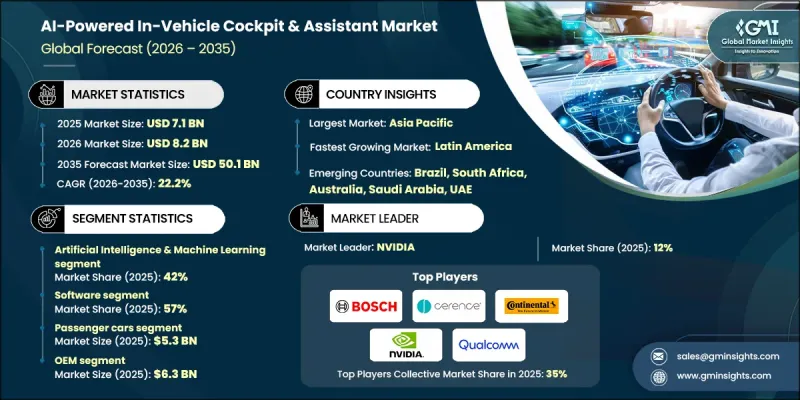
직관적이고 음성으로 조작할 수 있는 차량 상호작용과 지능형 운전자 지원에 대한 소비자의 기대가 높아지면서 성장을 주도하고 있습니다. 자동차 제조업체와 1차 협력사들은 고도로 개인화되고 상황 인식이 가능한 조종석 환경을 제공하기 위해 인공지능, 머신러닝, 자연어 기술에 대한 투자를 계속 가속화하고 있습니다. 이 플랫폼은 내비게이션, 미디어, 통신, 차량 제어를 하나의 지능형 인터페이스로 통합합니다. 소프트웨어 정의 차량 및 유연한 조종석 아키텍처로의 전환을 통해 제조업체는 새로운 AI 기반 기능을 보다 빠르게 도입할 수 있습니다. AI는 또한 고급 컨텐츠 관리와 선호도 기반 추천을 통해 인포테인먼트를 혁신하고, 운전자와 승객 모두의 참여를 높이고 있습니다. 이와 함께, 확장 가능한 고성능 컴퓨팅 플랫폼은 전체 조종석 시스템 및 운전 보조 기능에 AI 도입을 지원하여, 자동차 산업 전반에 걸쳐 소프트웨어 중심 설계가 표준화되는 가운데 개발 주기를 단축하고 장기적인 차량 적응성을 실현하고 있습니다.
| 시장 범위 | |
|---|---|
| 개시 연도 | 2025년 |
| 예측 연도 | 2026-2035년 |
| 개시 금액 | 71억 달러 |
| 예측 금액 | 501억 달러 |
| CAGR | 22.2% |
소프트웨어 부문은 2025년 57%의 점유율을 차지할 것으로 예상되며, 2026년부터 2035년까지 연평균 23.8%의 성장률을 보일 것으로 전망됩니다. AI에 초점을 맞춘 조종석 소프트웨어는 모듈식 및 서비스 지향 아키텍처를 지원하여 지능적이고 연결성이 뛰어나며 적응력이 뛰어난 사용자 경험을 제공합니다. 이 플랫폼은 원활한 시스템 통합과 무선 업데이트를 통한 신속한 기능 활성화로 차량의 장기적인 기능성을 향상시킬 수 있습니다.
승용차 부문은 2025년 53억 달러 시장 규모를 창출했습니다. 이 부문은 커넥티비티, 지능화, 개인화 기능을 갖춘 차량 내 환경에 대한 소비자 수요 증가에 따른 수혜를 받고 있습니다. AI 기반 음성 대화, 첨단 휴먼-머신 인터페이스, 예측 인텔리전스를 통해 승객 중심의 모빌리티 플랫폼 내에서 내비게이션, 통신, 엔터테인먼트, 차량 조작에 대한 원활한 접근을 실현합니다.
중국의 AI 탑재 차량용 조종석 비서 시장은 2025년 22억 달러에 달할 것으로 예측됩니다. 중국의 선도적 위치는 급속한 디지털 혁신, 국내 자동차 제조업체의 강력한 혁신, 그리고 차량 라인업 전반에 걸친 AI 기술의 대규모 통합에 의해 주도되고 있습니다. 디지털 생태계에 대한 소비자의 높은 수용성과 지원적인 정책 프레임워크로 인해 조종석 인텔리전스는 중국 자동차 시장에서 중요한 경쟁 차별화 요소로 부상하고 있습니다.
자주 묻는 질문
목차
제1장 조사 방법과 범위
제2장 주요 요약
제3장 업계 인사이트
제4장 경쟁 구도
제5장 시장 추산·예측 : 기술별, 2022-2035년
제6장 시장 추산·예측 : 컴포넌트별, 2022-2035년
제7장 시장 추산·예측 : 차량별, 2022-2035년
제8장 시장 추산·예측 : 용도별, 2022-2035년
제9장 시장 추산·예측 : 판매채널별, 2022-2035년
제10장 시장 추산·예측 : 지역별, 2022-2035년
제11장 기업 개요
LSH 26.03.26The Global AI-Powered In-Vehicle Cockpit & Assistant Market was valued at USD 7.1 billion in 2025 and is estimated to grow at a CAGR of 22.2% to reach USD 50.1 billion by 2035.
Rising consumer expectations for intuitive, voice-enabled vehicle interaction and intelligent driver support fuel growth. Automakers and Tier 1 suppliers continue to accelerate investment in artificial intelligence, machine learning, and natural language technologies to deliver highly personalized and context-aware cockpit environments. These platforms unify navigation, media, communication, and vehicle controls into a single intelligent interface. The shift toward software-defined vehicles and flexible cockpit architectures allows manufacturers to introduce new AI-driven functions at a much faster pace. AI is also reshaping infotainment through advanced content management and preference-based recommendations, increasing engagement for both drivers and passengers. In parallel, scalable high-performance computing platforms are supporting AI deployment across cockpit systems and driver assistance features, enabling quicker development cycles and long-term vehicle adaptability as software-centric design becomes standard across the automotive industry.
| Market Scope | |
|---|---|
| Start Year | 2025 |
| Forecast Year | 2026-2035 |
| Start Value | $7.1 Billion |
| Forecast Value | $50.1 Billion |
| CAGR | 22.2% |
The software segment held a 57% share in 2025 and is forecast to grow at a CAGR of 23.8% from 2026 to 2035. AI-focused cockpit software enables intelligent, connected, and adaptive user experiences by supporting modular and service-oriented architectures. These platforms allow seamless system integration and faster feature activation through over-the-air updates, enhancing long-term vehicle functionality.
The passenger vehicles segment generated USD 5.3 billion in 2025. This segment benefits from strong consumer demand for connected, intelligent, and personalized in-vehicle environments. AI-powered voice interaction, advanced human-machine interfaces, and predictive intelligence support smooth access to navigation, communication, entertainment, and vehicle operation within passenger-focused mobility platforms.
China AI-Powered In-Vehicle Cockpit & Assistant Market reached USD 2.2 billion in 2025. The country's leadership is driven by rapid digital transformation, strong innovation among domestic automakers, and large-scale integration of AI technologies across vehicle lineups. High consumer acceptance of digital ecosystems and supportive policy frameworks have made cockpit intelligence a key competitive differentiator in the Chinese automotive market.
Key companies active in the Global AI-Powered In-Vehicle Cockpit & Assistant Market include Qualcomm Technologies, NVIDIA, Harman International Industries, Robert Bosch, Continental, Aptiv, Visteon, Valeo, DENSO, and Panasonic Automotive Systems. Companies operating in the AI-Powered In-Vehicle Cockpit & Assistant Market focus on strengthening their position through software-centric innovation and ecosystem partnerships. Automakers and suppliers invest heavily in proprietary AI platforms and scalable computing architectures to support long-term feature expansion. Strategic collaboration with semiconductor and software firms improves processing efficiency and accelerates product development. Many players emphasize modular cockpit designs that can be deployed across multiple vehicle platforms. Over-the-air update capabilities are prioritized to ensure continuous performance enhancement and personalization. Firms also concentrate on improving voice intelligence accuracy, user data security, and seamless integration with digital services.
Table of Contents
Chapter 1 Methodology & Scope
- 1.1 Research approach
- 1.2 Quality Commitments
- 1.2.1 GMI AI policy & data integrity commitment
- 1.2.1.1 Source consistency protocol
- 1.2.1 GMI AI policy & data integrity commitment
- 1.3 Research Trail & Confidence Scoring
- 1.3.1 Research Trail Components
- 1.3.2 Scoring Components
- 1.4 Data Collection
- 1.4.1 Partial list of primary sources
- 1.5 Data mining sources
- 1.5.1 Paid sources
- 1.5.1.1 Sources, by region
- 1.5.1 Paid sources
- 1.6 Base estimates and calculations
- 1.6.1 Base year calculation for any one approach
- 1.7 Forecast
- 1.7.1 Quantified market impact analysis
- 1.7.1.1 Mathematical impact of growth parameters on forecast
- 1.7.1 Quantified market impact analysis
- 1.8 Research transparency addendum
- 1.8.1 Source attribution framework
- 1.8.2 Quality assurance metrics
- 1.8.3 Our commitment to trust
Chapter 2 Executive Summary
- 2.1 Industry 360° synopsis
- 2.2 Key market trends
- 2.2.1 Regional
- 2.2.2 Technology
- 2.2.3 Component
- 2.2.4 Vehicle
- 2.2.5 Application
- 2.2.6 Sales Channel
- 2.3 TAM Analysis, 2026-2035
- 2.4 CXO perspectives: Strategic imperatives
- 2.4.1 Key decision points for industry executives
- 2.4.2 Critical success factors for market players
- 2.5 Future outlook and strategic recommendations
Chapter 3 Industry Insights
- 3.1 Industry ecosystem analysis
- 3.1.1 Supplier landscape
- 3.1.1.1 Component suppliers
- 3.1.1.2 Technology platform providers
- 3.1.1.3 System integrators
- 3.1.1.4 Automotive OEMs
- 3.1.1.5 Aftermarket distributors
- 3.1.1.6 End-users
- 3.1.2 Cost structure
- 3.1.3 Profit margin
- 3.1.4 Value addition at each stage
- 3.1.5 Vertical integration trends
- 3.1.6 Disruptors
- 3.1.1 Supplier landscape
- 3.2 Impact on forces
- 3.2.1 Growth drivers
- 3.2.1.1 Growing adoption of connected and software-defined vehicles.
- 3.2.1.2 Rising consumer demand for personalization and hands-free operation
- 3.2.1.3 Expansion of EV and autonomous vehicle segments
- 3.2.1.4 Increasing aftermarket and software upgrade opportunities
- 3.2.2 Industry pitfalls & challenges
- 3.2.2.1 Growing adoption of connected and software-defined vehicles.
- 3.2.2.2 Rising consumer demand for personalization and hands-free operation
- 3.2.3 Market opportunities
- 3.2.3.1 AI-driven predictive and generative assistants
- 3.2.3.2 Multimodal HMI adoption
- 3.2.3.3 Cloud connectivity and OTA updates
- 3.2.3.4 Regional adoption of intelligent cockpits
- 3.2.1 Growth drivers
- 3.3 Technology trends & innovation ecosystem
- 3.3.1 Current technologies
- 3.3.2 Emerging technologies
- 3.4 Growth potential analysis
- 3.5 Regulatory landscape
- 3.5.1 North America
- 3.5.1.1 FMVSS Driver Distraction Guidelines
- 3.5.1.2 Transport Canada Connected Vehicle & Infotainment Guidelines
- 3.5.2 Europe
- 3.5.2.1 EU General Safety Regulation (GSR)
- 3.5.2.2 CE Certification for Automotive Infotainment
- 3.5.3 Asia-Pacific
- 3.5.3.1 Japan Automotive Electronics Safety Standards
- 3.5.3.2 China GB Standards for Connected Vehicles
- 3.5.3.3 India AIS / EMC Guidelines
- 3.5.4 Latin America
- 3.5.4.1 Brazil INMETRO Standards
- 3.5.4.2 Colombia Automotive Connected Systems Guidelines
- 3.5.4.3 Argentina Vehicle Electronics & Infotainment Regulations
- 3.5.5 Middle East & Africa
- 3.5.5.1 UAE Standards for Connected & Voice-Enabled Vehicles
- 3.5.5.2 Oman Automotive Electronics Guidelines
- 3.5.5.3 South Africa SABS Automotive Voice & Infotainment Standards
- 3.5.1 North America
- 3.6 Porter's analysis
- 3.7 PESTEL analysis
- 3.8 Price trends
- 3.8.1 OEM Pricing models
- 3.8.2 Aftermarket pricing trends
- 3.8.3 Subscription vs one-time purchase models
- 3.8.4 Regional price variations
- 3.9 Patent analysis
- 3.10 Sustainability and environmental aspects
- 3.10.1 Sustainable practices
- 3.10.2 Waste reduction strategies
- 3.10.3 Energy efficiency in production
- 3.10.4 Eco-friendly initiatives
- 3.10.5 Carbon footprint considerations
- 3.11 Supply chain analysis
- 3.11.1 Component sourcing strategies
- 3.11.2 Semiconductor chip supply constraints
- 3.11.3 Cloud infrastructure dependencies
- 3.11.4 Regional supply chain dynamics
- 3.12 Commercial viability & deployment
- 3.12.1 Cost competitiveness vs. premium audio upsells value.
- 3.12.2 OEM sourcing attractiveness and platform scalability
- 3.12.3 Aftermarket upgrade potential and dealer fitment economics
- 3.12.4 Localization, supply resilience, and logistics practicality
- 3.13 Human-Machine Interface (HMI) & User Experience Benchmarking
Chapter 4 Competitive Landscape, 2025
- 4.1 Introduction
- 4.2 Company market share analysis
- 4.2.1 North America
- 4.2.2 Europe
- 4.2.3 Asia-Pacific
- 4.2.4 Latin America
- 4.2.5 Middle East & Africa
- 4.3 Competitive positioning matrix
- 4.4 Strategic outlook matrix
- 4.5 Key developments
- 4.5.1 Mergers & acquisitions
- 4.5.2 Partnerships & collaborations
- 4.5.3 New product launches
- 4.5.4 Expansion plans and funding
Chapter 5 Market Estimates & Forecast, By Technology, 2022 - 2035 ($Bn, Units)
- 5.1 Key trends
- 5.2 Speech Recognition
- 5.3 Natural Language Processing (NLP)
- 5.4 Artificial Intelligence (AI)
Chapter 6 Market Estimates & Forecast, By Component, 2022 - 2035 ($Bn, Units)
- 6.1 Key trends
- 6.2 Software
- 6.2.1 Embedded Software
- 6.2.2 Cloud-based Software
- 6.2.3 AI-powered Applications
- 6.2.4 Others
- 6.3 Hardware
- 6.3.1 Microphones & Speakers
- 6.3.2 Display Panels & Screens
- 6.3.3 Control Units & Processors
- 6.3.4 Sensors & Cameras
- 6.3.5 Others
- 6.4 Services
- 6.4.1 Integration & Deployment
- 6.4.2 Maintenance & Support
- 6.4.3 Consulting Services
Chapter 7 Market Estimates & Forecast, By Vehicle, 2022 - 2035 ($Bn, Units)
- 7.1 Key trends
- 7.2 Passenger Cars
- 7.2.1 Sedans
- 7.2.2 Hatchbacks
- 7.2.3 SUVs
- 7.3 Commercial Vehicles
- 7.3.1 Light commercial vehicles (LCV)
- 7.3.2 Medium commercial vehicles (MCV)
- 7.3.3 Heavy commercial vehicles (HCV)
Chapter 8 Market Estimates & Forecast, By Application, 2022 - 2035 ($Bn, Units)
- 8.1 Key trends
- 8.2 Navigation & Mapping
- 8.3 Entertainment & Media
- 8.4 Communication
- 8.5 Vehicle Control & Settings
- 8.6 Others
Chapter 9 Market Estimates & Forecast, By Sales Channel, 2022 - 2035 ($Bn, Units)
- 9.1 Key trends
- 9.2 OEM
- 9.3 Aftermarket
Chapter 10 Market Estimates & Forecast, By Region, 2022 - 2035 ($Bn, Units)
- 10.1 North America
- 10.1.1 US
- 10.1.2 Canada
- 10.2 Europe
- 10.2.1 UK
- 10.2.2 Germany
- 10.2.3 France
- 10.2.4 Italy
- 10.2.5 Spain
- 10.2.6 Belgium
- 10.2.7 Netherlands
- 10.2.8 Sweden
- 10.2.9 Russia
- 10.3 Asia Pacific
- 10.3.1 China
- 10.3.2 India
- 10.3.3 Japan
- 10.3.4 Australia
- 10.3.5 Singapore
- 10.3.6 South Korea
- 10.3.7 Vietnam
- 10.3.8 Indonesia
- 10.4 Latin America
- 10.4.1 Brazil
- 10.4.2 Mexico
- 10.4.3 Argentina
- 10.5 MEA
- 10.5.1 South Africa
- 10.5.2 Saudi Arabia
- 10.5.3 UAE
Chapter 11 Company Profiles
- 11.1 Global Players
- 11.1.1 Aptiv
- 11.1.2 Continental
- 11.1.3 DENSO
- 11.1.4 Harman International Industries (Samsung)
- 11.1.5 NVIDIA
- 11.1.6 Panasonic Automotive Systems
- 11.1.7 Qualcomm Technologies
- 11.1.8 Robert Bosch
- 11.1.9 Valeo
- 11.1.10 Visteon
- 11.2 Regional players
- 11.2.1 Alps Alpine
- 11.2.2 Cerence
- 11.2.3 Desay SV Automotive
- 11.2.4 FORVIA
- 11.2.5 Garmin
- 11.2.6 Hyundai Mobis
- 11.2.7 Pateo Connect Technology
- 11.2.8 Pioneer
- 11.3 Emerging players
- 11.3.1 42dot
- 11.3.2 AEye
- 11.3.3 Arbe Robotics
- 11.3.4 Prophesee
- 11.3.5 Sonatus
- 11.3.6 StradVision


