
|
시장보고서
상품코드
1959594
자동차용 전자제어장치 시장 기회, 성장요인, 업계 동향 분석 및 예측(2026-2035년)Automotive Electronics Control Unit (ECU) Market Opportunity, Growth Drivers, Industry Trend Analysis, and Forecast 2026 - 2035 |
||||||

세계의 자동차용 전자제어장치 시장은 2025년에 625억 달러로 평가되었고, 2035년까지 연평균 복합 성장률(CAGR) 8.8%로 성장하여 1,430억 달러에 이를 것으로 예측됩니다.

커넥티드 및 지능형 차량에 대한 소비자 수요가 증가함에 따라 현대 자동차의 첨단 인포테인먼트 및 디지털 서비스 도입이 가속화되고 있습니다. 현재 차량에는 내비게이션, 멀티미디어, 인터넷 연결, 원활한 스마트폰 연동을 제공하는 첨단 시스템이 통합되어 있습니다. 실시간 교통 정보 업데이트, 스트리밍 기능, 핸즈프리 통신은 운전자에게 표준적인 기대치가 되고 있습니다. 또한, ECU가 지원하는 V2X(Vehicle-to-Everything) 통신은 충돌 경고 및 실시간 신호 정보 제공을 통해 안전성을 높입니다. 자동차 제조업체들은 편의성, 엔터테인먼트, 안전성을 모두 갖춘 스마트 커넥티드 차량을 제공하기 위해 이러한 기술에 많은 투자를 하고 있습니다. 유로6, 기업 평균 연비 기준(CAFE) 등 연비 향상, 배기가스 배출량 감소, 도로 안전성 향상을 위한 규제 요건은 친환경적이고 기술적으로 진보된 차량 시스템을 위한 연구개발을 더욱 가속화시키고 있습니다.
| 시장 범위 | |
|---|---|
| 개시 연도 | 2025년 |
| 예측 연도 | 2026-2035년 |
| 개시 연도 가치 | 625억 달러 |
| 예측 금액 | 1,430억 달러 |
| CAGR | 8.8% |
파워트레인 및 추진 ECU 부문은 2025년에 138억 달러로 평가되었고, 2026년부터 2035년까지 연평균 10.2% 성장할 것으로 예측됩니다. 이 ECU는 연비 최적화, 차량 성능 향상, 배기가스 관리를 실현합니다. 전동화 차량에서는 기존 엔진과 전기 모터를 연계하여 원활한 동력 공급과 에너지 회생을 실현합니다. 여러 영역을 통합하고 배선 복잡성을 줄이면서 첨단 차량 기능을 지원하는 중앙집중식 ECU 아키텍처가 점점 더 많은 인기를 얻고 있습니다.
승용차 부문은 커넥티드 서비스, 첨단 인포테인먼트, 안전 시스템 통합 확대에 힘입어 2025년 81.5%의 점유율을 차지할 것으로 예측됩니다. 고급차 및 중형차에는 첨단운전자보조시스템(ADAS), 전동화, 소프트웨어 구동 기능을 지원하는 프리미엄 ECU의 탑재가 증가하고 있으며, 우수한 지능형 운전 경험을 제공합니다.
북미 자동차 전자제어장치 시장은 2025년 27.7%의 점유율을 차지할 것으로 예측됩니다. 이 지역의 성장은 첨단 자동차 전자장비의 조기 도입, 높은 전기차(EV) 보급률, 소프트웨어 정의 차량 아키텍처로의 전환에 의해 촉진되고 있습니다. 자동차 제조업체들은 ADAS, 커넥티비티, 전기 파워트레인 기능 강화를 위해 분산형 ECU 시스템에서 도메인 기반 및 중앙집중형 컴퓨팅 아키텍처로 전환하고 있습니다. 강력한 R&D 투자, 엄격한 안전 규제, 승용차 및 상용차의 커넥티드 서비스에 대한 수요 증가는 ECU의 채택을 촉진하고 있습니다.
자주 묻는 질문
목차
제1장 조사 방법과 범위
제2장 주요 요약
제3장 업계 인사이트
제4장 경쟁 구도
제5장 시장 추산 및 예측 : ECU 유형별, 2022-2035
제6장 시장 추산 및 예측 : 차종별, 2022-2035
제7장 시장 추산 및 예측 : 보호 유형별, 2022-2035
제8장 시장 추산 및 예측 : 최종사용자별, 2022-2035
제9장 시장 추산 및 예측 : 지역별, 2022-2035
제10장 기업 개요
LSH 26.03.16The Global Automotive Electronics Control Unit Market was valued at USD 62.5 billion in 2025 and is estimated to grow at a CAGR of 8.8% to reach USD 143 billion by 2035.
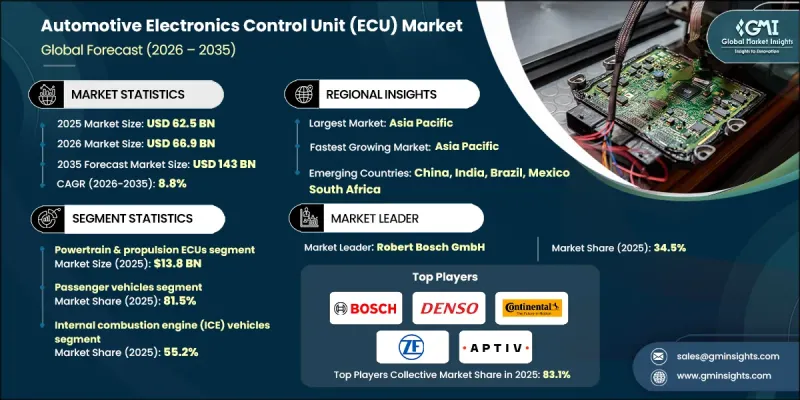
Rising consumer demand for connected, intelligent vehicles is driving the adoption of advanced infotainment and digital services in modern automobiles. Vehicles now integrate sophisticated systems that provide navigation, multimedia, internet connectivity, and seamless smartphone integration. Real-time traffic updates, streaming capabilities, and hands-free communication are becoming standard expectations for drivers. Additionally, vehicle-to-everything (V2X) communication supported by ECUs enhances safety by offering collision warnings and live traffic signal information. Automakers are investing heavily in these technologies to deliver smart, connected vehicles that combine convenience, entertainment, and safety. Regulatory mandates aimed at improving fuel efficiency, reducing emissions, and enhancing road safety, such as Euro 6 and Corporate Average Fuel Economy standards, are further accelerating R&D efforts toward eco-friendly and technologically advanced vehicle systems.
| Market Scope | |
|---|---|
| Start Year | 2025 |
| Forecast Year | 2026-2035 |
| Start Value | $62.5 Billion |
| Forecast Value | $143 Billion |
| CAGR | 8.8% |
The powertrain and propulsion ECU segment was valued at USD 13.8 billion in 2025 and is expected to grow at a CAGR of 10.2% from 2026 to 2035. These ECUs optimize fuel efficiency, enhance vehicle performance, and manage emissions. In electrified vehicles, they coordinate conventional engines with electric motors for seamless power delivery and energy recovery. Centralized ECU architectures are gaining momentum, combining multiple domains to reduce wiring complexity while supporting advanced vehicle functionalities.
The passenger vehicle segment held a share of 81.5% in 2025, driven by increasing integration of connected services, advanced infotainment, and safety systems. Luxury and mid-size vehicles are increasingly equipped with premium ECUs supporting advanced driver-assistance systems, electrification, and software-driven features, delivering superior intelligent driving experience.
North America Automotive Electronics Control Unit Market accounted for 27.7% share in 2025. Growth in the region is fueled by early adoption of advanced automotive electronics, high EV penetration, and the shift toward software-defined vehicle architectures. Manufacturers are moving from distributed ECU systems to domain-based and centralized computing architectures to enhance ADAS, connectivity, and electrified powertrain capabilities. Strong R&D investment, stringent safety regulations, and rising demand for connected services across passenger and commercial vehicles are driving ECU adoption.
Prominent players operating in the Global Automotive Electronics Control Unit Market include Aptiv PLC, Autoliv Inc., Continental AG, Denso Corporation, Hella GmbH & Co. KGaA, Hitachi Astemo, Ltd., Hyundai Mobis Co., Ltd., Lear Corporation, Magneti Marelli (a CK Holdings Company), Mitsubishi Electric Corporation, Panasonic Holdings Corporation, Robert Bosch GmbH, United Automotive Electronic Systems (UAES), Valeo SA, and ZF Friedrichshafen AG. Key strategies adopted by companies in the Global Automotive Electronics Control Unit Market include accelerating innovation in centralized and domain-based architectures to simplify vehicle electronics and enhance performance. Manufacturers are focusing on developing high-precision, software-defined ECUs that support advanced driver-assistance systems, infotainment, and electrified powertrains. Strategic partnerships with automakers, software providers, and semiconductor companies allow companies to integrate advanced features while meeting regulatory compliance. Expanding regional presence, particularly in high-growth EV markets, and investing in localized R&D centers enables rapid customization and faster time-to-market.
Table of Contents
Chapter 1 Methodology and Scope
- 1.1 Market scope and definition
- 1.2 Research design
- 1.2.1 Research approach
- 1.2.2 Data collection methods
- 1.3 Data mining sources
- 1.3.1 Global
- 1.3.2 Regional/Country
- 1.4 Base estimates and calculations
- 1.4.1 Base year calculation
- 1.4.2 Key trends for market estimation
- 1.5 Primary research and validation
- 1.5.1 Primary sources
- 1.6 Forecast model
- 1.7 Research assumptions and limitations
Chapter 2 Executive Summary
- 2.1 Industry 360° synopsis, 2021 - 2034
- 2.2 Key market trends
- 2.2.1 ECU type trends
- 2.2.2 Vehicle type trends
- 2.2.3 Propulsion type trends
- 2.2.4 E/E Architecture type trends
- 2.2.5 Regional trends
- 2.3 TAM analysis, 2026-2035
- 2.4 CXO perspectives: Strategic imperatives
- 2.4.1 Executive decision points
- 2.4.2 Critical success factors
- 2.5 Future outlook and strategic recommendations
Chapter 3 Industry Insights
- 3.1 Industry ecosystem analysis
- 3.1.1 Supplier landscape
- 3.1.2 Profit margin analysis
- 3.1.3 Cost structure
- 3.1.4 Value addition at each stage
- 3.1.5 Factor affecting the value chain
- 3.1.6 Disruptions
- 3.2 Industry impact forces
- 3.2.1 Growth drivers
- 3.2.1.1 Growing connectivity and infotainment features
- 3.2.1.2 Rising demand for electric vehicles (EVs)
- 3.2.1.3 Increasing complexity of vehicle systems
- 3.2.1.4 Demand for enhanced safety features
- 3.2.1.5 Advancements in autonomous driving
- 3.2.2 Industry pitfalls and challenges
- 3.2.2.1 Stringent regulatory standards
- 3.2.2.2 Supply chain disruptions
- 3.2.3 Market opportunities
- 3.2.3.1 Transition from distributed ECUs to domain and centralized architectures
- 3.2.3.2 Integration of ai and sensor fusion in vehicle control systems
- 3.2.1 Growth drivers
- 3.3 Regulatory landscape
- 3.3.1 North America
- 3.3.2 Europe
- 3.3.3 Asia Pacific
- 3.3.4 Latin America
- 3.3.5 Middle East & Africa
- 3.4 Porter’s analysis
- 3.5 PESTEL analysis
- 3.6 Technology and innovation landscape
- 3.6.1 Current technological trends
- 3.6.2 Emerging technologies
- 3.7 Emerging business models
- 3.8 Compliance requirements
- 3.9 Patent and IP analysis
- 3.10 Geopolitical and trade dynamics
Chapter 4 Competitive Landscape, 2024
- 4.1 Introduction
- 4.2 Company market share analysis
- 4.2.1 By region
- 4.2.1.1 North America
- 4.2.1.2 Europe
- 4.2.1.3 Asia Pacific
- 4.2.1.4 Latin America
- 4.2.1.5 Middle East & Africa
- 4.2.1 By region
- 4.3 Competitive benchmarking of key players
- 4.3.1 Financial performance comparison
- 4.3.1.1 Revenue
- 4.3.1.2 Profit margin
- 4.3.1.3 R&D
- 4.3.2 Product portfolio comparison
- 4.3.2.1 Product range breadth
- 4.3.2.2 Technology
- 4.3.2.3 Innovation
- 4.3.3 Geographic presence comparison
- 4.3.3.1 Global footprint analysis
- 4.3.3.2 Service network coverage
- 4.3.3.3 Market penetration by region
- 4.3.4 Competitive positioning matrix
- 4.3.4.1 Leaders
- 4.3.4.2 Challengers
- 4.3.4.3 Followers
- 4.3.4.4 Niche players
- 4.3.5 Strategic outlook matrix
- 4.3.1 Financial performance comparison
- 4.4 Key developments, 2021-2024
- 4.4.1 Mergers and acquisitions
- 4.4.2 Partnerships and collaborations
- 4.4.3 Technological advancements
- 4.4.4 Expansion and investment strategies
- 4.4.5 Digital transformation initiatives
- 4.5 Emerging/ startup competitors landscape
Chapter 5 Market Estimates and Forecast, By ECU Type, 2022 - 2035 ($ Bn)
- 5.1 Key trends
- 5.2 Powertrain & propulsion ECUs
- 5.2.1 Engine control units (ECU/ECM)
- 5.2.2 Transmission control units (TCU)
- 5.2.3 Hybrid control units (HCU)
- 5.3 Electrification ECUs
- 5.3.1 Battery management systems (BMS)
- 5.3.2 Inverter control units
- 5.3.3 Charging control units (onboard charger ECU)
- 5.3.4 Power control units (PCU)
- 5.4 Safety & ADAS ECUs
- 5.4.1 Foundation safety ECUs (ABS, ESC, airbag)
- 5.4.2 Adas domain controllers (level 2-3)
- 5.4.3 Automated parking ECUs
- 5.4.4 High-automation ECUs (level 4+)
- 5.5 Body control ECUs
- 5.5.1 Body control modules (BCM)
- 5.5.2 Lighting control units
- 5.5.3 HVAC control units
- 5.6 Infotainment & connectivity ECUs
- 5.6.1 Infotainment control units (head units)
- 5.6.2 Telematics control units (TCU)
- 5.6.3 Gateway ECUs
- 5.7 Chassis & dynamics ECUs
- 5.7.1 Steering control units
- 5.7.2 Suspension control units
- 5.8 Advanced architecture ECUs
- 5.8.1 Domain controllers
- 5.8.2 Zone controllers
- 5.8.3 Central vehicle controllers (CVC)
Chapter 6 Market Estimates and Forecast, By Vehicle Type, 2022 - 2035 ($ Bn)
- 6.1 Key trends
- 6.2 Passenger vehicles
- 6.3 Commercial vehicles
- 6.4 Off-highway vehicles
Chapter 7 Market Estimates and Forecast, By Protection Type, 2022 - 2035 ($ Bn)
- 7.1 Key trends
- 7.2 Internal combustion engine (ICE) vehicles
- 7.3 Hybrid electric vehicles (HEV) / plug-in hybrid electric vehicles (PHEV)
- 7.4 Battery electric vehicles (BEV)
Chapter 8 Market Estimates and Forecast, By End-User, 2022 - 2035 ($ Bn)
- 8.1 Key trends
- 8.2 Distributed ECU architecture
- 8.3 Domain controller architecture
- 8.4 Zonal architecture
- 8.5 Centralized / software-defined vehicle (SDV) architecture
Chapter 9 Market Estimates and Forecast, By Region, 2022 - 2035 ($ Bn)
- 9.1 Key trends
- 9.2 North America
- 9.2.1 U.S.
- 9.2.2 Canada
- 9.3 Europe
- 9.3.1 Germany
- 9.3.2 UK
- 9.3.3 France
- 9.3.4 Spain
- 9.3.5 Italy
- 9.3.6 Netherlands
- 9.4 Asia Pacific
- 9.4.1 China
- 9.4.2 India
- 9.4.3 Japan
- 9.4.4 Australia
- 9.4.5 South Korea
- 9.5 Latin America
- 9.5.1 Brazil
- 9.5.2 Mexico
- 9.5.3 Argentina
- 9.6 Middle East and Africa
- 9.6.1 South Africa
- 9.6.2 Saudi Arabia
- 9.6.3 UAE
Chapter 10 Company Profiles
- 10.1 Global Key Players
- 10.1.1 Robert Bosch GmbH
- 10.1.2 Denso Corporation
- 10.1.3 Continental AG
- 10.1.4 ZF Friedrichshafen AG
- 10.2 Regional Key Players
- 10.2.1 North America
- 10.2.1.1 Aptiv PLC
- 10.2.1.2 Autoliv Inc.
- 10.2.1.3 Lear Corporation
- 10.2.2 Europe
- 10.2.2.1 Valeo SA
- 10.2.2.2 Hella GmbH & Co. KGaA
- 10.2.2.3 Magneti Marelli (a CK Holdings Company)
- 10.2.3 APAC
- 10.2.3.1 Hitachi Astemo, Ltd.
- 10.2.3.2 Hyundai Mobis Co., Ltd.
- 10.2.3.3 Mitsubishi Electric Corporation
- 10.2.1 North America
- 10.3 Niche Players / Disruptors
- 10.3.1 Panasonic Holdings Corporation
- 10.3.2 United Automotive Electronic Systems (UAES)