|
시장보고서
상품코드
1982273
척추 성장 로드 시장 : 기회, 성장 요인, 업계 동향 분석 및 예측(2026-2035년)Spine Growing Rods Market Opportunity, Growth Drivers, Industry Trend Analysis, and Forecast 2026 - 2035 |
||||||

세계의 척추 성장 로드 시장은 2025년에 4,170만 달러로 평가되었고, CAGR은 8.8%를 나타낼 것으로 보이며, 2035년까지 9,760만 달러에 도달할 것으로 추정됩니다.
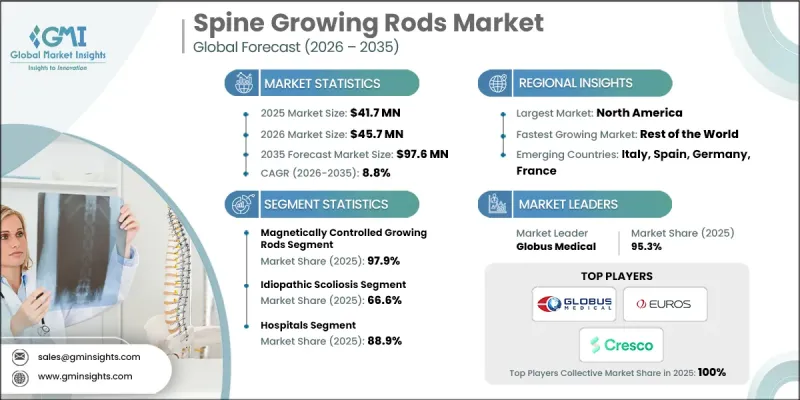
세계의 척추 성장 로드 산업의 성장은 조기 발병 척추측만증(EOS)의 진단 증가와 성장 보존형 척추 교정 시술에 대한 임상적 선호도 상승에 힘입고 있습니다. 척추 성장 로드는 소아 환자의 복잡한 척추 변형을 관리하기 위해 고안된 이식형 시스템으로, 척추의 지속적인 발달을 유지하면서 점차적으로 곡률을 교정할 수 있게 해줍니다. 10세 미만 아동의 조기 발병 척추측만증(EOS) 발생률 증가는 이 질환이 성장의 중요한 시기에 급속히 진행되는 경향이 있어 시장 확대에 크게 기여하고 있습니다. 의료 서비스 제공자들은 흉곽 및 골격 발달을 제한하지 않으면서 척추 변형을 안정화시키는 솔루션에 점점 더 주목하고 있습니다. 수술 기법의 발전, 치료 접근성 확대, 지원적인 보험 급여 체계, 그리고 임플란트 설계의 지속적인 혁신은 시장 도입을 더욱 가속화하고 있습니다. 인식 제고와 조기 진단 능력 향상으로 인해, 기술적으로 진보되고 신체에 미치는 영향을 최소화하는 척추 임플란트에 대한 수요가 세계의 척추 성장 로드 시장의 전망을 지속적으로 강화하고 있습니다.
| 시장 범위 | |
|---|---|
| 시작 연도 | 2025년 |
| 예측 기간 | 2026-2035년 |
| 시작 시장 규모 | 4,170만 달러 |
| 예측 금액 | 9,760만 달러 |
| CAGR | 8.8% |
특발성 척추측만증은 전체 진단 사례의 약 80-85%를 차지하며, 소아 척추 변형 분야 내 주요 범주로서의 입지를 공고히 하고 있습니다. 구조적 합병증 외에도 특발성 척추측만증은 정서적, 심리적 안녕에 영향을 미쳐 환아들에게 스트레스 관련 문제를 야기할 수 있습니다. 전문 치료에 대한 접근성 확대와 의료 기술의 지속적인 발전은 장기적인 교정 접근법으로서 척추 성장 로드에 대한 수요를 더욱 뒷받침하고 있습니다.
자기 제어 성장 로드 부문은 비침습적 로드 조정이 가능하다는 장점 덕분에 2025년 시장 점유율 97.9%를 차지했습니다. 이 기술은 재수술 빈도를 현저히 줄이고 전반적인 치료 부담을 경감시킵니다. 자기 제어 성장 척추 고정봉은 외부에서 길이를 조절할 수 있는 내부 자기 구동 장치를 통합하여, 지속적인 성장을 수용하면서도 척추 안정성과 지속적인 변형 교정을 지원합니다. 기존 시스템에 비해 갖는 이러한 임상적 이점은 외과 의사 및 의료 기관 사이에서 계속해서 폭넓은 선호도를 이끌어내고 있습니다.
신경근성 척추 측만증 부문은 2025년에 680만 달러 시장 규모를 기록하고 2026년부터 2035년에 걸쳐 CAGR 8.7%를 나타낼 것으로 예측됩니다. 이 부문은 신경근육 질환 환자의 생존율 개선에 힘입어 척추 성장 로드 용도 내에서 핵심적인 치료 영역을 차지하고 있습니다. 해당 환자 집단의 기대 수명이 증가함에 따라 교정적 개입이 필요한 진행성 척추 측만증의 발생률도 함께 상승하고 있어, 첨단 성장 보존 임플란트 시스템에 대한 지속적인 수요가 창출되고 있습니다.
북미의 척추 성장 로드 시장은 59.4%의 점유율을 기록했습니다. 이 지역은 선진적인 의료 인프라, 혁신적인 척추 임플란트 기술의 조기 도입, 소아 변형 관리에 대한 강력한 임상적 중점을 바탕으로 혜택을 누리고 있습니다. 성장 로드 시스템은 흉부 발달 보존과 장기적인 기능적 결과를 주요 치료 목표로 삼는 전문 소아 척추 센터 및 정형외과 시설에서 널리 활용되고 있습니다.
자주 묻는 질문
목차
제1장 연구 방법
- 연구 접근
- 품질에 관한 대처
- GMI AI 정책 및 데이터 무결성에 대한 노력
- 출처 일관성 프로토콜
- GMI AI 정책 및 데이터 무결성에 대한 노력
- 연구의 경위와 신뢰도 평가
- 연구 경로 컴포넌트
- 평가 컴포넌트
- 데이터 수집
- 1차 정보의 일부 리스트
- 데이터 마이닝 출처
- 유료 출처
- 지역별 출처
- 유료 출처
- 기본 추정 및 산출 방법
- 특정 접근 방식에 대한 기준 연도 계산
- 예측 모델
- 정량화된 시장 영향 분석
- 성장 매개변수가 예측에 미치는 수학적 영향
- 정량화된 시장 영향 분석
- 연구의 투명성에 관한 보충
- 출처의 귀속 프레임워크
- 품질 보증 지표
- 신뢰에 대한 노력
제2장 주요 요약
제3장 업계 인사이트
- 생태계 분석
- 업계에 미치는 영향요인
- 성장 촉진요인
- 조기 발병 척추측만증(EOS) 유병률 증가
- 성장 보존 척추 시술에 대한 수요
- 척추 임플란트 설계의 기술적 발전
- 업계의 잠재적 위험 및 과제
- 성장 로드 임플란트 시스템의 높은 비용
- 기계적 고장 및 로드 파손의 위험
- 시장 기회
- 신흥국의 MCGR의 보급 확대
- 성장로드 시스템에 스마트 센서 통합
- 성장 촉진요인
- 성장 가능성 분석
- 규제 상황
- 북미
- 유럽
- 기술 동향
- 현재의 기술 동향
- 신흥 기술
- 장래 시장 동향
- 특허 분석
- 파이프라인 분석
- 환자 인구통계 및 역학
- Porter's Five Forces 분석
- PESTEL 분석
제4장 경쟁 구도
- 소개
- 기업 매트릭스 분석
- 기업의 시장 점유율 분석
- 북미
- 유럽
- 기타 지역
- 경쟁 포지셔닝 매트릭스
- 주요 시장 기업의 경쟁 분석
- 주요 발전
- 합병 및 인수
- 제휴 및 협업
- 신기술 도입
- 사업 확대 계획
제5장 시장 추계 및 예측 : 기술별(2022-2035년)
- 자기 제어 성장 로드
- 기계식 단방향 자가 확장 로드
- 스프링식 자기 확장 시스템
제6장 시장 추계 및 예측 : 적응별(2022-2035년)
- 특발성 측만증
- 신경근성 측만증
- 선천성 척추 측만증
- 증후성 척추 측만증
제7장 시장 추계 및 예측 : 최종 용도별(2022-2035년)
- 병원
- 전문 정형외과 클리닉
- 외래수술센터(ASC)
제8장 시장 추계 및 예측 : 지역별(2022-2035년)
- 북미
- 미국
- 캐나다
- 유럽
- 독일
- 프랑스
- 이탈리아
- 스페인
- 네덜란드
- 스웨덴
- 기타 유럽
- 기타 지역
제9장 기업 프로파일
- Cresco
- EUROS
- Globus Medical
The Global Spine Growing Rods Market was valued at USD 41.7 million in 2025 and is estimated to grow at a CAGR of 8.8% to reach USD 97.6 million by 2035.
Growth across the global spine growing rods industry is propelled by the increasing diagnosis of early-onset scoliosis (EOS) and the growing clinical preference for growth-preserving spinal correction procedures. Spine growing rods are implantable systems designed to manage complex spinal deformities in pediatric patients, allowing for continued spinal development while gradually correcting the curvature. The rising incidence of EOS in children under the age of 10 is significantly contributing to market expansion, as this condition often progresses rapidly during critical growth years. Healthcare providers are increasingly focused on solutions that stabilize spinal deformities without limiting thoracic and skeletal development. Advancements in surgical techniques, broader treatment accessibility, supportive reimbursement frameworks, and continuous innovation in implant design are further accelerating adoption. As awareness grows and early diagnosis improves, demand for technologically advanced and minimally disruptive spinal implants continues to strengthen the outlook for the spine growing rods market worldwide.
| Market Scope | |
|---|---|
| Start Year | 2025 |
| Forecast Year | 2026-2035 |
| Start Value | $41.7 Million |
| Forecast Value | $97.6 Million |
| CAGR | 8.8% |
Idiopathic scoliosis accounts for nearly 80-85% of total diagnosed cases, reinforcing its position as the leading category within pediatric spinal deformities. Beyond structural complications, EOS can also influence emotional and psychological well-being, contributing to stress-related challenges in affected children. Expanding access to specialized care and continuous improvements in medical technology are supporting a stronger demand for spine growing rods as a long-term corrective approach.
The magnetically controlled growing rods segment held 97.9% share in 2025, owing to their ability to enable non-invasive rod adjustments. This technology significantly reduces the frequency of repeat surgical interventions and lowers the overall treatment burden. Magnetically controlled growing rods integrate an internal magnetic actuator that permits external lengthening, supporting spinal stability and sustained deformity correction while accommodating ongoing growth. Their clinical advantages over conventional systems continue to drive widespread preference among surgeons and healthcare institutions.
The neuromuscular scoliosis segment generated USD 6.8 million in 2025 and is anticipated to grow at a CAGR of 8.7% during 2026-2035. This segment represents a critical therapeutic area within spine growing rod applications, supported by improving survival outcomes among patients with neuromuscular disorders. As life expectancy increases within these patient populations, the incidence of progressive spinal curvature requiring corrective intervention is also rising, creating sustained demand for advanced growth-preserving implant systems.
North America Spine Growing Rods Market held a 59.4% share in 2025. The region benefits from advanced healthcare infrastructure, early integration of innovative spinal implant technologies, and strong clinical emphasis on pediatric deformity management. Growing rod systems are widely utilized across specialized pediatric spine centers and orthopedic facilities, where preserving thoracic development and long-term functional outcomes remain a primary treatment objective.
Key companies operating in the Global Spine Growing Rods Market include Globus Medical, EUROS, and Cresco. Companies in the Spine Growing Rods Market are reinforcing their market position through continuous product innovation and strategic expansion initiatives. Manufacturers are prioritizing research and development to enhance implant durability, improve magnetic control mechanisms, and optimize patient outcomes. Strategic collaborations with hospitals and specialty clinics are helping firms strengthen clinical adoption and brand recognition. Businesses are also expanding geographic reach through distribution partnerships and regulatory approvals in high-growth regions. Investment in surgeon training programs and post-market clinical studies is further supporting credibility and long-term demand. Additionally, companies are focusing on improving manufacturing efficiency and supply chain resilience to ensure consistent product availability while maintaining competitive pricing strategies in the global spine growing rods market.
Table of Contents
Chapter 1 Research Methodology
- 1.1 Research approach
- 1.2 Quality commitments
- 1.2.1 GMI AI policy & data integrity commitment
- 1.2.1.1 Source consistency protocol
- 1.2.1 GMI AI policy & data integrity commitment
- 1.3 Research trail & confidence scoring
- 1.3.1 Research trail components
- 1.3.2 Scoring components
- 1.4 Data collection
- 1.4.1 Partial list of primary sources
- 1.5 Data mining sources
- 1.5.1 Paid sources
- 1.5.1.1 Sources, by region
- 1.5.1 Paid sources
- 1.6 Base estimates and calculations
- 1.6.1 Base year calculation for any one approach
- 1.7 Forecast model
- 1.7.1 Quantified market impact analysis
- 1.7.1.1 Mathematical impact of growth parameters on forecast
- 1.7.1 Quantified market impact analysis
- 1.8 Research transparency addendum
- 1.8.1 Source attribution framework
- 1.8.2 Quality assurance metrics
- 1.8.3 Our commitment to trust
Chapter 2 Executive Summary
- 2.1 Industry 3600 synopsis
- 2.2 Key market trends
- 2.2.1 Regional trends
- 2.2.2 Technology trends
- 2.2.3 Indication trends
- 2.2.4 End use trends
- 2.3 CXO perspectives: Strategic imperatives
Chapter 3 Industry Insights
- 3.1 Industry ecosystem analysis
- 3.2 Industry impact forces
- 3.2.1 Growth drivers
- 3.2.1.1 Rising prevalence of early-onset scoliosis (EOS)
- 3.2.1.2 Demand for growth-preserving spinal interventions
- 3.2.1.3 Technological advancements in spinal implant design
- 3.2.2 Industry pitfalls and challenges
- 3.2.2.1 High cost of growing rod implant systems
- 3.2.2.2 Risk of mechanical failure and rod breakage
- 3.2.3 Market opportunities
- 3.2.3.1 Expansion of MCGR adoption in emerging economies
- 3.2.3.2 Integration of smart sensors in growing rod systems
- 3.2.1 Growth drivers
- 3.3 Growth potential analysis
- 3.4 Regulatory landscape
- 3.4.1 North America
- 3.4.2 Europe
- 3.5 Technology landscape
- 3.5.1 Current technological trends
- 3.5.2 Emerging technologies
- 3.6 Future market trends
- 3.7 Patent analysis
- 3.8 Pipeline analysis
- 3.9 Patient demographics and epidemiology
- 3.10 Porter's analysis
- 3.11 PESTEL analysis
Chapter 4 Competitive Landscape, 2025
- 4.1 Introduction
- 4.2 Company matrix analysis
- 4.3 Company market share analysis
- 4.3.1 North America
- 4.3.2 Europe
- 4.3.3 RoW
- 4.4 Competitive positioning matrix
- 4.5 Competitive analysis of major market players
- 4.6 Key developments
- 4.6.1 Mergers & acquisitions
- 4.6.2 Partnerships & collaborations
- 4.6.3 New technology launches
- 4.6.4 Expansion plans
Chapter 5 Market Estimates and Forecast, By Technology, 2022 - 2035 ($ Mn)
- 5.1 Key trends
- 5.2 Magnetically controlled growing rods
- 5.3 Mechanical one way self expanding rods
- 5.4 Spring-based self expanding systems
Chapter 6 Market Estimates and Forecast, By Indication, 2022 - 2035 ($ Mn)
- 6.1 Key trends
- 6.2 Idiopathic Scoliosis
- 6.3 Neuromuscular scoliosis
- 6.4 Congenital scoliosis
- 6.5 Syndromic scoliosis
Chapter 7 Market Estimates and Forecast, By End Use, 2022 - 2035 ($ Mn)
- 7.1 Key trends
- 7.2 Hospitals
- 7.3 Specialty orthopedic clinics
- 7.4 Ambulatory surgical centers (ASCs)
Chapter 8 Market Estimates and Forecast, By Region, 2022 - 2035 ($ Mn)
- 8.1 Key trends
- 8.2 North America
- 8.2.1 U.S.
- 8.2.2 Canada
- 8.3 Europe
- 8.3.1 Germany
- 8.3.2 France
- 8.3.3 Italy
- 8.3.4 Spain
- 8.3.5 Netherlands
- 8.3.6 Sweden
- 8.3.7 Rest of Europe
- 8.4 RoW
Chapter 9 Company Profiles
- 9.1 Cresco
- 9.2 EUROS
- 9.3 Globus Medical