

|
시장보고서
상품코드
1982326
피크 쉐이빙 발전기 시장의 기회, 성장 요인, 업계 동향 분석 및 예측(2026-2035년)Peak Shaving Generator Sets Market Opportunity, Growth Drivers, Industry Trend Analysis, and Forecast 2026 - 2035 |
||||||

세계의 피크 쉐이빙 발전기 시장은 2025년에 89억 달러로 평가되었고, CAGR 8.2%에서 성장하고, 2035년까지 196억 달러에 도달할 것으로 추정됩니다.
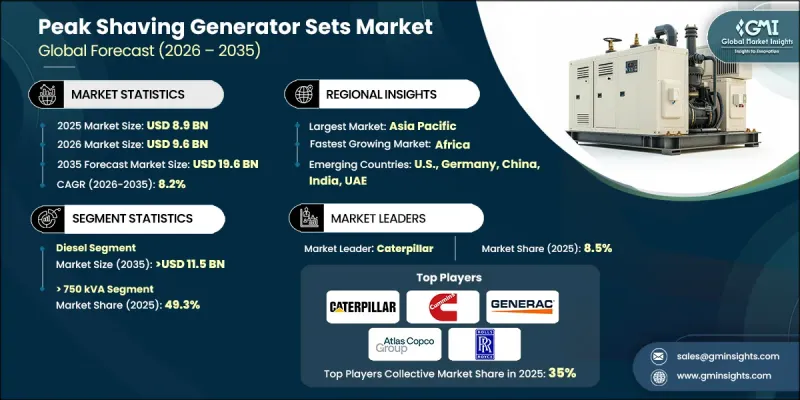
세계의 피크 쉐이빙 발전기 시장의 성장은 첨단 에너지 관리 솔루션에 대한 수요 증가에 힘입고 있으며, 특히 하루 중 전력 소비량이 크게 변동하는 상업 및 산업 분야에서 이러한 추세가 두드러집니다. 기업들은 안정적인 전력 공급을 유지하면서 운영 비용을 절감하는 데 점점 더 주력하고 있습니다. 동시에 건설 활동의 확대와 기업의 지속 가능성 약속 강화가 시장 확산에 기여하고 있습니다. 피크 쉐이빙 발전기는 수요가 급증하는 시간대에 현장에서 전력을 생산할 수 있게 하여, 전력망에 대한 의존도를 낮추고 수요에 따른 전기 요금을 절감해 줍니다. 이러한 시스템은 전력 소비가 급증할 때 자동으로 가동되어 에너지 부하를 안정화하고 비용 예측 가능성을 높여줍니다. 재정적 이점 외에도, 이 시스템은 전력 안정성을 강화하고 수요가 급증하는 시기에 지역 전력망에 가해지는 부담을 줄여줍니다. 전기 요금 상승, 수요 측 관리에 대한 강조 강화, 그리고 더 깨끗하고 스마트한 에너지 시스템으로의 세계적인 전환은 다양한 최종 사용 부문 전반에 걸쳐 장기적인 시장 성장세를 더욱 공고히 하고 있습니다.
| 시장 범위 | |
|---|---|
| 시작 연도 | 2025년 |
| 예측 기간 | 2026-2035년 |
| 시작 시장 규모 | 89억 달러 |
| 예측 금액 | 196억 달러 |
| CAGR | 8.2% |
디젤식 피크 쉐이빙 발전기 시장은 2035년까지 115억 달러에 이를 것으로 예측됩니다. 디젤 발전기는 신뢰성과 전력망 장애 시 즉각적인 백업 기능을 제공할 수 있다는 점 때문에 여전히 널리 활용되고 있습니다. 디젤과 재생 에너지를 결합한 하이브리드 발전기 구성의 채택이 증가함에 따라 연료 효율이 개선되고 탄소 배출량이 감소하고 있습니다. 또한, 디지털 모니터링 시스템과 IoT 기반 제어 장치의 통합으로 더 스마트한 성능 추적, 원격 진단 및 예측 유지보수가 가능해져 새로운 성장 기회를 창출하고 있습니다.
정격 출력 750kVA 초과 정격 발전기 세트 부문은 49.3%의 시장 점유율을 차지했다. 이러한 대용량 시스템은 상당한 피크 부하를 관리하는 데 필수적이며, 대규모 시설이 최대 수요 요금을 절감하고 운영 연속성을 유지할 수 있도록 지원합니다. 에너지 효율 및 배출 감축에 대한 규제 당국의 관심이 높아짐에 따라, 더 높은 용량과 최적화된 성능을 갖춘 솔루션의 도입이 더욱 촉진되고 있습니다.
미국의 피크 쉐이빙 발전기 시장은 2025년에 21억 달러에 달했습니다. 연비 개선 및 배출량 감축에 초점을 맞춘 지속적인 기술 혁신이 산업 확장을 뒷받침하고 있습니다. 분산형 에너지 자원의 광범위한 도입과 에너지 저장 통합을 장려하는 지원적인 규제 체계가 다양한 용도에서의 채택을 가속화하고 있습니다. 증가하는 국가 에너지 수요, 상승하는 전기 요금, 그리고 강화된 전력망 신뢰성 요구 사항이 향후 성장에 영향을 미칠 것으로 예상됩니다.
자주 묻는 질문
목차
제1장 조사 방법과 범위
제2장 주요 요약
제3장 업계 인사이트
- 생태계 분석
- 원재료 가용성 및 조달 분석
- 생산 능력 평가
- 공급망의 탄력성과 위험요인
- 유통 네트워크 분석
- 업계에 미치는 영향요인
- 성장 촉진요인
- 업계의 잠재적 위험 및 과제
- 규제 상황
- 성장 가능성 분석
- 가격 동향 분석(달러/대)
- 지역별
- 정격 출력별
- Porter's Five Forces 분석
- 공급기업의 협상력
- 구매자의 협상력
- 신규 참가업체의 위협
- 대체품의 위협
- PESTEL 분석
- 피크 쉐이빙 발전기 비용 구조 분석
- 새로운 기회와 동향
- 디지털화와 IoT의 통합
- 미개척 시장 및 용도의 성장
- 투자분석과 전망
제4장 경쟁 구도
- 소개
- 기업의 시장 점유율 분석 : 지역별
- 북미
- 유럽
- 아시아태평양
- 중동
- 아프리카
- 라틴아메리카
- 경쟁 포지셔닝 매트릭스
- 주요 발전
- 합병 및 인수
- 제휴 및 협업
- 신제품 발매
- 사업 확대 계획과 자금 조달
제5장 시장 규모 및 예측 : 출력별(2022-2035년)
- 75kVA 이하
- 75-375kVA
- >375-750kVA
- >750kVA
제6장 시장 규모 및 예측 : 최종 용도별(2022-2035년)
- 상업용
- 산업용
제7장 시장 규모 및 예측 : 연료별(2022-2035년)
- 디젤
- 가스
- 기타
제8장 시장 규모 및 예측 : 지역별(2022-2035년)
- 북미
- 미국
- 캐나다
- 유럽
- 러시아
- 영국
- 독일
- 프랑스
- 스페인
- 오스트리아
- 이탈리아
- 아시아태평양
- 중국
- 호주
- 인도
- 일본
- 한국
- 인도네시아
- 말레이시아
- 태국
- 베트남
- 필리핀
- 중동
- 사우디아라비아
- 아랍에미리트(UAE)
- 카타르
- 튀르키예
- 이란
- 오만
- 아프리카
- 이집트
- 나이지리아
- 알제리
- 남아프리카
- 앙골라
- 라틴아메리카
- 브라질
- 멕시코
- 아르헨티나
- 칠레
제9장 기업 프로파일
- AKSA POWER GENERATION
- Ashok Leyland
- Atlas Copco Group
- Briggs & Stratton
- Caterpillar
- Cummins
- Deere &Company
- Generac Power Systems
- Greaves Cotton
- Himoinsa
- Honda Motor Co.
- Kirloskar
- Kohler
- Mahindra Powerol
- Mitsubishi Turbocharger and Engine Europe
- Perkins Engines Company
- Rolls-Royce
- Sterling Generators
- Supernova Genset
- Wartsila
The Global Peak Shaving Generator Sets Market was valued at USD 8.9 billion in 2025 and is estimated to grow at a CAGR of 8.2% to reach USD 19.6 billion by 2035.
Growth in the global peak shaving generator sets market is being fueled by the rising need for advanced energy management solutions, particularly in commercial and industrial environments where electricity consumption varies significantly throughout the day. Businesses are increasingly focused on controlling operational expenses while maintaining reliable power availability. At the same time, expanding construction activities and stronger corporate sustainability commitments are contributing to broader adoption. Peak shaving generator sets enable organizations to generate electricity on-site during high-demand intervals, reducing dependence on grid power and lowering demand-related utility charges. These systems automatically activate when consumption spikes, helping stabilize energy loads and improve cost predictability. In addition to financial benefits, they enhance power security and reduce strain on regional grids during critical demand periods. Rising electricity prices, heightened emphasis on demand-side management, and the global shift toward cleaner and smarter energy systems are further reinforcing long-term market momentum across multiple end-use sectors.
| Market Scope | |
|---|---|
| Start Year | 2025 |
| Forecast Year | 2026-2035 |
| Start Value | $8.9 Billion |
| Forecast Value | $19.6 Billion |
| CAGR | 8.2% |
The diesel peak shaving generator sets segment is expected to reach USD 11.5 billion by 2035. Diesel-powered units remain widely utilized due to their reliability and ability to provide immediate backup during grid disruptions. Increasing adoption of hybrid generator configurations that combine diesel with renewable energy inputs is improving fuel efficiency and lowering carbon emissions. Furthermore, integration of digital monitoring systems and IoT-enabled controls is enabling smarter performance tracking, remote diagnostics, and predictive maintenance, creating new growth opportunities.
The generator sets rated above 750 kVA segment accounted for 49.3% share in 2025. These high-capacity systems are essential for managing substantial peak loads, allowing large facilities to reduce maximum demand charges and maintain operational continuity. Growing regulatory focus on energy efficiency and emission reduction is further supporting the adoption of higher-capacity, performance-optimized solutions.
United States Peak Shaving Generator Sets Market reached USD 2.1 billion in 2025. Industry expansion is being supported by continued technological innovation focused on improved fuel efficiency and reduced emissions. Broader deployment of distributed energy resources, along with supportive regulatory frameworks encouraging energy storage integration, is accelerating adoption across diverse applications. Rising national energy demand, increasing electricity costs, and stronger grid reliability requirements are expected to influence future growth.
Key companies operating in the Global Peak Shaving Generator Sets Market include Cummins, Caterpillar, Generac Power Systems, Rolls-Royce, Wartsila, Atlas Copco Group, Honda Motor Co., Briggs & Stratton, Kohler, Perkins Engines Company, Mitsubishi Turbocharger and Engine Europe, AKSA POWER GENERATION, Ashok Leyland, Kirloskar, Mahindra Powerol, Greaves Cotton, HIMOINSA, Deere & Company, Sterling Generators, and Supernova Genset. Companies in the Peak Shaving Generator Sets Market are strengthening their competitive position through innovation, strategic partnerships, and portfolio diversification. Manufacturers are investing in advanced engine technologies, hybrid configurations, and digital control systems to enhance fuel efficiency and reduce emissions. Strategic collaborations with energy service providers and infrastructure developers are expanding project pipelines and long-term service contracts. Many players are integrating IoT-based monitoring platforms to deliver predictive maintenance and remote management capabilities, increasing customer value. Geographic expansion into high-growth industrial regions and customization of generator capacities to meet specific load requirements are also key focus areas.
Table of Contents
Chapter 1 Methodology & Scope
- 1.1 Research approach
- 1.2 Quality commitments
- 1.2.1 GMI AI policy & data integrity commitment
- 1.2.1.1 Source consistency protocol
- 1.2.1 GMI AI policy & data integrity commitment
- 1.3 Research trail & confidence scoring
- 1.3.1 Research trail components
- 1.3.2 Scoring components
- 1.4 Data collection
- 1.4.1 Partial list of primary sources
- 1.5 Data mining sources
- 1.5.1 Paid sources
- 1.5.1.1 Sources, by region
- 1.5.1 Paid sources
- 1.6 Base estimates and calculations
- 1.6.1 Base year calculation for any one approach
- 1.7 Market estimates & forecasts parameters
- 1.8 Forecast model
- 1.8.1 Quantified market impact analysis
- 1.8.1.1 Mathematical impact of growth parameters on forecast
- 1.8.1 Quantified market impact analysis
- 1.9 Research transparency addendum
- 1.9.1 Source attribution framework
- 1.9.2 Quality assurance metrics
- 1.9.3 Our commitment to trust
- 1.10 Market definitions
Chapter 2 Executive Summary
- 2.1 Industry synopsis, 2022 - 2035
- 2.1.1 Business trends
- 2.1.2 Power rating trends
- 2.1.3 End use trends
- 2.1.4 Fuel trends
- 2.1.5 Regional trends
Chapter 3 Industry Insights
- 3.1 Industry ecosystem analysis
- 3.1.1 Raw material availability & sourcing analysis
- 3.1.2 Manufacturing capacity assessment
- 3.1.3 Supply chain resilience & risk factors
- 3.1.4 Distribution network analysis
- 3.2 Industry impact forces
- 3.2.1 Growth drivers
- 3.2.2 Industry pitfalls & challenges
- 3.3 Regulatory landscape
- 3.4 Growth potential analysis
- 3.5 Price trend analysis (USD/Unit)
- 3.5.1 By region
- 3.5.2 By power rating
- 3.6 Porter's analysis
- 3.6.1 Bargaining power of suppliers
- 3.6.2 Bargaining power of buyers
- 3.6.3 Threat of new entrants
- 3.6.4 Threat of substitutes
- 3.7 PESTEL analysis
- 3.7.1 Political factors
- 3.7.2 Economic factors
- 3.7.3 Social factors
- 3.7.4 Technological factors
- 3.7.5 Legal factors
- 3.7.6 Environmental factors
- 3.8 Cost structure analysis of peak shaving generator sets
- 3.9 Emerging opportunities & trends
- 3.9.1 Digitalization & IoT integration
- 3.9.2 Growth in untapped markets & applications
- 3.10 Investment analysis & future prospects
Chapter 4 Competitive Landscape, 2026
- 4.1 Introduction
- 4.2 Company market share analysis, by region, 2025
- 4.2.1 North America
- 4.2.2 Europe
- 4.2.3 Asia Pacific
- 4.2.4 Middle East
- 4.2.5 Africa
- 4.2.6 Latin America
- 4.3 Competitive positioning matrix
- 4.4 Key developments
- 4.4.1 Mergers & acquisitions
- 4.4.2 Partnerships & collaborations
- 4.4.3 New product launches
- 4.4.4 Expansion plans & funding
Chapter 5 Market Size and Forecast, By Power Rating, 2022 - 2035 (USD Million & '000 Units)
- 5.1 Key trends
- 5.2 ≤ 75 kVA
- 5.3 > 75 kVA - 375 kVA
- 5.4 > 375 KVA - 750 kVA
- 5.5 > 750 kVA
Chapter 6 Market Size and Forecast, By End Use, 2022 - 2035 (USD Million & '000 Units)
- 6.1 Key trends
- 6.2 Commercial
- 6.3 Industrial
Chapter 7 Market Size and Forecast, By Fuel, 2022 - 2035 (USD Million & '000 Units)
- 7.1 Key trends
- 7.2 Diesel
- 7.3 Gas
- 7.4 Others
Chapter 8 Market Size and Forecast, By Region, 2022 - 2035 (USD Million & '000 Units)
- 8.1 Key trends
- 8.2 North America
- 8.2.1 U.S.
- 8.2.2 Canada
- 8.3 Europe
- 8.3.1 Russia
- 8.3.2 UK
- 8.3.3 Germany
- 8.3.4 France
- 8.3.5 Spain
- 8.3.6 Austria
- 8.3.7 Italy
- 8.4 Asia Pacific
- 8.4.1 China
- 8.4.2 Australia
- 8.4.3 India
- 8.4.4 Japan
- 8.4.5 South Korea
- 8.4.6 Indonesia
- 8.4.7 Malaysia
- 8.4.8 Thailand
- 8.4.9 Vietnam
- 8.4.10 Philippines
- 8.5 Middle East
- 8.5.1 Saudi Arabia
- 8.5.2 UAE
- 8.5.3 Qatar
- 8.5.4 Turkey
- 8.5.5 Iran
- 8.5.6 Oman
- 8.6 Africa
- 8.6.1 Egypt
- 8.6.2 Nigeria
- 8.6.3 Algeria
- 8.6.4 South Africa
- 8.6.5 Angola
- 8.7 Latin America
- 8.7.1 Brazil
- 8.7.2 Mexico
- 8.7.3 Argentina
- 8.7.4 Chile
Chapter 9 Company Profiles
- 9.1 AKSA POWER GENERATION
- 9.2 Ashok Leyland
- 9.3 Atlas Copco Group
- 9.4 Briggs & Stratton
- 9.5 Caterpillar
- 9.6 Cummins
- 9.7 Deere & Company
- 9.8 Generac Power Systems
- 9.9 Greaves Cotton
- 9.10 Himoinsa
- 9.11 Honda Motor Co.
- 9.12 Kirloskar
- 9.13 Kohler
- 9.14 Mahindra Powerol
- 9.15 Mitsubishi Turbocharger and Engine Europe
- 9.16 Perkins Engines Company
- 9.17 Rolls-Royce
- 9.18 Sterling Generators
- 9.19 Supernova Genset
- 9.20 Wartsila


