|
시장보고서
상품코드
1982348
오토바이 액세서리 시장 기회, 성장 요인, 산업 동향 분석 및 예측(2026-2035년)Motorcycle Accessories Market Opportunity, Growth Drivers, Industry Trend Analysis, and Forecast 2026 - 2035 |
||||||

세계의 오토바이 액세서리 시장은 2025년 182억 달러로 평가되었으며, 2035년까지 연평균 복합 성장률(CAGR) 6.95%로 성장하여 353억 달러에 이를 것으로 추정됩니다.
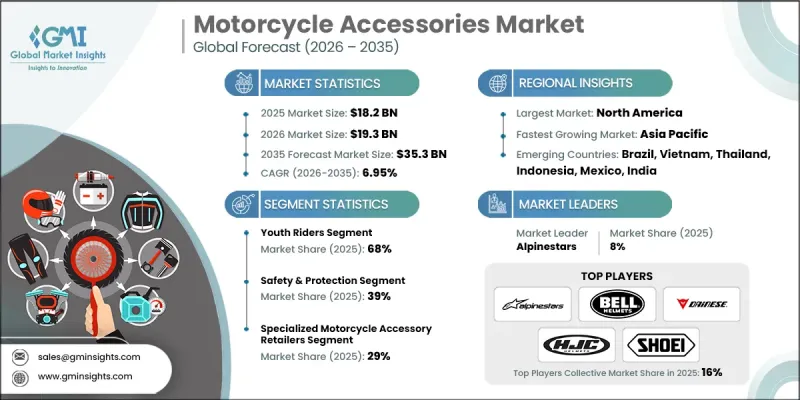
오토바이 액세서리는 다양한 오토바이 카테고리에서 라이더 안전, 차량 성능, 편안함 및 외관의 매력을 크게 향상시킵니다. 이 제품은 주행 품질, 장비 내구성, 사용자 정의 옵션 및 최신 기술의 통합에 직접적인 영향을 미칩니다. 제조업체 각사는 변화하는 라이더의 기대에 부응하기 위해 고성능 안전 장비, 커넥티드 일렉트로닉스, 프리미엄 커스터마이즈 제품에 중점을 두고 있습니다. 소비자의 선호도가 진화함에 따라 각 브랜드는 보호 성능과 주행 효율을 향상시키는 고급 소재, 인체 공학적 디자인, 통합 디지털 기능을 도입하고 있습니다. 세계 오토바이 소유 대수의 확대, 가처분 소득 증가, 레크리에이션으로서의 라이딩에 대한 관심 증가가 수요를 한층 더 추진하고 있습니다. 시장은 개인화의 강한 문화와 더불어 장거리 여행과 어드벤처 지향 여행에 대한 참여 증가의 혜택을 계속 받고 있습니다. 또한 디지털 소매 채널은 제품 입수 기회를 넓혀 라이더가 기능, 가격, 브랜드를 보다 효율적으로 비교할 수 있도록 합니다. 지속적인 혁신과 라이프스타일 주도 수요로 오토바이 액세서리는 보다 광범위한 파워스포츠 에코시스템에서 중요한 구성 요소로서의 지위를 확립하고 있습니다.
| 시장 범위 | |
|---|---|
| 시작 연도 | 2025년 |
| 예측 기간 | 2026-2035년 |
| 시작 금액 | 182억 달러 |
| 예측 금액 | 353억 달러 |
| CAGR | 6.95% |
이 시장은 보호용 헬멧, 기능성 라이딩웨어, 수납 시스템, 브레이크 부품, 조명 시스템, 성능 향상 부품, 통신 도구, 도난 방지 솔루션 등 다양한 제품 포트폴리오를 다룹니다. OEM 제품과 애프터마켓 제품 모두 총 매출에 크게 기여하고 있습니다. 기술이 발전함에 따라 스마트 헬멧, 무선 연결 시스템, 내비게이션 기능이 있는 장치, 고급 조명 기술 및 성능 향상 부품이 채택되고 있습니다. 이러한 혁신은 라이더의 인식 능력, 연결성 및 동작 신뢰성을 향상시키는 동시에 전체 라이딩 기능을 향상시킵니다.
2025년에는 청년 라이더 부문이 시장 점유율의 68%를 차지했고 2026년부터 2035년까지 CAGR7.1%를 나타낼 것으로 예측됩니다. 청소년 라이더는 활발한 라이딩 습관과 혁신에 대한 수용성으로 인해 액세서리 지출의 큰 비율을 차지합니다. 이 계층은 디지털 미디어 동향과 커뮤니티 참여에 영향을 받으면서 개인화 및 고급 기능에 강한 관심을 보이고 있습니다. 가처분 소득 증가와 오토바이 문화에 대한 열정은 이 부문에서 안정적인 구매를 계속 견인하고 있습니다.
안전 및 보호 카테고리는 2025년에 39%의 점유율을 차지했으며 CAGR 7%로 확대되고 있습니다. 이 부문에는 부상 위험을 최소화하고 다양한 상황에서 라이더의 안전성을 높이기 위해 특별히 설계된 장비가 포함됩니다. 도로안전기준에 대한 의식이 높아지고, 지원적인 규제조치, 세계의 이륜차 보급 확대가 보호용 액세서리에 대한 수요를 뒷받침하고 있습니다.
미국 오토바이 액세서리 시장은 2026년부터 2035년까지 연평균 복합 성장률(CAGR) 6.3%를 나타낼 것으로 예측됩니다. 럭셔리 라이딩 장비에 대한 소비자의 강한 수요, 확립된 오토바이 커뮤니티, 그리고 투어링과 어드벤처 라이딩에 대한 참여 증가는 시장 확대를 계속 지원하고 있습니다. 미국에서 사업을 전개하는 각 브랜드는 다층 보호 시스템, 공기역학 특성에 최적화된 헬멧, 다양한 라이딩 환경에 적합한 커넥티비티 대응 액세서리를 도입함으로써 기술력을 높이고 있습니다.
자주 묻는 질문
목차
제1장 조사 방법
제2장 주요 요약
제3장 업계 인사이트
- 생태계 분석
- 공급자의 상황
- 이익률 분석
- 비용 구조
- 각 단계에서의 부가가치
- 밸류체인에 영향을 주는 요인
- 혁신
- 업계에 미치는 영향요인
- 성장 촉진요인
- 세계 오토바이의 판매 대수 및 소유 대수 증가
- 라이더의 안전과 보호에 대한 관심 증가
- 가처분 소득과 개인 소비 증가
- 오토바이 관광 및 어드벤처 라이딩의 급증
- 전자상거래 및 온라인 유통 채널 성장
- 커스터마이즈 및 개인화의 동향
- 업계의 잠재적 위험 및 과제
- 위조품 및 저품질 제품의 유통 상황
- 고급 액세서리의 고비용
- 성숙 시장에서 오토바이 판매 감소
- 복잡한 규제 및 인증 요건
- 시장 기회
- 전기 오토바이 액세서리 시장 확대
- 스마트하고 커넥티드한 액세서리의 개발
- 신흥 시장에 침투
- 구독형 액세서리 서비스의 성장
- 지속 가능하고 환경 친화적인 제품의 혁신
- 프레임 보강을 필요로 하는 전동 자전거 부문의 현저한 성장
- 성장 촉진요인
- 성장 가능성 분석
- 규제 상황
- 북미
- 미국 - 오토바이 액세서리의 안전 규제
- 캐나다 - 안전 규정 준수 프레임워크
- 유럽
- 독일 - 기술 및 품질 인증 기준
- 영국 - 브렉시트 후 컴플라이언스 요건
- 프랑스 - 모빌리티 안전인증
- 이탈리아 - 산업과 이동성의 통합 기준
- 아시아태평양
- 중국 - 제조 및 자동차용 액세서리에 관한 규제
- 인도 - 제품 인증 및 안전 기준에 적합
- 일본 - 선진적인 안전 및 품질 관리 기준
- 호주 - 소비자 보호 및 제품 품질 기준
- 라틴아메리카
- 멕시코 - 도로 안전용 액세서리 기준
- 아르헨티나 - 교통 안전 규제
- 중동 및 아프리카
- 남아프리카 - 도로 교통 안전 규제 준수 상황
- 사우디아라비아 - 모빌리티 안전 대책
- 북미
- Porter's Five Forces 분석
- PESTEL 분석
- 기술 및 혁신 동향
- 현재의 기술 동향
- 센서 기술의 진화(카메라, LiDAR, 레이더, 초음파)
- 센서 퓨전 및 통합
- 보행자 감지에서의 AI 및 머신러닝
- 신흥기술
- 감지 능력 향상을 위한 V2X 통신
- 야간 및 저조도 감지 기술
- 현재의 기술 동향
- 특허 동향(1차 조사에 기초)
- 투자 및 자금 조달 분석
- 벤처캐피탈 투자 동향
- 주요 기업에 의한 R&D 투자
- 가격 분석(1차 조사에 기초)
- 과거 가격 동향 분석
- 사업자 유형별 가격 전략
- 무역 데이터 분석(1차 조사에 기초)
- 수출입 수량 및 금액의 동향
- 주요 무역 경로와 관세의 영향
- AI 및 생성형 AI가 시장에 미치는 영향(1차 조사에 기초)
- AI에 의한 기존 비즈니스 모델의 변화
- 부문별 GenAI 이용 사례 및 도입 로드맵
- 위험, 제한 사항 및 규제 고려 사항
- 이용 사례와 성공 사례
- 사례 연구
- 지속가능성 및 환경면
- 지속가능한 대처
- 폐기물 감축 전략
- 생산 에너지 효율
- 친환경 이니셔티브
- 탄소발자국에 관한 고찰
- 생산 능력 및 생산 동향(1차 조사에 기초)
- 지역별 및 주요 생산자별 설비 용량
- 가동률 및 확장 계획
- 예측의 전제조건 및 시나리오 분석(1차 조사에 기초)
- 베이스 케이스 - CAGR을 견인하는 주요 거시 경제 및 업계 변수
- 상승 시나리오 - 상향 조정 전제조건 및 트리거 조건
- 하락 시나리오 - 하향 조정 전제조건 및 위험 요인
- 감도 분석 - 예측에 가장 영향을 받기 쉬운 변수
제4장 경쟁 구도
- 소개
- 기업의 시장 점유율 분석
- 북미
- 유럽
- 아시아태평양
- 라틴아메리카
- 중동 및 아프리카(MEA)
- 주요 시장 기업의 경쟁 분석
- 경쟁 포지셔닝 매트릭스
- 전략적 전망 매트릭스
- 주요 발전
- 합병 및 인수
- 파트너십 및 제휴
- 신제품 발매
- 사업 확대 계획과 자금 조달
- 기업의 티어별 벤치마크
- 티어 분류 기준 및 선정 기준
- 매출액, 지역, 혁신별 티어위치매트릭스
제5장 시장 추계 및 예측 : 제품별(2022-2035년)
- 안전 장비
- 보호구
- 퍼포먼스 파츠
- 커스터마이즈용 액세서리
- 가방 및 수납 용품
- 전자 액세서리
- 의류 및 관련 상품
- 유지관리 및 케어 제품
- 쾌적성 및 편리성
제6장 시장 추계 및 예측 : 차종별(2022-2035년)
- 크루저
- 스포츠 오토바이
- 표준형 및 통근용 자전거
- 오프로드 및 어드벤처 오토바이
- 스쿠터
제7장 시장 추계 및 예측 : 라이더 연령별(2022-2035년)
- 청년 라이더
- 성인 라이더
- 노년 라이더
제8장 시장 추계 및 예측 : 판매 채널별(2022-2035년)
- 오토바이 액세서리 전문 소매업체
- 정규 판매점
- 온라인 및 E커머스 플랫폼
- 독립계 소매점
- 슈퍼마켓 및 하이퍼마켓
제9장 시장 추계 및 예측 : 용도별(2022-2035년)
- 안전 및 보호
- 성능 향상
- 쾌적성 및 편리성
- 스타일 및 외관 커스터마이징
제10장 시장 추계 및 예측 : 지역별(2022-2035년)
- 북미
- 미국
- 캐나다
- 유럽
- 독일
- 영국
- 프랑스
- 이탈리아
- 스페인
- 러시아
- 네덜란드
- 스웨덴
- 덴마크
- 폴란드
- 아시아태평양
- 중국
- 인도
- 일본
- 호주
- 한국
- 싱가포르
- 태국
- 인도네시아
- 베트남
- 라틴아메리카
- 브라질
- 멕시코
- 아르헨티나
- 콜롬비아
- 중동 및 아프리카(MEA)
- 남아프리카
- 사우디아라비아
- 아랍에미리트(UAE)
- 이스라엘
제11장 기업 프로파일
- 세계기업
- Alpinestars
- Bell Helmets
- Brembo
- Cardo
- Fox Racing
- Garmin
- Givi
- GoPro
- Icon
- Shoei
- 지역 기업
- Airhawk
- Arlen Ness
- Corbin
- Dynojet
- Kryptonite
- Nelson-Rigg
- Roland Sands Design(RSD)
- Saddlemen
- Speed and Strength
- 신흥기업 및 기술기반기업
- Xena
The Global Motorcycle Accessories Market was valued at USD 18.2 billion in 2025 and is estimated to grow at a CAGR of 6.95% to reach USD 35.3 billion by 2035.
Motorcycle accessories significantly enhance rider safety, vehicle performance, comfort, and visual appeal across multiple bike categories. These products directly influence riding quality, equipment durability, personalization options, and integration of modern technology. Manufacturers are placing strong emphasis on high-performance safety equipment, connected electronics, and premium customization offerings to align with shifting rider expectations. As consumer preferences evolve, brands are introducing advanced materials, ergonomic designs, and integrated digital features that improve protection and riding efficiency. Expanding global motorcycle ownership, rising disposable income levels, and growing interest in recreational riding are further supporting demand. The market continues to benefit from increasing participation in long-distance touring and adventure-oriented travel, alongside a strong culture of personalization. Additionally, digital retail channels are broadening product access, enabling riders to compare features, pricing, and brands more efficiently. Continuous innovation and lifestyle-driven demand are positioning motorcycle accessories as a critical component of the broader powersports ecosystem.
| Market Scope | |
|---|---|
| Start Year | 2025 |
| Forecast Year | 2026-2035 |
| Start Value | $18.2 Billion |
| Forecast Value | $35.3 Billion |
| CAGR | 6.95% |
The market spans a diverse product portfolio, including protective headgear, technical riding apparel, storage systems, braking components, illumination systems, performance upgrades, communication tools, and anti-theft solutions. Both original equipment manufacturer offerings and aftermarket products contribute substantially to overall revenue. Technological progress is driving the adoption of intelligent headgear, wireless connectivity systems, navigation-enabled devices, advanced lighting technologies, and performance-enhancing components. These innovations improve rider awareness, connectivity, and operational reliability while enhancing overall riding functionality.
The youth riders segment accounted for 68% share in 2025 and is forecast to grow at a CAGR of 7.1% between 2026 and 2035. Younger riders represent a significant portion of accessory spending, supported by active riding habits and openness to innovation. This demographic demonstrates a strong interest in personalization and advanced features, often influenced by digital media trends and community engagement. Higher discretionary income and enthusiasm for motorcycling culture continue to drive consistent purchasing within this segment.
The safety and protection category held 39% share in 2025 and is expanding at a CAGR of 7%. This segment includes gear specifically designed to minimize injury risk and improve rider security in various conditions. Increasing awareness regarding road safety standards, supportive regulatory measures, and rising global two-wheeler adoption are reinforcing demand for protective accessories.
United States Motorcycle Accessories Market is projected to grow at a CAGR of 6.3% from 2026 to 2035. Strong consumer demand for premium riding equipment, a well-established motorcycling community, and growing participation in touring and adventure riding continue to support expansion. Brands operating in the U.S. are advancing engineering capabilities by introducing multi-layer protective systems, aerodynamically optimized headgear, and connectivity-enabled accessories suited for diverse riding environments.
Key players operating in the Global Motorcycle Accessories Market include Shoei, Alpinestars, Brembo, Cardo, Givi, Fox Racing, Garmin, Bell Helmets, Icon, and GoPro. These companies compete through innovation in safety engineering, material technology, performance optimization, and digital integration. Companies in the Motorcycle Accessories Market are strengthening their competitive position by investing in advanced protective technologies, lightweight materials, and smart connectivity features. Many brands are expanding premium product lines while maintaining accessible pricing tiers to reach diverse rider segments. Strategic collaborations with motorcycle manufacturers and motorsport communities enhance product credibility and brand visibility. Firms are also leveraging e-commerce growth, direct-to-consumer platforms, and data-driven marketing to increase global reach. Continuous research into aerodynamics, impact resistance, and wearable technology improves product differentiation.
Table of Contents
Chapter 1 Methodology
- 1.1 Research approach
- 1.2 Quality commitments
- 1.3 Research trail and confidence scoring
- 1.3.1 Research trail components
- 1.3.2 Scoring components
- 1.4 Data collection
- 1.4.1 Partial list of primary sources
- 1.5 Data mining sources
- 1.5.1 Paid sources
- 1.6 Best estimates and calculations
- 1.6.1 Base year calculation for any one approach
- 1.7 Forecast model
- 1.8 Research transparency addendum
Chapter 2 Executive Summary
- 2.1 Industry 360° synopsis, 2022 - 2035
- 2.2 Key market trends
- 2.2.1 Regional
- 2.2.2 Product
- 2.2.3 Vehicle
- 2.2.4 Rider Age
- 2.2.5 Sales Channel
- 2.2.6 Usage
- 2.3 TAM Analysis, 2026-2035
- 2.4 CXO perspectives: Strategic imperatives
Chapter 3 Industry Insights
- 3.1 Industry ecosystem analysis
- 3.1.1 Supplier landscape
- 3.1.2 Profit margin analysis
- 3.1.3 Cost structure
- 3.1.4 Value addition at each stage
- 3.1.5 Factor affecting the value chain
- 3.1.6 Disruptions
- 3.2 Industry impact forces
- 3.2.1 Growth drivers
- 3.2.1.1 Rising global motorcycle sales and ownership
- 3.2.1.2 Growing emphasis on rider safety and protection
- 3.2.1.3 Increasing disposable income and consumer spending
- 3.2.1.4 Surge in motorcycle tourism and adventure riding
- 3.2.1.5 Growth of e-commerce and online distribution channels
- 3.2.1.6 Rising trends in customization and personalization
- 3.2.2 Industry pitfalls and challenges
- 3.2.2.1 Availability of counterfeit and low-quality products
- 3.2.2.2 High cost of premium accessories
- 3.2.2.3 Declining motorcycle sales in mature markets
- 3.2.2.4 Complex regulatory and certification requirements
- 3.2.3 Market opportunities
- 3.2.3.1 Expansion of the electric motorcycle accessories market
- 3.2.3.2 Development of smart and connected accessories
- 3.2.3.3 Penetration into emerging markets
- 3.2.3.4 Growth of subscription-based accessory services
- 3.2.3.5 Innovation in sustainable and eco-friendly products
- 3.2.3.6 Growing e-bike segment requiring reinforced frames.
- 3.2.1 Growth drivers
- 3.3 Growth potential analysis
- 3.4 Regulatory landscape
- 3.4.1 North America
- 3.4.1.1 US- Motorcycle accessory safety regulations
- 3.4.1.2 Canada - Safety compliance framework
- 3.4.2 Europe
- 3.4.2.1 Germany- Technical and quality certification standards
- 3.4.2.2 UK- Post-Brexit compliance requirements
- 3.4.2.3 France- Mobility safety certification
- 3.4.2.4 Italy- Industrial and mobility integration standards
- 3.4.3 Asia Pacific
- 3.4.3.1 China- Manufacturing and vehicle accessory regulations
- 3.4.3.2 India- Product certification and safety compliance
- 3.4.3.3 Japan- Advanced safety quality control standards
- 3.4.3.4 Australia- Consumer protection and product quality norms
- 3.4.4 LATAM
- 3.4.4.1 Mexico- Road safety accessory standards
- 3.4.4.2 Argentina- Traffic safety regulation
- 3.4.5 MEA
- 3.4.5.1 South Africa- Road safety compliance
- 3.4.5.2 Saudi Arabia- Mobility safety initiatives
- 3.4.1 North America
- 3.5 Porter’s analysis
- 3.6 PESTEL analysis
- 3.7 Technology and innovation landscape
- 3.7.1 Current technological trends
- 3.7.1.1 Sensor technology evolution (camera, LiDAR, RADAR, ultrasonic)
- 3.7.1.2 Sensor fusion & integration
- 3.7.1.3 AI & machine learning in pedestrian detection
- 3.7.2 Emerging technologies
- 3.7.2.1 V2X communication for enhanced detection
- 3.7.2.2 Nighttime & low-light detection technologies
- 3.7.1 Current technological trends
- 3.8 Patent landscape (Driven by Primary Research)
- 3.8.1 Investment and funding analysis
- 3.8.2 Venture capital investment trends
- 3.8.3 R&D investment by key players
- 3.9 Price analysis (Driven by Primary Research)
- 3.9.1 Historical price trend analysis
- 3.9.2 Pricing strategy by player type
- 3.10 Trade data analysis (Driven by Primary Research)
- 3.10.1 Import/export volume and value trends
- 3.10.2 Key trade corridors and tariff impact
- 3.11 Impact of AI and generative AI on the market (Driven by Primary Research)
- 3.11.1 AI-driven disruption of existing business models
- 3.11.2 GenAI use cases and adoption roadmap by segment
- 3.11.3 Risks, limitations and regulatory considerations
- 3.12 Use cases & success stories
- 3.13 Case studies
- 3.14 Sustainability and environmental aspects
- 3.14.1 Sustainable practices
- 3.14.2 Waste reduction strategies
- 3.14.3 Energy efficiency in production
- 3.14.4 Eco-friendly Initiatives
- 3.14.5 Carbon footprint considerations
- 3.15 Capacity & production landscape (Driven by Primary Research)
- 3.15.1 Installed capacity by region & key producer
- 3.15.2 Capacity utilization rates & expansion pipelines
- 3.16 Forecast assumptions & scenario analysis (Driven by Primary Research)
- 3.16.1 Base Case - key macro & industry variables driving CAGR
- 3.16.2 Bull Scenario - upside assumptions & trigger conditions
- 3.16.3 Bear Scenario - downside assumptions & risk factors
- 3.16.4 Sensitivity Analysis - variables the forecast is most sensitive to
Chapter 4 Competitive Landscape, 2025
- 4.1 Introduction
- 4.2 Company market share analysis
- 4.2.1 North America
- 4.2.2 Europe
- 4.2.3 Asia Pacific
- 4.2.4 LATAM
- 4.2.5 MEA
- 4.3 Competitive analysis of major market players
- 4.4 Competitive positioning matrix
- 4.5 Strategic outlook matrix
- 4.6 Key developments
- 4.6.1 Mergers & acquisitions
- 4.6.2 Partnerships & collaborations
- 4.6.3 New product launches
- 4.6.4 Expansion plans and funding
- 4.7 Company tier benchmarking
- 4.7.1 Tier classification criteria and qualifying thresholds
- 4.7.2 Tier positioning matrix by revenue, geography, and innovation
Chapter 5 Market Estimates & Forecast, By Product, 2022 - 2035 ($Bn, Units)
- 5.1 Key trends
- 5.2 Safety gear
- 5.3 Protective gear
- 5.4 Performance parts
- 5.5 Customization accessories
- 5.6 Luggage and storage
- 5.7 Electronic accessories
- 5.8 Apparel and merchandise
- 5.9 Maintenance and care products
- 5.10 Comfort and convenience
Chapter 6 Market Estimates & Forecast, By Vehicles, 2022 - 2035 ($Bn, Units)
- 6.1 Key trends
- 6.2 Cruiser
- 6.3 Sports bike
- 6.4 Standard/commuter bike
- 6.5 Off-road/adventure bike
- 6.6 Scooters
Chapter 7 Market Estimates & Forecast, By Rider Age, 2022 - 2035 ($Bn, Units)
- 7.1 Key trends
- 7.2 Youth Riders
- 7.3 Adult Riders
- 7.4 Senior Riders
Chapter 8 Market Estimates & Forecast, By Sales Channel, 2022 - 2035 ($Bn, Units)
- 8.1 Key trends
- 8.2 Specialized motorcycle accessory retailers
- 8.3 Authorized dealerships
- 8.4 Online/e-commerce platforms
- 8.5 Independent outlets
- 8.6 Supermarkets & hypermarkets
Chapter 9 Market Estimates & Forecast, By Usage, 2022 - 2035 ($Bn, Units)
- 9.1 Key trends
- 9.2 Safety & protection
- 9.3 Performance enhancement
- 9.4 Comfort & convenience
- 9.5 Style & aesthetic customization
Chapter 10 Market Estimates & Forecast, By Region, 2022 - 2035 ($Bn, Units)
- 10.1 Key trends
- 10.2 North America
- 10.2.1 US
- 10.2.2 Canada
- 10.3 Europe
- 10.3.1 Germany
- 10.3.2 UK
- 10.3.3 France
- 10.3.4 Italy
- 10.3.5 Spain
- 10.3.6 Russia
- 10.3.7 Netherlands
- 10.3.8 Sweden
- 10.3.9 Denmark
- 10.3.10 Poland
- 10.4 Asia Pacific
- 10.4.1 China
- 10.4.2 India
- 10.4.3 Japan
- 10.4.4 Australia
- 10.4.5 South Korea
- 10.4.6 Singapore
- 10.4.7 Thailand
- 10.4.8 Indonesia
- 10.4.9 Vietnam
- 10.5 Latin America
- 10.5.1 Brazil
- 10.5.2 Mexico
- 10.5.3 Argentina
- 10.5.4 Colombia
- 10.6 MEA
- 10.6.1 South Africa
- 10.6.2 Saudi Arabia
- 10.6.3 UAE
- 10.6.4 Israel
Chapter 11 Company Profiles
- 11.1 Global Players
- 11.1.1 Alpinestars
- 11.1.2 Bell Helmets
- 11.1.3 Brembo
- 11.1.4 Cardo
- 11.1.5 Fox Racing
- 11.1.6 Garmin
- 11.1.7 Givi
- 11.1.8 GoPro
- 11.1.9 Icon
- 11.1.10 Shoei
- 11.2 Regional Players
- 11.2.1 Airhawk
- 11.2.2 Arlen Ness
- 11.2.3 Corbin
- 11.2.4 Dynojet
- 11.2.5 Kryptonite
- 11.2.6 Nelson-Rigg
- 11.2.7 Roland Sands Design (RSD)
- 11.2.8 Saddlemen
- 11.2.9 Speed and Strength
- 11.3 Emerging Players & Technology Enablers
- 11.3.1 Xena