
|
시장보고서
상품코드
1982373
아쿠아포닉스 시장 기회, 성장 요인, 산업 동향 분석 및 예측(2026-2035년)Aquaponics Market Opportunity, Growth Drivers, Industry Trend Analysis, and Forecast 2026 - 2035 |
||||||

세계의 아쿠아포닉스 시장은 2025년 5억 8,290만 달러로 평가되었으며, 2035년까지 연평균 복합 성장률(CAGR) 12.4%로 성장하여 18억 달러에 이를 것으로 추정됩니다.
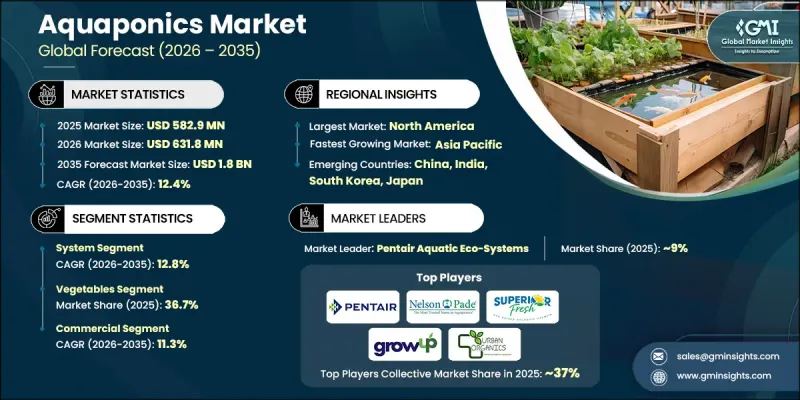
농부와 도시 지역의 재배자가 물을 대량으로 소비하고 화학 물질에 의존하는 기존 농업을 대체하는 방법을 점점 더 추구함에 따라 환경 친화적이고 효율적인 농업 솔루션에 대한 수요가 성장을 이끌고 있습니다. 아쿠아포닉스는 물고기와 채소 재배를 결합하여 물 사용량을 최소화하고 화학 비료의 필요성을 제거하는 폐쇄형 영양 순환 시스템을 구축합니다. 이 방법은 환경 제어형 농업을 통해 안정적인 수확량을 확보하기 위해 물 부족과 토지 제약에 직면하는 지역에 이상적입니다. 지속가능하고 추적성이 확보되고 현지에서 생산된 식품에 대한 소비자의 의식이 높아지면서 상업 사업자에게 아쿠아포닉스의 도입을 촉구하고 있습니다. 재정적 인센티브와 지원 법규를 포함한 정부의 이니셔티브는 보급을 더욱 가속화하고 있습니다. 도시농업 프로그램과 상업농가는 신선한 현지산 농산물 수요 고조에 부응하고, 자원 효율을 극대화하고 일년 내내 높은 작물의 품질을 유지하기 위해 아쿠아포닉스에 투자를 하고 있습니다.
| 시장 규모 | |
|---|---|
| 시작 연도 | 2025년 |
| 예측 기간 | 2026-2035년 |
| 시작 규모 | 5억 8,290만 달러 |
| 예측 금액 | 18억 달러 |
| CAGR | 12.4% |
시스템 부문은 2025년에 4억 4,340만 달러를 차지하며, 2035년까지 연평균 복합 성장률(CAGR) 12.8%를 나타낼 것으로 예측됩니다. 탱크, 틀밭, 펌프, 여과 장치를 통합한 기능으로 전체 시스템이 시장을 독점하고 있습니다. 전체 시스템을 통해 상업 운영자는 물고기와 식물 생산주기를 동기화하고 설치 실수를 줄이고 소규모 도시 농장에서 대규모 상업시설에 이르기까지 확장성을 지원할 수 있습니다. 기술 통합은 물 순환, 양분 분배, 실시간 모니터링을 강화하여 운영 효율성을 더욱 향상시킵니다.
채소 부문은 2025년에 36.7%의 점유율을 차지하고, 2035년까지 연평균 복합 성장률(CAGR) 7.2%를 나타낼 것으로 예측됩니다. 잎채소, 허브 및 기타 성장이 빠른 야채는 아쿠아포닉스 시스템에서 잘 자라며 연간 여러 번 수확하고 안정적인 품질을 제공합니다. 관리되는 환경은 농약 사용을 줄이고 레스토랑, 소매업체, 건강 지향 소비자들에게 지지되는 안전하고 고품질의 농산물을 보장합니다. 과실류에 비해 재배 위험이 낮은 것도 농가에 의한 도입을 뒷받침하고 있습니다.
미국의 아쿠아포닉스 시장은 2025년에 1억 6,480만 달러에 달했고, 2035년까지 연평균 복합 성장률(CAGR) 12.2%를 나타낼 것으로 예측됩니다. 지속 가능한 식량 생산에 대한 관심 증가, 도시 농업 노력, 유기농 및 무농약 농산물에 대한 수요가 이러한 성장을 지원합니다. 교육기관과 연구시설이 아쿠아포닉스 프로그램을 확대하고 있는 한편, 전문 농장에서는 상업 규모의 시스템에 대한 투자가 증가하고 있으며, 이는 시장의 추가 확대를 뒷받침하고 있습니다.
자주 묻는 질문
목차
제1장 조사 방법과 범위
제2장 주요 요약
제3장 업계 인사이트
- 생태계 분석
- 공급자의 상황
- 이익률
- 각 단계에서의 부가가치
- 밸류체인에 영향을 주는 요인
- 업계에 미치는 영향요인
- 성장 촉진요인
- 지속 가능하고 자원 효율이 높은 농업에 대한 수요 증가
- 도시형 및 수직 농업에 대한 투자 확대
- 높아지는 세계 식량 안보에 대한 우려
- 함정과 과제
- 높은 초기 설치비 및 자본 비용
- 기술적 복잡성과 지식의 벽
- 기회
- 신재생에너지 도입으로 운영비용 절감
- 서비스가 세심하지 않은 지역이나 원격지에 진출
- 성장 촉진요인
- 성장 가능성 분석
- 미래 시장 동향
- 기술과 혁신 동향
- 현재의 기술 동향
- 신흥기술
- 가격 동향
- 지역별
- 제품별
- 규제 상황
- 규격 및 컴플라이언스 요건
- 지역별 규제 프레임워크
- 인증기준
- Porter's Five Forces 분석
- PESTEL 분석
제4장 경쟁 구도
- 소개
- 기업의 시장 점유율 분석
- 지역별
- 북미
- 유럽
- 아시아태평양
- 라틴아메리카
- 중동 및 아프리카
- 지역별
- 기업 매트릭스 분석
- 주요 시장 기업의 경쟁 분석
- 경쟁 포지셔닝 매트릭스
- 주요 발전
- 합병 및 인수
- 제휴 및 협업
- 신제품 발매
- 사업 확대 계획
제5장 시장 추계 및 예측 : 컴포넌트별(2022-2035년)
- 시스템
- 재배용 조명
- 펌프 및 밸브
- 온수기
- 에어레이션 시스템
- 모니터링 및 제어 시스템
- 기타
- 소프트웨어
제6장 시장 추계 및 예측 : 프레임 기술별(2022-2035년)
- 영양막 재배법(NFT)
- 배지 충전형 틀밭
- 심층수 재배(DWC)
- 기타
제7장 시장 추계 및 예측 : 생산물별(2022-2035년)
- 물고기
- 채소
- 과일
- 기타
제8장 시장 추계 및 예측 : 용도별(2022-2035년)
- 상업용
- 가정 생산
- 기타
제9장 시장 추계 및 예측 : 지역별(2022-2035년)
- 북미
- 미국
- 캐나다
- 유럽
- 독일
- 영국
- 프랑스
- 이탈리아
- 스페인
- 아시아태평양
- 중국
- 인도
- 일본
- 한국
- 호주
- 라틴아메리카
- 브라질
- 멕시코
- 아르헨티나
- 중동 및 아프리카(MEA)
- 사우디아라비아
- 아랍에미리트(UAE)
- 남아프리카
제10장 기업 프로파일
- Aquaculture Technology Group
- Aquaponic Lynx, LLC
- Aquaponic Solutions
- AquaSprouts
- Backyard Aquaponics
- Bright Agrotech
- EZ-Aquaponics
- FarmTek
- Greentrees International Pty Ltd
- GrowUp Urban Farms
- Nelson and Pade, Inc.
- Pentair Aquatic Eco-Systems
- Superior Fresh
- Symbiotic Systems
- Urban Organics
The Global Aquaponics Market was valued at USD 582.9 million in 2025 and is estimated to grow at a CAGR of 12.4% to reach USD 1.8 billion by 2035.
Demand for environmentally friendly and efficient farming solutions is driving growth, as farmers and urban growers increasingly seek alternatives to traditional, water-intensive, and chemical-dependent agriculture. By combining fish farming with vegetable cultivation, aquaponics creates a closed-loop nutrient system that minimizes water usage and eliminates the need for synthetic fertilizers. The method ensures stable yields through controlled environment agriculture, making it ideal for regions facing water scarcity or land constraints. Consumer awareness of sustainable, traceable, and locally produced food is rising, prompting commercial operators to adopt aquaponics. Government initiatives, including financial incentives and supportive legislation, further accelerate adoption. Urban agriculture programs and commercial farmers are investing in aquaponics to meet growing demand for fresh, local produce while maximizing resource efficiency and maintaining high crop quality year-round.
| Market Scope | |
|---|---|
| Start Year | 2025 |
| Forecast Year | 2026-2035 |
| Start Value | $582.9 Million |
| Forecast Value | $1.8 Billion |
| CAGR | 12.4% |
The system segment accounted for USD 443.4 million in 2025 and is expected to grow at a CAGR of 12.8% through 2035. Complete systems dominate the market due to their integrated functionality, which combines tanks, grow beds, pumps, and filtration units into one cohesive setup. Full systems allow commercial operators to synchronize fish and plant production cycles, reduce installation errors, and support scalability from small urban farms to large commercial facilities. Technological integration enhances water circulation, nutrient distribution, and real-time monitoring, further boosting operational efficiency.
The vegetables segment held a 36.7% share in 2025 and is projected to grow at a CAGR of 7.2% by 2035. Leafy greens, herbs, and other fast-growing vegetables thrive in aquaponic systems, offering multiple harvests per year and consistent quality. Controlled environments reduce pesticide use, ensuring safe, high-quality produce that appeals to restaurants, retailers, and health-conscious consumers. Lower cultivation risks compared to fruiting crops also drive farmer adoption.
U.S. Aquaponics Market reached USD 164.8 million in 2025 and is expected to grow at a CAGR of 12.2% through 2035. Rising interest in sustainable food production, urban farming initiatives, and the demand for organic, pesticide-free produce support growth. Educational institutions and research facilities are expanding aquaponics programs, while specialty farms are increasingly investing in commercial-scale systems, further driving market expansion.
Key players in the Global Aquaponics Market include Bright Agrotech, EZ-Aquaponics, FarmTek, GrowUp Urban Farms, Pentair Aquatic Eco-Systems, Urban Organics, Nelson and Pade, Inc., Symbiotic Systems, Aquaponic Solutions, AquaSprouts, Aquaculture Technology Group, Aquaponic Lynx, LLC, Superior Fresh, Greentrees International Pty Ltd., and Backyard Aquaponics. Companies in the Aquaponics Market are focusing on innovation, scalability, and sustainability to strengthen their market presence. They are investing in fully integrated system solutions with advanced automation for water and nutrient management, reducing labor and operational complexity. Strategic partnerships with urban farms, commercial growers, and educational institutions expand adoption and credibility. Product diversification, including modular and customizable systems for small-scale and large-scale operations, allows firms to cater to varied customer segments. Firms are also emphasizing sustainability through energy-efficient equipment, recyclable materials, and organic-friendly solutions.
Table of Contents
Chapter 1 Methodology & Scope
- 1.1 Market scope and definition
- 1.2 Research design
- 1.2.1 Research approach
- 1.2.2 Data collection methods
- 1.3 Data mining sources
- 1.3.1 Global
- 1.3.2 Regional/Country
- 1.4 Base estimates and calculations
- 1.4.1 Base year calculation
- 1.4.2 Key trends for market estimation
- 1.5 Primary research and validation
- 1.5.1 Primary sources
- 1.6 Forecast model
- 1.7 Research assumptions and limitations
Chapter 2 Executive Summary
- 2.1 Industry 360° synopsis
- 2.2 Key market trends
- 2.2.1 Component
- 2.2.2 By Framing Technique
- 2.2.3 Produce
- 2.2.4 Application
- 2.3 CXO perspectives: Strategic imperatives
- 2.3.1 Key decision points for industry executives
- 2.3.2 Critical success factors for market players
- 2.4 Future outlook and strategic recommendations
Chapter 3 Industry Insights
- 3.1 Industry ecosystem analysis
- 3.1.1 Supplier landscape
- 3.1.2 Profit margin
- 3.1.3 Value addition at each stage
- 3.1.4 Factor affecting the value chain
- 3.2 Industry impact forces
- 3.2.1 Growth drivers
- 3.2.1.1 Rising demand for sustainable and resource-efficient agriculture
- 3.2.1.2 Increased investment in urban and vertical farming initiatives
- 3.2.1.3 Growing global food security concerns
- 3.2.2 Pitfalls & Challenges
- 3.2.2.1 High initial setup and capital costs
- 3.2.2.2 Technical complexity and knowledge barriers
- 3.2.3 Opportunities
- 3.2.3.1 Integration of renewable energy to lower operating costs
- 3.2.3.2 Expansion into underserved and remote regions
- 3.2.1 Growth drivers
- 3.3 Growth potential analysis
- 3.4 Future market trends
- 3.5 Technology and innovation landscape
- 3.5.1 Current technological trends
- 3.5.2 Emerging technologies
- 3.6 Price trends
- 3.6.1 By region
- 3.6.2 By product
- 3.7 Regulatory landscape
- 3.7.1 Standards and compliance requirements
- 3.7.2 Regional regulatory frameworks
- 3.7.3 Certification standards
- 3.8 Porter’s analysis
- 3.9 PESTEL analysis
Chapter 4 Competitive Landscape, 2025
- 4.1 Introduction
- 4.2 Company market share analysis
- 4.2.1 By Region
- 4.2.1.1 North America
- 4.2.1.2 Europe
- 4.2.1.3 Asia Pacific
- 4.2.1.4 Latin America
- 4.2.1.5 Middle East & Africa
- 4.2.1 By Region
- 4.3 Company matrix analysis
- 4.4 Competitive analysis of major market players
- 4.5 Competitive positioning matrix
- 4.6 Key developments
- 4.6.1 Mergers & acquisitions
- 4.6.2 Partnerships & collaborations
- 4.6.3 New product launches
- 4.6.4 Expansion plans
Chapter 5 Market Estimates & Forecast, By Component, 2022 - 2035, (USD Million) (Thousand Units)
- 5.1 Key trends
- 5.2 System
- 5.2.1 Grow Lights
- 5.2.2 Pumps and Valves
- 5.2.3 Water Heaters
- 5.2.4 Aeration Systems
- 5.2.5 Monitoring and Control Systems
- 5.2.6 Others
- 5.3 Software
Chapter 6 Market Estimates & Forecast, By Framing Technique, 2022 - 2035, (USD Million) (Thousand Units)
- 6.1 Key trends
- 6.2 Nutrient Film Technique (NFT)
- 6.3 Media-Filled Growbeds
- 6.4 Deep Water Culture (DWC)
- 6.5 Others
Chapter 7 Market Estimates & Forecast, By Produce, 2022 - 2035, (USD Million) (Thousand Units)
- 7.1 Key trends
- 7.2 Fish
- 7.3 Vegetables
- 7.4 Fruits
- 7.5 Others
Chapter 8 Market Estimates & Forecast, By Application, 2022 - 2035, (USD Million) (Thousand Units)
- 8.1 Key trends
- 8.2 Commercial
- 8.3 Home Production
- 8.4 Others
Chapter 9 Market Estimates & Forecast, By Region, 2022 - 2035, (USD Million) (Thousand Units)
- 9.1 Key trends
- 9.2 North America
- 9.2.1 U.S.
- 9.2.2 Canada
- 9.3 Europe
- 9.3.1 Germany
- 9.3.2 UK
- 9.3.3 France
- 9.3.4 Italy
- 9.3.5 Spain
- 9.4 Asia Pacific
- 9.4.1 China
- 9.4.2 India
- 9.4.3 Japan
- 9.4.4 South Korea
- 9.4.5 Australia
- 9.5 Latin America
- 9.5.1 Brazil
- 9.5.2 Mexico
- 9.5.3 Argentina
- 9.6 MEA
- 9.6.1 Saudi Arabia
- 9.6.2 UAE
- 9.6.3 South Africa
Chapter 10 Company Profiles
- 10.1 Aquaculture Technology Group
- 10.2 Aquaponic Lynx, LLC
- 10.3 Aquaponic Solutions
- 10.4 AquaSprouts
- 10.5 Backyard Aquaponics
- 10.6 Bright Agrotech
- 10.7 EZ-Aquaponics
- 10.8 FarmTek
- 10.9 Greentrees International Pty Ltd
- 10.10 GrowUp Urban Farms
- 10.11 Nelson and Pade, Inc.
- 10.12 Pentair Aquatic Eco-Systems
- 10.13 Superior Fresh
- 10.14 Symbiotic Systems
- 10.15 Urban Organics