

|
시장보고서
상품코드
1998666
스마트 파종기 시장 기회, 성장요인, 업계 동향 분석 및 예측(2026-2035년)Smart Seed Planting Machine Market Opportunity, Growth Drivers, Industry Trend Analysis, and Forecast 2026 - 2035 |
||||||

세계의 스마트 파종기 시장은 2025년에 108억 달러로 평가되었고, CAGR 8.8%로 성장하여 2035년까지 242억 달러에 달할 것으로 예측됩니다.
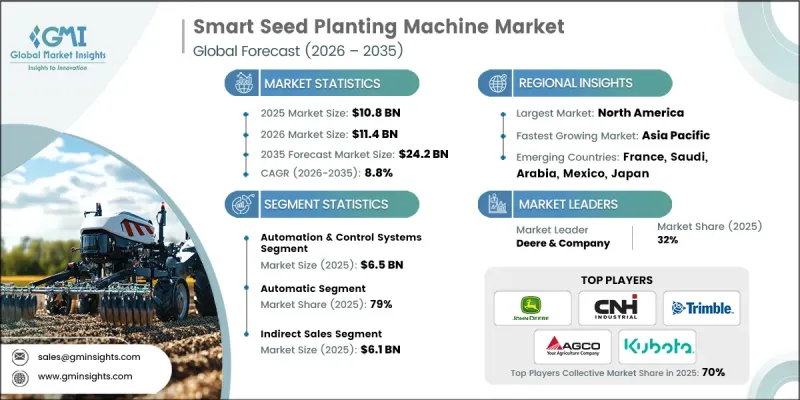
스마트 농업 장비용 스마트 파종기 시장의 확대는 주로 농업 생산성 향상과 업무 효율성 최적화에 대한 관심 증가에 힘입은 바 큽니다. 농업 생산자들은 데이터에 기반한 의사결정을 가능하게 하는 첨단 장비를 점점 더 많이 도입하고 있으며, 토양 품질, 밭의 변동성, 수분 분포, 종자 특성 등의 요인을 평가하여 이상적인 파종 조건을 결정할 수 있게 되었습니다. 또한, 첨단 디지털 플랫폼, 센싱 기술, 자동화 시스템의 보급으로 정밀 농업 도구에 대한 접근성이 향상되고 있습니다. 그 결과, 생산자들은 보다 정확한 종자 배치가 발아 성능을 크게 향상시키고, 투입물 낭비를 줄이며, 보다 안정적인 수확량으로 이어진다는 것을 인식하고 있습니다. 또한, 디지털 농업 솔루션의 통합으로 보다 일관되고 예측 가능한 결과를 얻을 수 있게 되면서 파종 작업이 변화하고 있습니다. 농장이 운영 현대화를 추진하고 기술 중심의 농업 관리에 계속 의존함에 따라 스마트 파종기에 대한 수요는 꾸준히 확대될 것으로 예측됩니다.
| 시장 범위 | |
|---|---|
| 개시 연도 | 2025년 |
| 예측 기간 | 2026-2035년 |
| 개시 연도 시장 규모 | 108억 달러 |
| 예측액 | 242억 달러 |
| CAGR | 8.8% |
환경 조건의 변화로 인해 데이터에 기반한 지식이 아닌 추정에 의존하는 기존 작물 재배 방법의 신뢰성은 더욱 떨어지고 있습니다. 정밀 파종 시스템은 다양한 밭 조건에서도 일관된 작업 성능을 발휘하여 신뢰할 수 있는 대안을 제공합니다. 이 기계를 통해 농부들은 파종 효율을 지속적으로 모니터링하고, 기계 설정을 자동으로 조정하고, 계획을 개선하고 장기적인 운영 전략을 뒷받침하는 상세한 밭 기록을 유지할 수 있습니다. 정밀 농업으로의 전환은 현대 농업 관행의 큰 변화를 의미하며, 생산자에게 파종 작업을 더 잘 제어하고 농업 자원을 더 효율적으로 관리할 수 있게 해줍니다.
2025년 자동화 및 제어 시스템 분야 시장 규모는 65억 달러에 달했습니다. 현대의 스마트 파종 장비는 자동화 및 제어 기술에 크게 의존하여 종자를 매우 정확하고 균일하게 파종할 수 있습니다. 이 시스템은 디지털 종자 계량 메커니즘, 전자 제어 액추에이터, 실시간 프로그래밍 가능한 제어 장치 및 기계 간 통신 플랫폼을 결합하여 종자 배치, 파종 깊이의 균일성 및 줄 간격을 조정합니다. 이러한 기술은 주요 작업 매개변수를 자동화함으로써 수동 개입으로 인한 편차를 줄이고 작물 재배의 균일성을 향상시킵니다. 자동화 및 제어 시스템의 또 다른 중요한 장점은 첨단 모니터링 기술과 통합할 수 있다는 점인데, 이를 통해 기계가 밭에서 실시간 피드백을 받고 그에 따라 작업을 조정할 수 있다는 점입니다.
2025년에는 자동 부문이 79%의 점유율을 차지했습니다. 자동 파종기는 작동 매개변수 설정이 완료되면 작업자의 개입을 최소화하면서 기본적인 파종 기능을 수행하도록 설계되어 있습니다. 통합 전자 장치와 기계식 액추에이터가 작업 전반에 걸쳐 씨앗의 흐름을 제어하고 정확한 간격을 유지하며 파종 깊이를 조정합니다. 가이던스 및 정렬 기술을 통해 밭 전체에 걸쳐 일정한 줄 간격을 유지합니다. 작업자가 원하는 설정을 입력하면, 밭의 상황이 변하더라도 시스템은 파종 과정에서 해당 매개 변수를 자율적으로 유지합니다. 이 수준의 자동화는 작업 속도와 지형 조건에 관계없이 균일한 성능을 유지하여 작업자의 작업 부하를 줄이고 파종 일관성을 높입니다.
미국 스마트 파종기 시장은 79.7%의 점유율을 차지하고 있으며, 2025년에는 33억 달러 규모에 도달할 것으로 예측됩니다. 미국은 고도로 기계화된 농업 부문과 혁신적인 기술의 적극적인 도입으로 스마트 농업 기계의 발전에 중요한 역할을 하고 있습니다. 대규모 농업 경영, 인건비 상승, 강력한 설비 투자 능력으로 인해 생산자들은 자동화 및 정밀 파종 기술을 농업에 도입하도록 장려하고 있습니다. 주요 농기계 제조업체의 존재는 첨단 디지털 농업 장비에 대한 접근을 용이하게 함으로써 국가의 입지를 더욱 공고히 하고 있습니다. 또한, 농업 기술 혁신 생태계의 지속적인 발전은 미국 농업 분야에서 지능형 파종 솔루션의 발전을 뒷받침하고 있습니다.
자주 묻는 질문
목차
제1장 조사 방법과 범위
제2장 주요 요약
제3장 업계 인사이트
제4장 경쟁 구도
제5장 시장 추산 및 예측 : 제품 유형별, 2022-2035
제6장 시장 추산 및 예측 : 자동화 레벨별, 2022-2035
제7장 시장 추산 및 예측 : 작물 유형별, 2022-2035
제8장 시장 추산 및 예측 : 용도별, 2022-2035
제9장 시장 추산 및 예측 : 유통 채널별, 2022-2035
제10장 시장 추산 및 예측 : 지역별, 2022-2035
제11장 기업 개요
LSH 26.04.23The Global Smart Seed Planting Machine Market was valued at USD 10.8 billion in 2025 and is estimated to grow at a CAGR of 8.8% to reach USD 24.2 billion by 2035.
Expansion in the smart seed planting machine market for smart agricultural equipment is largely supported by the growing emphasis on improving farming productivity while optimizing operational efficiency. Agricultural producers are increasingly adopting advanced equipment that enables data-based decision making, allowing them to determine ideal planting conditions by evaluating factors related to soil quality, field variability, moisture distribution, and seed characteristics. The availability of advanced digital platforms, sensing technologies, and automated systems is also improving accessibility to precision farming tools. As a result, growers are recognizing that more accurate seed placement can significantly improve germination performance and reduce input wastage, which contributes to more stable crop yields. In addition, the integration of digital agriculture solutions is transforming planting operations by enabling more consistent and predictable outcomes. As farms continue to modernize operations and rely on technology-driven agricultural management, the demand for smart seed planting machines is expected to grow steadily.
| Market Scope | |
|---|---|
| Start Year | 2025 |
| Forecast Year | 2026-2035 |
| Start Value | $10.8 Billion |
| Forecast Value | $24.2 Billion |
| CAGR | 8.8% |
Changing environmental conditions have further reduced the reliability of conventional planting approaches that rely on estimation rather than data-driven insights. Precision planting systems offer a dependable alternative by delivering consistent operational performance across varying field conditions. These machines allow farmers to monitor planting efficiency continuously, adjust machine settings automatically, and maintain detailed field records that support improved planning and long-term operational strategies. The shift toward precision agriculture represents a major transformation in modern farming practices, providing producers with improved control over planting operations and enabling more efficient management of agricultural resources.
In 2025, the automation & control systems segment accounted for USD 6.5 billion. Modern smart planting equipment relies heavily on automation and control technologies to ensure highly accurate and uniform seed distribution. These systems combine digital seed metering mechanisms, electronically controlled actuators, real-time programmable control units, and machine communication platforms to regulate seed placement, depth consistency, and row spacing. By automating key operational parameters, these technologies reduce variability caused by manual intervention and improve the uniformity of crop establishment. Another important advantage of automation and control systems is their ability to integrate with advanced monitoring technologies, allowing machines to receive real-time field feedback and adjust operations accordingly.
The automatic segment held 79% share in 2025. Automatic seed planting machines are designed to perform essential planting functions with minimal operator involvement once operational parameters have been configured. Integrated electronics and mechanical actuators control seed flow, maintain accurate spacing, and regulate planting depth throughout the operation. Guidance and alignment technologies ensure that rows remain consistent across the entire field. After the operator inputs the desired settings, the system independently maintains those parameters during the planting process, even when field conditions change. This level of automation reduces operator workload and enhances planting consistency by maintaining uniform performance regardless of operational speed or terrain conditions.
U.S. Smart Seed Planting Machine Market captured 79.7% share, generating USD 3.3 billion in 2025. The United States plays a significant role in advancing smart agricultural machinery due to its highly mechanized farming sector and strong adoption of innovative technologies. Large-scale farming operations, rising labor costs, and strong capital investment capabilities encourage producers to incorporate automation and precision planting technologies into their agricultural practices. The presence of major agricultural machinery manufacturers further strengthens the country's position by enabling easier access to advanced digital farming equipment. Additionally, the continued development of agritech innovation ecosystems is supporting the advancement of intelligent planting solutions across the U.S. agricultural landscape.
Major companies operating in the Global Smart Seed Planting Machine Market include Deere & Company, AGCO, CNH Industrial, Kubota, Mahindra & Mahindra, Trimble, CLAAS KGaA, Bourgault Industries, Kinze Manufacturing, Vaderstad AB, Agrisem International, MaterMacc, Semeato, Jumil, and Yetter Farm Equipment. Companies participating in the Smart Seed Planting Machine Market are implementing several strategic initiatives to strengthen their market position and expand their global footprint. Leading manufacturers are investing heavily in research and development to introduce advanced precision planting technologies that improve accuracy, automation, and operational efficiency. Many firms are focusing on integrating digital agriculture platforms, sensor-based technologies, and connectivity features to enhance machine intelligence and real-time data analysis capabilities. Strategic partnerships with agricultural technology providers and equipment distributors are also helping companies expand their reach across key farming regions. In addition, manufacturers are emphasizing product customization to meet diverse farming requirements and crop types.
Table of Contents
Chapter 1 Methodology and Scope
- 1.1 Market scope and definition
- 1.2 Research design
- 1.2.1 Research approach
- 1.2.2 Data collection methods
- 1.3 Data mining sources
- 1.3.1 Global
- 1.3.2 Regional/Country
- 1.4 Base estimates and calculations
- 1.4.1 Base year calculation
- 1.4.2 Key trends for market estimation
- 1.5 Primary research and validation
- 1.5.1 Primary sources
- 1.6 Forecast model
- 1.7 Research assumptions and limitations
Chapter 2 Executive Summary
- 2.1 Industry 360° synopsis
- 2.2 Key market trends
- 2.2.1 Regional
- 2.2.2 Product type
- 2.2.3 Automation level
- 2.2.4 Crop type
- 2.2.5 Application
- 2.2.6 Distribution channel
- 2.3 CXO perspectives: Strategic imperatives
- 2.3.1 Key decision points for industry executives
- 2.3.2 Critical success factors for market players
- 2.4 Future outlook and strategic recommendations
Chapter 3 Industry Insights
- 3.1 Industry ecosystem analysis
- 3.1.1 Supplier landscape
- 3.1.2 Profit margin
- 3.1.3 Value addition at each stage
- 3.1.4 Factor affecting the value chain
- 3.2 Industry impact forces
- 3.2.1 Growth drivers
- 3.2.1.1 Rising demand for precision agriculture
- 3.2.1.2 Shift toward large-scale mechanized farming
- 3.2.1.3 Labor shortages & rising wages
- 3.2.2 Industry pitfalls & challenges
- 3.2.2.1 High initial capital costs
- 3.2.2.2 Limited technical knowledge among farmers
- 3.2.3 Opportunities
- 3.2.3.1 Integration of AI-driven decision support
- 3.2.3.2 Growth of autonomous & electric planters
- 3.2.1 Growth drivers
- 3.3 Growth potential analysis
- 3.4 Future market trends
- 3.5 Technology and innovation landscape
- 3.5.1 Current technological trends
- 3.5.2 Emerging technologies
- 3.6 Price trends
- 3.6.1 By region
- 3.6.2 By product type
- 3.7 Regulatory landscape
- 3.7.1 Standards and compliance requirements
- 3.7.2 Regional regulatory frameworks
- 3.7.3 Certification standards
- 3.8 Porter’s analysis
- 3.9 PESTEL analysis
Chapter 4 Competitive Landscape, 2025
- 4.1 Introduction
- 4.2 Company market share analysis
- 4.2.1 By region
- 4.2.1.1 North America
- 4.2.1.2 Europe
- 4.2.1.3 Asia Pacific
- 4.2.1.4 Latin America
- 4.2.1.5 Middle East and Africa
- 4.2.1 By region
- 4.3 Company matrix analysis
- 4.4 Competitive analysis of major market players
- 4.5 Competitive positioning matrix
- 4.6 Key developments
- 4.6.1 Mergers & acquisitions
- 4.6.2 Partnerships & collaborations
- 4.6.3 New product launches
- 4.6.4 Expansion plans
Chapter 5 Market Estimates and Forecast, By Product Type, 2022 - 2035 (USD Billion) (Thousand Units)
- 5.1 Key trends
- 5.2 Automation & control systems
- 5.2.1 Guidance systems
- 5.2.2 Drive systems
- 5.2.3 Display systems
- 5.2.4 Control systems
- 5.2.5 GPS receivers
- 5.2.6 Drones/UAVS
- 5.3 Sensing & monitoring devices
- 5.3.1 Smart metering systems
- 5.3.2 Sensors
- 5.3.3 Cameras
- 5.3.4 Delivery systems
Chapter 6 Market Estimates and Forecast, By Automation Level, 2022 - 2035 (USD Billion) (Thousand Units)
- 6.1 Key trends
- 6.2 Automatic
- 6.3 Manual
Chapter 7 Market Estimates and Forecast, By Crop Type, 2022 - 2035 (USD Billion) (Thousand Units)
- 7.1 Key trends
- 7.2 Row crops
- 7.3 Grains & cereals
- 7.4 Pulses & oilseeds
- 7.5 Vegetables & fruits
- 7.6 Forestry
Chapter 8 Market Estimates and Forecast, By Application, 2022 - 2035 (USD Billion) (Thousand Units)
- 8.1 Key trends
- 8.2 Small farms (Below 400 hectares)
- 8.3 Large farms (Above 400 hectares)
Chapter 9 Market Estimates and Forecast, By Distribution Channel, 2022 - 2035 (USD Billion) (Thousand Units)
- 9.1 Key trends
- 9.2 Direct sales
- 9.3 Indirect sales
Chapter 10 Market Estimates and Forecast, By Region, 2022 - 2035 (USD Billion) (Thousand Units)
- 10.1 Key trends
- 10.2 North America
- 10.2.1 U.S.
- 10.2.2 Canada
- 10.3 Europe
- 10.3.1 Germany
- 10.3.2 UK
- 10.3.3 France
- 10.3.4 Italy
- 10.3.5 Spain
- 10.4 Asia Pacific
- 10.4.1 China
- 10.4.2 Japan
- 10.4.3 India
- 10.4.4 Australia
- 10.4.5 South Korea
- 10.5 Latin America
- 10.5.1 Brazil
- 10.5.2 Mexico
- 10.5.3 Argentina
- 10.6 Middle East and Africa
- 10.6.1 South Africa
- 10.6.2 Saudi Arabia
- 10.6.3 UAE
Chapter 11 Company Profiles
- 11.1 AGCO
- 11.2 Agrisem International
- 11.3 Bourgault Industries
- 11.4 CLAAS KGaA
- 11.5 CNH Industrial
- 11.6 Deere & Company
- 11.7 Jumil
- 11.8 Kinze Manufacturing
- 11.9 Kubota
- 11.10 Mahindra & Mahindra
- 11.11 MaterMacc
- 11.12 Semeato
- 11.13 Trimble
- 11.14 Vaderstad AB
- 11.15 Yetter Farm Equipment


