

|
시장보고서
상품코드
1998736
궤양성 대장염 시장 기회, 성장요인, 업계 동향 분석 및 예측(2026-2035년)Ulcerative Colitis Market Opportunity, Growth Drivers, Industry Trend Analysis, and Forecast 2026 - 2035 |
||||||

세계의 궤양성 대장염 시장은 2025년에 83억 달러로 평가되며, CAGR 5.8%로 성장하며, 2035년까지 145억 달러에 달할 것으로 추정되고 있습니다.
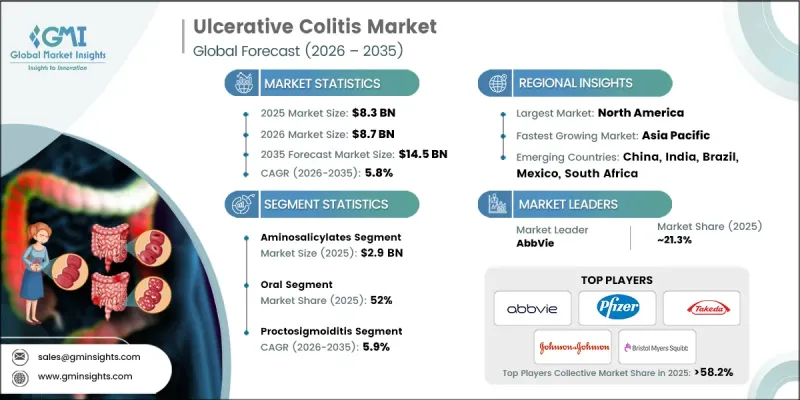
세계에서 궤양성 대장염의 유병률이 지속적으로 증가함에 따라 시장이 확대되고 있습니다. 급속한 도시화, 라이프스타일의 변화, 식습관의 변화, 환경적 요인 등이 궤양성 대장염을 포함한 염증성장질환 증가에 기여하고 있습니다. 이러한 유병률 증가와 더불어 의료진과 환자 모두 질병에 대한 인식이 높아지면서 조기 발견과 적시 치료를 촉진하고 있습니다. 조기 진단을 통해 의료 서비스 프로바이더는 적절한 치료를 더 빨리 시작할 수 있으며, 이는 더 나은 질병 관리를 지원하고 의약품 치료에 대한 수요를 증가시킵니다. 치료법 혁신의 지속적인 발전은 보다 효과적인 치료 접근법을 도입하여 시장 상황을 형성하고 있습니다. 최신 영상 진단 기술, 내시경 검사, 바이오마커 식별 기술 향상 등 진단 기술의 발전으로 임상 평가와 질병 모니터링이 강화되고 있습니다. 또한 선진국과 신흥 국가의 의료비 지출이 확대되면서 고급 의료 치료에 대한 접근성이 향상되고 있습니다. 이러한 발전은 의료 시스템이 새로운 치료 옵션을 도입하고 더 많은 환자에게 접근할 수 있도록 지원함으로써 궤양성 대장염 시장의 장기적인 성장을 촉진할 수 있도록 돕고 있습니다.
| 시장 범위 | |
|---|---|
| 시작연도 | 2025년 |
| 예측 기간 | 2026-2035년 |
| 개시 금액 | 83억 달러 |
| 예측액 | 145억 달러 |
| CAGR | 5.8% |
첨단 치료법의 개발은 궤양성 대장염의 치료 전략을 변화시키는 데 큰 역할을 해왔습니다. 표적치료제의 도입으로 중등도에서 중증의 병을 앓고 있는 환자들의 치료 옵션이 크게 확대되었습니다. 이러한 혁신적인 치료법은 기존 약물보다 더 효과적으로 면역 체계의 활동을 조절하고 염증을 감소시키도록 설계되었습니다. 동시에 진단 기술의 발전으로 질병의 조기 발견과 임상 모니터링이 강화되었습니다. 진단 툴의 발전으로 의료진은 질병의 진행을 보다 정확하게 평가하고, 질병의 초기 단계에서 치료를 시작할 수 있게 되었습니다. 그 결과, 기존 약물과 첨단 치료법의 병용을 통해 장기적인 질환 관리를 개선하고, 전 세계에서 궤양성 대장염 치료제의 사용 확대에 기여하고 있습니다.
2025년에는 경구용 의약품 부문이 52%의 점유율을 차지했습니다. 이 부문은 경구용 의약품의 편의성과 접근성 덕분에 지속적으로 높은 성장세를 보이고 있습니다. 많은 환자들은 투여가 쉽고 침습적인 시술이 필요하지 않기 때문에 경구용 치료제를 선호합니다. 이러한 약물은 장기적인 질병 관리에 일반적으로 사용되며, 다양한 단계의 질환에서 실용적인 치료 옵션으로 간주됩니다. 제제 기술의 지속적인 발전으로 경구용 약물의 효능은 더욱 향상되고 있습니다. 서방형 및 표적 전달 메커니즘과 같은 혁신 기술은 치료 효과를 향상시키는 동시에 환자의 내약성 및 복약 순응도를 높여 경구용 치료제의 보급 확대를 지원하고 있습니다.
병원 약국 부문은 2026-2035년 연평균 복합 성장률(CAGR) 5.6%를 나타낼 것으로 예측됩니다. 병원 약국은 복잡한 치료 요법을 제공하고 안전한 약물 투여를 보장하는 데 있으며, 매우 중요한 역할을 담당하고 있습니다. 병원내 의료진은 첨단 치료를 받고 있는 환자를 면밀히 모니터링하고, 잠재적인 부작용을 관리하며, 치료 결과를 최적화하기 위해 노력하고 있습니다. 궤양성 대장염의 합병증으로 인한 입원 환자 수가 증가함에 따라 치료 제공에 있으며, 병원 약국의 중요성이 더욱 커지고 있습니다. 또한 병원 약국과 의료 서비스 프로바이더와의 협력은 협력적 치료를 지원하고 치료 관리 및 환자 결과를 개선하는 데 도움이 됩니다. 보험 적용 및 상환 프로그램에 대한 접근성 확대는 병원 약국이 환자에게 고가의 치료제를 제공할 수 있게 해주며, 시장에서의 선도적 지위에 기여하고 있습니다.
북미 궤양성 대장염 시장은 41.2%의 점유율을 차지하고 있으며, 2035년까지 연평균 복합 성장률(CAGR) 5.6%를 나타낼 것으로 예측됩니다. 이 지역은 잘 정비된 의료 인프라, 첨단 치료 옵션에 대한 높은 접근성, 그리고 현대적 치료법을 이용할 수 있는 광범위한 보험 적용 범위의 이점을 가지고 있습니다. 조기 진단과 의료진 및 환자의 인식 개선도 치료법 채택률 향상에 기여하고 있습니다. 또한 북미는 제약 혁신의 주요 거점으로서 새로운 치료법과 치료 기술이 자주 도입되고 있습니다. 주요 제약사들의 지속적인 연구 활동, 임상시험 및 환자 지원 노력은 시장을 더욱 강화하고 지역 전체의 지속적인 성장을 지원하고 있습니다.
자주 묻는 질문
목차
제1장 조사 방법
제2장 개요
제3장 업계 인사이트
제4장 경쟁 구도
제5장 시장 추산·예측 : 약제 유형별, 2022-2035
제6장 시장 추산·예측 : 질환 유형별, 2022-2035
제7장 시장 추산·예측 : 투여 경로별, 2022-2035
제8장 시장 추산·예측 : 유통 채널별, 2022-2035
제9장 시장 추산·예측 : 지역별, 2022-2035
제10장 기업 개요
KSA 26.04.20The Global Ulcerative Colitis Market was valued at USD 8.3 billion in 2025 and is estimated to grow at a CAGR of 5.8% to reach USD 14.5 billion by 2035.
The market is expanding as the prevalence of ulcerative colitis continues to rise worldwide. Factors such as rapid urban development, lifestyle shifts, dietary changes, and environmental influences are contributing to a growing number of inflammatory bowel disease cases, including ulcerative colitis. Alongside this rising incidence, improved disease awareness among both healthcare professionals and patients is encouraging earlier detection and timely treatment. Early diagnosis allows healthcare providers to initiate appropriate therapies sooner, which supports better disease management and increases demand for pharmaceutical treatments. Continuous progress in treatment innovation is also shaping the market landscape by introducing more effective therapeutic approaches. Advances in diagnostic technologies, including modern imaging techniques, endoscopic procedures, and improved biomarker identification, have strengthened clinical evaluation and disease monitoring. In addition, the expansion of healthcare funding across both developed and emerging economies is improving access to advanced medical therapies. These developments are enabling healthcare systems to adopt newer treatment options and support broader patient access, which continues to drive the long-term growth of the ulcerative colitis market.
| Market Scope | |
|---|---|
| Start Year | 2025 |
| Forecast Year | 2026-2035 |
| Start Value | $8.3 Billion |
| Forecast Value | $14.5 Billion |
| CAGR | 5.8% |
The development of advanced therapeutic options has played a major role in transforming ulcerative colitis treatment strategies. The introduction of targeted therapies has significantly expanded available treatment choices for patients experiencing moderate to severe disease conditions. These innovative therapies are designed to regulate immune system activity and reduce inflammation more effectively than traditional medications. At the same time, improvements in diagnostic technologies have strengthened early disease detection and clinical monitoring. Enhanced diagnostic tools allow healthcare providers to assess disease progression more accurately and initiate treatment earlier in the disease cycle. As a result, the combined use of conventional medications and advanced treatment approaches is improving long-term disease management while contributing to increased utilization of ulcerative colitis therapies worldwide.
The oral segment accounted for 52% share in 2025. This segment continues to demonstrate strong growth due to the convenience and accessibility associated with oral medications. Many patients prefer oral therapies because they are easier to administer and do not require invasive procedures. These medications are commonly used for long-term disease management and are considered a practical treatment option across different stages of the condition. Continuous improvements in drug formulation technologies have further enhanced the effectiveness of oral medications. Innovations such as controlled-release and targeted delivery mechanisms are improving treatment performance while also increasing patient tolerance and adherence, which supports the growing adoption of oral therapies.
The hospital pharmacies segment is projected to grow at a CAGR of 5.6% during 2026-2035. Hospital pharmacies play a vital role in distributing complex treatment regimens and ensuring safe medication administration. Healthcare professionals within hospital settings closely monitor patients receiving advanced therapies to manage potential side effects and optimize treatment outcomes. The increasing number of hospital admissions related to ulcerative colitis complications is further strengthening the importance of hospital pharmacies in treatment delivery. In addition, integration between hospital pharmacies and healthcare providers helps support coordinated care, improving treatment management and patient outcomes. Greater access to insurance coverage and reimbursement programs also enables hospital pharmacies to provide patients with access to high-cost therapies, contributing to their leading position in the market.
North America Ulcerative Colitis Market accounted for 41.2% share and is expected to grow at a CAGR of 5.6% throughout 2035. The region benefits from a well-developed healthcare infrastructure, strong accessibility to advanced treatment options, and widespread insurance coverage that supports the use of modern therapies. Early diagnosis and increased awareness among healthcare professionals and patients also contribute to higher treatment adoption rates. Furthermore, North America serves as a major center for pharmaceutical innovation, where new therapies and treatment technologies are frequently introduced. Ongoing research activities, clinical studies, and patient support initiatives conducted by major pharmaceutical companies are further strengthening the market and supporting continued growth across the region.
Major companies operating in the Global Ulcerative Colitis Market include Pfizer, AbbVie, Takeda Pharmaceutical Company Limited, Johnson & Johnson, Bristol Myers Squibb, Novartis, Eli Lilly and Company, Merck, Sun Pharmaceutical Industries, Mitsubishi Tanabe Pharma Corporation, Bausch Health Companies, and Teva Pharmaceutical Industries. Companies competing in the Global Ulcerative Colitis Market are implementing a range of strategies to strengthen their competitive positions and expand their global presence. Leading pharmaceutical organizations are investing heavily in research and development to introduce innovative therapies that improve disease management and patient outcomes. Many companies are also focusing on expanding their product pipelines through clinical trials and regulatory approvals for advanced treatment options. Strategic collaborations with biotechnology firms, research institutions, and healthcare providers are helping accelerate drug discovery and development processes. In addition, companies are expanding their geographic reach through global distribution networks and market entry strategies in emerging healthcare markets.
Table of Contents
Chapter 1 Research Methodology
- 1.1 Market scope and definition
- 1.2 Research approach
- 1.3 Quality commitments
- 1.3.1 GMI AI policy & data integrity commitment
- 1.3.1.1 Source consistency protocol
- 1.3.1 GMI AI policy & data integrity commitment
- 1.4 Research trail & confidence scoring
- 1.4.1 Research trail components
- 1.4.2 Scoring components
- 1.5 Data collection
- 1.5.1 Partial list of primary sources
- 1.6 Data mining sources
- 1.6.1 Paid sources
- 1.6.1.1 Sources, by region
- 1.6.1 Paid sources
- 1.7 Base estimates and calculations
- 1.7.1 Base year calculation for any one approach
- 1.8 Forecast model
- 1.8.1 Quantified market impact analysis
- 1.8.1.1 Mathematical impact of growth parameters on forecast
- 1.8.1 Quantified market impact analysis
- 1.9 Research transparency addendum
- 1.9.1 Source attribution framework
- 1.9.2 Quality assurance metrics
- 1.9.3 Our commitment to trust
Chapter 2 Executive Summary
- 2.1 Industry 360° synopsis
- 2.2 Key market trends
- 2.2.1 Drug type trends
- 2.2.2 Disease type trends
- 2.2.3 Route of administration trends
- 2.2.4 Distribution channel trends
- 2.3 CXO perspectives: Strategic imperatives
Chapter 3 Industry Insights
- 3.1 Industry ecosystem analysis
- 3.2 Industry impact forces
- 3.2.1 Growth drivers
- 3.2.1.1 Increasing prevalence of ulcerative colitis
- 3.2.1.2 Expanding treatment options
- 3.2.1.3 Increasing awareness and diagnosis
- 3.2.2 Industry pitfalls and challenges
- 3.2.2.1 High treatment costs
- 3.2.2.2 Side effects and safety concerns
- 3.2.3 Market opportunities
- 3.2.3.1 Growing demand and utilization of combination therapies
- 3.2.3.2 Development of pediatric ulcerative colitis treatment
- 3.2.1 Growth drivers
- 3.3 Growth potential analysis
- 3.4 Regulatory landscape (Driven by primary research)
- 3.4.1 North America
- 3.4.1.1 U.S.
- 3.4.1.2 Canada
- 3.4.2 Europe
- 3.4.3 Asia Pacific
- 3.4.1 North America
- 3.5 Pricing analysis (Driven by primary research)
- 3.6 Pipeline and clinical trials landscape
- 3.7 Impact of AI and generative AI on the market
- 3.8 Future market trends
- 3.9 Porter's analysis
- 3.10 PESTEL analysis
Chapter 4 Competitive Landscape, 2025
- 4.1 Introduction
- 4.2 Company market share analysis
- 4.2.1 North America
- 4.2.2 Europe
- 4.2.3 Asia Pacific
- 4.3 Company matrix analysis
- 4.4 Competitive analysis of major market players
- 4.5 Competitive positioning matrix
- 4.6 Key developments
- 4.6.1 Merger and acquisition
- 4.6.2 Partnership and collaboration
- 4.6.3 New product launches
- 4.6.4 Expansion plans
Chapter 5 Market Estimates and Forecast, By Drug Type, 2022 - 2035 ($ Mn)
- 5.1 Key trends
- 5.2 Aminosalicylates
- 5.3 Biologics
- 5.4 Corticosteroids
- 5.5 Janus kinase (JAK) inhibitors
- 5.6 Immunosuppressants
- 5.7 Other drug types
Chapter 6 Market Estimates and Forecast, By Disease Type, 2022 - 2035 ($ Mn)
- 6.1 Key trends
- 6.2 Proctosigmoiditis
- 6.3 Ulcerative proctitis
- 6.4 Left-sided colitis
- 6.5 Pancolitis or universal colitis
- 6.6 Fulminant colitis
Chapter 7 Market Estimates and Forecast, By Route of Administration, 2022 - 2035 ($ Mn)
- 7.1 Key trends
- 7.2 Oral
- 7.3 Injectable
Chapter 8 Market Estimates and Forecast, By Distribution Channel, 2022 - 2035 ($ Mn)
- 8.1 Key trends
- 8.2 Hospital pharmacies
- 8.3 Retail pharmacies
- 8.4 Online pharmacies
Chapter 9 Market Estimates and Forecast, By Region, 2022 - 2035 ($ Mn)
- 9.1 Key trends
- 9.2 North America
- 9.2.1 U.S.
- 9.2.2 Canada
- 9.3 Europe
- 9.3.1 Germany
- 9.3.2 UK
- 9.3.3 France
- 9.3.4 Italy
- 9.3.5 Spain
- 9.3.6 Netherlands
- 9.4 Asia Pacific
- 9.4.1 China
- 9.4.2 Japan
- 9.4.3 India
- 9.4.4 Australia
- 9.4.5 South Korea
- 9.5 Latin America
- 9.5.1 Brazil
- 9.5.2 Mexico
- 9.5.3 Argentina
- 9.6 Middle East and Africa
- 9.6.1 South Africa
- 9.6.2 Saudi Arabia
- 9.6.3 UAE
Chapter 10 Company Profiles
- 10.1 AbbVie
- 10.2 Bausch Health Companies
- 10.3 Bristol Myers Squibb
- 10.4 Eli Lilly and Company
- 10.5 Johnson & Johnson
- 10.6 Merck
- 10.7 Mitsubishi Tanabe Pharma Corporation
- 10.8 Novartis
- 10.9 Pfizer
- 10.10 Sun Pharmaceutical Industries
- 10.11 Takeda Pharmaceutical Company Limited
- 10.12 Teva Pharmaceutical Industries


