

|
시장보고서
상품코드
1998806
신경혈관 기기 시장 기회, 성장 촉진요인, 업계 동향 분석 및 예측(2026-2035년)Neurovascular Devices Market Opportunity, Growth Drivers, Industry Trend Analysis, and Forecast 2026 - 2035 |
||||||

세계의 신경혈관 기기 시장은 2025년에 50억 달러로 평가되었고, CAGR5.2%로 성장하여 2035년까지 85억 달러에 달할 것으로 예측됩니다.
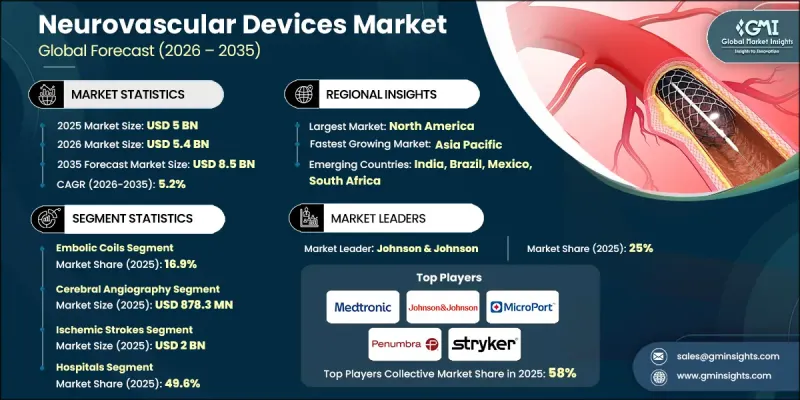
세계 의료시스템이 신경혈관질환 증가라는 문제에 직면한 가운데 신경혈관 기기 시장은 꾸준히 성장하고 있습니다. 효과적인 치료법에 대한 수요가 증가함에 따라 병원과 전문 의료센터에서는 복잡한 뇌혈관 질환을 관리하기 위한 첨단 의료기술의 도입이 활발히 진행되고 있습니다. 성장을 뒷받침하는 또 다른 주요 요인은 뇌와 중추신경계에 영향을 미치는 혈관 질환에 취약한 고령 인구 증가입니다. 장치 공학, 재료 과학 및 영상 진단 기술의 통합에 대한 지속적인 발전은 치료 효율성과 임상 결과의 향상에 기여하고 있습니다. 또한, 의료진은 의사가 복잡한 혈관 질환을 보다 정확하게 치료할 수 있는 동시에 환자의 회복 기간과 수술 위험을 줄일 수 있는 최소침습적 수술을 점점 더 선호하고 있습니다. 많은 지역 정부가 의료 현대화와 첨단 의료 기술에 대한 접근성 향상에 투자하고 있으며, 이는 신경혈관 장치 시장의 발전을 더욱 촉진하고 있습니다. 그 결과, 의료기관에서는 진단의 정확성을 높이고, 치료의 정확성을 향상시키며, 환자의 장기적인 관리를 지원하는 혁신적인 신경중재 시스템을 점점 더 많이 도입하고 있습니다.
| 시장 범위 | |
|---|---|
| 개시 연도 | 2025년 |
| 예측 기간 | 2026-2035년 |
| 개시 금액 | 50억 달러 |
| 예측 금액 | 85억 달러 |
| CAGR | 5.2% |
신경혈관 기기는 뇌 및 중추신경계 혈관에 영향을 미치는 질환의 진단, 치료, 관리를 목적으로 설계된 특수 의료기기 및 임플란트를 말합니다. 이 장비들은 일반적으로 정상적인 혈액 순환을 회복하고, 혈관 파열을 예방하며, 심각한 신경학적 합병증의 위험을 줄이기 위한 최소 침습 수술에 사용됩니다. 장치 설계, 재료, 기능의 지속적인 혁신으로 신경중재술은 크게 변화하고 있습니다. 현대의 신경혈관 기술을 통해 의사는 시술 성공률을 높이고 합병증을 최소화하면서 극도로 정밀한 치료를 할 수 있게 되었습니다. 장치의 성능이 계속 발전함에 따라 의료진은 복잡한 뇌혈관 질환에 대해 보다 신속하고 안전하며 효과적인 치료를 제공할 수 있게 될 것입니다. 이러한 기술의 발전으로 신경혈관 치료는 전통적인 접근 방식에서 최소침습적 치료법을 지원하고 환자의 회복 결과를 개선할 수 있도록 설계된 고도로 정교한 시스템으로 전환되고 있습니다.
색전술 코일 부문은 2025년 8억 4,740만 달러 시장 규모를 기록하며 16.9%의 점유율을 차지했습니다. 색전 코일은 신경중재술에서 표적 혈관 내 비정상적인 혈류를 제어하거나 차단하기 위해 사용되는 특수 의료기기입니다. 이 장치는 환부의 혈관 내에서 혈전 형성을 조절하여 혈전 형성을 촉진하여 혈관 이상이 있는 부위의 혈류를 제한하는 데 도움을 줍니다. 코일 설계, 재료 구성 및 전달 기술의 지속적인 발전으로 이러한 장치의 안전성과 성능이 향상되었습니다. 또한, 향상된 배치 정확도와 기기의 유연성은 의사들의 시스템에 대한 신뢰를 높이고, 의료시설 전반의 채택을 더욱 촉진하여 전체 신경혈관 장치 시장 확대에 기여하고 있습니다.
뇌혈관조영술 부문은 2025년 8억 7,830만 달러 시장 규모를 기록했습니다. 뇌혈관조영술은 뇌와 그 주변 부위의 혈관을 평가하기 위해 사용되는 카테터를 이용한 영상진단법입니다. 이 기술을 통해 혈관 구조를 매우 세밀하게 시각화할 수 있기 때문에 의료진은 뇌 순환에 영향을 미치는 이상 징후를 파악할 수 있습니다. 정확하고 역동적인 영상을 생성하는 능력으로 뇌혈관 치료에 있어 필수적인 진단 도구로 자리매김하고 있습니다. 혈관조영 기술 향상을 위한 연구개발에 대한 지속적인 투자로 첨단 영상진단 시스템이 도입되고 있습니다. 이러한 혁신은 진단 능력을 향상시키고 영상 진단 절차에 사용되는 신경혈관 장치의 보급을 촉진하고 있으며, 이는 시장 확대에 기여하고 있습니다.
2025년 북미 신경혈관기기 시장은 34.7%의 점유율을 차지했습니다. 이 지역은 첨단 의료 인프라와 의료기기 개발의 급속한 기술 발전에 힘입어 지속적인 성장이 예상되고 있습니다. 이 지역의 의료 서비스 제공업체들은 치료 효율성과 환자 예후를 개선하기 위해 혁신적인 신경혈관 기술을 임상 현장에 점점 더 많이 도입하고 있습니다. 미국은 강력한 연구 역량과 전문 의료시설에 대한 광범위한 접근성을 바탕으로 첨단 신경중재장치의 개발 및 도입에 있어 중심적인 역할을 하고 있습니다. 의료 혁신에 대한 지속적인 투자와 첨단 신경혈관 치료에 대한 수요 증가가 결합되어 세계 신경혈관 기기 시장에서 이 지역의 선도적 지위를 계속 유지하고 있습니다.
세계 신경혈관기기 시장에는 Asahi Intecc, Acandis, Blockade Medical, Balt Extrusion, Integer Holdings Corporation, Johnson & Johnson, Kaneka Medix Corp, Medtronic, Merit Medical System, MicroPort Scientific Corporation, Penumbra, Phenox, Stryker, Sensome, Terumo Corporation 등 많은 주요 기업들이 참여하고 있습니다. 세계 신경혈관기기 시장에 진출한 기업들은 시장에서의 입지를 강화하고 세계 진출을 확대하기 위해 다양한 전략을 시행하고 있습니다. 주요 기업들은 치료의 정확성, 시술의 안전성 및 임상 효율성을 향상시키는 첨단 기기를 도입하기 위해 연구개발에 많은 투자를 하고 있습니다. 제품 혁신은 여전히 핵심 초점이며, 특히 저침습 기술 개발, 재료 및 디자인 개선을 통한 기기 성능 향상에 중점을 두고 있습니다. 의료기관 및 연구기관과의 전략적 제휴도 기업의 기술 진보를 가속화하고 임상 적용을 확대하는 데 도움이 되고 있습니다. 많은 제조업체들이 신흥 의료 시장에서 판매망 구축 및 제휴 관계를 구축하여 지리적 확장을 꾀하고 있습니다. 또한, 각 사들은 신제품에 대한 규제 당국의 승인 획득에 적극 나서고 있으며, 다양한 신경혈관 치료 수요에 대응하고 장기적으로 신경혈관 기기 시장에서의 경쟁력을 유지하기 위해 디바이스 포트폴리오를 확장하고 있습니다.
자주 묻는 질문
목차
제1장 조사 방법과 범위
제2장 주요 요약
제3장 업계 인사이트
제4장 경쟁 구도
제5장 시장 추산 및 예측 : 제품별, 2022년-2035년
제6장 시장 추산 및 예측 : 시술별, 2022년-2035년
제7장 시장 추산 및 예측 : 치료 용도별, 2022년-2035년
제8장 시장 추산 및 예측 : 최종 용도별, 2022년-2035년
제9장 시장 추산 및 예측 : 지역별, 2022년-2035년
제10장 기업 개요
LSH 26.04.23The Global Neurovascular Devices Market was valued at USD 5 billion in 2025 and is estimated to grow at a CAGR of 5.2% to reach USD 8.5 billion by 2035.
The neurovascular devices market is witnessing steady expansion as healthcare systems worldwide face a growing burden of neurological vascular disorders. Rising demand for effective treatment solutions is encouraging hospitals and specialized care centers to adopt advanced medical technologies designed to manage complex cerebrovascular conditions. Another major factor supporting growth is the increasing global elderly population, which is more vulnerable to vascular disorders affecting the brain and central nervous system. Continuous progress in device engineering, material science, and imaging integration is also contributing to improvements in treatment efficiency and clinical outcomes. In addition, healthcare providers are increasingly favoring minimally invasive procedures that allow physicians to treat complex vascular conditions with greater precision while reducing patient recovery times and surgical risks. Governments in multiple regions are investing in healthcare modernization and improving access to advanced medical technologies, further supporting the development of the neurovascular devices market. As a result, healthcare institutions are increasingly integrating innovative neuro-interventional systems that enhance diagnostic accuracy, improve treatment precision, and support better long-term patient management.
| Market Scope | |
|---|---|
| Start Year | 2025 |
| Forecast Year | 2026-2035 |
| Start Value | $5 Billion |
| Forecast Value | $8.5 Billion |
| CAGR | 5.2% |
Neurovascular devices refer to specialized medical instruments and implants designed to diagnose, treat, and manage disorders affecting the blood vessels of the brain and central nervous system. These devices are commonly used in minimally invasive procedures aimed at restoring healthy blood circulation, preventing vascular rupture, and lowering the risk of serious neurological complications. Continuous innovation in device design, materials, and functionality has significantly transformed neuro-interventional procedures. Modern neurovascular technologies enable physicians to perform highly precise treatments that improve procedural success rates while minimizing complications. As device capabilities continue to advance, healthcare professionals can deliver faster, safer, and more effective interventions for complex cerebrovascular conditions. The evolution of these technologies has shifted neurovascular treatment from conventional approaches toward highly sophisticated systems designed to support minimally invasive therapeutic procedures and improve patient recovery outcomes.
The embolic coils segment generated USD 847.4 million in 2025 and accounted for 16.9% share. Embolic coils are specialized medical devices utilized in neuro-interventional procedures to control or block abnormal blood flow within targeted vessels. These devices work by promoting controlled clot formation inside the affected vessel, which helps restrict circulation in areas where vascular abnormalities are present. Continuous advancements in coil design, material composition, and delivery technologies have enhanced the safety and performance of these devices. Improvements in deployment accuracy and device flexibility have also strengthened physician confidence in these systems, further encouraging their adoption across healthcare facilities and contributing to the overall expansion of the neurovascular devices market.
The cerebral angiography segment generated USD 878.3 million in 2025. Cerebral angiography is a catheter-based diagnostic imaging procedure used to evaluate blood vessels within the brain and surrounding regions. The technique provides a highly detailed visualization of vascular structures, allowing healthcare professionals to identify abnormalities affecting cerebral circulation. Its ability to produce precise and dynamic imaging makes it an essential diagnostic tool in neurovascular care. Continuous investment in research and product development aimed at improving angiography technologies is leading to the introduction of advanced imaging systems. These innovations are enhancing diagnostic capabilities and supporting the broader adoption of neurovascular devices used in imaging procedures, which is contributing to market expansion.
North America Neurovascular Devices Market accounted for 34.7% share in 2025. The region continues to experience strong growth supported by advanced healthcare infrastructure and rapid technological progress in medical device development. Healthcare providers in the region are increasingly integrating innovative neurovascular technologies into clinical practice to improve treatment efficiency and patient outcomes. The United States plays a central role in both the development and adoption of advanced neuro-interventional devices, supported by strong research capabilities and widespread access to specialized healthcare facilities. Ongoing investments in healthcare innovation, combined with increasing demand for advanced neurovascular treatments, continue to support the region's leading position in the global neurovascular devices market.
Several key companies operate in the Global Neurovascular Devices Market, including Asahi Intecc, Acandis, Blockade Medical, Balt Extrusion, Integer Holdings Corporation, Johnson & Johnson, Kaneka Medix Corp, Medtronic, Merit Medical System, MicroPort Scientific Corporation, Penumbra, Phenox, Stryker, Sensome, and Terumo Corporation. Companies participating in the Global Neurovascular Devices Market are implementing a range of strategies to strengthen their market position and expand global reach. Major players are investing significantly in research and development to introduce advanced devices that improve treatment precision, procedural safety, and clinical efficiency. Product innovation remains a central focus, particularly in developing minimally invasive technologies and enhancing device performance through improved materials and engineering. Strategic partnerships with healthcare institutions and research organizations are also helping companies accelerate technological advancements and expand clinical adoption. Many manufacturers are pursuing geographic expansion by establishing distribution networks and collaborations in emerging healthcare markets. In addition, companies are actively working to secure regulatory approvals for new products while broadening their device portfolios to address diverse neurovascular treatment needs and maintain long-term competitiveness in the neurovascular devices market.
Table of Contents
Chapter 1 Methodology and Scope
- 1.1 Market scope and definition
- 1.2 Research design
- 1.2.1 Research approach
- 1.2.2 Data collection methods
- 1.3 Data mining sources
- 1.3.1 Global
- 1.3.2 Regional/Country
- 1.4 Base estimates and calculations
- 1.4.1 Base year calculation
- 1.4.2 Key trends for market estimation
- 1.5 Primary research and validation
- 1.5.1 Primary sources
- 1.6 Forecast model
- 1.7 Research assumptions and limitations
Chapter 2 Executive Summary
- 2.1 Industry 360° synopsis
- 2.2 Key market trends
- 2.2.1 Regional trends
- 2.2.2 Product trends
- 2.2.3 Process trends
- 2.2.4 Therapeutic application trends
- 2.2.5 End use trends
- 2.3 CXO perspectives: Strategic imperatives
Chapter 3 Industry Insights
- 3.1 Industry ecosystem analysis
- 3.2 Industry impact forces
- 3.2.1 Growth drivers
- 3.2.1.1 Increasing prevalence of neurological diseases
- 3.2.1.2 Rising demand for minimally invasive surgical procedures
- 3.2.1.3 Technological advancement in neurovascular devices
- 3.2.1.4 Growing geriatric population base
- 3.2.2 Industry pitfalls and challenges
- 3.2.2.1 High cost of devices
- 3.2.2.2 Stringent regulatory scenario
- 3.2.3 Market opportunities
- 3.2.3.1 Growing healthcare expansion in emerging economies
- 3.2.1 Growth drivers
- 3.3 Growth potential analysis
- 3.4 Regulatory landscape
- 3.4.1 North America
- 3.4.2 Europe
- 3.4.3 Asia Pacific
- 3.5 Technological advancements
- 3.5.1 Current technological trends
- 3.5.2 Emerging technologies
- 3.6 Future market trends
- 3.7 Impact of AI and generative AI on the market
- 3.8 Porter's analysis
- 3.9 PESTEL analysis
Chapter 4 Competitive Landscape, 2025
- 4.1 Introduction
- 4.2 Company market share analysis
- 4.3 Company matrix analysis
- 4.4 Competitive analysis of major market players
- 4.5 Competitive positioning matrix
- 4.6 Key developments
- 4.6.1 Mergers and acquisitions
- 4.6.2 Partnerships and collaborations
- 4.6.3 New product launches
- 4.6.4 Expansion plans
Chapter 5 Market Estimates and Forecast, By Product, 2022 - 2035 ($ Mn)
- 5.1 Key trends
- 5.2 Embolic coils
- 5.3 Carotid stents
- 5.4 Intracranial stents
- 5.5 Catheters
- 5.6 Embolic protection devices
- 5.7 Flow diverters
- 5.8 Neurothrombectomy devices
- 5.9 Intrasaccular devices
- 5.10 Balloon systems
- 5.11 Stent retrievers
- 5.12 Guidewires
- 5.13 Other products
Chapter 6 Market Estimates and Forecast, By Process, 2022 - 2035 ($ Mn)
- 6.1 Key trends
- 6.2 Neurothrombectomy
- 6.3 Cerebral angiography
- 6.4 Carotid endarterectomy
- 6.5 Stenting
- 6.6 Microsurgical clipping
- 6.7 Coiling
- 6.8 Flow diversion
- 6.9 Other processes
Chapter 7 Market Estimates and Forecast, By Therapeutic Applications, 2022 - 2035 ($ Mn)
- 7.1 Key trends
- 7.2 Brain aneurysm
- 7.3 Stenosis
- 7.4 Ischemic strokes
- 7.5 Other therapeutic applications
Chapter 8 Market Estimates and Forecast, By End Use, 2022 - 2035 ($ Mn)
- 8.1 Key trends
- 8.2 Hospitals
- 8.3 Ambulatory surgical centers
- 8.4 Clinics
- 8.5 Other end users
Chapter 9 Market Estimates and Forecast, By Region, 2022 - 2035 ($ Mn)
- 9.1 Key trends
- 9.2 North America
- 9.2.1 U.S.
- 9.2.2 Canada
- 9.3 Europe
- 9.3.1 Germany
- 9.3.2 UK
- 9.3.3 France
- 9.3.4 Spain
- 9.3.5 Italy
- 9.3.6 Netherlands
- 9.4 Asia Pacific
- 9.4.1 China
- 9.4.2 India
- 9.4.3 Japan
- 9.4.4 Australia
- 9.4.5 South Korea
- 9.5 Latin America
- 9.5.1 Brazil
- 9.5.2 Mexico
- 9.5.3 Argentina
- 9.6 Middle East and Africa
- 9.6.1 Saudi Arabia
- 9.6.2 South Africa
- 9.6.3 UAE
Chapter 10 Company Profiles
- 10.1 Asahi Intecc
- 10.2 Acandis
- 10.3 Blockade Medical
- 10.4 Balt Extrusion
- 10.5 Integer Holdings Corporation
- 10.6 Johnson & Johnson
- 10.7 Kaneka Medix Corp
- 10.8 Medtronic
- 10.9 Merit Medical System
- 10.10 MicroPort Scientific Corporation
- 10.11 Penumbra
- 10.12 Phenox
- 10.13 Stryker
- 10.14 Sensome
- 10.15 Terumo Corporation


