

|
시장보고서
상품코드
2066534
신경혈관 의료기기 시장 : 점유율 분석, 업계 동향과 통계, 성장 예측(2026-2031년)Neurovascular Devices - Market Share Analysis, Industry Trends & Statistics, Growth Forecasts (2026 - 2031) |
||||||
 Mordor Intelligence
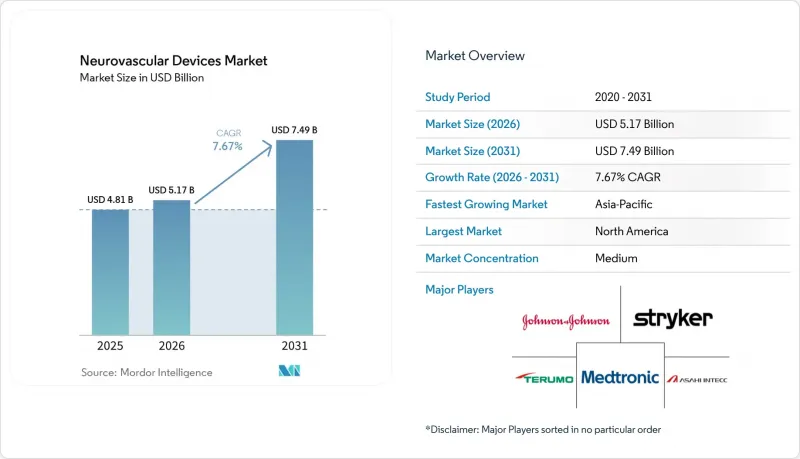
Mordor Intelligence에 의하면, 신경혈관 의료기기 시장 규모는 2025년에 48억 1,000만 달러로 평가되었고 2026년 51억 7,000만 달러에서 2031년까지 74억 9,000만 달러에 이를 것으로 예측되며, 예측 기간(2026-2031년) CAGR은 7.67%를 나타낼 전망입니다.
본 보고서는 제품별(동맥류 코일 색전술·색전술용 기기, 뇌 풍선 혈관성형술·스텐트 삽입 시스템, 신경 혈전 제거 기기 등), 대상 질환별(허혈성 뇌졸중, 뇌동맥류 등), 최종 사용자별(병원, 외래수술센터(ASC) 등), 지역별(북미, 유럽 등)로 분류되어 있습니다. 시장 전망은 금액(달러) 기준으로 제시되어 있습니다.
세계 신경혈관 의료기기 시장 동향 및 인사이트
전 세계 뇌졸중 발병률 증가와 이에 따른 사회경제적 부담
세계적으로 뇌졸중과 관련된 생산성 손실은 연간 455억 달러에 달하며, 이로 인해 장기 요양 비용을 절감할 수 있는 조기 개입에 대한 보험사의 보상 지급이 촉진되고 있습니다. 신흥 경제국의 사망률은 선진국에 비해 여전히 40-60% 더 높은데, 이는 신경혈관 의료기기 시장이 해결할 수 있는 인프라 격차를 반영하고 있습니다. 아시아태평양 지역의 고령화 진행에 따라, 2030년까지 해당 지역의 뇌졸중 발병률이 30% 더 증가할 것으로 예측되며, 이에 따라 의료기기의 보급이 가속화될 것으로 보입니다. 현재 의료 제도에서는 재활 기간 단축과 사회적 생산성 향상을 비교 검토함으로써, 신경혈관 프로그램에 대한 투자 대비 효과를 정량화하고 있습니다.
저침습 신경 중재술 기술의 급속한 혁신
SOFIA 시리즈와 같은 차세대 흡입 카테터는 기존 설계의 기준치인 65%에 비해 85%의 재개통률을 달성하여, 도입을 가속화할 수 있는 임상적 이점을 제공합니다. Pipeline Vantage와 같은 플로우 다이버터는 12개월 시점에서 95%의 동맥류 폐쇄율을 달성하는 동시에, 평균 시술 시간을 25% 단축하고 있습니다. 로봇 보조 혈전 제거술에 관한 초기 데이터에 따르면, 방사선 피폭량이 20% 감소한 것으로 나타나, 병원의 안전 대책 추진에 힘을 실어주고 있습니다. AI를 활용한 영상 진단 플랫폼은 실시간 혈관 분석을 실현하여 합병증을 최대 20%까지 줄이고 있습니다. 이러한 성능 향상으로 인해 프리미엄 가격을 유지할 수 있게 되었으며, 신경혈관 의료기기 시장의 수익 잠재력이 한층 더 강화되고 있습니다.
주요 시장에서 이루어지는 엄격하고 장기적인 규제 승인 절차
2024년, 미국 내 510(k) 승인의 평균 소요 일수는 201일에 달하고, 법정 목표의 2배 이상을 기록하며, 시판이 지연되고 있습니다. 현재 PMA 승인을 받는 데 12개월 이상이 소요되며, EU 의료기기 규정에 따라 제조업체는 카테고리별로 최대 500만 달러의 비용이 드는 개별 임상 데이터 세트를 준비해야 할 의무가 있습니다. 소규모 혁신 기업들은 두 지역에 신청 비용을 충당하는 데 어려움을 겪고 있어, 파이프라인의 다양성이 훼손되고 있습니다. 승인 주기의 장기화는 선점 우위를 훼손하고, 자본의 시간 가치를 중시하는 투자자들의 의욕을 꺾고 있습니다. 그 결과 발생하는 지연이 신경혈관 의료기기 시장에서 수익 창출을 저해하고 있습니다.
부문별 분석
동맥류 코일 및 색전 장치는 다양한 형태의 동맥류에 대해 입증된 효능 덕분에 2025년에는 신경혈관 의료기기 시장 점유율의 32.35%를 차지했습니다. 하이드로겔 및 생체활성 코일은 베어 플래티넘 코일의 기준치인 85%에 비해 5년 폐색률 92%를 달성하여, 이 부문은 병원 프로토콜 내에서 확고한 입지를 다지고 있습니다. 예측 기간 동안, 원자재 및 배송 시스템의 지속적인 개선이 단위 수요 유지에 기여할 것으로 보입니다.
신경 혈전 제거 기기는 발병 후 24시간 이내의 치료를 허용하는 지침의 확대에 힘입어 연평균 성장률(CAGR) 8.52%라는 가장 높은 성장률을 보이고 있습니다. ‘흡입 우선’ 시술법과 대구경 카테터의 등장으로 인해, 광범위한 중심성 경색을 가진 환자에 대한 적용 범위가 확대되면서 신경혈관 의료기기 시장 규모가 점차 커지고 있습니다. 뇌 풍선 혈관 성형술 및 스텐트 삽입 시스템은 풍선의 순응도 및 폐쇄형 스텐트의 설계 개선을 통해 꾸준한 성장을 보이고 있습니다. 마이크로카테터나 가이드와이어와 같은 보조 기기는 혈전 제거술 1회당 여러 개의 일회용 제품이 소모되기 때문에 안정적인 매출을 유지하고 있습니다. 틈새 시장인 액체 색전제, 폐쇄용 풍선, 차세대 플로우 다이버터는 기존 기구로는 해부학적 한계에 부딪히는 분야에서 점진적인 성장을 이끌고 있습니다.
지역별 분석
북미는 2025년에 전 세계 매출의 44.24%를 차지했으며, 이는 경동맥 스텐트 삽입술에 대한 메디케어 적용 확대와 미국 병원의 바이플레인 혈관조영술 보급률 65%에 힘입은 결과였습니다. 캐나다의 각 주는 3차 의료기관에 혈전 제거 수술실을 구축하기 위한 새로운 뇌졸중 인프라 예산을 배정하는 한편, 멕시코의 민간 병원들은 의료 관광객을 수용하기 위해 흡입 시스템에 투자했습니다.
아시아태평양은 중국의 허혈성 뇌졸중 환자 수 277만 명, 일본의 급속한 고령화, 그리고 인도의 중산층 확대에 힘입어 8.66%라는 가장 높은 연평균 성장률(CAGR)을 보일 것으로 전망됩니다. 그렇긴 하지만, 의료기기의 보급률에는 편차가 있습니다. 일본은 서유럽 국가 수준의 보급률에 가까워지고 있는 반면, 아세안(ASEAN)의 신흥 시장에서는 관류 CT 스캐너 등 기초적인 의료 체계의 구축이 우선시되고 있습니다. 중국 내 현지 생산에 대한 우대 조치는 수입 관세 및 규제상의 지연을 상쇄하는 파트너십을 촉진하고 있으며, 신경혈관 의료기기 시장의 장기적인 성장을 뒷받침하고 있습니다.
유럽에서는 독일, 영국, 프랑스에서 안정적인 수요가 유지되고 있으며, 이들 국가의 근거 기반 구매 위원회는 비용 대비 효과에 관한 확실한 자료를 갖춘 의료기기를 우선적으로 선정하고 있습니다. 중동 및 아프리카에서는 걸프협력회의(GCC) 회원국을 중심으로 도입이 초기 단계에 있지만, 남미에서는 브라질이 뇌졸중 네트워크를 구축하고 아르헨티나가 국내 의료기기 생산을 활용하고 있어 점차 진전되고 있습니다. 각 지역의 성장세는 인프라의 성숙도, 보험사의 방침, 경제 발전에 따라 달라지므로, 지역에 맞는 비즈니스 모델이 필수적입니다.
기타 혜택:
- 엑셀 형식 시장 예측(ME) 시트
- 3개월간의 애널리스트 지원
자주 묻는 질문
목차
제1장 서론
제2장 조사 방법
제3장 주요 요약
제4장 시장 구도
제5장 시장 규모와 성장 예측
제6장 경쟁 구도
제7장 시장 기회와 향후 전망
JHS 26.06.29According to Mordor Intelligence, the neurovascular devices market size was valued at USD 4.81 billion in 2025 and estimated to grow from USD 5.17 billion in 2026 to reach USD 7.49 billion by 2031, at a CAGR of 7.67% during the forecast period (2026-2031).
This report is Segmented by Product (Aneurysm Coiling & Embolization Devices, Cerebral Balloon Angioplasty & Stenting Systems, Neurothrombectomy Devices, and More), Target Disease (Ischemic Stroke, Cerebral Aneurysm, and More), End User (Hospitals, Ambulatory Surgical Centers, and More), and Geography (North America, Europe, and More). The Market Forecasts are Provided in Terms of Value (USD).
Global Neurovascular Devices Market Trends and Insights
Escalating Global Stroke Incidence and Associated Socio-economic Burden
Worldwide, stroke-related productivity losses cost USD 45.5 billion annually, incentivizing payers to reimburse early interventions that trim long-term care spending. Mortality rates in emerging economies remain 40-60% higher than in developed nations, reflecting infrastructure gaps that the neurovascular devices market can address. Asia-Pacific's demographic shift toward older cohorts is projected to lift regional stroke incidence another 30% by 2030, accelerating device uptake. Health systems now quantify the return on investment of neurovascular programs by weighing shorter rehabilitation timelines against societal productivity gains.
Rapid Innovation in Minimally-Invasive Neuro-interventional Technologies
Next-generation aspiration catheters such as the SOFIA family deliver 85% recanalization versus the 65% benchmarks of earlier designs, providing a clinical edge that speeds adoption. Flow diverters like Pipeline Vantage achieve 95% aneurysm occlusion at 12 months while cutting average procedure times by 25%. Early evidence from robotic-assisted thrombectomy shows a 20% reduction in radiation exposure, supporting hospitals' safety initiatives. AI-enhanced imaging platforms now deliver real-time vessel analysis that reduces complications by up to 20%. These performance gains lock in premium pricing, reinforcing the revenue potential of the neurovascular devices market.
Stringent and Lengthy Regulatory Approval Processes Across Key Markets
Average US 510(k) clearance time stretched to 201 days in 2024, more than doubling the statutory target and delaying commercial launches. PMA approvals now exceed 12 months, and the EU Medical Device Regulation forces manufacturers to prepare separate clinical datasets costing up to USD 5 million per category. Smaller innovators struggle to fund dual-region submissions, damping pipeline diversity. Protracted approval cycles erode first-mover advantage, discouraging investors who weigh time-value of capital. The resulting lag constrains revenue realization within the neurovascular devices market.
Other drivers and restraints analyzed in the detailed report include:
- Hospital Adoption of Biplane Angio Suites Boosting Procedure Volumes
- Increasing Research and Development Investments
- High Procedure and Capital Equipment Costs Limiting Adoption in Budget-Constrained Hospitals
For complete list of drivers and restraints, kindly check the Table Of Contents.
Segment Analysis
Aneurysm coiling and embolization devices captured 32.35% of the neurovascular devices market share in 2025 thanks to proven efficacy across diverse aneurysm morphologies. Hydrogel and bioactive coils now deliver 92% five-year occlusion versus the 85% benchmark of bare platinum variants, keeping the segment firmly entrenched in hospital protocols. Over the forecast horizon, continuous material and delivery improvements help sustain unit demand.
Neurothrombectomy devices are growing fastest at a 8.52% CAGR, catalyzed by guideline expansions that allow treatment up to 24 hours after onset. Aspiration-first techniques and larger-bore catheters extend eligibility to patients with large core infarcts, broadening the neurovascular devices market. Cerebral balloon angioplasty and stenting systems post steady gains from refinements in balloon compliance and closed-cell stent design. Support devices such as micro-catheters and guidewires maintain consistent pull-through revenues as each thrombectomy consumes multiple disposables. Niche categories-liquid embolics, occlusion balloons, and next-gen flow diverters-offer incremental growth where conventional tools meet anatomical limits.
Geography Analysis
North America generated 44.24% of global revenue in 2025, buoyed by Medicare coverage expansion for carotid stenting and 65% penetration of biplane angiography among US hospitals. Canadian provinces allocated new stroke-infrastructure budgets that equipped tertiary centers with thrombectomy suites, while Mexican private hospitals invested in aspiration systems to service medical tourists.
Asia-Pacific is forecast to post the strongest 8.66% CAGR, propelled by China's 2.77 million ischemic stroke cases, Japan's rapidly aging population, and India's growing middle class. Nevertheless, device penetration varies: Japan approaches Western adoption levels, whereas emerging ASEAN markets prioritize foundational capacity such as perfusion CT scanners. Local manufacturing incentives in China encourage partnerships that counterbalance import tariffs and regulatory delays, supporting long-term growth for the neurovascular devices market.
Europe maintains steady demand across Germany, the United Kingdom, and France, where evidence-based purchasing committees favor devices with robust cost-effectiveness dossiers. Middle East & Africa show nascent uptake concentrated in Gulf Cooperation Council states, while South America progresses gradually as Brazil deploys stroke networks and Argentina capitalizes on domestic device production. Regional momentum hinges on infrastructure maturity, payer policy, and economic development, necessitating localized commercial models.
- Medtronic
- Stryker
- Penumbra
- CERENOVUS (Johnson & Johnson)
- Terumo Corporation (MicroVention)
- Asahi Intecc Co., Ltd.
- MicroPort
- Integer Holdings
- Imperative Care Inc.
- Shape Memory Medical
- Balt Group
- Acandis
- Rapid Medical Ltd.
- Kaneka
- Trandomed 3D Inc.
- Evasc Neurovascular
- Wallaby Medical
Additional Benefits:
- The market estimate (ME) sheet in Excel format
- 3 months of analyst support
TABLE OF CONTENTS
1 Introduction
- 1.1 Study Assumptions & Market Definition
- 1.2 Scope of the Study
2 Research Methodology
3 Executive Summary
4 Market Landscape
- 4.1 Market Overview
- 4.2 Market Drivers
- 4.2.1 Escalating Global Stroke Incidence and Associated Socio-economic Burden
- 4.2.2 Rapid Innovation in Minimally Invasive Neuro-interventional Technologies
- 4.2.3 Hospital Adoption of Biplane Angio Suites Boosting Procedure Volumes
- 4.2.4 Increasing Research and Development Investments
- 4.2.5 Expanding Reimbursement Coverage for Endovascular Stroke Care in Major Healthcare Systems
- 4.2.6 Expansion of Healthcare Infrastructure in Emerging Markets
- 4.3 Market Restraints
- 4.3.1 Stringent and Lengthy Regulatory Approval Processes Across Key Markets
- 4.3.2 High Procedure and Capital Equipment Costs Limiting Adoption in Budget-Constrained Hospitals
- 4.3.3 Persistent Shortage of Trained Neuro-interventionalists-Especially in Low- and Middle-Income Regions
- 4.3.4 Procedural Complications: Risks, Awareness Gaps, and Diagnostic Delays
- 4.4 Value / Supply-Chain Analysis
- 4.5 Regulatory Outlook
- 4.6 Technological Outlook
- 4.7 Porter's Five Forces Analysis
- 4.7.1 Threat of New Entrants
- 4.7.2 Bargaining Power of Buyers
- 4.7.3 Bargaining Power of Suppliers
- 4.7.4 Threat of Substitutes
- 4.7.5 Intensity of Competitive Rivalry
5 Market Size & Growth Forecasts (Value)
- 5.1 By Product
- 5.1.1 Aneurysm Coiling & Embolization Devices
- 5.1.2 Cerebral Balloon Angioplasty & Stenting Systems
- 5.1.3 Neurothrombectomy Devices
- 5.1.4 Support Devices (Micro-catheters, Guidewires, Sheaths)
- 5.1.5 Other Devices (Liquid Embolics, Occlusion Balloons)
- 5.2 By Target Disease
- 5.2.1 Ischemic Stroke
- 5.2.2 Cerebral Aneurysm
- 5.2.3 Arteriovenous Malformations & Fistulas
- 5.2.4 Intracerebral Hemorrhage
- 5.3 By End User
- 5.3.1 Hospitals
- 5.3.2 Ambulatory Surgical Centers
- 5.3.3 Specialty Neurology & Stroke Centers
- 5.4 By Geography
- 5.4.1 North America
- 5.4.1.1 United States
- 5.4.1.2 Canada
- 5.4.1.3 Mexico
- 5.4.2 Europe
- 5.4.2.1 Germany
- 5.4.2.2 United Kingdom
- 5.4.2.3 France
- 5.4.2.4 Italy
- 5.4.2.5 Spain
- 5.4.2.6 Rest of Europe
- 5.4.3 Asia-Pacific
- 5.4.3.1 China
- 5.4.3.2 Japan
- 5.4.3.3 India
- 5.4.3.4 Australia
- 5.4.3.5 South Korea
- 5.4.3.6 Rest of Asia-Pacific
- 5.4.4 Middle East and Africa
- 5.4.4.1 GCC
- 5.4.4.2 South Africa
- 5.4.4.3 Rest of Middle East and Africa
- 5.4.5 South America
- 5.4.5.1 Brazil
- 5.4.5.2 Argentina
- 5.4.5.3 Rest of South America
- 5.4.1 North America
6 Competitive Landscape
- 6.1 Market Concentration
- 6.2 Market Share Analysis
- 6.3 Company Profiles (includes Global level Overview, Market level overview, Core Segments, Financials as available, Strategic Information, Market Rank/Share for key companies, Products & Services, and Recent Developments)
- 6.3.1 Medtronic plc
- 6.3.2 Stryker Corporation
- 6.3.3 Penumbra Inc.
- 6.3.4 CERENOVUS (Johnson & Johnson)
- 6.3.5 Terumo Corporation (MicroVention)
- 6.3.6 Asahi Intecc Co., Ltd.
- 6.3.7 MicroPort Scientific Corporation
- 6.3.8 Integer Holdings Corporation
- 6.3.9 Imperative Care Inc.
- 6.3.10 Shape Memory Medical Inc.
- 6.3.11 Balt Group
- 6.3.12 Acandis GmbH
- 6.3.13 Rapid Medical Ltd.
- 6.3.14 Kaneka Corporation
- 6.3.15 Trandomed 3D Inc.
- 6.3.16 Evasc Neurovascular
- 6.3.17 Wallaby Medical
7 Market Opportunities & Future Outlook
- 7.1 White-space & Unmet-Need Assessment


