|
시장보고서
상품코드
1998845
비강 스프레이 시장 기회, 성장요인, 업계 동향 분석 및 예측(2026-2035년)Nasal Spray Market Opportunity, Growth Drivers, Industry Trend Analysis, and Forecast 2026 - 2035 |
||||||

세계의 점비약 시장은 2025년에 281억 달러로 평가되며, CAGR 8.1%로 성장하며, 2035년까지 604억 달러에 달할 것으로 추정되고 있습니다.
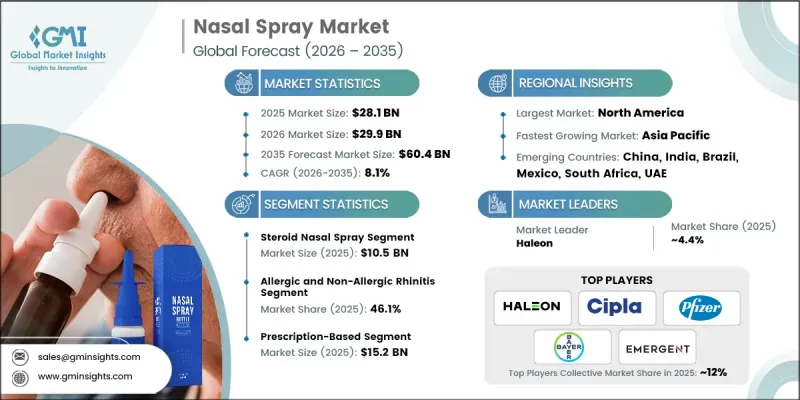
만성 호흡기 질환의 유병률 증가, 알레르기성 및 비알레르기성 비염의 발병률 증가, 비침습적 약물전달 방법에 대한 수요 증가가 시장 성장을 촉진하고 있습니다. 비강 점적제는 경구제 대비 작용 발현이 빠르고, 국소적 약물전달이 가능하며, 환자의 복약 순응도를 높여 부비동염, 알레르기, 코막힘 관리에 있으며, 선호되는 선택이 되고 있습니다. 일반의약품(OTC) 제품의 가용성 확대와 소매 및 온라인 약국 네트워크의 확장에 힘입어 셀프케어(self-care)로의 전환이 가속화되고 있는 것도 시장 성장을 더욱 가속화하고 있습니다. 무방부제 제제, 정량 분무기, 병용 요법 등의 기술적 발전으로 치료 효과와 안전성이 향상되어 선진국과 신흥 시장 모두에서 채택이 확대되고 있습니다.
| 시장 범위 | |
|---|---|
| 시작연도 | 2025년 |
| 예측 기간 | 2026-2035년 |
| 개시 금액 | 281억 달러 |
| 예측액 | 604억 달러 |
| CAGR | 8.1% |
제품 유형별로는 스테로이드 비강 점안제 부문이 2025년 105억 달러의 매출을 기록했습니다. 스테로이드 비강 점안제는 강력한 항염증 작용, 장기적인 안전성 프로파일, 낮은 전신 흡수율로 인해 알레르기성 비염과 만성 부비동염의 1차 치료제로 널리 처방되고 있습니다. 플루티카손, 모메타손, 부데소니드, 시클레소니드를 포함한 제품들은 확고한 임상 가이드라인과 의사들의 선호에 힘입어 처방약 및 OTC(일반의약품) 시장에서 선도적인 지위를 유지하고 있습니다. 분무의 정착성 향상과 환자 친화적인 디자인 등 투여 메커니즘의 지속적인 혁신은 이 부문의 우위를 더욱 강화시키고 있습니다.
적응증별로는 알레르기성 및 비알레르기성 비염 부문이 2025년 46.1%의 점유율을 차지했습니다. 도시화, 대기 오염, 기후 변화에 따른 알레르겐 노출의 변화로 인한 계절성 및 연중 알레르기의 높은 부담은 효과적인 비강내 치료에 대한 수요를 지속적으로 증가시키고 있습니다. 처방약 및 OTC 비강 스프레이는 코막힘, 재채기, 콧물 등의 증상을 조절하는 데 널리 사용되고 있습니다. 조기 치료에 대한 인식이 높아지고 성인 및 소아 연령층에서 비강 스프레이 사용이 증가함에 따라 이 부문은 예측 기간 중 견고한 성장을 지속할 것으로 예측됩니다.
2025년 기준, 북미 비강 점적기 시장은 35% 점유율을 차지했습니다. 이 지역의 선도적 지위는 알레르기성 비염과 만성 부비동염의 높은 유병률, 잘 구축된 의료 인프라, 혁신과 제네릭 의약품의 승인을 촉진하는 강력한 규제 프레임워크에 의해 지원됩니다. 광범위한 소매 약국 네트워크, E-Commerce 보급률 증가, 셀프 케어를 위한 OTC 비강 스프레이의 채택 확대는 지역 수요를 더욱 강화하고 있습니다. 첨단 제형과 치료 적응증 확대를 포함한 지속적인 신제품 출시로 2034년까지 북미 시장에서의 선도적 지위를 유지할 것으로 예측됩니다.
자주 묻는 질문
목차
제1장 조사 방법과 범위
제2장 개요
제3장 업계 인사이트
제4장 경쟁 구도
제5장 시장 추산·예측 : 제품 유형별, 2022-2035
제6장 시장 추산·예측 : 용도별, 2022-2035
제7장 시장 추산·예측 : 환자 유형별, 2022-2035
제8장 시장 추산·예측 : 유형별, 2022-2035
제9장 시장 추산·예측 : 유통 채널별, 2022-2035
제10장 시장 추산·예측 : 지역별, 2022-2035
제11장 기업 개요
KSA 26.04.20The Global Nasal Spray Market was valued at USD 28.1 billion in 2025 and is estimated to grow at a CAGR of 8.1% to reach USD 60.4 billion by 2035.
Market growth is driven by the rising prevalence of chronic respiratory diseases, increasing incidence of allergic and non-allergic rhinitis, and growing demand for non-invasive drug delivery methods. Nasal sprays offer a rapid onset of action, localized drug delivery, and improved patient compliance compared to oral formulations, making them a preferred option for managing sinusitis, allergies, and nasal congestion. The growing shift toward self-care, supported by wider availability of over-the-counter (OTC) products and expanding retail and online pharmacy networks, is further accelerating market growth. Technological advancements such as preservative-free formulations, metered-dose spray devices, and combination therapies are enhancing treatment efficacy and safety, strengthening adoption across both developed and emerging markets.
| Market Scope | |
|---|---|
| Start Year | 2025 |
| Forecast Year | 2026-2035 |
| Start Value | $28.1 Billion |
| Forecast Value | $60.4 Billion |
| CAGR | 8.1% |
By product type, the steroid nasal spray segment generated USD 10.5 billion in 2025. Steroid nasal sprays are widely prescribed as first-line therapy for allergic rhinitis and chronic rhinosinusitis due to their strong anti-inflammatory action, long-term safety profile, and low systemic absorption. Products containing fluticasone, mometasone, budesonide, and ciclesonide continue to dominate prescriptions and OTC sales, supported by strong clinical guidelines and physician preference. Ongoing innovation in delivery mechanisms, including improved spray deposition and patient-friendly designs, is further reinforcing the dominance of this segment.
In terms of application, the allergic and non-allergic rhinitis segment held 46.1% share in 2025. The high burden of seasonal and perennial allergies, driven by urbanization, air pollution, and climate-related changes in allergen exposure, continues to fuel demand for effective intranasal therapies. Both prescription and OTC nasal sprays are extensively used for symptom control, including nasal congestion, sneezing, and rhinorrhea. The growing awareness of early treatment and the increasing use of nasal sprays across adult and pediatric populations are expected to sustain strong growth in this segment over the forecast period.
North America Nasal Spray Market held 35% share in 2025. The region's leadership is supported by a high prevalence of allergic rhinitis and chronic sinusitis, a well-established healthcare infrastructure, and strong regulatory frameworks that encourage innovation and generic product approvals. Extensive retail pharmacy networks, rising e-commerce penetration, and increasing adoption of OTC nasal sprays for self-management further strengthen regional demand. Continued product launches, including advanced formulations and expanded therapeutic applications, are expected to maintain North America's leading position through 2034.
Key players operating in the Global Nasal Spray Market include Haleon, Bayer, GlaxoSmithKline, Pfizer, Sanofi, Cipla, Dr. Reddy's Laboratories, Teva Pharmaceutical, Viatris, AstraZeneca, ARS Pharmaceuticals, Emergent BioSolutions, Church & Dwight, and Sun Pharmaceutical, among others. These companies compete through strong brand portfolios, extensive distribution networks, and continuous product innovation across prescription and OTC segments. Companies in the Nasal Spray Market are strengthening their market foothold through a combination of product innovation, portfolio expansion, and strategic collaborations. Leading players are investing heavily in R&D to develop preservative-free formulations, combination therapies, and advanced delivery devices that enhance efficacy and patient adherence. Expansion of OTC product lines and brand repositioning toward self-care solutions are helping companies capture a broader consumer base. Strategic partnerships, licensing agreements, and acquisitions are being used to expand geographic reach and accelerate regulatory approvals.
Table of Contents
Chapter 1 Methodology and Scope
- 1.1 Market scope and definition
- 1.2 Research approach
- 1.3 Quality commitments
- 1.3.1 GMI AI policy and data integrity commitment
- 1.3.1.1 Source consistency protocol
- 1.3.1 GMI AI policy and data integrity commitment
- 1.4 Research trail and confidence scoring
- 1.4.1 Research trail components
- 1.4.2 Scoring components
- 1.5 Data collection
- 1.5.1 Partial list of primary sources
- 1.6 Data mining sources
- 1.6.1 Paid sources
- 1.6.1.1 Sources, by region
- 1.6.1 Paid sources
- 1.7 Base estimates and calculations
- 1.7.1 Revenue share analysis
- 1.7.2 Base year calculation
- 1.8 Forecast model
- 1.9 Research transparency addendum
- 1.9.1 Source attribution framework
- 1.9.2 Quality assurance metrics
- 1.9.3 Our commitment to trust
Chapter 2 Executive Summary
- 2.1 Industry 3600 synopsis
- 2.2 Key market trends
- 2.2.1 Business trends
- 2.2.2 Regional trends
- 2.2.3 Product type trends
- 2.2.4 Application trends
- 2.2.5 Patient type trends
- 2.2.6 Type trends
- 2.2.7 Distribution channel trends
- 2.3 CXO perspectives: Strategic imperatives
Chapter 3 Industry Insights
- 3.1 Industry ecosystem analysis
- 3.2 Industry impact forces
- 3.2.1 Growth drivers
- 3.2.1.1 Increase in prevalence of chronic respiratory diseases and nasal disorders
- 3.2.1.2 Rising demand for non-invasive drug delivery methods
- 3.2.1.3 Shift toward over the counter (OTC) products
- 3.2.2 Industry pitfalls and challenges
- 3.2.2.1 Risk of overuse leading to rebound congestion
- 3.2.2.2 Side effects and contraindications with prolonged use
- 3.2.3 Market opportunities
- 3.2.3.1 Expansion of nasal delivery for systemic and CNS therapies
- 3.2.3.2 Rising focus on non-invasive pediatric drug delivery
- 3.2.1 Growth drivers
- 3.3 Growth potential analysis
- 3.4 Regulatory landscape (Driven by primary research)
- 3.4.1 North America
- 3.4.1.1 U.S.
- 3.4.1.2 Canada
- 3.4.2 Europe
- 3.4.3 Asia Pacific
- 3.4.1 North America
- 3.5 Technology landscape (Driven by primary research)
- 3.5.1 Current technological trends
- 3.5.2 Emerging technologies
- 3.6 Pricing analysis (Driven by primary research)
- 3.7 Pipeline and clinical trials landscape
- 3.8 Patent analysis
- 3.9 Future market trends
- 3.10 Impact of AI and generative AI on the market
- 3.11 Porter's analysis
- 3.12 PESTEL analysis
Chapter 4 Competitive Landscape, 2024
- 4.1 Introduction
- 4.2 Company market share analysis
- 4.2.1 North America
- 4.2.2 Europe
- 4.2.3 Asia Pacific
- 4.3 Company matrix analysis
- 4.4 Competitive analysis of major market players
- 4.5 Competitive positioning matrix
- 4.6 Key developments
- 4.6.1 Merger and acquisition
- 4.6.2 Partnership and collaboration
- 4.6.3 New product launches
- 4.6.4 Expansion plans
Chapter 5 Market Estimates and Forecast, By Product Type, 2022 - 2035 ($ Mn & Units)
- 5.1 Key trends
- 5.2 Steroid nasal spray
- 5.3 Antihistamine nasal spray
- 5.4 Decongestion nasal spray
- 5.5 Saline nasal spray
- 5.6 Other product types
Chapter 6 Market Estimates and Forecast, By Application, 2022 - 2035 ($ Mn)
- 6.1 Key trends
- 6.2 Sinusitis
- 6.3 Allergic and non-allergic rhinitis
- 6.4 Nasal polyps
- 6.5 Other applications
Chapter 7 Market Estimates and Forecast, By Patient Type, 2022 - 2035 ($ Mn)
- 7.1 Key trends
- 7.2 Adults
- 7.3 Pediatrics
- 7.4 Infants
Chapter 8 Market Estimates and Forecast, By Type, 2022 - 2035 ($ Mn and Units)
- 8.1 Key trends
- 8.2 Prescription-based
- 8.3 Over-the-counter (OTC)
Chapter 9 Market Estimates and Forecast, By Distribution Channel, 2022 - 2035 ($ Mn)
- 9.1 Key trends
- 9.2 Retail pharmacies
- 9.3 Hospital pharmacies
- 9.4 Online pharmacies
Chapter 10 Market Estimates and Forecast, By Region, 2022 - 2035 ($ Mn and Units)
- 10.1 Key trends
- 10.2 North America
- 10.2.1 U.S.
- 10.2.2 Canada
- 10.3 Europe
- 10.3.1 Germany
- 10.3.2 UK
- 10.3.3 France
- 10.3.4 Spain
- 10.3.5 Italy
- 10.3.6 Netherlands
- 10.4 Asia Pacific
- 10.4.1 China
- 10.4.2 Japan
- 10.4.3 India
- 10.4.4 Australia
- 10.4.5 South Korea
- 10.5 Latin America
- 10.5.1 Brazil
- 10.5.2 Mexico
- 10.5.3 Argentina
- 10.6 Middle East and Africa
- 10.6.1 South Africa
- 10.6.2 Saudi Arabia
- 10.6.3 UAE
Chapter 11 Company Profiles
- 11.1 ARS Pharmaceuticals
- 11.2 AstraZeneca
- 11.3 Aurena Laboratories
- 11.4 Bayer
- 11.5 Church & Dwight
- 11.6 Cipla
- 11.7 COSWELL
- 11.8 Dr. Reddy’s Laboratories
- 11.9 EMERGENT
- 11.10 Haleon
- 11.11 J Pharmaceuticals
- 11.12 Leeford Healthcare
- 11.13 Pfizer
- 11.14 Sanofi
- 11.15 Sun Pharmaceutical
- 11.16 Teva Pharmaceutical
- 11.17 Viatris