
|
시장보고서
상품코드
1998853
보행자 감지 시스템 시장 기회, 성장요인, 업계 동향 분석 및 예측(2026-2035년)Pedestrian Detection System Market Opportunity, Growth Drivers, Industry Trend Analysis, and Forecast 2026 - 2035 |
||||||

세계의 보행자 감지 시스템 시장은 2025년에 96억 달러로 평가되며, 2035년까지 CAGR 16.4%로 성장하며, 427억 달러에 달할 것으로 추정되고 있습니다.
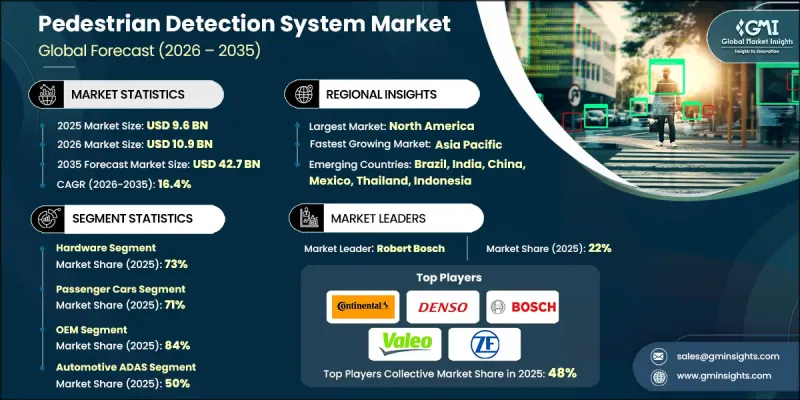
자동차 제조업체들이 도로 안전과 사고 방지 기술을 점점 더 중요시함에 따라 이 시장은 큰 추진력을 보이고 있습니다. 보행자 감지 시스템은 보행자 및 기타 취약한 도로 이용자를 실시간으로 식별할 수 있으며, 현대 차량 안전 아키텍처에서 매우 중요한 역할을 하고 있습니다. 이러한 시스템은 차량 주변의 사람의 움직임을 감지하기 위해 비전 카메라, 레이더, LiDAR, 적외선 센서, 인공지능(AI)을 활용한 이미지 처리 등 첨단 센싱 기술에 의존하고 있습니다. 충돌 위험이 감지되면 시스템은 운전자에게 경고를 보내거나 자동으로 브레이크를 작동시켜 충돌의 충격을 완화하고 사고를 피할 수 있습니다. 지능형 운전 보조 기술에 대한 관심이 높아지면서 여러 차종에 대한 도입이 가속화되고 있습니다. 또한 전 세계 규제 당국과 안전 기관은 차량 안전 기준을 강화하고 있으며, 자동차 제조업체가 신차에 보행자 보호 기능을 탑재할 것을 촉구하고 있습니다. AI 기반 인지 소프트웨어, 센서 융합, 고성능 컴퓨팅 플랫폼의 지속적인 혁신으로 복잡한 교통 환경에서 시스템의 정확성, 신뢰성, 반응성을 더욱 향상시키고 있습니다. 도시화가 진행되고 교통 밀도가 높아짐에 따라 고급 보행자 보호 솔루션에 대한 수요는 꾸준히 증가할 것으로 예상되며, 이는 보행자 감지 시스템 산업의 장기적인 확장을 견인할 것입니다.
| 시장 범위 | |
|---|---|
| 시작연도 | 2025년 |
| 예측 기간 | 2026-2035년 |
| 개시 금액 | 96억 달러 |
| 예측액 | 427억 달러 |
| CAGR | 16.4% |
하드웨어 부문은 2025년 73%의 점유율을 차지하며, 2026-2035년 연평균 복합 성장률(CAGR) 16.5%로 성장할 것으로 전망됩니다. 이 부문에는 카메라 시스템, 레이더 모듈, LiDAR 센서, 적외선 감지 장치, 초음파 센서, 실시간 인식 및 의사결정을 가능하게 하는 전용 처리 장치 등 다양한 센싱 기술이 포함됩니다. 이러한 구성 요소 중 고급 처리 하드웨어는 물체 인식, 분류 및 동작 예측에 사용되는 복잡한 알고리즘을 지원하는 데 있으며, 매우 중요한 역할을 합니다. 자동차 AI 프로세서 및 전자제어장치(ECU)는 하드웨어 부문 가치의 약 18%를 차지하며, 딥러닝 모델과 멀티센서 융합 플랫폼 증가하는 컴퓨팅 요구사항을 충족하기 위해 빠르게 진화하고 있습니다. 제조업체들이 감지 정확도와 응답 시간을 지속적으로 개선하고 있는 가운데, 자동차 산업 전반에 걸쳐 고급 하드웨어 솔루션에 대한 수요는 지속적으로 증가하고 있습니다.
승용차 부문은 2025년 71%의 점유율을 차지했으며, 2026-2035년 연평균 복합 성장률(CAGR) 16.5%를 나타낼 것으로 예측됩니다. 이 부문의 확대는 보행자 자동 긴급 제동 성능 및 취약한 도로 이용자 보호를 강조하는 규제 요건과 소비자 안전 평가 프로그램의 영향을 크게 받고 있습니다. 자동차 제조업체들은 다양한 승용차에 보행자 감지 기술을 표준 안전 기능으로 탑재하는 추세를 보이고 있습니다. 차량 안전에 대한 소비자의 인식이 높아지고 정부의 엄격한 가이드라인이 강화됨에 따라 제조업체들은 보급형부터 프리미엄급 승용차까지 다양한 고급 운전 보조 기능을 탑재하도록 장려하고 있습니다.
미국 보행자 감지 시스템 시장은 2026-2035년 연평균 복합 성장률(CAGR) 16.3%를 나타낼 것으로 예측됩니다. 강력한 규제 프레임워크와 적극적인 차량 안전 기준의 시행으로 첨단운전자보조시스템(ADAS)의 도입이 크게 가속화되고 있습니다. 국가 안전 프로그램 및 연방 정부의 교통 구상에 따라 자동차 제조업체는 다양한 교통 환경에서 주행하는 차량에 보행자 감지 시스템을 장착하도록 권장하고 있습니다. 미국의 자동차 제조업체들은 밀집된 도시 지역과 고속도로망을 포함한 복잡한 교통 시나리오에서 시스템의 안정적인 성능을 보장하기 위해 조사, 시뮬레이션 테스트, 현장 검증에 많은 투자를 하고 있습니다. 기술 혁신, 강력한 자동차 제조거점, 첨단 안전 기능에 대한 소비자 수요 증가와 함께 미국 시장에서의 입지는 지속적으로 강화되고 있습니다.
자주 묻는 질문
목차
제1장 조사 방법
제2장 개요
제3장 업계 인사이트
제4장 경쟁 구도
제5장 시장 추산·예측 : 컴포넌트별, 2022-2035
제6장 시장 추산·예측 : 기술별, 2022-2035
제7장 시장 추산·예측 : 차량별, 2022-2035
제8장 시장 추산·예측 : 유통 채널별, 2022-2035
제9장 시장 추산·예측 : 용도별, 2022-2035
제10장 시장 추산·예측 : 지역별, 2022-2035
제11장 기업 개요
KSA 26.04.20The Global Pedestrian Detection System Market was valued at USD 9.6 billion in 2025 and is estimated to grow at a CAGR of 16.4% to reach USD 42.7 billion by 2035.
The market is gaining significant momentum as vehicle manufacturers increasingly prioritize road safety and accident prevention technologies. Pedestrian detection systems play a critical role in modern vehicle safety architectures by enabling real-time identification of pedestrians and other vulnerable road users. These systems rely on advanced sensing technologies such as vision cameras, radar, LiDAR, infrared sensors, and artificial intelligence-driven image processing to detect human movement near vehicles. Once a potential collision risk is identified, the system can alert drivers or automatically initiate braking to reduce impact severity or avoid accidents. The growing emphasis on intelligent driver assistance technologies is accelerating adoption across multiple vehicle segments. Additionally, regulatory authorities and safety organizations worldwide are strengthening vehicle safety standards, encouraging manufacturers to integrate pedestrian protection features into new vehicles. Continuous innovation in AI-based perception software, sensor fusion, and high-performance computing platforms is further improving system accuracy, reliability, and responsiveness in complex traffic environments. As urbanization increases and traffic density rises, the need for advanced pedestrian protection solutions is expected to grow steadily, driving long-term expansion of the pedestrian detection system industry.
| Market Scope | |
|---|---|
| Start Year | 2025 |
| Forecast Year | 2026-2035 |
| Start Value | $9.6 Billion |
| Forecast Value | $42.7 Billion |
| CAGR | 16.4% |
The hardware segment accounted for 73% share in 2025 and is anticipated to grow at a CAGR of 16.5% between 2026 and 2035. This segment includes a wide range of sensing technologies such as camera systems, radar modules, LiDAR sensors, infrared detection devices, ultrasonic sensors, and dedicated processing units that enable real-time perception and decision-making. Among these components, advanced processing hardware plays a critical role by supporting complex algorithms used for object recognition, classification, and motion prediction. Automotive-grade AI processors and electronic control units represent approximately 18% of the hardware segment value and are evolving rapidly to meet the increasing computational requirements of deep learning models and multi-sensor fusion platforms. As manufacturers continue to improve detection accuracy and response times, demand for advanced hardware solutions remains strong across the automotive industry.
The passenger cars segment held a 71% share in 2025 and is expected to grow at a CAGR of 16.5% throughout 2026-2035. The expansion of this segment is largely influenced by regulatory requirements and consumer safety evaluation programs that emphasize pedestrian automatic emergency braking performance and protection of vulnerable road users. Automakers are increasingly integrating pedestrian detection technologies as standard safety features across a wide range of passenger vehicles. Growing consumer awareness regarding vehicle safety, combined with stricter government guidelines, is encouraging manufacturers to incorporate more advanced driver assistance capabilities in both entry-level and premium passenger vehicles.
United States Pedestrian Detection System Market is projected to grow at a CAGR of 16.3% between 2026 and 2035. Strong regulatory frameworks and active enforcement of vehicle safety standards have significantly accelerated the adoption of advanced driver assistance technologies. National safety programs and federal transportation initiatives are encouraging automakers to incorporate pedestrian detection systems in vehicles operating across various traffic environments. Automotive manufacturers in the country are investing heavily in research, simulation testing, and real-world validation to ensure reliable system performance in complex traffic scenarios, including dense urban areas and high-speed road networks. The combination of technological innovation, strong automotive manufacturing presence, and increasing consumer demand for advanced safety features continues to strengthen the market position of the United States.
Key players operating in the Global Pedestrian Detection System Market include Aptiv, Autoliv, Continental, Denso, Magna, Mobileye, NVIDIA, Robert Bosch, Valeo, and ZF Friedrichshafen. Companies operating in the Pedestrian Detection System Market are adopting several strategies to strengthen their market position and expand technological capabilities. Key players are investing heavily in research and development to improve sensor accuracy, AI perception algorithms, and multi-sensor fusion technologies that enhance detection reliability in challenging environments. Strategic partnerships with automotive manufacturers allow technology providers to integrate pedestrian detection systems directly into vehicle platforms during early design stages. Companies are also focusing on expanding product portfolios with advanced processing hardware, high-resolution sensors, and scalable software architectures. Additionally, firms are increasing investments in simulation tools, testing environments, and data analytics to accelerate innovation and system validation.
Table of Contents
Chapter 1 Methodology
- 1.1 Research approach
- 1.2 Quality commitments
- 1.3 Research trail and confidence scoring
- 1.3.1 Research trail components
- 1.3.2 Scoring components
- 1.4 Data collection
- 1.4.1 Partial list of primary sources
- 1.5 Data mining sources
- 1.5.1 Paid sources
- 1.6 Best estimates and calculations
- 1.6.1 Base year calculation for any one approach
- 1.7 Forecast model
- 1.8 Research transparency addendum
Chapter 2 Executive Summary
- 2.1 Industry 360° synopsis, 2022 - 2035
- 2.2 Key market trends
- 2.2.1 Regional
- 2.2.2 Components
- 2.2.3 Technology
- 2.2.4 Vehicles
- 2.2.5 Distribution Channel
- 2.2.6 Application
- 2.3 TAM Analysis, 2026-2035
- 2.4 CXO perspectives: Strategic imperatives
Chapter 3 Industry Insights
- 3.1 Industry ecosystem analysis
- 3.1.1 Supplier landscape
- 3.1.2 Profit margin analysis
- 3.1.3 Cost structure
- 3.1.4 Value addition at each stage
- 3.1.5 Factor affecting the value chain
- 3.1.6 Disruptions
- 3.2 Industry impact forces
- 3.2.1 Growth drivers
- 3.2.1.1 Increasing pedestrian fatalities and road safety concerns
- 3.2.1.2 Stringent government regulations and mandatory ADAS requirements
- 3.2.1.3 Rising consumer awareness and demand for vehicle safety features
- 3.2.1.4 Technological advancements in AI and machine learning
- 3.2.1.5 Growing adoption of autonomous and semi-autonomous vehicles
- 3.2.1.6 Insurance premium incentives for safety-equipped vehicles
- 3.2.2 Industry pitfalls and challenges
- 3.2.2.1 High initial system costs and affordability barriers
- 3.2.2.2 Performance limitations in adverse weather and low-light conditions
- 3.2.2.3 False detection rates and system reliability concerns
- 3.2.2.4 Complex installation and integration requirements
- 3.2.3 Market opportunities
- 3.2.3.1 Expansion in emerging markets with growing vehicle production
- 3.2.3.2 Aftermarket retrofitting potential for existing vehicle fleet
- 3.2.3.3 Integration with smart city infrastructure and IoT ecosystems
- 3.2.3.4 Cross-industry applications (industrial vehicles, construction equipment)
- 3.2.3.5 Edge computing and on-device AI processing advancements
- 3.2.1 Growth drivers
- 3.3 Growth potential analysis
- 3.4 Regulatory landscape
- 3.4.1 North America
- 3.4.1.1 US- Federal safety rules & ADAS deployment guidance
- 3.4.1.2 Canada - Safety framework for connected & automated vehicles (CASF)
- 3.4.2 Europe
- 3.4.2.1 Germany- Euro NCAP and IIHS testing protocols
- 3.4.2.2 UK- Post-Brexit ADAS flexibility
- 3.4.2.3 France- National ADAS testing & ITS strategy
- 3.4.2.4 Italy- ITS pilots & smart infrastructure
- 3.4.3 Asia Pacific
- 3.4.3.1 China- MIIT C V2X mandates & standards
- 3.4.3.2 India- Emerging ADAS & automotive connectivity regulations
- 3.4.3.3 Japan- ITS connect & spectrum policy
- 3.4.3.4 Australia- Technology neutral ITS policies
- 3.4.4 LATAM
- 3.4.4.1 Mexico- NOM vehicle safety standards
- 3.4.4.2 Argentina- National traffic law 24.449
- 3.4.5 MEA
- 3.4.5.1 South Africa- National road traffic act (1996)
- 3.4.5.2 Saudi Arabia- Traffic law & vision 2030 transport initiatives
- 3.4.1 North America
- 3.5 Porter's analysis
- 3.6 PESTEL analysis
- 3.7 Technology and innovation landscape
- 3.7.1 Current technological trends
- 3.7.1.1 Computer vision and image processing advancements
- 3.7.1.2 Deep learning and neural network integration
- 3.7.2 Emerging technologies
- 3.7.2.1 Sensor fusion technology evolution
- 3.7.2.2 Real-time processing and edge computing
- 3.7.2.3 V2X communication integration
- 3.7.1 Current technological trends
- 3.8 3.5 Patent landscape (Driven by primary research)
- 3.8.1 Key technology patent clusters
- 3.8.2 Major patent holders and innovation leaders
- 3.8.3 Patent filing trends (2019-2025)
- 3.8.4 Emerging patent areas and white space analysis
- 3.9 Cost breakdown analysis
- 3.10 Pricing analysis (Driven by primary research)
- 3.10.1 Historical price trend analysis
- 3.10.2 Pricing strategy by player type (premium, value, cost-plus)
- 3.10.3 OEM versus aftermarket price differential
- 3.10.4 Regional price variations
- 3.11 Trade data analysis (Driven by paid database)
- 3.11.1 Import and export volume and value trends
- 3.11.2 Key trade corridors and tariff impact
- 3.11.3 Regional trade flow patterns
- 3.12 Impact of AI and generative AI on the market
- 3.12.1 AI-driven disruption of existing business models
- 3.12.2 GenAI use cases and adoption roadmap by segment
- 3.12.3 Risks, limitations, and regulatory considerations
- 3.13 Use cases & success stories
- 3.14 Sustainability and environmental aspects
- 3.14.1 Sustainable practices
- 3.14.2 Waste reduction strategies
- 3.14.3 Energy efficiency in production
- 3.14.4 Eco-friendly Initiatives
- 3.14.5 Carbon footprint considerations
- 3.15 Infrastructure and deployment landscape (Driven by primary research)
- 3.15.1 Deployment penetration by region and buyer segment
- 3.15.2 Scalability constraints and infrastructure investment trends
- 3.16 Forecast assumptions & scenario analysis (Driven by Primary Research)
- 3.16.1 Base Case - key macro & industry variables driving CAGR
- 3.16.2 Optimistic Scenarios - Favorable macro and industry tailwinds
- 3.16.3 Pessimistic Scenario - Macroeconomic slowdown or industry headwinds
Chapter 4 Competitive Landscape, 2025
- 4.1 Introduction
- 4.2 Company market share analysis
- 4.2.1 North America
- 4.2.2 Europe
- 4.2.3 Asia Pacific
- 4.2.4 LATAM
- 4.2.5 MEA
- 4.3 Competitive analysis of major market players
- 4.4 Competitive positioning matrix
- 4.5 Company tier benchmarking
- 4.5.1 Tier classification criteria & qualifying thresholds
- 4.5.2 Tier positioning matrix by revenue, geography & innovation
- 4.6 Key developments
- 4.6.1 Mergers & acquisitions
- 4.6.2 Partnerships & collaborations
- 4.6.3 New product launches
- 4.6.4 Expansion plans and funding
Chapter 5 Market Estimates & Forecast, By Component, 2022 - 2035 ($Bn, Units)
- 5.1 Key trends
- 5.2 Hardware
- 5.2.1 Cameras
- 5.2.2 Sensors (Ultrasonic, Infrared, Lidar, Radar)
- 5.2.3 Control units
- 5.2.4 Others
- 5.3 Software
- 5.3.1 Detection algorithms
- 5.3.2 Data processing software
- 5.3.3 Others
Chapter 6 Market Estimates & Forecast, By Technology, 2022 - 2035 ($Bn, Units)
- 6.1 Key trends
- 6.2 Vision-based systems
- 6.3 Sensor fusion systems
- 6.4 Infrared systems
- 6.5 Ultrasonic systems
- 6.6 Hybrid systems
Chapter 7 Market Estimates & Forecast, By Vehicle, 2022 - 2035 ($Bn, Units)
- 7.1 Key trends
- 7.2 Passenger cars
- 7.2.1 Hatchback
- 7.2.2 Sedan
- 7.2.3 SUV
- 7.3 Commercial vehicles
- 7.3.1 Light commercial vehicles (LCVs)
- 7.3.2 Medium commercial vehicles (MCVs)
- 7.3.3 Heavy commercial vehicles (HCVs)
Chapter 8 Market Estimates & Forecast, By Distribution Channel, 2022 - 2035 ($Bn, Units)
- 8.1 Key trends
- 8.2 OEM
- 8.3 Aftermarket
Chapter 9 Market Estimates & Forecast, By Application, 2022 - 2035 ($Bn, Units)
- 9.1 Key trends
- 9.2 Automotive ADAS
- 9.3 Traffic management
- 9.4 Surveillance & safety monitoring
- 9.5 Others
Chapter 10 Market Estimates & Forecast, By Region, 2022 - 2035 ($Bn, Units)
- 10.1 Key trends
- 10.2 North America
- 10.2.1 US
- 10.2.2 Canada
- 10.3 Europe
- 10.3.1 Germany
- 10.3.2 UK
- 10.3.3 France
- 10.3.4 Italy
- 10.3.5 Spain
- 10.3.6 Russia
- 10.3.7 Netherlands
- 10.3.8 Sweden
- 10.3.9 Denmark
- 10.3.10 Poland
- 10.4 Asia Pacific
- 10.4.1 China
- 10.4.2 India
- 10.4.3 Japan
- 10.4.4 Australia
- 10.4.5 South Korea
- 10.4.6 Singapore
- 10.4.7 Thailand
- 10.4.8 Indonesia
- 10.4.9 Vietnam
- 10.5 Latin America
- 10.5.1 Brazil
- 10.5.2 Mexico
- 10.5.3 Argentina
- 10.5.4 Colombia
- 10.6 MEA
- 10.6.1 South Africa
- 10.6.2 Saudi Arabia
- 10.6.3 UAE
- 10.6.4 Israel
Chapter 11 Company Profiles
- 11.1 Global Players
- 11.1.1 Aptiv
- 11.1.2 Autoliv
- 11.1.3 Continental
- 11.1.4 Denso
- 11.1.5 Intel
- 11.1.6 NVIDIA
- 11.1.7 NXP Semiconductors
- 11.1.8 Robert Bosch
- 11.1.9 Valeo
- 11.1.10 ZF Friedrichshafen
- 11.2 Regional Players
- 11.2.1 HELLA
- 11.2.2 Hyundai Mobis
- 11.2.3 Magna International
- 11.2.4 Mobileye
- 11.2.5 Veoneer
- 11.3 Emerging Players & Technology Enablers
- 11.3.1 AEye
- 11.3.2 Innoviz Technologies
- 11.3.3 Luminar Technologies
- 11.3.4 Ouster
- 11.3.5 Perceptive Automata