

|
시장보고서
상품코드
2019062
종이 및 판지 포장 시장 기회, 성장 촉진요인, 업계 동향 분석 및 예측(2026-2035년)Paper and Paperboard Packaging Market Opportunity, Growth Drivers, Industry Trend Analysis, and Forecast 2026 - 2035 |
||||||

세계의 종이 및 판지 포장 시장은 2025년에 3,967억 달러로 평가되었으며, CAGR 5.3%로 성장하여 2035년까지 6,591억 달러에 달할 것으로 추정됩니다.
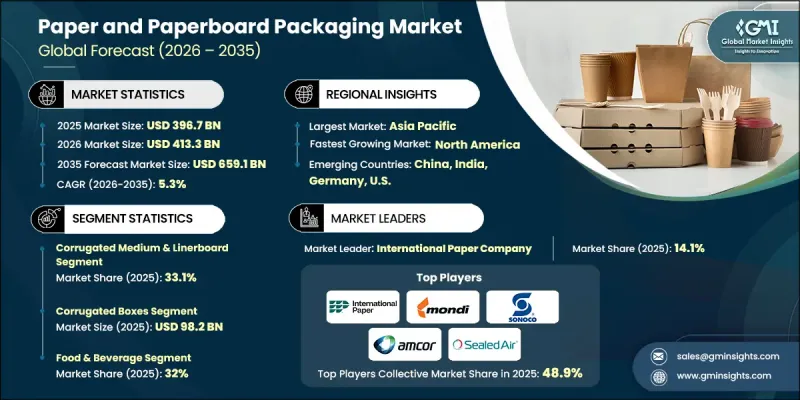
종이 및 판지 포장 산업의 성장은 E-Commerce의 급속한 확장에 의해 주도되고 있습니다. 이로 인해 내구성이 뛰어나고, 가볍고, 비용 효율적인 포장 솔루션에 대한 수요가 크게 증가하고 있습니다. 기업들은 제품을 안전하게 보호하는 동시에 시각적으로 매력적인 디자인을 통해 고객 참여를 높이는 포장을 점점 더 중요하게 여기고 있습니다. 인쇄 기술의 발전으로 보다 개인화된 인터랙티브한 포장 형태가 가능해져 브랜드 커뮤니케이션과 소비자와의 연결이 강화되고 있습니다. 동시에 환경 지속가능성에 대한 인식이 높아짐에 따라 재활용 및 생분해성 소재의 채택이 증가하고 있습니다. 친환경 소비 패턴으로의 전환과 플라스틱 사용 감소에 대한 규제 압력이 더해지면서 종이 기반 대체품에 대한 수요가 가속화되고 있습니다. 또한 소매 및 물류 네트워크의 확장은 시장 성장을 더욱 뒷받침하고 있으며, 종이 및 판지 포장 시장은 현대 공급망에서 중요한 구성요소로 자리 매김하고 있습니다.
| 시장 범위 | |
|---|---|
| 시작 연도 | 2025년 |
| 예측 기간 | 2026-2035년 |
| 시작 시점 시장 규모 | 3,967억 달러 |
| 예측 규모 | 6,591억 달러 |
| CAGR | 5.3% |
종이 및 판지 포장 시장 제조업체들은 대량 유통 채널의 변화하는 요구에 부응하기 위해 강도, 경량화, 경제성, 균형 잡힌 솔루션 개발에 주력하고 있습니다. 제품 보호와 브랜드 인지도를 높이기 위해 내구성과 커스터마이징 능력의 향상이 점점 더 중요해지고 있습니다. 식음료 부문의 수요 증가도 시장 확대에 중요한 역할을 하고 있습니다. 소비 패턴의 변화에 따라 보관 및 운송을 지원하는 신뢰할 수 있는 포장에 대한 요구가 증가하고 있기 때문입니다. 동시에 각 제조사들은 규제 기준과 변화하는 소비자의 기대에 부응하기 위해 지속가능한 소재의 혁신과 환경 부하를 줄이는 데 중점을 두고 있습니다.
화이트 라이닝 마분지 부문은 2026년부터 2035년까지 CAGR 6.9%로 성장할 것으로 예상됩니다. 이 부문은 다재다능함, 시각적 매력, 그리고 지속가능성 트렌드에 대한 적합성으로 인해 점점 더 많은 관심을 받고 있습니다. 고품질 인쇄에 대응하고 친환경적인 포장 옵션을 제공할 수 있다는 특징이 다양한 최종 용도 분야에서의 채택 확대를 촉진하고 있습니다.
골판지 상자 부문은 2025년 982억 달러의 시장 규모를 기록했습니다. 그 강도, 적응성, 재활용 가능성으로 인해 현대 물류 시스템에 매우 적합하여 널리 사용되고 있습니다. 기업이 물류 효율을 최적화하고 고객 만족도를 높이기 위해 직접 배송 모델에 대한 의존도가 높아지고, 보호 포장 솔루션에 대한 수요가 증가함에 따라 수요가 더욱 증가하고 있습니다.
2025년 북미 종이 및 판지 포장 시장은 29.7%의 점유율을 차지했습니다. 이 지역의 시장 성장은 지속가능한 포장 관행의 적극적인 도입과 포장 기술의 발전으로 뒷받침되고 있습니다. 친환경 소재를 장려하고 재활용이 불가능한 포장재에 대한 의존도를 줄이기 위한 규제적 노력은 종이 기반 솔루션의 사용을 촉진하고 있습니다. 지속적인 혁신과 높아진 소비자의 환경 의식은 이 지역 시장에서의 입지를 더욱 공고히 하고 있습니다.
자주 묻는 질문
목차
제1장 조사 방법과 범위
제2장 주요 요약
제3장 업계 인사이트
제4장 경쟁 구도
제5장 시장 추정 및 예측 : 판지 종류별, 2022-2035
제6장 시장 추정 및 예측 : 제품 유형별, 2022-2035
제7장 시장 추정 및 예측 : 용도별, 2022-2035
제8장 시장 추정 및 예측 : 지역별, 2022-2035
제9장 기업 개요
KSM 26.05.06The Global Paper and Paperboard Packaging Market was valued at USD 396.7 billion in 2025 and is estimated to grow at a CAGR of 5.3% to reach USD 659.1 billion by 2035.
Growth in the paper & paperboard packaging industry is driven by the rapid rise of e-commerce, which is significantly increasing the demand for durable, lightweight, and cost-efficient packaging solutions. Businesses are increasingly prioritizing packaging that ensures product protection while also enhancing customer engagement through visually appealing designs. Advancements in printing technologies are enabling more personalized and interactive packaging formats, strengthening brand communication and consumer connection. At the same time, growing awareness around environmental sustainability is encouraging the adoption of recyclable and biodegradable materials. The shift toward eco-conscious consumption patterns, combined with regulatory pressure to reduce plastic usage, is accelerating demand for paper-based alternatives. Additionally, the expansion of retail and logistics networks is further supporting market growth, positioning the paper & paperboard packaging market as a critical component of modern supply chains.
| Market Scope | |
|---|---|
| Start Year | 2025 |
| Forecast Year | 2026-2035 |
| Start Value | $396.7 Billion |
| Forecast Value | $659.1 Billion |
| CAGR | 5.3% |
Manufacturers in the paper & paperboard packaging market are focusing on developing solutions that balance strength, lightweight properties, and affordability to meet the evolving needs of high-volume distribution channels. Enhancing durability and customization capabilities is becoming increasingly important to improve product protection and brand visibility. Rising demand from the food and beverage sector is also playing a crucial role in market expansion, as changing consumption patterns are increasing the need for reliable packaging that supports storage and transportation. At the same time, producers are emphasizing sustainable material innovation and reducing environmental impact to align with regulatory standards and shifting consumer expectations.
The white-lined chipboard segment is expected to grow at a CAGR of 6.9% during 2026-2035. This segment is gaining momentum due to its versatility, visual appeal, and alignment with sustainability trends. Its ability to support high-quality printing and provide an environmentally responsible packaging option is encouraging broader adoption across multiple end-use applications.
The corrugated boxes segment generated USD 98.2 billion in 2025. Their widespread use is supported by their strength, adaptability, and recyclability, making them highly suitable for modern distribution systems. Increasing reliance on direct delivery models and the need for protective packaging solutions are further driving demand, as businesses seek to optimize logistics efficiency and enhance customer satisfaction.
North America Paper and Paperboard Packaging Market accounted for 29.7% share in 2025. Market growth in the region is being supported by strong adoption of sustainable packaging practices and advancements in packaging technologies. Regulatory initiatives promoting environmentally friendly materials and reducing reliance on non-recyclable packaging are encouraging the use of paper-based solutions. Continuous innovation and growing environmental awareness among consumers are further reinforcing the region's position in the market.
Key players operating in the Global Paper and Paperboard Packaging Market include Amcor, Billerud AB, Eastern Pak Limited, Georgia-Pacific Corporation, International Paper Company, Mondi Group, Nippon Paper Industries Ltd, Oji Holdings Corporation, Packaging Corporation of America, and Pactiv Evergreen Inc. Companies in the Global Paper and Paperboard Packaging Market are prioritizing sustainable innovation by developing recyclable, biodegradable, and lightweight materials to meet regulatory and consumer expectations. They are investing in advanced manufacturing and printing technologies to enhance product quality, customization, and operational efficiency. Expanding production capacities and strengthening supply chain networks are key strategies to support growing global demand. Firms are also focusing on strategic partnerships and acquisitions to broaden their market presence and technological capabilities. Additionally, companies are emphasizing cost optimization, product differentiation, and eco-friendly solutions to remain competitive, while leveraging digital tools to improve customer engagement and streamline packaging design and delivery processes.
Table of Contents
Chapter 1 Methodology and Scope
- 1.1 Market scope and definition
- 1.2 Research design
- 1.2.1 Research approach
- 1.2.2 Data collection methods
- 1.3 Data mining sources
- 1.3.1 Global
- 1.3.2 Regional/Country
- 1.4 Base estimates and calculations
- 1.4.1 Base year calculation
- 1.4.2 Key trends for market estimation
- 1.5 Primary research and validation
- 1.5.1 Primary sources
- 1.6 Forecast model
- 1.7 Research assumptions and limitations
Chapter 2 Executive Summary
- 2.1 Industry 360° synopsis, 2022 - 2035
- 2.2 Key market trends
- 2.2.1 Paperboard grade trends
- 2.2.2 Product type trends
- 2.2.3 Application trends
- 2.2.4 Regional trends
- 2.3 TAM Analysis, 2026-2035
- 2.4 CXO perspectives: Strategic imperatives
Chapter 3 Industry Insights
- 3.1 Industry ecosystem analysis
- 3.1.1 Supplier Landscape
- 3.1.2 Profit Margin
- 3.1.3 Cost structure
- 3.1.4 Value addition at each stage
- 3.1.5 Factor affecting the value chain
- 3.1.6 Disruptions
- 3.2 Industry impact forces
- 3.2.1 Growth drivers
- 3.2.1.1 Regulatory support from government
- 3.2.1.2 Shift towards sustainable packaging
- 3.2.1.3 Rising demand from food & beverage industry
- 3.2.1.4 Surge in e-commerce sector
- 3.2.1.5 Cost-effectiveness and recyclability
- 3.2.2 Industry pitfalls and challenges
- 3.2.2.1 Durability Limitations
- 3.2.2.2 Recycling Infrastructure
- 3.2.3 Market opportunities
- 3.2.3.1 Increasing substitution of plastic with fiber-based packaging
- 3.2.3.2 Premiumization and customization in consumer packaging
- 3.2.1 Growth drivers
- 3.3 Growth potential analysis
- 3.4 Regulatory landscape
- 3.4.1 North America
- 3.4.2 Europe
- 3.4.3 Asia Pacific
- 3.4.4 Latin America
- 3.4.5 Middle East & Africa
- 3.5 Porter's analysis
- 3.6 PESTEL analysis
- 3.7 Technology and Innovation landscape
- 3.7.1 Current technological trends
- 3.7.2 Emerging technologies
- 3.8 Emerging business models
- 3.9 Compliance requirements
- 3.10 Sustainability measures
- 3.10.1 Sustainable materials assessment
- 3.10.2 Carbon footprint analysis
- 3.10.3 Circular economy implementation
- 3.10.4 Sustainability certifications and standards
- 3.10.5 Sustainability roi analysis
- 3.11 Global consumer sentiment analysis
- 3.12 Patent analysis
Chapter 4 Competitive Landscape, 2025
- 4.1 Introduction
- 4.2 Company market share analysis
- 4.2.1 By region
- 4.2.1.1 North America
- 4.2.1.2 Europe
- 4.2.1.3 Asia Pacific
- 4.2.1.4 Latin America
- 4.2.1.5 Middle East & Africa
- 4.2.2 Market concentration analysis
- 4.2.1 By region
- 4.3 Competitive benchmarking of key players
- 4.3.1 Financial performance comparison
- 4.3.1.1 Revenue
- 4.3.1.2 Profit margin
- 4.3.1.3 R&D
- 4.3.2 Product portfolio comparison
- 4.3.2.1 Product range breadth
- 4.3.2.2 Technology
- 4.3.2.3 Innovation
- 4.3.3 Geographic presence comparison
- 4.3.3.1 Global footprint analysis
- 4.3.3.2 Service network coverage
- 4.3.3.3 Market penetration by region
- 4.3.4 Competitive positioning matrix
- 4.3.4.1 Leaders
- 4.3.4.2 Challengers
- 4.3.4.3 Followers
- 4.3.4.4 Niche players
- 4.3.5 Strategic outlook matrix
- 4.3.1 Financial performance comparison
- 4.4 Key developments
- 4.4.1 Mergers and acquisitions
- 4.4.2 Partnerships and collaborations
- 4.4.3 Technological advancements
- 4.4.4 Expansion and investment strategies
- 4.4.5 Digital transformation initiatives
- 4.5 Emerging/ startup competitors landscape
Chapter 5 Market Estimates and Forecast, By Paperboard Grade, 2022 - 2035 (USD Billion & Kilo Tons)
- 5.1 Key trends
- 5.2 Solid bleached sulfate (SBS)
- 5.3 White lined chipboard (WLC)
- 5.4 Corrugated medium & linerboard
- 5.5 Kraft paper
- 5.6 Others
Chapter 6 Market Estimates and Forecast, By Product Type, 2022 - 2035 (USD Billion & Kilo Tons)
- 6.1 Key trends
- 6.2 Corrugated boxes
- 6.3 Paper bags & sacks
- 6.4 Folding cartons
- 6.5 Wraps
- 6.6 Pouches & sachets
- 6.7 Cups & trays
- 6.8 Others
Chapter 7 Market Estimates and Forecast, By Application, 2022 - 2035 (USD Billion & Kilo Tons)
- 7.1 Key trends
- 7.2 Food & beverage
- 7.2.1 Bakery & confectionery
- 7.2.2 Dairy products
- 7.2.3 Ready-to-eat meals
- 7.2.4 Beverages
- 7.3 Personal care & cosmetics
- 7.3.1 Skincare
- 7.3.2 Fragrance & perfume
- 7.3.3 Cosmetics & color products
- 7.3.4 Hygiene products
- 7.3.5 Others
- 7.4 Pharmaceutical & healthcare
- 7.4.1 OTC medicines
- 7.4.2 Prescription drugs
- 7.4.3 Medical devices
- 7.4.4 Nutraceuticals
- 7.5 Automotive
- 7.5.1 Spare parts
- 7.5.2 Lubricants & fluids
- 7.5.3 Others
- 7.6 Consumer electronics
- 7.7 Others
Chapter 8 Market Estimates and Forecast, By Region, 2022 - 2035 (USD Billion & Kilo Tons)
- 8.1 Key trends
- 8.2 North America
- 8.2.1 U.S.
- 8.2.2 Canada
- 8.3 Europe
- 8.3.1 Germany
- 8.3.2 UK
- 8.3.3 France
- 8.3.4 Spain
- 8.3.5 Italy
- 8.3.6 Russia
- 8.3.7 Rest of Europe
- 8.4 Asia Pacific
- 8.4.1 China
- 8.4.2 India
- 8.4.3 Japan
- 8.4.4 Australia
- 8.4.5 South Korea
- 8.4.6 Rest of Asia Pacific
- 8.5 Latin America
- 8.5.1 Brazil
- 8.5.2 Mexico
- 8.5.3 Argentina
- 8.5.4 Rest of Latin America
- 8.6 Middle East and Africa
- 8.6.1 South Africa
- 8.6.2 Saudi Arabia
- 8.6.3 UAE
- 8.6.4 Rest of Middle East & Africa
Chapter 9 Company Profiles
- 9.1 Global Key Players
- 9.1.1 International Paper Company
- 9.1.2 Mondi Group
- 9.1.3 Sonoco Products Company
- 9.1.4 Amcor
- 9.1.5 Sealed Air
- 9.2 Regional key players
- 9.2.1 Billerud AB
- 9.2.2 Georgia-Pacific Corporation
- 9.2.3 Nippon Paper Industries Ltd
- 9.2.4 Oji Holdings Corporation
- 9.2.5 Packaging Corporation of America
- 9.2.6 Pactiv Evergreen Inc.
- 9.2.7 Rengo Co., Ltd.
- 9.2.8 Sappi
- 9.2.9 Smurfit Westrock
- 9.2.10 Stora Enso Oyj
- 9.2.11 Proampac
- 9.3 Niche Players/Disruptors
- 9.3.1 Eastern Pak Limited
- 9.3.2 Trident Paper Box Industries


