|
시장보고서
상품코드
2019083
팔레트 시장 기회, 성장 촉진요인, 업계 동향 분석 및 예측(2026-2035년)Pallets Market Opportunity, Growth Drivers, Industry Trend Analysis, and Forecast 2026 - 2035 |
||||||

세계의 팔레트 시장은 2025년에 883억 달러로 평가되었으며, CAGR 5.8%로 성장하여 2035년에는 1,545억 달러에 달할 것으로 추정됩니다.
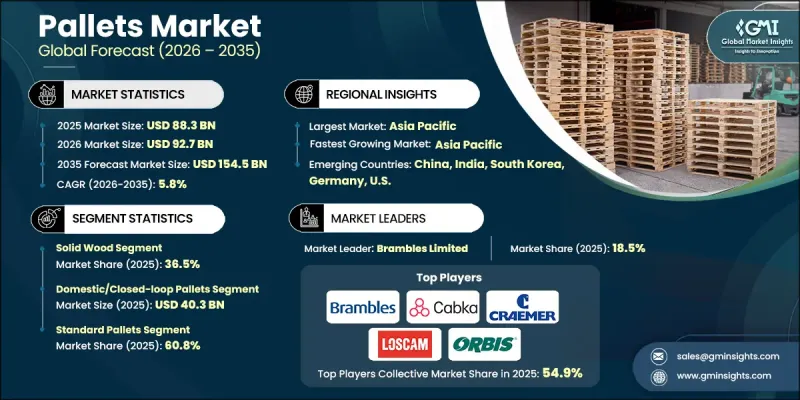
이러한 시장 확대는 E-Commerce 풀필먼트 네트워크의 성장, FMCG(일용소비재) 및 식품 유통 부문의 수요 증가, 팔레트 풀링 및 렌탈 모델 도입 확대에 기인합니다. 기업들은 자동화된 창고 및 세계 물류 업무의 효율화를 위해 표준화된 자재 취급 솔루션을 요구하고 있습니다. 또한, 지속가능하고 재사용 및 재활용이 가능한 팔레트 재료로의 전환과 국경을 초월한 무역 활동의 확대가 결합되어 시장 확대를 더욱 촉진하고 있습니다. 효율적인 팔레트 시스템은 운영 비용 절감, 공급망 복원력 강화, 창고 및 운송 네트워크 간의 원활한 상호 운용성 확보에 기여합니다. 또한, 콜드체인 물류와 대량 소매업에 대한 관심이 높아지고 있는 것도 도입에 힘을 실어주고 있습니다. 기업은 공급망 전반에 걸쳐 제품의 품질을 유지하고, 프로세스를 간소화하며, 지속가능성 목표를 달성하기 위해 노력하고 있기 때문입니다.
| 시장 범위 | |
|---|---|
| 시작 연도 | 2025년 |
| 예측 기간 | 2026-2035년 |
| 시작 시점 시장 규모 | 883억 달러 |
| 예측 규모 | 1,545억 달러 |
| CAGR | 5.8% |
플라스틱 팔레트 시장은 위생과 내구성이 매우 중요한 식품, 제약, 화학 산업에서 강한 수요를 바탕으로 2035년까지 연평균 7%의 성장률을 보일 것으로 예상됩니다. 플라스틱 팔레트는 내습성, 높은 내구성, 최신 자재 취급 시스템과의 호환성을 갖추고 있어 운영 및 비용 측면 모두에서 이점을 제공합니다. 재사용 가능한 포장 솔루션에 대한 관심이 높아지면서 각 업계에서 재사용 가능한 포장 솔루션에 대한 도입이 더욱 가속화되고 있습니다.
풀 팔레트 부문은 2026년부터 2035년까지 CAGR 6.2%로 성장할 것으로 예상됩니다. 공유 팔레트 시스템을 통해 기업은 초기 투자를 줄이면서 공급망 효율성을 향상시킬 수 있습니다. 기업들은 팔레트 품질 표준화, 역물류 단순화, 확장성을 실현하기 위해 렌탈 및 풀링 모델을 채택하고 있습니다. 이러한 솔루션은 지속가능성 이니셔티브를 지원하기 때문에 FMCG(일용소비재), 소매 및 세계 물류 비즈니스에 매우 매력적인 솔루션입니다.
북미 팔레트 시장은 2025년 29.1%의 점유율을 차지했습니다. 이 지역의 성장은 대규모 물류 네트워크의 확장, 창고 자동화의 발전, 소매, FMCG, 제조업의 수요 증가에 의해 뒷받침되고 있습니다. 이 지역은 재사용이 가능하고 표준화된 팔레트가 널리 사용되는 팔레트 풀링 생태계가 잘 구축되어 있는 혜택을 누리고 있습니다. 또한, 현대화된 물류 인프라와 강력한 공급망 시스템에 대한 정부 및 업계의 투자도 시장 확대를 촉진하고 있습니다.
자주 묻는 질문
목차
제1장 조사 방법과 범위
제2장 주요 요약
제3장 업계 인사이트
제4장 경쟁 구도
제5장 시장 추정 및 예측 : 소재 유형별, 2022-2035
제6장 시장 추정 및 예측 : 구조별, 2022-2035
제7장 시장 추정 및 예측 : 용도별, 2022-2035
제8장 시장 추정 및 예측 : 제공 형태별, 2022-2035
제9장 시장 추정 및 예측 : 팔레트 사이즈 규격별, 2022-2035
제10장 시장 추정 및 예측 : 최종 이용 산업별, 2022-2035
제11장 시장 추정 및 예측 : 지역별, 2022-2035
제12장 기업 개요
KSM 26.05.06The Global Pallets Market was valued at USD 88.3 billion in 2025 and estimated to grow at a CAGR of 5.8% to reach USD 154.5 billion in 2035.
The market is expanding due to the growth of e-commerce fulfillment networks, rising demand from FMCG and food distribution sectors, and the increasing adoption of pallet pooling and rental models. Businesses are seeking standardized material handling solutions to improve efficiency in automated warehousing and global logistics operations. Additionally, the shift toward sustainable, reusable, and recyclable pallet materials, coupled with growing cross-border trade activities, is further fueling market expansion. Efficient pallet systems help reduce operational costs, enhance supply chain resilience, and support seamless interoperability across warehouses and transport networks. The growing focus on cold chain logistics and high-volume retail operations is also driving adoption, as companies aim to maintain product quality, streamline processes, and achieve sustainability goals throughout the supply chain.
| Market Scope | |
|---|---|
| Start Year | 2025 |
| Forecast Year | 2026-2035 |
| Start Value | $88.3 Billion |
| Forecast Value | $154.5 Billion |
| CAGR | 5.8% |
The plastic pallets segment is expected to grow at a CAGR of 7% through 2035, owing to strong demand from the food, pharmaceutical, and chemical industries, where hygiene and durability are critical. Plastic pallets offer moisture resistance, high longevity, and compatibility with modern material handling systems, providing both operational and cost advantages. The increasing focus on reusable packaging solutions is further accelerating adoption across sectors.
The pooling pallets segment is forecast to grow at a CAGR of 6.2% during 2026-2035. Shared pallet systems allow businesses to reduce upfront investment while improving supply chain efficiency. Companies are adopting rental and pooling models to ensure standardized pallet quality, simplify reverse logistics, and achieve scalability. These solutions also support sustainability initiatives, making them highly attractive for FMCG, retail, and global logistics operations.
North America Pallets Market accounted for 29.1% share in 2025. The growth in the region is supported by expanding high-volume logistics networks, rising warehouse automation, and increasing demand from retail, FMCG, and manufacturing industries. The region benefits from a well-established pallet pooling ecosystem, with extensive use of reusable and standardized pallets. Government and industry investments in modernized logistics infrastructure and resilient supply chain systems are also driving market expansion.
Key players operating in the Global Pallets Market include Brambles Limited, CABKA, Craemer Holding GmbH, DNA Packaging Systems, Falkenhahn AG, Hemant Wooden Packaging, Loscam International Holdings Co., Limited, MAPAC TECHNOLOGY, Nefab Group, Nilkamal Material Handling, ORBIS Corporation, PGS Group, Radha Agro Industries, RAMDEV WOOD, Rehrig Pacific Company, Schoeller Allibert, Shree Ganesh Packers, UFP Industries Inc., WOOD PAKER, and World Steel Pallet Co. Ltd. Companies in the pallets market are strengthening their presence by investing in advanced manufacturing facilities and expanding production capacities to meet rising demand. They are focusing on developing reusable, recyclable, and lightweight pallet solutions to appeal to sustainability-conscious customers. Partnerships with e-commerce fulfillment centers, FMCG distributors, and global logistics companies enhance market penetration. Firms are leveraging pooling and rental models to provide scalable and standardized solutions while reducing supply chain costs. Additionally, investments in automation compatibility, digital tracking, and warehouse integration ensure operational efficiency and long-term market competitiveness.
Table of Contents
Chapter 1 Methodology and Scope
- 1.1 Market scope and definition
- 1.2 Research design
- 1.2.1 Research approach
- 1.2.2 Data collection methods
- 1.3 Data mining sources
- 1.3.1 Global
- 1.3.2 Regional/Country
- 1.4 Base estimates and calculations
- 1.4.1 Base year calculation
- 1.4.2 Key trends for market estimation
- 1.5 Primary research and validation
- 1.5.1 Primary sources
- 1.6 Forecast model
- 1.7 Research assumptions and limitations
Chapter 2 Executive Summary
- 2.1 Industry 360° synopsis, 2022 - 2035
- 2.2 Key market trends
- 2.2.1 Material type trends
- 2.2.2 Design trends
- 2.2.3 Usage type trends
- 2.2.4 Offering type trends
- 2.2.5 Pallet size standard trends
- 2.2.6 End-use industry trends
- 2.2.7 Regional trends
- 2.3 TAM Analysis, 2026-2035
- 2.4 CXO perspectives: Strategic imperatives
Chapter 3 Industry Insights
- 3.1 Industry ecosystem analysis
- 3.1.1 Supplier Landscape
- 3.1.2 Profit Margin
- 3.1.3 Cost structure
- 3.1.4 Value addition at each stage
- 3.1.5 Factor affecting the value chain
- 3.1.6 Disruptions
- 3.2 Industry impact forces
- 3.2.1 Growth drivers
- 3.2.1.1 Rapid e-commerce fulfillment network expansion
- 3.2.1.2 Rising FMCG and food distribution volumes
- 3.2.1.3 Standardization in global logistics and warehousing systems
- 3.2.1.4 Automation in warehouses requiring standardized pallet formats
- 3.2.1.5 Increasing adoption of pallet pooling services
- 3.2.2 Industry pitfalls and challenges
- 3.2.2.1 Volatility in timber prices impacting wood pallets
- 3.2.2.2 Limited recycling infrastructure in emerging markets
- 3.2.3 Market opportunities
- 3.2.3.1 Expansion of plastic pallets in hygiene-sensitive industries
- 3.2.3.2 Integration of RFID and IoT-enabled smart pallets
- 3.2.1 Growth drivers
- 3.3 Growth potential analysis
- 3.4 Regulatory landscape
- 3.4.1 North America
- 3.4.2 Europe
- 3.4.3 Asia Pacific
- 3.4.4 Latin America
- 3.4.5 Middle East & Africa
- 3.5 Porter's analysis
- 3.6 PESTEL analysis
- 3.7 Technology and Innovation landscape
- 3.7.1 Current technological trends
- 3.7.2 Emerging technologies
- 3.8 Price trends
- 3.8.1 By region
- 3.8.2 By product
- 3.9 Pricing Strategies
- 3.10 Emerging Business Models
- 3.11 Compliance Requirements
- 3.12 Patent and IP analysis
Chapter 4 Competitive Landscape, 2025
- 4.1 Introduction
- 4.2 Company market share analysis
- 4.2.1 By region
- 4.2.1.1 North America
- 4.2.1.2 Europe
- 4.2.1.3 Asia Pacific
- 4.2.1.4 Latin America
- 4.2.1.5 Middle East & Africa
- 4.2.2 Market concentration analysis
- 4.2.1 By region
- 4.3 Competitive benchmarking of key players
- 4.3.1 Financial performance comparison
- 4.3.1.1 Revenue
- 4.3.1.2 Profit margin
- 4.3.1.3 R&D
- 4.3.2 Product portfolio comparison
- 4.3.2.1 Product range breadth
- 4.3.2.2 Technology
- 4.3.2.3 Innovation
- 4.3.3 Geographic presence comparison
- 4.3.3.1 Global footprint analysis
- 4.3.3.2 Service network coverage
- 4.3.3.3 Market penetration by region
- 4.3.4 Competitive positioning matrix
- 4.3.4.1 Leaders
- 4.3.4.2 Challengers
- 4.3.4.3 Followers
- 4.3.4.4 Niche players
- 4.3.5 Strategic outlook matrix
- 4.3.1 Financial performance comparison
- 4.4 Key developments
- 4.4.1 Mergers and acquisitions
- 4.4.2 Partnerships and collaborations
- 4.4.3 Technological advancements
- 4.4.4 Expansion and investment strategies
- 4.4.5 Digital transformation initiatives
- 4.5 Emerging/ startup competitors landscape
Chapter 5 Market Estimates and Forecast, By Material Type, 2022 - 2035 (USD Million)
- 5.1 Key trends
- 5.2 Solid wood
- 5.3 Composite / engineered wood
- 5.4 Plastic
- 5.5 Metal
- 5.6 Corrugated paper / cardboard
Chapter 6 Market Estimates and Forecast, By Design, 2022 - 2035 (USD Million)
- 6.1 Key trends
- 6.2 Block pallets
- 6.3 Stringer pallets
- 6.4 Single-face pallets
- 6.5 Double-face pallets
- 6.6 Reversible pallets
- 6.7 Non-reversible pallets
Chapter 7 Market Estimates and Forecast, By Usage Type, 2022 - 2035 (USD Million)
- 7.1 Key trends
- 7.2 Domestic / closed-loop pallets
- 7.3 Export / one-way pallets
- 7.4 Pooling pallets
Chapter 8 Market Estimates and Forecast, By Offering Type, 2022 - 2035 (USD Million)
- 8.1 Key trends
- 8.2 Pallet manufacturing & sales
- 8.3 Pallet pooling & rental services
- 8.4 Pallet repair & refurbishment
- 8.5 Pallet recycling
Chapter 9 Market Estimates and Forecast, By Pallet Size Standard, 2022 - 2035 (USD Million)
- 9.1 Key trends
- 9.2 Standard pallets
- 9.3 Custom pallets
Chapter 10 Market Estimates and Forecast, By End-Use Industry, 2022 - 2035 (USD Million)
- 10.1 Key trends
- 10.2 Food & beverage
- 10.3 Retail & e-commerce
- 10.4 Pharmaceuticals & healthcare
- 10.5 Chemicals & petrochemicals
- 10.6 Automotive & manufacturing
- 10.7 Logistics & 3PL
- 10.8 Agriculture
- 10.9 Consumer goods
- 10.10 Others
Chapter 11 Market Estimates and Forecast, By Region, 2022 - 2035 (USD Million)
- 11.1 Key trends
- 11.2 North America
- 11.2.1 U.S.
- 11.2.2 Canada
- 11.3 Europe
- 11.3.1 Germany
- 11.3.2 UK
- 11.3.3 France
- 11.3.4 Spain
- 11.3.5 Italy
- 11.3.6 Netherlands
- 11.4 Asia Pacific
- 11.4.1 China
- 11.4.2 India
- 11.4.3 Japan
- 11.4.4 Australia
- 11.4.5 South Korea
- 11.5 Latin America
- 11.5.1 Brazil
- 11.5.2 Mexico
- 11.5.3 Argentina
- 11.6 Middle East and Africa
- 11.6.1 South Africa
- 11.6.2 Saudi Arabia
- 11.6.3 UAE
Chapter 12 Company Profiles
- 12.1 Global Key Players
- 12.1.1 Brambles Limited
- 12.1.2 Loscam International Holdings Co., Limited
- 12.1.3 Nefab Group
- 12.1.4 Schoeller Allibert
- 12.1.5 UFP Industries Inc.
- 12.2 Regional key players
- 12.2.1 North America
- 12.2.1.1 ORBIS Corporation
- 12.2.1.2 Rehrig Pacific Company
- 12.2.2 Asia Pacific
- 12.2.2.1 Nilkamal Material Handling
- 12.2.2.2 World Steel Pallet Co. Ltd
- 12.2.3 Europe
- 12.2.3.1 CABKA
- 12.2.3.2 Craemer Holding GmbH
- 12.2.3.3 Falkenhahn AG
- 12.2.1 North America
- 12.3 Niche Players/Disruptors
- 12.3.1 DNA Packaging Systems
- 12.3.2 Hemant Wooden Packaging
- 12.3.3 MAPAC TECHNOLOGY
- 12.3.4 PGS Group
- 12.3.5 Radha Agro Industries
- 12.3.6 RAMDEV WOOD
- 12.3.7 Shree Ganesh Packers
- 12.3.8 WOOD PAKER