
|
시장보고서
상품코드
2019128
정지형 열량계 시장 기회, 성장요인, 업계 동향 분석 및 예측(2026-2035년)Static Heat Meters Market Opportunity, Growth Drivers, Industry Trend Analysis, and Forecast 2026 - 2035 |
||||||

세계의 정지형 열량계 시장은 2025년에 26억 달러로 평가되고 CAGR 6.4%로 성장하며, 2035년까지 47억 달러에 달할 것으로 추정되고 있습니다.
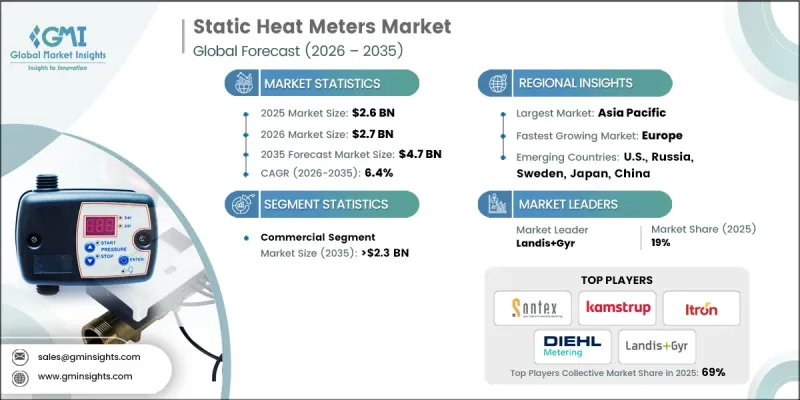
고정식 열량계는 움직이는 부품을 사용하지 않고 난방 시스템에서 열에너지 소비 및 전달량을 측정하도록 설계된 솔리드 스테이트 장치로, 높은 내구성, 정확성 및 장기적인 신뢰성을 보장합니다. 에너지 절약 노력, 전자 청구의 발전, 안정적이고 정확한 측정 시스템에 대한 요구로 인해 스마트 미터링 솔루션에 대한 수요가 증가함에 따라 이 제품의 보급이 촉진되고 있습니다. 실시간 모니터링을 통한 지속가능한 열 관리에 대한 관심이 높아진 데다 정밀한 데이터 수집의 기술 혁신이 더해져 제품의 시장 침투가 가속화되고 있습니다. 탄소 배출에 대한 정부 규제 강화, 에너지 효율이 높은 솔루션에 대한 인센티브, 지역 난방 시스템에서 비용 효율적인 측정에 대한 추진은 유리한 시장 환경을 조성하고 있습니다. 한편, 지속가능성과 정확한 청구에 대한 중요성이 높아짐에 따라 글로벌 수요는 계속 증가하고 있습니다.
| 시장 범위 | |
|---|---|
| 시작연도 | 2025년 |
| 예측 기간 | 2026-2035년 |
| 개시 금액 | 26억 달러 |
| 예측액 | 47억 달러 |
| CAGR | 6.4% |
상업용 부문은 에너지 효율화 의무화, 지역 열 공급 네트워크 확대, 스마트 빌딩 기술 통합으로 인해 2035년까지 23억 달러에 달할 것으로 예상됩니다. 이러한 수요는 비용 효율적인 설계, 내구성 및 정확한 측정 기능을 통해 정밀한 열 모니터링과 맞춤형 과금 솔루션을 가능하게 하는 비용 효율적인 설계로 지원됩니다.
미국의 고정식 열량계 시장은 지속가능성, 규제 동향, 스마트 인프라 도입에 힘입어 2035년까지 3억 달러 규모에 달할 것으로 전망됩니다. 고정식 열량계를 HVAC 시스템, 온도 조절기, 에너지 모니터링 플랫폼과 통합하면 효율적인 에너지 추적이 가능해져 낭비를 줄이고, 비용을 절감하며, 거주자의 편안함을 향상시킬 수 있으며, 이 모든 것이 결합되어 시장 성장을 주도하고 있습니다.
자주 묻는 질문
목차
제1장 조사 방법과 범위
제2장 개요
제3장 업계 인사이트
제4장 경쟁 구도
제5장 시장 규모·예측 : 용도별, 2022-2035년
제6장 시장 규모·예측 : 지역별, 2022-2035년
제7장 기업 개요
KSA 26.05.13The Global Static Heat Meters Market was valued at USD 2.6 billion in 2025 and is estimated to grow at a CAGR of 6.4% to reach USD 4.7 billion by 2035.
Static heat meters are solid-state devices designed to measure thermal energy consumption or transfer in heating systems without any moving components, ensuring high durability, precision, and long-term reliability. The rising demand for smart metering solutions is driving widespread adoption, fueled by energy-saving initiatives, electronic billing advancements, and the need for stable, accurate measurement systems. Increasing focus on sustainable heat management with real-time monitoring, coupled with technological innovations in precision data collection, is enhancing product penetration. Stricter government regulations on carbon emissions, incentives for energy-efficient solutions, and the push for cost-effective metering in district heating systems are creating a favorable market environment, while the growing emphasis on sustainability and accurate billing continues to strengthen demand globally.
| Market Scope | |
|---|---|
| Start Year | 2025 |
| Forecast Year | 2026-2035 |
| Start Value | $2.6 Billion |
| Forecast Value | $4.7 Billion |
| CAGR | 6.4% |
The commercial applications segment is expected to reach USD 2.3 billion by 2035 due to mandates for energy efficiency, expansion of district heating networks, and the integration of smart building technologies. The demand is supported by cost-effective designs, durability, and accurate measurement capabilities, enabling precise heat monitoring and customized billing solutions.
U.S. Static Heat Meters Market is forecast to reach USD 0.3 billion by 2035, driven by sustainability initiatives, regulatory developments, and the adoption of smart infrastructure. Integration of static heat meters with HVAC systems, thermostats, and energy monitoring platforms allows efficient energy tracking, reduces waste, lowers costs, and enhances occupant comfort, which collectively drives growth.
Prominent players in the Global Static Heat Meters Market include ABB, Apator S.A., Axioma Metering UAB, BMETERS, Danfoss, Diehl Stiftung & Co. KG, Engelmann Sensor GmbH, Huizhong Instrumentation, Itron, Kamstrup, Landis+Gyr AG, Metrix Polska, Micronics, QUNDIS, Schneider Electric, Siemens, Sensus, Sontex, Techem, and ZENNER International. Companies in the static heat meters market strengthen their position by investing in R&D to develop more accurate, durable, and energy-efficient devices, expanding their smart metering solutions, and offering integration with digital energy management platforms. Strategic collaborations and partnerships with utility providers and technology companies accelerate innovation and adoption. Firms also target emerging markets by customizing products for local heating systems and regulatory requirements. Offering comprehensive after-sales services, remote monitoring, and training programs builds customer trust. Focus on sustainable manufacturing, cost optimization, and scalable production further enhances market foothold while ensuring compliance with global energy standards.
Table of Contents
Chapter 1 Methodology & Scope
- 1.1 Research design
- 1.2 Quality commitment
- 1.2.1 GMI AI policy & data integrity commitment
- 1.2.1.1 Source consistency protocol
- 1.2.1 GMI AI policy & data integrity commitment
- 1.3 Research trail & Confidence Scoring
- 1.3.1 Research trail components
- 1.3.2 Scoring components
- 1.4 Data Collection
- 1.4.1 Partial list of primary sources
- 1.5 Data mining sources
- 1.5.1 Paid sources
- 1.5.1.1 Sources, by region
- 1.5.1 Paid sources
- 1.6 Base estimates and calculations
- 1.6.1 Base year calculation for any one approach
- 1.7 Forecast model
- 1.8 Research transparency addendum
- 1.8.1 Source attribution framework
- 1.8.2 Quality assurance metrics
- 1.8.3 Our commitment to trust
- 1.9 Market definitions
Chapter 2 Executive Summary
- 2.1 Industry 360-degree synopsis, 2022 - 2035
- 2.2 Business trends
- 2.3 Product trends
- 2.4 Application trends
- 2.5 Regional trends
Chapter 3 Industry Insights
- 3.1 Industry ecosystem
- 3.2 Regulatory landscape
- 3.3 Industry impact forces
- 3.3.1 Growth drivers
- 3.3.2 Industry pitfalls & challenges
- 3.4 Growth potential analysis
- 3.5 Porter's analysis
- 3.5.1 Bargaining power of suppliers
- 3.5.2 Bargaining power of buyers
- 3.5.3 Threat of new entrants
- 3.5.4 Threat of substitutes
- 3.6 PESTEL analysis
- 3.6.1 Political factors
- 3.6.2 Economic factors
- 3.6.3 Social factors
- 3.6.4 Technological factors
- 3.6.5 Legal factors
- 3.6.6 Environmental factors
- 3.7 Cost structure analysis
- 3.8 Price trend analysis, 2022-2035
- 3.8.1 By Application
- 3.8.2 By Region
- 3.9 Emerging opportunities & trends
- 3.9.1 Digitalization & IoT integration
- 3.10 Investment analysis & future outlook
Chapter 4 Competitive landscape, 2026
- 4.1 Introduction
- 4.2 Company market share analysis, by region, 2025
- 4.2.1 North America
- 4.2.2 Europe
- 4.2.3 Asia Pacific
- 4.3 Competitive positioning matrix
- 4.4 Key developments
- 4.4.1 Mergers & acquisitions
- 4.4.2 Partnerships & collaborations
- 4.4.3 New product launches
- 4.4.4 Expansion plans & funding
Chapter 5 Market Size and Forecast, By Application, 2022 - 2035 (USD Million & '000 Units)
- 5.1 Key trends
- 5.2 Residential
- 5.3 Commercial
- 5.3.1 College/University
- 5.3.2 Office Building
- 5.3.3 Government Building
- 5.3.4 Others
- 5.4 Industrial
Chapter 6 Market Size and Forecast, By Region, 2022 - 2035 (USD Million & '000 Units)
- 6.1 Key trends
- 6.2 North America
- 6.2.1 U.S.
- 6.2.2 Canada
- 6.3 Europe
- 6.3.1 Germany
- 6.3.2 Poland
- 6.3.3 Sweden
- 6.3.4 Denmark
- 6.3.5 Finland
- 6.3.6 Italy
- 6.3.7 UK
- 6.4 Asia Pacific
- 6.4.1 China
- 6.4.2 Japan
- 6.4.3 South Korea
Chapter 7 Company Profiles
- 7.1 ABB
- 7.2 Apator S.A.
- 7.3 Axioma Metering UAB
- 7.4 BMETERS
- 7.5 Danfoss
- 7.6 Diehl Stiftung & Co. KG
- 7.7 Engelmann Sensor GmbH
- 7.8 Huizhong Instrumentation
- 7.9 Itron
- 7.10 Kamstrup
- 7.11 Landis+Gyr AG
- 7.12 Metrix Polska
- 7.13 Micronics
- 7.14 QUNDIS
- 7.15 Schneider Electric
- 7.16 Siemens
- 7.17 Sensus
- 7.18 Sontex
- 7.19 Techem
- 7.20 ZENNER International