|
시장보고서
상품코드
2019142
섬유 착색제 시장 비즈니스 기회, 성장요인, 업계 동향 분석 및 예측(2026-2035년)Textile Colorant Market Opportunity, Growth Drivers, Industry Trend Analysis, and Forecast 2026 - 2035 |
||||||

세계의 섬유 착색제 시장은 2025년에 79억 달러로 평가되었고, CAGR 5.2%로 성장하여 2035년까지 132억 달러에 이를 것으로 추정되고 있습니다.
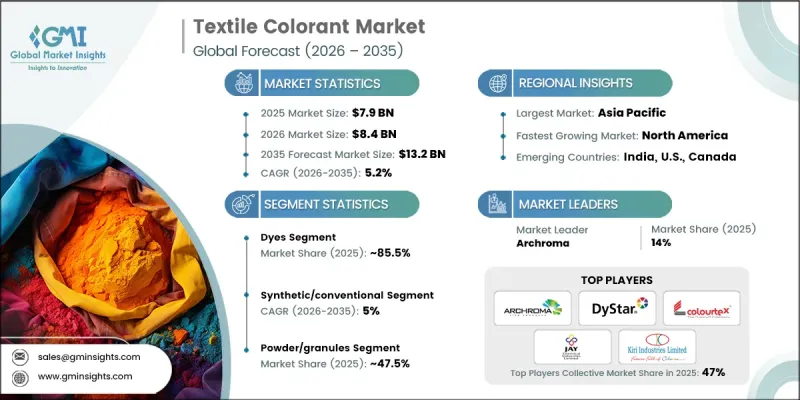
섬유 응용 분야 전반에 걸쳐 시각적으로 매력적이고 내구성이 뛰어난 착색 솔루션에 대한 수요가 증가함에 따라 섬유 착색제 시장은 꾸준히 발전하고 있습니다. 색감이 좋은 고품질 원단을 찾는 소비자의 성향이 강화되고 있는 것이 제품의 혁신과 보급에 큰 영향을 미치고 있습니다. 동시에 지속가능성에 대한 고려가 업계 트렌드를 재구성하고 있으며, 각 제조업체들은 바이오, 환경 친화적 배합 등 친환경 염료 기술에 대한 투자를 진행하고 있습니다. 전 세계 섬유 및 의류 부문의 확장은 다양한 색상과 생산 속도 향상에 대한 수요를 더욱 가속화시키고 있습니다. 절수형 및 디지털 제어 공정을 포함한 염색 기술의 발전은 환경에 미치는 영향을 최소화하면서 업무 효율을 향상시키고 있습니다. 화학물질 안전 및 환경 보호에 대한 규제 압력도 더 깨끗한 생산 방식으로의 전환을 촉진하고 있습니다. 지속 가능한 착색제와 관련된 비용 및 기술적 복잡성은 여전히 남아 있지만, 지속적인 기술 발전과 업계의 우선순위 변화로 인해 섬유용 착색제 시장 전반의 장기적인 성장과 혁신이 지속될 것으로 예측됩니다.
| 시장 범위 | |
|---|---|
| 개시 연도 | 2025년 |
| 예측 기간 | 2026-2035년 |
| 개시 연도 시장 규모 | 79억 달러 |
| 예측액 | 132억 달러 |
| CAGR | 5.2% |
섬유용 착색제 시장은 효율성, 정확성, 환경 영향 감소를 중시하는 현대적 제조 방식으로의 전환이 가속화되고 있는 점도 호재로 작용하고 있습니다. 첨단 착색 기술의 채택이 진행됨에 따라 염료의 적용을 보다 세밀하게 제어할 수 있게 되어 제품의 일관성이 향상되고 폐기물의 발생을 줄일 수 있게 되었습니다. 시장 진출기업들은 엄격한 환경 기준을 준수하는 동시에 변화하는 소비자 수요를 충족시키기 위해 생산의 유연성을 높이는 데 주력하고 있으며, 이는 전체 시장의 발전을 더욱 촉진하고 있습니다.
염료 부문은 2025년 85.5%의 점유율을 차지했으며, 2035년까지 연평균 복합 성장률(CAGR) 5%를 나타낼 것으로 예측됩니다. 이 부문은 다양한 섬유에 대한 높은 친화력과 깊이 있고 균일한 발색을 구현할 수 있는 능력으로 인해 계속해서 선도적인 위치를 유지하고 있습니다. 염료는 섬유 소재와 안정적인 화학적 결합을 형성하여 내구성과 반복적인 세탁 및 마모에 대한 내성을 보장합니다. 이 제품의 신뢰성과 성능 특성으로 인해 다양한 섬유 응용 분야에서 일관된 발색과 오래 지속되는 마무리를 원하는 제조업체에게 선호되는 선택이 되었습니다.
분말 및 과립 부문은 2025년 47.5%의 점유율을 차지했으며, 2035년까지 연평균 4.9%의 성장률을 보일 것으로 예측됩니다. 이러한 형태는 안정성, 보관 용이성 및 대규모 염색 공정에서 일관된 성능으로 인해 널리 사용되고 있습니다. 다양한 섬유 유형에 대한 적응성과 다양한 가공 조건과의 호환성으로 인해 산업용으로 매우 적합합니다. 또한 가혹한 작업 환경에서도 효과를 유지할 수 있는 특성으로 인해 제조업체의 지속적인 지지를 받고 있습니다.
북미 섬유 염료 시장은 탄탄한 제조거점과 규제 준수에 대한 강한 집중력에 힘입어 2025년 10.2%의 점유율을 차지할 것으로 예측됩니다. 이 지역은 엄격한 환경 기준과 친환경 섬유 솔루션에 대한 수요 증가에 힘입어 지속 가능한 염색 기술의 중요한 혁신의 중심지로 계속 발전하고 있습니다. 이 지역의 제조업체들은 환경에 미치는 영향을 최소화하면서 효율성을 높이기 위해 첨단 생산 기술을 적극적으로 도입하고 있으며, 이는 시장의 꾸준한 성장에 기여하고 있습니다.
자주 묻는 질문
목차
제1장 조사 방법과 범위
제2장 주요 요약
제3장 업계 인사이트
제4장 경쟁 구도
제5장 시장 추산 및 예측 : 제품 유형별, 2022-2035
제6장 시장 추산 및 예측 : 원료 유형별, 2022-2035
제7장 시장 추산 및 예측 : 형태별, 2022-2035
제8장 시장 추산 및 예측 : 섬유 유형별, 2022-2035
제9장 시장 추산 및 예측 : 최종사용자별, 2022-2035
제10장 시장 추산 및 예측 : 지역별, 2022-2035
제11장 기업 개요
LSH 26.05.08The Global Textile Colorant Market was valued at USD 7.9 billion in 2025 and is estimated to grow at a CAGR of 5.2% to reach USD 13.2 billion by 2035.
The textile colorant market is evolving steadily as demand rises for visually appealing and durable coloration solutions across textile applications. Increasing consumer inclination toward high-quality fabrics with long-lasting color performance is significantly influencing product innovation and adoption. At the same time, sustainability considerations are reshaping industry dynamics, as manufacturers invest in environmentally responsible colorant technologies, including bio-based and low-impact formulations. The expansion of the global textile and apparel sector is further accelerating demand for diverse color ranges and faster production capabilities. Advancements in dyeing techniques, including water-efficient and digitally controlled processes, are improving operational efficiency while minimizing environmental impact. Regulatory pressure related to chemical safety and environmental protection is also encouraging the transition toward cleaner production methods. While cost challenges and technical complexities associated with sustainable colorants persist, continuous technological progress and shifting industry priorities are expected to support long-term growth and innovation across the textile colorant market.
| Market Scope | |
|---|---|
| Start Year | 2025 |
| Forecast Year | 2026-2035 |
| Start Value | $7.9 Billion |
| Forecast Value | $13.2 Billion |
| CAGR | 5.2% |
The textile colorant market is also benefiting from the growing shift toward modern manufacturing practices that emphasize efficiency, precision, and reduced environmental footprint. Increasing adoption of advanced coloration technologies is enabling better control over dye application, resulting in improved product consistency and reduced waste generation. Industry participants are focusing on enhancing production flexibility to meet evolving consumer demands while maintaining compliance with stringent environmental standards, further strengthening overall market development.
The dyes segment accounted for 85.5% share in 2025 and is anticipated to grow at a CAGR of 5% through 2035. This segment continues to lead due to its strong compatibility with a wide range of fibers and its ability to deliver deep, uniform coloration. Dyes form stable chemical bonds with textile materials, ensuring durability and resistance to repeated washing and wear. Their reliability and performance characteristics make them a preferred choice for manufacturers seeking consistent color output and long-lasting results across various textile applications.
The powder and granules segment captured 47.5% share in 2025 and is expected to grow at a CAGR of 4.9% by 2035. These formats are widely utilized due to their stability, ease of storage, and consistent performance during large-scale dyeing operations. Their adaptability across different fiber types and compatibility with various processing conditions make them highly suitable for industrial applications. Additionally, their ability to maintain effectiveness under demanding operational environments contributes to their continued preference among manufacturers.
North America Textile Colorant Market held a 10.2% share in 2025, supported by a well-established manufacturing base and a strong focus on regulatory compliance. The region continues to advance as a significant center for innovation in sustainable coloration technologies, driven by stringent environmental standards and increasing demand for eco-friendly textile solutions. Manufacturers in the region are actively adopting advanced production techniques to enhance efficiency while minimizing environmental impact, which is contributing to steady market expansion.
Prominent players in the Global Textile Colorant Market include Huntsman Corporation, Archroma, DyStar Group, Kiri Industries, Atul Ltd, Colourtex Industries, Jay Chemical Industries, Yorkshire Group, Kyung-In Synthetic Corporation, Everlight Chemical Industrial Corporation, and Anoky Group. Companies operating in the textile colorant market are implementing strategic initiatives focused on innovation, sustainability, and market expansion to strengthen their competitive position. Investments in research and development are enabling the introduction of advanced colorant solutions with improved environmental performance and enhanced durability. Strategic collaborations and partnerships are helping companies expand their technological capabilities and access new markets. Businesses are also focusing on optimizing supply chains and adopting digital manufacturing processes to improve efficiency and reduce costs.
Table of Contents
Chapter 1 Methodology & Scope
- 1.1 Market scope and definition
- 1.2 Research design
- 1.2.1 Research approach
- 1.2.2 Data collection methods
- 1.3 Data mining sources
- 1.3.1 Global
- 1.3.2 Regional/Country
- 1.4 Base estimates and calculations
- 1.4.1 Base year calculation
- 1.4.2 Key trends for market estimation
- 1.5 Primary research and validation
- 1.5.1 Primary sources
- 1.6 Forecast model
- 1.7 Research assumptions and limitations
Chapter 2 Executive Summary
- 2.1 Industry 360° synopsis
- 2.2 Key market trends
- 2.2.1 Regional
- 2.2.2 Product Type
- 2.2.3 Source Type
- 2.2.4 Form
- 2.2.5 Fiber Type
- 2.2.6 End-Use
- 2.3 TAM Analysis, 2026-2035
- 2.4 CXO perspectives: Strategic imperatives
- 2.4.1 Executive decision points
- 2.4.2 Critical success factors
- 2.5 Future Outlook and Strategic Recommendations
Chapter 3 Industry Insights
- 3.1 Industry ecosystem analysis
- 3.1.1 Supplier landscape
- 3.1.2 Profit margin
- 3.1.3 Value addition at each stage
- 3.1.4 Factor affecting the value chain
- 3.1.5 Disruptions
- 3.2 Industry impact forces
- 3.2.1 Growth drivers
- 3.2.1.1 Rising demand for sustainable and eco-friendly colorant
- 3.2.1.2 Growth of the fast fashion and textile industry
- 3.2.1.3 Advancements in dyeing technology and digital printing
- 3.2.2 Industry pitfalls and challenges
- 3.2.2.1 Stringent environmental regulations & compliance
- 3.2.2.2 High water use in traditional dyeing
- 3.2.3 Market opportunities
- 3.2.3.1 Sustainable & bio-based colorants
- 3.2.3.2 Digital printing expansion
- 3.2.1 Growth drivers
- 3.3 Growth potential analysis
- 3.4 Regulatory landscape
- 3.4.1 North America
- 3.4.2 Europe
- 3.4.3 Asia Pacific
- 3.4.4 Latin America
- 3.4.5 Middle East & Africa
- 3.5 Porter's analysis
- 3.6 PESTEL analysis
- 3.7 Price trends
- 3.7.1 By region
- 3.7.2 By product type
- 3.8 Future market trends
- 3.9 Technology and Innovation landscape
- 3.9.1 Current technological trends
- 3.9.2 Emerging technologies
- 3.10 Patent Landscape
- 3.11 Trade statistics (HS code)
- 3.11.1 Major importing countries
- 3.11.2 Major exporting countries
- 3.12 Sustainability and environmental aspects
- 3.12.1 Sustainable practices
- 3.12.2 Waste reduction strategies
- 3.12.3 Energy efficiency in production
- 3.12.4 Eco-friendly initiatives
- 3.13 Carbon footprint consideration
Chapter 4 Competitive Landscape, 2025
- 4.1 Introduction
- 4.2 Company market share analysis
- 4.2.1 By region
- 4.2.1.1 North America
- 4.2.1.2 Europe
- 4.2.1.3 Asia Pacific
- 4.2.1.4 LATAM
- 4.2.1.5 MEA
- 4.2.1 By region
- 4.3 Company matrix analysis
- 4.4 Competitive analysis of major market players
- 4.5 Competitive positioning matrix
- 4.6 Key developments
- 4.6.1 Mergers & acquisitions
- 4.6.2 Partnerships & collaborations
- 4.6.3 New Product Launches
- 4.6.4 Expansion Plans
Chapter 5 Market Estimates and Forecast, By Product Type, 2022-2035 (USD Billion) (Kilo Tons)
- 5.1 Key trends
- 5.2 Dyes
- 5.2.1 Disperse Dyes
- 5.2.2 Reactive Dyes
- 5.2.3 Acid Dyes
- 5.2.4 Direct Dyes
- 5.2.5 Vat Dyes
- 5.2.6 Sulfur Dyes
- 5.2.7 Others
- 5.3 Pigments
- 5.3.1 Inorganic Pigments
- 5.3.2 Organic Pigments
Chapter 6 Market Estimates and Forecast, By Source Type, 2022-2035 (USD Billion) (Kilo Tons)
- 6.1 Key trends
- 6.2 Synthetic / Conventional
- 6.3 Natural / Bio-based
- 6.4 Hybrid / Blended
Chapter 7 Market Estimates and Forecast, By Form, 2022-2035 (USD Billion) (Kilo Tons)
- 7.1 Key trends
- 7.2 Powder / Granules
- 7.3 Liquid / Solution
- 7.4 Paste / Concentrated
Chapter 8 Market Estimates and Forecast, By Fiber Type, 2022-2035 (USD Billion) (Kilo Tons)
- 8.1 Key trends
- 8.2 Polyester
- 8.3 Cotton
- 8.4 Blends
- 8.5 Nylon/Polyamide
- 8.6 Wool
- 8.7 Silk
- 8.8 Others
Chapter 9 Market Estimates and Forecast, By End-User, 2022-2035 (USD Billion) (Kilo Tons)
- 9.1 Key trends
- 9.2 Apparel & Footwear
- 9.3 Home Textiles
- 9.4 Technical/Industrial
- 9.5 Automotive
- 9.6 Healthcare
- 9.7 Others
Chapter 10 Market Estimates and Forecast, By Region, 2022-2035 (USD Billion) (Kilo Tons)
- 10.1 Key trends
- 10.2 North America
- 10.2.1 U.S.
- 10.2.2 Canada
- 10.3 Europe
- 10.3.1 Germany
- 10.3.2 UK
- 10.3.3 France
- 10.3.4 Spain
- 10.3.5 Italy
- 10.3.6 Rest of Europe
- 10.4 Asia Pacific
- 10.4.1 China
- 10.4.2 India
- 10.4.3 Japan
- 10.4.4 Australia
- 10.4.5 South Korea
- 10.4.6 Rest of Asia Pacific
- 10.5 Latin America
- 10.5.1 Brazil
- 10.5.2 Mexico
- 10.5.3 Argentina
- 10.5.4 Rest of Latin America
- 10.6 Middle East and Africa
- 10.6.1 Saudi Arabia
- 10.6.2 South Africa
- 10.6.3 UAE
- 10.6.4 Rest of Middle East and Africa
Chapter 11 Company Profiles
- 11.1 Huntsman Corporation
- 11.2 Archroma
- 11.3 DyStar Group
- 11.4 Kiri Industries
- 11.5 Atul Ltd
- 11.6 Colourtex Industries
- 11.7 Jay Chemical Industries
- 11.8 Yorkshire Group
- 11.9 Kyung-In Synthetic Corporation
- 11.10 Everlight Chemical Industrial Corporation
- 11.11 Anoky Group