

|
시장보고서
상품코드
2019158
스마트 수도 계량기 시장 기회, 성장요인, 업계 동향 분석 및 예측(2026-2035년)Smart Water Meter Market Opportunity, Growth Drivers, Industry Trend Analysis, and Forecast 2026 - 2035 |
||||||

세계의 스마트 수도 계량기 시장은 2025년에 41억 달러로 평가되었고, 2035년까지 연평균 복합 성장률(CAGR) 24.9%로 성장하여 388억 달러에 이를 것으로 추정되고 있습니다.
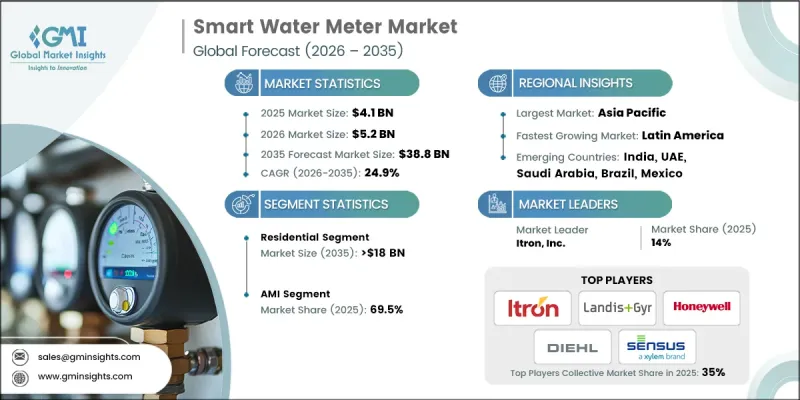
이러한 급격한 성장은 급속한 기술 발전, 물 절약 노력의 확대, 규제 의무, 그리고 보다 효율적인 물 관리 시스템의 필요성에 의해 주도되고 있습니다. 전 세계 수도 유틸리티자와 도시들은 물 분배를 최적화하고, 낭비를 최소화하며, 운영 효율성을 높이기 위해 스마트 수도 계량기를 도입하고 있습니다. 기존 계량기는 시간이 오래 걸리고 오류가 발생하기 쉬운 수동 검침에 의존하는 경우가 많기 때문에 물 사용량의 정확한 실시간 모니터링에 대한 수요가 주요 성장 요인으로 작용하고 있습니다. IoT 기술과 통합된 스마트 미터는 원격 모니터링, 자동 청구, 실시간 데이터 수집, 효율성과 서비스 품질을 향상시킬 수 있습니다. 특히 물 부족에 시달리는 지역에서는 물 절약과 누수 감지를 촉진하는 정부 정책과 인센티브 프로그램이 도입에 더욱 박차를 가하고 있습니다. 특히 물 인프라의 현대화가 필수적인 신흥 경제국에서 디지털화 노력과 지속가능성 목표가 증가하고 있는 것도 시장 성장을 뒷받침하고 있습니다.
| 시장 범위 | |
|---|---|
| 개시 연도 | 2025년 |
| 예측 기간 | 2026-2035년 |
| 개시 시점 시장 규모 | 41억 달러 |
| 예측액 | 388억 달러 |
| CAGR | 24.9% |
주택 부문은 물과 에너지 관리 개선, 정확한 청구 실현, 재생에너지 통합을 지원하기 위해 스마트 미터의 소비자 도입이 증가함에 따라 2035년까지 180억 달러에 달할 것으로 예상되고 있습니다. 가정용 스마트미터는 정확한 사용량 파악을 가능하게 하여 소비자가 소비량을 관리할 수 있도록 하고, 홈 오토메이션 시스템과 원활하게 연동하여 시장 성장에 기여하고 있습니다.
AMI(첨단 계량 인프라) 부문은 양방향 통신 기능을 갖추고 있어 AMR(자동검침) 시스템을 능가하여 2025년 69.5%의 점유율을 차지할 것으로 예측됩니다. AMI를 통해 유틸리티 사업자는 실시간 데이터 수집, 계량기 원격 관리, 신속한 누수 감지, 이상 징후에 대한 신속한 대응이 가능합니다. 스마트그리드 및 디지털 물 관리 솔루션과의 통합은 그 우위를 더욱 공고히 하여 효율적인 유틸리티 운영을 위한 최적의 기술로 자리매김하고 있습니다.
2025년 미국의 스마트 수량계 시장 규모는 7억 4,000만 달러로 평가되었습니다. 인구 증가, 인프라 노후화, 기후 변화의 영향으로 여러 지역에서 물 부족이 심화되고 있습니다. 미국의 유틸리티 사업자들은 실시간으로 소비량을 모니터링하고, 누수를 파악하며, 비정상적인 사용 패턴을 감지하기 위해 스마트 미터 도입을 확대하여 물 절약과 운영 효율을 향상시키고 있습니다.
자주 묻는 질문
목차
제1장 조사 방법과 범위
제2장 주요 요약
제3장 업계 인사이트
제4장 경쟁 구도
제5장 시장 규모와 예측 : 용도별, 2022-2035
제6장 시장 규모와 예측 : 제품별, 2022-2035
제7장 시장 규모와 예측 : 지역별, 2022-2035
제8장 기업 개요
LSH 26.05.08The Global Smart Water Meter Market was valued at USD 4.1 billion in 2025 and is estimated to grow at a CAGR of 24.9% to reach USD 38.8 billion by 2035.
The surge is driven by rapid technological advancements, increasing water conservation initiatives, regulatory mandates, and the need for more efficient water management systems. Utilities and cities worldwide are adopting smart water meters to optimize water distribution, minimize wastage, and enhance operational efficiency. The demand for accurate, real-time monitoring of water consumption is a key growth factor, as conventional meters often rely on manual readings that are time-consuming and prone to errors. Smart meters integrated with IoT technology provide remote monitoring, automated billing, and real-time data collection, boosting efficiency and service quality. Government policies and incentive programs promoting water conservation and leakage detection, particularly in water-stressed regions, are further accelerating adoption. The market is also supported by growing digitalization efforts and sustainability goals, especially in emerging economies where water infrastructure modernization is critical.
| Market Scope | |
|---|---|
| Start Year | 2025 |
| Forecast Year | 2026-2035 |
| Start Value | $4.1 Billion |
| Forecast Value | $38.8 Billion |
| CAGR | 24.9% |
The residential segment is expected to reach USD 18 billion by 2035, driven by rising consumer adoption of smart meters to improve water and energy management, enable accurate billing, and support renewable energy integration. Smart meters in homes provide precise usage insights, empower consumers to manage consumption, and integrate seamlessly with home automation systems, contributing to market growth.
The AMI (Advanced Metering Infrastructure) segment captured 69.5% share in 2025, leading over AMR (Automatic Meter Reading) systems due to its two-way communication capabilities. AMI enables utilities to collect real-time data, remotely manage meters, detect leaks promptly, and respond faster to anomalies. Its integration with smart grids and digital water management solutions further reinforces its dominance, making it the preferred technology for efficient utility operations.
U.S. Smart Water Meter Market was valued at USD 704 million in 2025. The country faces rising water scarcity across several regions, influenced by population growth, aging infrastructure, and climate variability. Utilities in the U.S. are increasingly deploying smart meters to monitor consumption in real-time, identify leaks, and detect abnormal usage patterns, enhancing water conservation and operational efficiency.
Key players in the Global Smart Water Meter Market include Landis + Gyr, Diehl Stiftung, Itron, Inc., Honeywell International, and Xylem (Sensus). Companies in the Smart Water Meter Market are strengthening their presence through continuous innovation in IoT-enabled metering solutions and real-time analytics. They are focusing on strategic collaborations with utilities, governments, and technology providers to expand deployment and offer integrated water management systems. R&D investments drive the development of highly accurate, low-maintenance, and energy-efficient meters. Businesses are also leveraging data-driven services, remote diagnostics, and predictive maintenance to enhance customer value and operational reliability. Regional expansion, participation in government incentive programs, and sustainable product development are additional strategies to solidify their market foothold and capture a larger share of the rapidly growing smart water meter industry.
Table of Contents
Chapter 1 Methodology & Scope
- 1.1 Research design
- 1.2 Market estimates & forecast parameters
- 1.3 Forecast calculation
- 1.4 Data sources
- 1.4.1 Primary
- 1.4.2 Secondary
- 1.4.2.1 Paid
- 1.4.2.2 Public
Chapter 2 Executive Summary
- 2.1 Industry synopsis, 2022 - 2035
Chapter 3 Industry Insights
- 3.1 Industry ecosystem analysis
- 3.2 Regulatory landscape
- 3.3 Price trend analysis, by region (USD/Unit)
- 3.4 Industry impact forces
- 3.4.1 Growth drivers
- 3.4.2 Industry pitfalls & challenges
- 3.5 Growth potential analysis
- 3.6 Porter's analysis
- 3.6.1 Bargaining power of suppliers
- 3.6.2 Bargaining power of buyers
- 3.6.3 Threat of new entrants
- 3.6.4 Threat of substitutes
- 3.7 PESTEL analysis
- 3.7.1 Political factors
- 3.7.2 Economic factors
- 3.7.3 Social factors
- 3.7.4 Technological factors
- 3.7.5 Legal factors
- 3.7.6 Environmental factors
- 3.8 Emerging opportunities & trends
- 3.8.1 Digitalization & IoT integration
- 3.8.2 Emerging market penetration
- 3.9 Investment analysis & future outlook
Chapter 4 Competitive Landscape, 2026
- 4.1 Introduction
- 4.2 Company market share analysis, by region, 2025
- 4.2.1 North America
- 4.2.2 Europe
- 4.2.3 Asia Pacific
- 4.2.4 Middle East & Africa
- 4.2.5 Latin America
- 4.3 Strategic initiatives
- 4.4 Competitive benchmarking depictions
- 4.5 Strategy dashboard
- 4.6 Innovation & technology landscape
Chapter 5 Market Size and Forecast, By Application, 2022 - 2035 (USD Million & '000 Units)
- 5.1 Key trends
- 5.2 Residential
- 5.3 Commercial
- 5.4 Utility
- 5.5 Market Size and Forecast, By Technology, 2022 - 2035 (USD Million & '000 Units)
- 5.6 Key trends
- 5.7 AMI
- 5.8 AMR
Chapter 6 Market Size and Forecast, By Product, 2022 - 2035 (USD Million & '000 Units)
- 6.1 Key trends
- 6.2 Hot water meter
- 6.3 Cold water meter
Chapter 7 Market Size and Forecast, By Region, 2022 - 2035 (USD Million & '000 Units)
- 7.1 Key trends
- 7.2 North America
- 7.2.1 U.S.
- 7.2.2 Canada
- 7.2.3 Mexico
- 7.3 Europe
- 7.3.1 Germany
- 7.3.2 UK
- 7.3.3 France
- 7.3.4 Italy
- 7.3.5 Sweden
- 7.4 Asia Pacific
- 7.4.1 China
- 7.4.2 Japan
- 7.4.3 India
- 7.4.4 South Korea
- 7.4.5 Australia
- 7.5 Middle East & Africa
- 7.5.1 UAE
- 7.5.2 Saudi Arabia
- 7.5.3 South Africa
- 7.5.4 Egypt
- 7.6 Latin America
- 7.6.1 Brazil
- 7.6.2 Argentina
Chapter 8 Company Profiles
- 8.1 ABB
- 8.2 Apator S.A.
- 8.3 Arad Group:
- 8.4 Badger Meter, Inc.
- 8.5 BMETERS S.r.l
- 8.6 Diehl Stiftung & Co. KG
- 8.7 Honeywell International Inc.
- 8.8 Itron Inc.
- 8.9 Kamstrup
- 8.10 Landis+Gyr
- 8.11 Neptune Technology Group Inc.
- 8.12 Ningbo Water Meter Co., Ltd.
- 8.13 Schneider Electric
- 8.14 Siemens
- 8.15 Sontex SA
- 8.16 Xylem (Sensus)
- 8.17 ZENNER International GmbH & Co. KG
- 8.18 Suez
- 8.19 Baylan Water Meters
- 8.20 BOVE Technology


