

|
시장보고서
상품코드
2019165
폐기능 검사 시스템 시장 비즈니스 기회, 성장요인, 업계 동향 분석 및 예측(2026-2035년)Pulmonary Function Testing Systems Market Opportunity, Growth Drivers, Industry Trend Analysis, and Forecast 2026 - 2035 |
||||||

세계의 폐기능 검사 시스템 시장은 2025년에 31억 달러로 평가되었고, CAGR 6.9%로 성장하여 2035년까지 59억 달러에 이를 것으로 추정되고 있습니다.
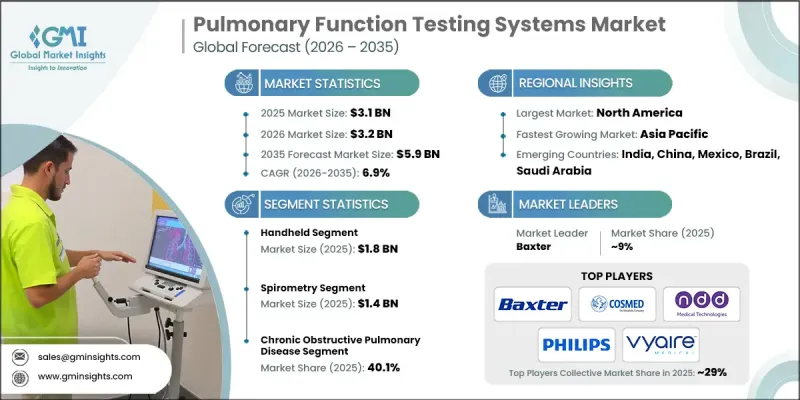
만성 호흡기 질환의 유병률 증가와 조기 진단 및 관리를 촉진하는 정부 지원책으로 인해 이 시장은 견조한 성장세를 보이고 있습니다. 폐 기능 검사 시스템은 폐 기능 평가, 기류, 폐 용량 및 가스 교환 효율을 측정하는 데 필수적인 도구입니다. 천식, 만성폐쇄성폐질환(COPD), 기타 폐질환 등 호흡기 질환 증가가 병원, 진료소, 재택의료 현장의 도입을 촉진하고 있습니다. 휴대용 기기, 첨단 스파이로미터, 통합형 분석 소프트웨어 등의 기술 혁신으로 진단 정확도와 환자 편의성이 향상되어 시장 보급을 촉진하고 있습니다. 또한, 산업보건 모니터링, 산업용도, 재택 호흡관리 등에도 활용이 확대되고 있습니다. 디지털 헬스와의 통합, 원격 모니터링 기능, 컴팩트하고 사용하기 쉬운 기기에 대한 수요 증가는 특히 예방 의료 및 원격 의료 솔루션을 중시하는 지역에서 폐 기능 검사 시스템 시장의 성장을 가속화하고 있습니다.
| 시장 범위 | |
|---|---|
| 개시 연도 | 2025년 |
| 예측 기간 | 2026-2035년 |
| 개시 연도 시장 규모 | 31억 달러 |
| 예측액 | 59억 달러 |
| CAGR | 6.9% |
핸드헬드 부문은 2025년 18억 달러에 달했습니다. 이 휴대용 기기는 컴팩트한 디자인, 저렴한 가격, 사용 편의성으로 평가받고 있으며, 진료 현장이나 재택 모니터링에 적합합니다. 휴대용 폐기능 검사 시스템을 통해 의료진과 환자는 다양한 환경에서 검사를 할 수 있어 유연성과 편의성을 높일 수 있습니다. 이러한 장비의 비용 효율성은 소규모 진료소, 1차 진료소 및 자원이 제한된 환경에서 도입을 촉진하고 있습니다. 접근성, 휴대성 및 사용자 친화적인 기능의 조합으로 인해 핸드헬드 부문은 임상 및 개인 건강 모니터링의 요구를 충족시키며 그 우위를 유지하고 있습니다.
스파이로메트리 시장은 2025년 14억 달러 규모에 달할 것으로 예상되며, 2035년까지 연평균 복합 성장률(CAGR) 7.2%를 나타낼 것으로 예측됩니다. 폐활량 측정은 폐기능을 평가하고 기도폐쇄, 기류장애 등 호흡기 질환을 발견하기 위한 중요한 진단검사로 여전히 중요한 검사입니다. 디지털 인터페이스, 무선 연결, 건강 데이터 플랫폼과의 통합과 같은 기술 발전으로 현대의 스파이로미터는 더욱 정확하고 직관적이며 휴대성이 뛰어납니다. 이러한 기능 강화는 임상 현장과 재택 치료 환경에서 환자의 컴플라이언스 및 업무 효율성을 향상시켜 보다 폭넓은 보급을 지원하고 있습니다. 정확하고 신속하며 사용하기 쉬운 폐 기능 평가에 대한 수요가 증가함에 따라, 폐활량 측정 시스템은 시장에서 주요 수익원이 될 것으로 예측됩니다.
미국 폐기능 검사 시스템 시장은 2025년 14억 달러 규모에 달할 것으로 예상되며, 2026년부터 2035년까지 연평균 5.8%의 성장률을 보일 것으로 예측됩니다. 의료 기술 혁신에서 북미의 선도적 위치는 무선 연결 기능을 갖춘 디지털 기기 및 휴대용 기기를 포함한 첨단 폐 기능 검사 시스템의 빠른 보급을 뒷받침하고 있습니다. 의료 서비스 제공업체들은 정확하고 효율적이며 환자 친화적인 진단 도구에 점점 더 많은 투자를 하고 있습니다. 의료비 증가와 함께 품질과 조기 발견을 중시하는 규제 프레임워크가 결합되어 폐기능 검사 솔루션에 대한 수요를 더욱 자극하고 있습니다. 미국 시장은 선진화된 인프라, 호흡기 건강에 대한 높은 인식, 만성 폐질환 유병률 증가 등의 요인이 복합적으로 작용하여 세계 시장 성장의 주요 원동력이 되고 있습니다.
자주 묻는 질문
목차
제1장 조사 방법
제2장 주요 요약
제3장 업계 인사이트
제4장 경쟁 구도
제5장 시장 추산 및 예측 : 제품별, 2022-2035
제6장 시장 추산 및 예측 : 테스트 유형별, 2022-2035
제7장 시장 추산 및 예측 : 용도별, 2022-2035
제8장 시장 추산 및 예측 : 최종 용도별, 2022-2035
제9장 시장 추산 및 예측 : 지역별, 2022-2035
제10장 기업 개요
LSH 26.05.08The Global Pulmonary Function Testing Systems Market was valued at USD 3.1 billion in 2025 and is estimated to grow at a CAGR of 6.9% to reach USD 5.9 billion by 2035.
The market is experiencing robust growth due to the rising prevalence of chronic respiratory conditions and supportive government initiatives that promote early diagnosis and management. Pulmonary function testing systems are critical tools for assessing lung performance, measuring airflow, lung volumes, and gas exchange efficiency. Increasing cases of respiratory diseases, such as asthma, chronic obstructive pulmonary disease (COPD), and other pulmonary disorders, are driving adoption across hospitals, clinics, and home care settings. Innovations, including portable devices, advanced spirometers, and integrated analytical software, are enhancing diagnostic accuracy and patient comfort while promoting widespread acceptance. The industry is also witnessing growing use in occupational health monitoring, industrial applications, and home-based respiratory care. Digital health integration, remote monitoring capabilities, and the rising demand for compact, easy-to-use devices are accelerating the expansion of the pulmonary function testing systems market, particularly in regions emphasizing preventive healthcare and telemedicine solutions.
| Market Scope | |
|---|---|
| Start Year | 2025 |
| Forecast Year | 2026-2035 |
| Start Value | $3.1 Billion |
| Forecast Value | $5.9 Billion |
| CAGR | 6.9% |
The handheld segment reached USD 1.8 billion in 2025. These portable devices are favored for their compact design, affordability, and ease of use, making them ideal for point-of-care and home-based monitoring. Handheld pulmonary function testing systems allow healthcare providers and patients to conduct assessments across diverse environments, promoting flexibility and convenience. The devices' cost-effectiveness enhances their adoption in small clinics, primary care centers, and resource-limited settings. The combination of accessibility, portability, and user-friendly features ensures that the handheld segment maintains its dominance, catering to both clinical and personal health monitoring needs.
The spirometry segment accounted for USD 1.4 billion in 2025 and is expected to grow at a CAGR of 7.2% through 2035. Spirometry remains a cornerstone diagnostic test for assessing lung function and detecting respiratory issues, such as airway obstruction and impaired airflow. Technological advancements, including digital interfaces, wireless connectivity, and integration with health data platforms, have made modern spirometers more precise, intuitive, and portable. These enhancements increase patient compliance and operational efficiency in clinical and home care environments, supporting wider adoption. As the demand for accurate, rapid, and user-friendly pulmonary assessments rises, spirometry systems are anticipated to remain a primary revenue contributor within the market.
U.S. Pulmonary Function Testing Systems Market captured USD 1.4 billion in 2025 and is projected to grow at a CAGR of 5.8% from 2026 to 2035. North America's leadership in medical technology innovation supports the rapid adoption of advanced pulmonary function testing systems, including digital and portable devices with wireless connectivity. Healthcare providers are increasingly investing in accurate, efficient, and patient-friendly diagnostic tools. Rising healthcare expenditure, coupled with regulatory frameworks emphasizing quality and early detection, further stimulates demand for pulmonary testing solutions. The U.S. market benefits from a combination of advanced infrastructure, high awareness of respiratory health, and increasing prevalence of chronic lung conditions, making it a key driver of global market growth.
Prominent players in the Global Pulmonary Function Testing Systems Market include Baxter, CHEST M.I, COSMED, ECO MEDICS, FUKUDA SANGYO, GANSHORN SCHILLER GROUP, Geratherm Respiratory, Medical Equipment Europe, MGC DIAGNOSTICS, MINATO MEDICAL SCIENCE, MORGAN, ndd Medical Technologies, PHILIPS, Vitalograph, and Vyaire MEDICAL. Key strategies adopted by companies in the Global Pulmonary Function Testing Systems Market focus on innovation, technological integration, and global expansion to strengthen market presence. Businesses are investing in R&D to develop portable, digital, and connected devices that enhance usability, accuracy, and patient engagement. Strategic partnerships, acquisitions, and collaborations are enabling access to new markets, advanced technologies, and manufacturing capabilities. Companies are also emphasizing customized solutions tailored for hospitals, clinics, and home-based monitoring to meet diverse consumer needs. Expanding distribution networks, enhancing customer support, and maintaining compliance with regulatory standards are critical tactics to improve brand trust and penetration. Additionally, firms are leveraging digital platforms to offer remote monitoring, data analytics, and telehealth solutions, ensuring a stronger foothold and competitive advantage in the market.
Table of Contents
Chapter 1 Research Methodology
- 1.1 Research approach
- 1.2 Quality commitments
- 1.2.1 GMI AI policy & data integrity commitment
- 1.2.1.1 Source consistency protocol
- 1.2.1 GMI AI policy & data integrity commitment
- 1.3 Research trail & confidence scoring
- 1.3.1 Research trail components
- 1.3.2 Scoring components
- 1.4 Data collection
- 1.4.1 Partial list of primary sources
- 1.5 Data mining sources
- 1.5.1 Paid sources
- 1.5.1.1 Sources, by region
- 1.5.1 Paid sources
- 1.6 Base estimates and calculations
- 1.6.1 Base year calculation for any one approach
- 1.7 Forecast model
- 1.7.1 Quantified market impact analysis
- 1.7.1.1 Mathematical impact of growth parameters on forecast
- 1.7.1 Quantified market impact analysis
- 1.8 Research transparency addendum
- 1.8.1 Source attribution framework
- 1.8.2 Quality assurance metrics
- 1.8.3 Our commitment to trust
Chapter 2 Executive Summary
- 2.1 Industry 360° synopsis
- 2.2 Key market trends
- 2.2.1 Regional trends
- 2.2.2 Product trends
- 2.2.3 Test type trends
- 2.2.4 Application trends
- 2.2.5 End use trends
- 2.3 CXO perspectives: Strategic imperatives
Chapter 3 Industry Insights
- 3.1 Industry ecosystem analysis
- 3.2 Industry impact forces
- 3.2.1 Growth drivers
- 3.2.1.1 Increase in prevalence of chronic respiratory diseases
- 3.2.1.2 Technological advancements
- 3.2.1.3 Favourable government initiatives
- 3.2.2 Industry pitfalls and challenges
- 3.2.2.1 Stringent regulatory framework
- 3.2.2.2 High cost associated with pulmonary function testing devices
- 3.2.3 Market opportunities
- 3.2.3.1 Expansion of portable & wireless PFT devices
- 3.2.1 Growth drivers
- 3.3 Growth potential analysis
- 3.4 Regulatory landscape
- 3.4.1 North America
- 3.4.2 Europe
- 3.4.3 Asia Pacific
- 3.5 Technology landscape (Driven by Primary Research)
- 3.5.1 Current technological trends
- 3.5.2 Emerging technologies
- 3.6 Future market trends (Driven by Primary Research)
- 3.7 Impact of AI and Generative AI on the Market (Driven by Primary Research)
- 3.8 Patent analysis
- 3.9 Pricing analysis, 2025 (Driven by Primary Research)
- 3.10 Customer insights
- 3.11 Porter's analysis
- 3.12 PESTEL analysis
- 3.13 Gap analysis
Chapter 4 Competitive Landscape, 2025
- 4.1 Introduction
- 4.2 Company matrix analysis
- 4.3 Company market share analysis
- 4.3.1 Global
- 4.3.2 North America
- 4.3.3 Europe
- 4.3.4 Asia Pacific
- 4.3.5 LAMEA
- 4.4 Competitive positioning matrix
- 4.5 Competitive analysis of major market players
- 4.6 Key developments
- 4.6.1 Mergers & acquisitions
- 4.6.2 Partnerships & collaborations
- 4.6.3 New product type launches
- 4.6.4 Expansion plans
Chapter 5 Market Estimates and Forecast, By Product, 2022 - 2035 ($ Mn)
- 5.1 Key trends
- 5.2 Handheld
- 5.3 Tabletop
Chapter 6 Market Estimates and Forecast, By Test Type, 2022 - 2035 ($ Mn)
- 6.1 Key trends
- 6.2 Spirometry
- 6.3 Exercise stress test
- 6.4 Lung volume test
- 6.5 High altitude simulation testing
- 6.6 Gas diffusion test
- 6.7 Other test types
Chapter 7 Market Estimates and Forecast, By Application, 2022 - 2035 ($ Mn)
- 7.1 Key trends
- 7.2 Chronic obstructive pulmonary disease
- 7.3 Asthma
- 7.4 Chronic shortness of breath
- 7.5 Pulmonary fibrosis
- 7.6 Other applications
Chapter 8 Market Estimates and Forecast, By End Use, 2022 - 2035 ($ Mn)
- 8.1 Key trends
- 8.2 Hospitals & clinics
- 8.3 Diagnostic centers
- 8.4 Homecare settings
- 8.5 Other end users
Chapter 9 Market Estimates and Forecast, By Region, 2022 - 2035 ($ Mn)
- 9.1 Key trends
- 9.2 North America
- 9.2.1 U.S.
- 9.2.2 Canada
- 9.3 Europe
- 9.3.1 Germany
- 9.3.2 UK
- 9.3.3 France
- 9.3.4 Spain
- 9.3.5 Italy
- 9.3.6 Netherlands
- 9.4 Asia Pacific
- 9.4.1 China
- 9.4.2 Japan
- 9.4.3 India
- 9.4.4 Australia
- 9.4.5 South Korea
- 9.5 Latin America
- 9.5.1 Brazil
- 9.5.2 Mexico
- 9.5.3 Argentina
- 9.6 Middle East and Africa
- 9.6.1 South Africa
- 9.6.2 Saudi Arabia
- 9.6.3 UAE
Chapter 10 Company Profiles
- 10.1 Baxter
- 10.2 CHEST M.I
- 10.3 COSMED
- 10.4 ECO MEDICS
- 10.5 FUKUDA SANGYO
- 10.6 GANSHORN SCHILLER GROUP
- 10.7 Geratherm Respiratory
- 10.8 medical equipment Europe
- 10.9 MGC DIAGNOSTICS
- 10.10 MINATO MEDICAL SCIENCE
- 10.11 MORGAN
- 10.12 ndd Medical Technologies
- 10.13 PHILIPS
- 10.14 Vitalograph
- 10.15 Vyaire MEDICAL


