

|
시장보고서
상품코드
2099901
심폐 운동 부하 시험 시장 : 시장 점유율 분석, 업계 동향 및 통계, 성장 예측(2026-2031년)Cardiopulmonary Exercise Testing - Market Share Analysis, Industry Trends & Statistics, Growth Forecasts (2026 - 2031) |
||||||
 Mordor Intelligence
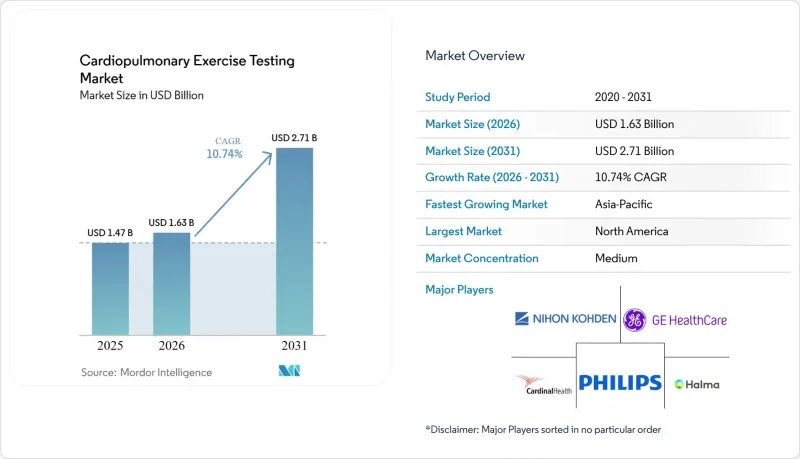
Mordor Intelligence에 의하면, 심폐 운동 부하 시험 시장 규모는 2025년에 14억 7,000만 달러로 평가되었고, 2026년 16억 3,000만 달러에서 2031년까지 27억 1,000만 달러에 이를 것으로 예측되며, 예측 기간(2026-2031년) CAGR은 10.74%를 나타낼 전망입니다.
본 보고서는 제품별(심폐 운동 부하 시험 시스템, 대사 측정 카트 등), 용도별(임상 진단, 수술 전 평가 등), 적응증별(심혈관 질환, 호흡기 질환 등), 최종 사용자별(병원 등), 지역별(북미, 유럽, 아시아태평양 등)로 분류되어 있습니다. 시장 전망은 금액(달러) 기준으로 제시되어 있습니다.
세계의 심폐 운동 부하 시험 시장 동향 및 인사이트
심혈관 질환 및 호흡기 질환의 부담 증가
심폐 운동 부하 시험 시장은 일상 진료에서 심혈관 질환과 호흡기 질환의 관리가 그 어느 때보다 밀접하게 연관되어 있는 국면에 놓여 있습니다. 세계보건기구(WHO) 보고서에 따르면, 2022년 심혈관 질환으로 인한 사망자 수는 1,980만 명으로, 이는 전 세계 사망자 수의 32%에 해당합니다. 또한, 그 사망자의 4분의 3 이상이 중저소득국에서 발생하고 있으며, 보급률이 낮은 지역에서는 CPET의 확대 여지가 여전히 크게 남아 있습니다. 미국심장협회(AHA)의 2025년 통계 갱신 보고서에 따르면, 절대적인 환자 수 증가와 생존율 향상으로 인해 급성기 치료뿐만 아니라 장기적인 기능 모니터링이 필요한 환자 수가 증가하고 있는 것으로 나타났습니다. 이는 심폐 운동 부하 시험 시장에 중요한 의미를 지닙니다. 왜냐하면 현재는 더 많은 환자가 장수하게 되었으며, 여러 의료 현장에서 운동 내성, 환기 반응, 그리고 치료 후 회복 상황에 대한 반복적인 평가가 필요해졌기 때문입니다. 이와 유사한 추세는 심장 재활 분야의 후속 관리 수요도 촉진하고 있습니다. 심장 재활에서는 운동 처방이 일반적인 활동 계획이 아니라, 측정 가능한 생리학적 역치에 근거하여 결정됩니다. 『European Journal of Preventive Cardiology』지에 게재된 2025년 연구에 따르면, 1년간 제3단계 재활 치료를 받은 후 VO2 피크가 5% 이상 향상된 환자는 복합적 결과가 양호한 것으로 밝혀졌으며, 이는 단일 기준선 평가가 아닌 지속적인 검사를 실시하는 것의 유효성을 뒷받침합니다.
수술 전 위험도 계층화의 활용 사례 확대
심폐 운동 부하 시험(CPET) 시장은 대규모 병원 및 학술 기관에서 외과적 위험 평가에 CPET를 활용하는 사례가 확대됨에 따라 성장하고 있습니다. 『British Journal of Anesthesia Open』지에 게재된 2025년 체계적 문헌고찰에 따르면, 아최대 CPET 측정값, 특히 VE/VCO₂ 경사도는 복부암 환자군 전체에서 수술 후 조기 합병증과 독립적으로 관련되어 있으며, 식도암 수술 후 합병증 위험은 이 수치가 38을 초과할 경우 높아지는 것으로 나타났습니다. 또한, 2025년 『PLOS Digital Health』지에 게재된 또 다른 연구에서는 수술 전 CPET 데이터에 머신러닝을 적용하여, 심폐 기능 지표를 통해 정적인 임상 측정값만으로는 파악할 수 없는 비선형적 위험 임계값을 밝혀낼 수 있음이 입증되었습니다. 이러한 연구 결과를 통해 심폐 운동 부하 시험 시장의 역할은 특정 고위험 사례에서 흉부·복부·종양 외과 수술 전 관리 과정에서의 보다 표준화된 활용으로 확대되고 있습니다. 이러한 수요 증가는 완전한 최대 부하 검사에만 국한된 것이 아닙니다. 환자 수가 많고 처리 능력이 높은 수술 전 진료 클리닉에서는 더 짧은 시간의 프로토콜도 실용화되고 있기 때문입니다. 2025년 『JMIR Perioperative Medicine』지에 게재된 타당성 조사에 따르면, 18분간의 아최대 CPET 프로토콜은 환자 수가 많은 클리닉에서도 기술적으로 신뢰성이 높고 수용 가능함이 입증되었습니다. 고령자의 96%가 ‘견딜 수 있는 정도의 운동 부하’라고 보고하고 있어, 이를 통해 보다 광범위한 이용을 위한 업무상의 장벽이 낮아지고 있습니다.
CPET 장비 및 서비스 계약에 드는 고액의 초기 비용
심폐 운동 부하 시험 시장은 완전한 CPET 검사실 설치에 막대한 초기 투자가 필요하기 때문에 여전히 큰 도입 장벽에 직면해 있습니다. 초안에 따르면, 대사 카트, 교정된 에르고미터, 12유도 심전도 및 소프트웨어를 결합한 통합 시스템의 도입 비용은 1대당 5만-15만 달러에 달하며, 연간 유지보수 계약으로 인해 소유 비용에 10%-15%가 추가로 부과될 가능성이 있습니다. 이러한 부담으로 인해 지역 병원이나 2차 의료 기관에서의 구매가 주춤하고 있으며, 특히 관리자들이 CPET를 더 시급해 보이거나 더 많은 환자를 수용할 수 있는 다른 설비 투자와 비교할 때 이러한 현상이 두드러집니다. 이러한 제약 요인은 저·중소득 국가에서 더욱 두드러집니다. 이는 보험 환급액이 낮고 장비 자금 조달이 제한적이어서, 긴 회수 기간을 정당화하기 어렵기 때문입니다. 또한 지속적인 교정, 센서 교체, 마스크나 마우스피스 등의 소모품도 총 소유 비용을 끌어올려, 고정된 진단 요금 체계 하에서 운영되는 공공 의료 기관에 예산상의 압박을 가하고 있습니다. 이로 인해 교체 주기도 늦어지며, 결과적으로 이미 도입된 구형 시스템이 더 오랫동안 사용되고, 새로운 플랫폼이 심폐운동부하검사 시장에 침투하는 속도는 완만해집니다.
부문 분석
2025년, CPET 시스템은 전 세계 제품 매출의 42.37%를 차지했으며, 심폐 운동 부하 시험 시장에서 주요 제품군으로서의 위상을 유지했습니다. 이러한 우위는 병원들이 여전히 가스 교환 분석, 에르고미터, 심전도 기능, 판정 소프트웨어를 단일 임상 설정에 통합한 플랫폼을 선호한다는 사실을 반영합니다. 이러한 시스템은 진단 깊이의 기준으로 여전히 자리 잡고 있으며, 심부전 예후 판정, 이식 전 검사, 폐고혈압 관리 및 기타 지침에 기반한 이용 사례에서 널리 활용되고 있습니다. 또한, 제품 구성에서 볼 수 있듯이, 병원의 심혈관내과 및 호흡기내과 검사실이 심폐 운동 부하 시험 시장의 구매 패턴을 여전히 얼마나 강력하게 좌우하고 있는지도 알 수 있습니다. ACC 2025에서 발표된 CardioSoft 기술이 탑재된 GE 헬스케어의 CASE 플랫폼 업데이트는 구매자들이 디지털 워크플로우 통합 및 병원 정보 시스템과의 직접적인 호환성을 점점 더 요구하고 있다는 점에서 이 카테고리의 방향성을 반영하고 있습니다.
대사 측정 카트는 2026-2031년 연평균 성장률(CAGR) 11.34%로 확대될 것으로 예측되며, 심폐 운동 부하 시험 시장에서 가장 빠르게 성장하는 제품군이 될 것입니다. 이러한 급속한 성장은 완전한 검사 시스템보다는 간소화된 구성을 선호하는 외래 재활 프로그램, 전문 클리닉, 진단센터 수요를 반영한 것입니다. 심전도(ECG) 및 혈압 모니터링 시스템은 여전히 표준화된 제품이지만, 대부분의 CPET 워크플로우에서 통합이 필수적이라는 점에서 혜택을 받고 있으며, 소모품 및 소프트웨어 연동 기능을 통해 지속적인 수익을 뒷받침하고 있습니다. 웨어러블 대사 모니터, 원격 폐기능 검사용 액세서리, 맥박 산소 포화도 측정 모듈 등을 포함하는 광의의 ‘기타’ 그룹은 규모는 작지만, 심폐 운동 부하 시험 시장 전체에서 센서 융합 모델이 개발됨에 따라 전략적으로 중요한 위치를 계속 차지하고 있습니다. 규제 또한 제품 선택에 영향을 미치고 있습니다. 미국 내 CPET용 가스 분석 장치의 대부분은 21 CFR Part 868의 FDA 의료기기 분류 규정의 적용을 받는 반면, CMS에 의한 A56784 항목 청구 규정 업데이트는 병원이 환급 대상이 되는 폐기능 부하 검사의 구성을 조달 계획에 어떻게 부합시킬지에 영향을 미치고 있습니다.
2025년, 임상 진단은 심폐 운동 부하 시험 시장 규모의 43.68%를 차지했으며, 여전히 가장 큰 용도 분야로서의 지위를 유지했습니다. 이러한 위상은 병원 심혈관 진료에서 원인 불명의 호흡곤란 평가, 심부전 중증도 분류, 관상동맥 질환 평가에 있어 CPET가 주요 도구로 활용되고 있음을 반영합니다. 이러한 이용 사례는 의뢰 기관이나 확립된 전문의의 진료 경로와 밀접하게 연관되어 있어 막대한 검사 건수를 발생시키고 있습니다. 수술 전 평가도 상당한 비중을 차지하고 있습니다. 이는 흉부외과 및 주요 복부 종양학 프로그램에서 복잡한 수술 전에 표준화된 CPET 검사가 더욱 빈번하게 시행되고 있기 때문입니다. 연구 분야의 검사 건수는 여전히 적지만, 후원 연구에서는 상세한 프로토콜, 구조화된 결과, 재현 가능한 측정값이 요구되기 때문에 고성능 장비 구성 및 첨단 소프트웨어에 대한 수요를 뒷받침하고 있습니다.
폐 재활 시장은 2026-2031년 연평균 성장률(CAGR) 11.89%를 나타낼 것으로 예측되며, 심폐 운동 부하 시험 시장에서 가장 빠르게 확대될 용도 분야가 될 전망입니다. 이러한 성장은 COPD, 심부전 및 COVID-19 후 기능 장애에 대한 공식 재활 지침을 반영한 것으로, 일반적인 지구력 계획보다 측정된 생리학적 역치에 기반한 운동 처방이 더 효과적인 것으로 간주됩니다. 2025년 BMC Cardiovascular Disorders 저널에 발표된 연구에 따르면, CPET에 기반한 운동 훈련은 급성 심근경색 후 심부전 환자 중 사쿠비트릴 또는 발사르탄 치료를 받고 있는 경우, 최대 VO2, 무산소 역치 및 METS를 개선하는 것으로 밝혀졌습니다. 이 결과는 반복되는 치료 과정에서 약물 요법과 재활 모니터링이 서로를 보완하는 복합 모델을 뒷받침한다는 점에서 중요한 의미를 지닙니다. 따라서 심폐 운동 부하 시험 시장은 수술 전 평가와는 다른 형태로 재활 수요의 혜택을 받고 있습니다. 반복적인 추적 관찰은 단일 진단 기회보다 지속적인 검사 이용을 유도하기 때문입니다.
지역별 분석
2025년, 북미는 심폐 운동 부하 시험 시장 점유율의 38.46%를 차지했으며, 이 지역은 계속해서 선두 자리를 유지했습니다. 이 지역은 심장학 및 호흡기학 분야의 학술 프로그램이 잘 갖춰져 있고, 운동 부하 진단에 대한 폭넓은 이해가 있으며, 병원 및 외래 진료 모두에서 보험 적용 범위가 광범위하다는 점의 혜택을 받고 있습니다. 미국은 GE 헬스케어, MGC 다이아그노스틱스, 선텍 메디컬, 마시모 등 몇몇 주요 플랫폼 개발 기업이 거점을 두고 있어, 현지에서의 제품 인지도 제고, 서비스 체계 강화, 워크플로우 혁신을 지원하고 있기 때문에 계속해서 이 지역의 중심적인 존재로 자리매김하고 있습니다. 캐나다는 고령화 진행과 의료 기술 평가(HTA) 활동의 활성화로 인해 심폐 모니터링의 보급이 촉진되고 있어, 제2의 성장 시장으로 부상하고 있습니다. 한편, 멕시코는 보험 적용 범위가 파편화되어 있고, CPET(심폐 운동 부하 시험) 전문 인프라가 여전히 주요 도시 지역에 집중되어 있어 시장 발전 속도는 비교적 완만합니다.
유럽은 견고한 의료 인프라와 심폐 진단에 관한 확립된 보험 급여 체계에 힘입어, 심폐 운동 부하 시험 시장에서 두 번째로 큰 규모를 자랑하는 지역 블록입니다. 독일은 공적 의료보험의 높은 보급률과 SCHILLER AG, CORTEX Biophysik과 같은 기업들이 국내에 거점을 두고 있어 확고한 입지를 다지고 있습니다. 한편, 영국에서는 외과적 결과 개선 이니셔티브와 연계된 NHS(국민보건서비스)의 수술 전 평가 네트워크를 통해 의료 기관의 검사 건수가 높은 수준을 유지하고 있습니다. 유럽 내에서도 이용 현황은 균일하지 않으며, 포르투갈 심장학회(Portuguese Society of Cardiology)의 2026년 조사에 따르면, 인프라는 성숙해 있지만 접근성 격차와 수련의 교육 부족이 여전히 광범위한 도입을 저해하고 있는 것으로 나타났습니다. 또한, EU 의료기기 규정의 일정도 유통업체 및 OEM의 전략에 영향을 미치고 있습니다. 이는 소프트웨어나 AI 모듈이 탑재된 차세대 시스템의 경우, 본격적인 전개에 앞서 신중한 규정 준수 계획이 필요하기 때문입니다.
아시아태평양은 2026-2031년 연평균 성장률(CAGR) 14.62%로 확대될 것으로 예측되며, 심폐 운동 부하 시험 시장에서 가장 빠르게 성장하는 지역이 될 것입니다. 중국과 인도는 병원 수용 능력 확대와 심폐 진단을 국가 비감염성 질환 대책 프로그램에 더욱 통합함으로써 이러한 성장 속도를 주도하고 있습니다. 일본은 기술적으로 선진적이지만, 『Journal of Arrhythmia』지의 조사에 따르면 CPET 장비를 도입한 시설은 고작 21%에 불과하며, 장비를 이용할 수 있는 경우에도 인력 부족이 이용 확대의 주요 제약 요인으로 작용하고 있습니다. 한국과 호주는 모두 확립된 심혈관 네트워크와 확대되는 외래 재활 인프라를 보유하고 있어, 해당 지역의 성장에 탄력을 더하고 있습니다. 중동 및 아프리카는 절대적인 규모 면에서는 여전히 작지만, GCC 국가들은 3차 의료 체계에 대한 투자를 추진하고 있으며, 사우디아라비아의 데이터에 따르면 장비 비용의 급등과 기술자 부족이 지속되는 상황에서도 이용률은 20년 전과 비교해 14.1% 증가했습니다. 남미는 여전히 초기 단계에 있으며, 도입은 상파울루, 부에노스아이레스, 보고타 등의 도시에 위치한 대규모 민간 병원 네트워크 및 연구 기관에 집중되어 있는 반면, 공공 부문에서의 도입은 예산 주기나 보험 환급 격차에 계속해서 좌우되고 있습니다.
기타 혜택 :
- 엑셀 형식 시장 예측(ME) 시트
- 3개월간의 애널리스트 지원
자주 묻는 질문
목차
제1장 서론
제2장 조사 방법
제3장 주요 요약
제4장 시장 구도
제5장 시장 규모 및 성장 예측
제6장 경쟁 구도
제7장 시장 기회 및 향후 전망
AJY 26.08.07According to Mordor Intelligence, the cardiopulmonary exercise testing market size was valued at USD 1.47 billion in 2025 and is estimated to grow from USD 1.63 billion in 2026 to reach USD 2.71 billion by 2031, at a CAGR of 10.74% during the forecast period (2026-2031).
This report is Segmented by Product (Cardiopulmonary Exercise Testing Systems, Metabolic Carts, and More), Application (Clinical Diagnostics, Pre-Operative Assessment, and More), Indication (Cardiovascular Diseases, Respiratory Diseases, and More), End User (Hospitals, and More), and Geography (North America, Europe, Asia-Pacific, and More). The Market Forecasts are Provided in Terms of Value (USD).
Global Cardiopulmonary Exercise Testing Market Trends and Insights
Rising Burden of Cardiovascular and Respiratory Disease
The cardiopulmonary exercise testing market sits at the point where cardiovascular and respiratory disease management now overlap more often in routine care. The World Health Organization reported 19.8 million cardiovascular disease deaths in 2022, equal to 32% of all global deaths, and more than three-quarters of those deaths occurred in low and middle-income countries, which still leaves substantial room for CPET expansion where penetration is low. The American Heart Association's 2025 statistical update also showed that growing absolute incidence and better survival are extending the number of patients who need long-term functional monitoring instead of only acute treatment. This matters for the cardiopulmonary exercise testing market because more patients now live long enough to require repeated assessment of exercise tolerance, ventilatory response, and treatment recovery across several care settings. The same pattern supports follow-up demand in cardiac rehabilitation, where exercise prescription depends on measurable physiologic thresholds instead of generalized activity plans. A 2025 study in the European Journal of Preventive Cardiology found that patients with at least a 5% gain in VO2 peak after 1 year of phase III rehabilitation had better composite outcomes, which strengthens the case for serial testing rather than a single baseline evaluation.
Expansion of Pre-Operative Risk Stratification Use Cases
The cardiopulmonary exercise testing market is also being supported by the wider use of CPET in surgical risk assessment at large hospitals and academic centers. A 2025 systematic review in the British Journal of Anesthesia Open found that submaximal CPET measures, especially the VE/VCO2 slope, were independently linked to early postoperative complications across abdominal cancer populations, and values above 38 were tied to higher complication risk after esophageal cancer surgery. A separate 2025 study in PLOS Digital Health used machine learning on preoperative CPET data and showed that cardiorespiratory fitness variables can reveal nonlinear risk thresholds that are not captured through static clinical measures alone. These findings are widening the role of the cardiopulmonary exercise testing market from selected high-risk cases to more standardized use in thoracic, abdominal, and oncologic surgical pathways. The demand effect is not limited to full maximal testing because shorter protocols are also becoming more practical for presurgical clinics with heavy throughput. A 2025 JMIR Perioperative Medicine feasibility study showed that an 18-minute submaximal CPET protocol was technically reliable and acceptable in a high-volume clinic, with 96% of older adults reporting tolerable exertion, which lowers workflow barriers for broader use.
High Capital Cost of CPET Equipment and Service Contracts
The cardiopulmonary exercise testing market still faces a meaningful adoption barrier because a full CPET laboratory setup requires a large upfront investment. The input draft states that integrated systems combining a metabolic cart, calibrated ergometer, 12-lead ECG, and software can cost USD 50,000 to USD 150,000 per installation, and annual service contracts can add another 10% to 15% to ownership costs. That burden slows purchasing in community and secondary hospitals, especially where administrators compare CPET with other capital needs that appear more urgent or serve broader patient volumes. The restraint is stronger in low and middle-income countries because thin reimbursement and limited equipment financing make it harder to justify long payback periods. Ongoing calibration, sensor replacement, and mask or mouthpiece consumables also raise the total cost of ownership and create budget pressure in public systems operating under fixed diagnostic tariffs. This slows replacement cycles as well, which means older installed systems stay in use longer and newer platforms enter the cardiopulmonary exercise testing market more gradually.
Other drivers and restraints analyzed in the detailed report include:
- Artificial Intelligence Assisted Test Interpretation
- Portable and Compact CPET Adoption in Outpatient Settings
- Need for Specialized Training and Standardized Protocol Adherence
For complete list of drivers and restraints, kindly check the Table Of Contents.
Segment Analysis
CPET systems held 42.37% of global product revenue in 2025, which kept them as the leading product group within the cardiopulmonary exercise testing market. Their lead reflects the fact that hospitals still prefer integrated platforms that combine gas exchange analysis, ergometers, ECG capability, and interpretation software in a single clinical setup. These systems remain the reference standard for diagnostic depth and are widely used in heart failure prognosis, transplant workup, pulmonary hypertension management, and other guideline-based use cases. The product mix also shows how strongly hospital cardiology and pulmonology labs continue to shape purchasing patterns in the cardiopulmonary exercise testing market. GE HealthCare's CASE platform update with CardioSoft technology, presented at ACC 2025, reflects the direction of this category because buyers increasingly want digital workflow integration and direct compatibility with hospital information systems.
Metabolic carts are projected to expand at an 11.34% CAGR from 2026 to 2031, which makes them the fastest-growing product group in the cardiopulmonary exercise testing market. Their faster growth reflects demand from outpatient rehabilitation programs, specialist clinics, and diagnostic centers that want leaner configurations than full laboratory systems. ECG and blood pressure monitoring systems remain more standardized products, but they still benefit from mandatory integration in most CPET workflows and continue to support recurring revenue through consumables and software-linked functionality. The broader "others" group, which includes wearable metabolic monitors, remote spirometry accessories, and pulse oximetry modules, remains smaller but strategically relevant as sensor-fusion models develop across the cardiopulmonary exercise testing market. Regulation is also shaping product choices because most CPET gas analyzers in the United States fall under FDA device classification rules in 21 CFR Part 868, while the CMS billing update to Article A56784 affects how hospitals align reimbursable pulmonary stress testing configurations with procurement plans.
Clinical diagnostics accounted for 43.68% share of the cardiopulmonary exercise testing market size in 2025, which kept it as the largest application area. That position reflects CPET's role as a leading tool in evaluating unexplained dyspnea, classifying heart failure severity, and assessing coronary artery disease in hospital cardiology practice. These use cases generate large testing volumes because they sit close to referral hubs and established specialist pathways. Pre-operative assessment also holds an important share because thoracic surgery and major abdominal oncology programs are using standardized CPET workup more often before complex procedures. Research remains smaller in volume, but it still supports premium device configurations and advanced software demand because sponsored studies require detailed protocols, structured outputs, and reproducible measurements.
Pulmonary rehabilitation is projected to grow at an 11.89% CAGR from 2026 to 2031, making it the fastest-expanding application in the cardiopulmonary exercise testing market. Its rise reflects formal rehabilitation guidance for COPD, heart failure, and post-COVID functional limitation, where exercise prescription is stronger when based on measured physiologic thresholds rather than generic endurance plans. A 2025 BMC Cardiovascular Disorders study found that CPET-guided exercise training improved peak VO2, anaerobic threshold, and METS in heart failure patients after acute myocardial infarction who received sacubitril or valsartan therapy. That result matters because it supports a combined model in which pharmacotherapy and rehabilitation monitoring reinforce each other over repeated care episodes. The cardiopulmonary exercise testing market therefore benefits from rehabilitation demand differently than from pre-operative assessment, since repeated follow-up creates more durable testing utilization than a single diagnostic event.
Complete Report Scope:
- By Product
- Cardiopulmonary Exercise Testing (CPET) Systems
- Metabolic Carts
- ECG & Blood Pressure Monitoring Systems
- Others
- By Application
- Clinical Diagnostics
- Pre-operative Assessment
- Research Applications
- Pulmonary Rehabilitation
- Others
- By Indication
- Cardiovascular Diseases
- Respiratory Diseases
- Heart Failure
- Pulmonary Hypertension
- Others
- By End User
- Hospitals
- Diagnostic Centers
- Specialty Cardiology & Pulmonology Clinics
- Others
- By Geography
- North America
- United States
- Canada
- Mexico
- Europe
- Germany
- United Kingdom
- France
- Italy
- Spain
- Rest of Europe
- Asia-Pacific
- China
- India
- Japan
- Australia
- South Korea
- Rest of Asia-Pacific
- Middle East and Africa
- GCC
- South Africa
- Rest of Middle East and Africa
- South America
- Brazil
- Argentina
- Rest of South America
- North America
Geography Analysis
North America accounted for 38.46% of the cardiopulmonary exercise testing market share in 2025, which kept the region in the leading position. The region benefits from a dense base of academic cardiology and pulmonology programs, broad familiarity with exercise-based diagnostics, and stronger payer coverage across hospital and outpatient settings. The United States remains the regional anchor because several major platform developers, including GE HealthCare, MGC Diagnostics, SunTech Medical, and Masimo, are based there and support local product visibility, service capacity, and workflow innovation. Canada is emerging as a secondary growth market because aging demographics and health technology assessment activity are improving the case for broader cardiopulmonary monitoring. Mexico remains slower to develop because insurance coverage is more fragmented, and specialist CPET infrastructure is still concentrated in major urban centers.
Europe is the second-largest regional bloc in the cardiopulmonary exercise testing market, supported by strong healthcare infrastructure and established reimbursement pathways for cardiopulmonary diagnostics. Germany holds a solid position because of its statutory insurance depth and the domestic presence of SCHILLER AG and CORTEX Biophysik, while the United Kingdom sustains high institutional testing volumes through NHS pre-operative assessment networks that are tied to surgical outcomes initiatives. Even within Europe, utilization is not uniform, and a 2026 survey from the Portuguese Society of Cardiology showed that access gaps and insufficient residency training still limit fuller adoption despite mature infrastructure. The EU Medical Device Regulation timeline also affects distributor and OEM strategy because next-generation systems with software and AI modules require careful compliance planning before wider rollout.
Asia-Pacific is projected to expand at a 14.62% CAGR from 2026 to 2031, which makes it the fastest-growing region in the cardiopulmonary exercise testing market. China and India are driving that pace through hospital capacity expansion and stronger integration of cardiopulmonary diagnostics into national non-communicable disease programs. Japan is technically advanced, but a Journal of Arrhythmia study found that only 21% of facilities had introduced CPET equipment, and staffing limitations remained a key brake on utilization even where devices were available. South Korea and Australia add depth to regional growth because both have established cardiology networks and expanding outpatient rehabilitation infrastructure. The Middle East and Africa remain smaller in absolute size, but GCC countries are investing in tertiary care capacity and Saudi data showed a 14.1% increase in utilization versus 2 decades earlier even as equipment cost and technician shortages persisted. South America is still at an earlier stage, with adoption concentrated in large private hospital networks and research institutions in cities such as Sao Paulo, Buenos Aires, and Bogota, while public sector uptake remains tied to budget cycles and reimbursement gaps.
- Allengers
- Cardinal Health
- Cardioline
- CORTEX Biophysik
- Cosmed
- Ergoline GmbH
- Fukuda Denshi Co., Ltd.
- GE Healthcare
- Geratherm Medical
- Halma
- Innomed Medical Zrt.
- Koninklijke Philips
- Masimo
- Medisoft SA
- MGC Diagnostics
- Nihon Kohden
- Schiller
- Spacelabs Healthcare
- SunTech Medical, Inc.
- Vyaire Medical
- Welch Allyn
Additional Benefits:
- The market estimate (ME) sheet in Excel format
- 3 months of analyst support
TABLE OF CONTENTS
1 Introduction
- 1.1 Study Assumptions and Market Definition
- 1.2 Scope of the Study
2 Research Methodology
3 Executive Summary
4 Market Landscape
- 4.1 Market Overview
- 4.2 Market Drivers
- 4.2.1 Rising Burden of Cardiovascular and Respiratory Disease
- 4.2.2 Expansion of Pre-Operative Risk Stratification Use Cases
- 4.2.3 Shift Toward Objective Exercise-Based Functional Assessment
- 4.2.4 Artificial Intelligence Assisted Test Interpretation
- 4.2.5 Portable and Compact CPET Adoption in Outpatient Settings
- 4.2.6 Reimbursement Backing for Specialty Diagnostic Testing in Mature Markets
- 4.3 Market Restraints
- 4.3.1 High Capital Cost of CPET Equipment and Service Contracts
- 4.3.2 Need for Specialized Training and Standardized Protocol Adherence
- 4.3.3 Limited Reimbursement Depth in Emerging Healthcare Systems
- 4.3.4 Workflow Complexity in Low-Volume Clinical Settings
- 4.4 Value And Supply-Chain Analysis
- 4.5 Regulatory Landscape
- 4.6 Technological Outlook
- 4.7 Porter's Five Forces Analysis
- 4.7.1 Threat of New Entrants
- 4.7.2 Bargaining Power of Buyers
- 4.7.3 Bargaining Power of Suppliers
- 4.7.4 Threat of Substitutes
- 4.7.5 Competitive Rivalry
5 Market Size and Growth Forecasts
- 5.1 By Product
- 5.1.1 Cardiopulmonary Exercise Testing (CPET) Systems
- 5.1.2 Metabolic Carts
- 5.1.3 ECG & Blood Pressure Monitoring Systems
- 5.1.4 Others
- 5.2 By Application
- 5.2.1 Clinical Diagnostics
- 5.2.2 Pre-operative Assessment
- 5.2.3 Research Applications
- 5.2.4 Pulmonary Rehabilitation
- 5.2.5 Others
- 5.3 By Indication
- 5.3.1 Cardiovascular Diseases
- 5.3.2 Respiratory Diseases
- 5.3.3 Heart Failure
- 5.3.4 Pulmonary Hypertension
- 5.3.5 Others
- 5.4 By End User
- 5.4.1 Hospitals
- 5.4.2 Diagnostic Centers
- 5.4.3 Specialty Cardiology & Pulmonology Clinics
- 5.4.4 Others
- 5.5 By Geography
- 5.5.1 North America
- 5.5.1.1 United States
- 5.5.1.2 Canada
- 5.5.1.3 Mexico
- 5.5.2 Europe
- 5.5.2.1 Germany
- 5.5.2.2 United Kingdom
- 5.5.2.3 France
- 5.5.2.4 Italy
- 5.5.2.5 Spain
- 5.5.2.6 Rest of Europe
- 5.5.3 Asia-Pacific
- 5.5.3.1 China
- 5.5.3.2 India
- 5.5.3.3 Japan
- 5.5.3.4 Australia
- 5.5.3.5 South Korea
- 5.5.3.6 Rest of Asia-Pacific
- 5.5.4 Middle East and Africa
- 5.5.4.1 GCC
- 5.5.4.2 South Africa
- 5.5.4.3 Rest of Middle East and Africa
- 5.5.5 South America
- 5.5.5.1 Brazil
- 5.5.5.2 Argentina
- 5.5.5.3 Rest of South America
- 5.5.1 North America
6 Competitive Landscape
- 6.1 Market Concentration
- 6.2 Market Share Analysis
- 6.3 Company Profiles (includes Global Level Overview, Market Level Overview, Core Segments, Financials as Available, Strategic Information, Market Rank/Share, Products and Services, Recent Developments)
- 6.3.1 Allengers Medical Systems Limited
- 6.3.2 Cardinal Health
- 6.3.3 Cardioline SpA
- 6.3.4 CORTEX Biophysik GmbH
- 6.3.5 COSMED srl
- 6.3.6 Ergoline GmbH
- 6.3.7 Fukuda Denshi Co., Ltd.
- 6.3.8 GE HealthCare
- 6.3.9 Geratherm Medical AG
- 6.3.10 Halma plc
- 6.3.11 Innomed Medical Zrt.
- 6.3.12 Koninklijke Philips N.V.
- 6.3.13 Masimo Corporation
- 6.3.14 Medisoft SA
- 6.3.15 MGC Diagnostics Corporation
- 6.3.16 Nihon Kohden Corporation
- 6.3.17 SCHILLER AG
- 6.3.18 Spacelabs Healthcare
- 6.3.19 SunTech Medical, Inc.
- 6.3.20 Vyaire Medical, Inc.
- 6.3.21 Welch Allyn
7 Market Opportunities and Future Outlook
- 7.1 White-Space And Unmet-Need Assessment


