|
시장보고서
상품코드
2019200
식품 향료 시장 기회, 성장요인, 업계 동향 분석 및 예측(2026-2035년)Food Flavor Market Opportunity, Growth Drivers, Industry Trend Analysis, and Forecast 2026 - 2035 |
||||||

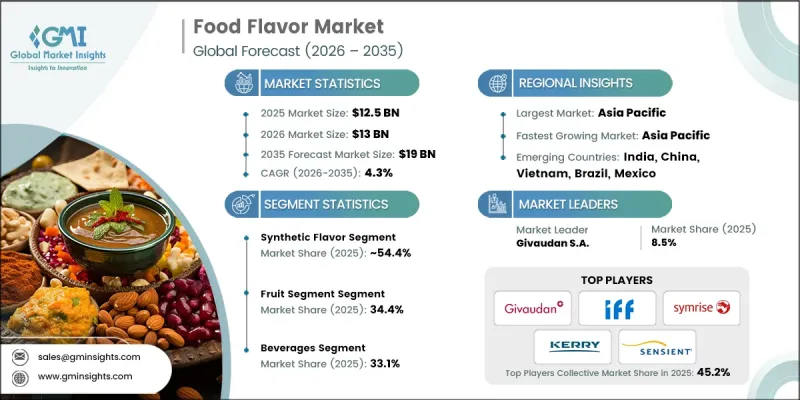
세계의 식품 향료 시장은 2025년에 125억 달러로 평가되었고, CAGR 4.3%로 성장하여 2035년까지 190억 달러에 이를 것으로 추정되고 있습니다.
소비자의 취향 변화에 따라 천연 원료, 투명성, 그리고 더 풍부한 미각 경험을 중시하게 되면서 시장은 꾸준히 진화하고 있습니다. 천연 유래 및 합성으로 개발된 다양한 식품 향료는 제조업체들이 일관되고 매력적인 관능적 특성을 제공하기 위해 다양한 식품의 배합에 있어 점점 더 중요해지고 있습니다. 원료 조달 및 제품 진위성에 대한 인식이 높아짐에 따라 업계는 클린 라벨 솔루션으로의 명확한 전환을 볼 수 있습니다. 건강 지향적인 소비 패턴과 제품 혁신에 대한 관심이 높아지면서 고급 향료 시스템 개발이 더욱 가속화되고 있습니다. 음료의 배합에서 맛은 제품의 정체성을 확립하고 소비자의 수용성을 높이는 데 매우 중요한 역할을 합니다. 특히 기업이 맛과 저당화, 기능적 장점의 균형을 맞추기 위해 노력하면서 그 중요성이 더욱 커지고 있습니다. 독특한 맛에 대한 선호도 증가와 식습관 변화로 인해 다양한 맛에 대한 실험이 활발해지면서 여러 응용 분야에 걸쳐 장기적인 시장 확대가 이루어지고 있습니다.
| 시장 범위 | |
|---|---|
| 개시 연도 | 2025년 |
| 예측 기간 | 2026-2035년 |
| 개시 연도 시장 규모 | 125억 달러 |
| 예측액 | 190억 달러 |
| CAGR | 4.3% |
합성 향료 부문은 2025년 54.4%의 점유율을 차지했으며, 2035년까지 연평균 복합 성장률(CAGR) 4%를 나타낼 것으로 예측됩니다. 이 부문은 일관된 품질, 비용 효율성 및 장기 보존성을 실현할 수 있기 때문에 지속적으로 강력한 입지를 유지하고 있습니다. 합성 향료는 천연 유래의 향미 프로파일을 재현하도록 설계되어 가공 식품 및 음료의 대규모 생산에 적합합니다. 계절별 원재료에 의존하지 않고 사계절 내내 사용할 수 있기 때문에 제조업체의 선호도가 높아지고 있습니다. 또한, 이러한 향료는 배합을 정밀하게 제어할 수 있어 생산 로트 간 맛의 일관성을 보장할 수 있습니다. 이러한 장점에도 불구하고, 클린 라벨 제품에 대한 수요 증가는 점차 이 분야에 영향을 미치고 있으며, 기업들은 성능 효율성과 소비자 평가 및 규제 준수를 동시에 충족하는 하이브리드 솔루션 개발을 추진하고 있습니다.
과일 맛 부문은 2025년 34.4%의 큰 점유율을 차지하며 2035년까지 연평균 복합 성장률(CAGR) 3.9%를 나타낼 것으로 예측됩니다. 이 부문은 다양한 음료 및 식품 카테고리에서 폭넓게 수용되고 적응력이 높기 때문에 계속해서 선도적인 위치를 유지하고 있습니다. 과일 베이스 맛은 변화하는 소비자 취향에 맞추어 자연스러운 단맛과 매력적인 맛의 특징을 제공하기 때문에 많은 제품 제형에 널리 채택되고 있습니다. 건강 지향적 소비와의 연관성은 소비자들이 자연스럽고 유익한 것으로 인식되는 제품을 점점 더 많이 찾게 되면서 시장에서의 입지를 더욱 공고히 하고 있습니다. 전 세계적으로 미각의 취향이 다양해지고 다양한 맛 경험에 대한 수요가 증가하면서 과일에서 영감을 받은 새로운 포뮬러 개발도 이 부문의 꾸준한 성장에 기여하고 있습니다.
2025년 북미 식품 향료 시장은 29.6%의 점유율을 차지했습니다. 이 지역은 혁신과 제품 차별화를 적극적으로 도입하는 기존 식음료 부문의 혜택을 누리고 있습니다. 건강, 웰빙, 원재료의 투명성에 대한 소비자의 인식이 높아지면서 제조업체들이 자연스럽고 지속 가능한 향료 솔루션으로 전환하고 있습니다. 또한, 기능성 식품 및 영양 강화 제품에 대한 수요는 맛과 제품 포지셔닝을 향상시키는 고급 향료 기술의 채택을 촉진하고 있습니다. 소비자의 취향 변화와 다양한 식문화의 영향력 확대가 맞물려 시장 성장을 더욱 촉진하고 있습니다. 탄탄한 유통 네트워크, 높은 가공 능력, 지속적인 제품 개발 노력으로 세계 시장에서 이 지역의 입지를 강화하고 있습니다.
자주 묻는 질문
목차
제1장 조사 방법과 범위
제2장 주요 요약
제3장 업계 인사이트
제4장 경쟁 구도
제5장 시장 추산 및 예측 : 유형별, 2022-2035
제6장 시장 추산 및 예측 : 향료(Flavor)별, 2022-2035
제7장 시장 추산 및 예측 : 용도별, 2022-2035
제8장 시장 추산 및 예측 : 지역별, 2022-2035
제9장 기업 개요
LSH 26.05.08The Global Food Flavor Market was valued at USD 12.5 billion in 2025 and is estimated to grow at a CAGR of 4.3% to reach USD 19 billion by 2035.
The market continues to evolve steadily as shifting consumer preferences place greater emphasis on natural ingredients, transparency, and enhanced taste experiences. Food flavors, which include both naturally derived and synthetically developed variants, are gaining importance across diverse food and beverage formulations as manufacturers aim to deliver consistent and appealing sensory profiles. The industry is witnessing a clear transition toward clean-label solutions, supported by rising awareness around ingredient sourcing and product authenticity. Increasing focus on health-oriented consumption patterns and product innovation is further encouraging the development of advanced flavor systems. In beverage formulations, flavors play a vital role in defining product identity and improving consumer acceptance, particularly as companies work to balance taste with reduced sugar content and functional benefits. The growing inclination toward unique taste profiles and evolving culinary preferences is also contributing to broader flavor experimentation, reinforcing long-term market expansion across multiple application areas.
| Market Scope | |
|---|---|
| Start Year | 2025 |
| Forecast Year | 2026-2035 |
| Start Value | $12.5 Billion |
| Forecast Value | $19 Billion |
| CAGR | 4.3% |
The synthetic flavor segment accounted for 54.4% share in 2025 and is anticipated to grow at a CAGR of 4% through 2035. This segment continues to maintain a strong presence due to its ability to deliver consistent quality, cost efficiency, and extended shelf stability. Synthetic flavors are engineered to replicate naturally occurring taste profiles, making them suitable for large-scale production across processed foods and beverages. Their availability throughout the year without dependency on seasonal raw materials enhances their appeal among manufacturers. In addition, these flavors allow precise formulation control, ensuring uniformity in taste across production batches. Despite these advantages, increasing demand for clean-label products is gradually influencing the segment, encouraging companies to develop hybrid solutions that combine performance efficiency with improved consumer perception and regulatory compliance.
The fruit flavor segment held a significant share of 34.4% in 2025 and is expected to grow at a CAGR of 3.9% by 2035. This segment continues to lead due to its broad acceptance and adaptability across various food and beverage categories. Fruit-based flavors are widely incorporated into multiple product formulations because they provide natural sweetness and appealing taste characteristics that align with evolving consumer preferences. Their association with health-conscious consumption further strengthens their market position, as consumers increasingly gravitate toward products perceived as natural and beneficial. The expansion of global taste preferences and demand for diverse flavor experiences is also supporting the development of new fruit-inspired formulations, contributing to steady growth across the segment.
North America Food Flavor Market accounted for a 29.6% share in 2025. The region benefits from a well-established food and beverage sector that actively embraces innovation and product differentiation. Rising consumer awareness regarding health, wellness, and ingredient transparency is encouraging manufacturers to shift toward natural and sustainable flavor solutions. In addition, the demand for functional food products and nutritionally enhanced offerings is driving the adoption of sophisticated flavor technologies that improve both taste and product positioning. Evolving consumer preferences, combined with the expansion of diverse culinary influences, are further supporting market growth. Strong distribution networks, advanced processing capabilities, and continuous product development initiatives are reinforcing the region's position in the global market.
Key players operating in the Global Food Flavor Market include Givaudan S.A., Symrise AG, Kerry Group plc, International Flavors and Fragrances (IFF), Sensient Technologies, Firmenich SA, Dohler, MANE Flavor & Fragrance Manufacturer, McCormick & Company, Inc., Frutarom (part of IFF), Gold Coast Ingredients, BioSun Flavors & Food Ingredients, Flavaroma, Natures Flavors, Inc., and Synergy Flavors. Companies in the food flavor market are strengthening their competitive position by investing in research and development to create advanced flavor formulations that align with evolving consumer preferences. They are focusing on expanding portfolios with natural and clean-label ingredients while improving sourcing transparency and sustainability practices. Strategic collaborations with food and beverage manufacturers are enabling tailored flavor solutions and long-term partnerships. Businesses are also enhancing production capabilities and adopting innovative technologies to ensure consistency, scalability, and efficiency. Geographic expansion into emerging markets, combined with the introduction of differentiated and customized flavor profiles, is further helping companies build stronger market presence and maintain long-term growth potential.
Table of Contents
Chapter 1 Methodology & Scope
- 1.1 Market scope and definition
- 1.2 Research design
- 1.2.1 Research approach
- 1.2.2 Data collection methods
- 1.3 Data mining sources
- 1.3.1 Global
- 1.3.2 Regional/Country
- 1.4 Base estimates and calculations
- 1.4.1 Base year calculation
- 1.4.2 Key trends for market estimation
- 1.5 Primary research and validation
- 1.5.1 Primary sources
- 1.6 Forecast model
- 1.7 Research assumptions and limitations
Chapter 2 Executive Summary
- 2.1 Industry 360° synopsis
- 2.2 Key market trends
- 2.2.1 Type
- 2.2.2 Flavor
- 2.2.3 Application
- 2.2.4 Regional
- 2.3 TAM Analysis, 2026-2035
- 2.4 CXO perspectives: Strategic imperatives
Chapter 3 Industry Insights
- 3.1 Industry ecosystem analysis
- 3.1.1 Supplier landscape
- 3.1.2 Profit margin
- 3.1.3 Value addition at each stage
- 3.1.4 Factor affecting the value chain
- 3.1.5 Disruptions
- 3.2 Industry impact forces
- 3.2.1 Growth drivers
- 3.2.2 Industry pitfalls and challenges
- 3.2.3 Market opportunities
- 3.3 Growth potential analysis
- 3.4 Regulatory landscape
- 3.4.1 North America
- 3.4.2 Europe
- 3.4.3 Asia Pacific
- 3.4.4 Latin America
- 3.4.5 Middle East & Africa
- 3.5 Porter's analysis
- 3.6 PESTEL analysis
- 3.7 Price trends
- 3.7.1 By region
- 3.7.2 By type
- 3.8 Future market trends
- 3.9 Technology and Innovation landscape
- 3.9.1 Current technological trends
- 3.9.2 Emerging technologies
- 3.10 Patent Landscape
- 3.11 Trade statistics (HS code)
- 3.11.1 Major importing countries
- 3.11.2 Major exporting countries
- 3.12 Sustainability and environmental aspects
- 3.12.1 Sustainable practices
- 3.12.2 Waste reduction strategies
- 3.12.3 Energy efficiency in production
- 3.12.4 Eco-friendly initiatives
- 3.13 Carbon footprint consideration
Chapter 4 Competitive Landscape, 2025
- 4.1 Introduction
- 4.2 Company market share analysis
- 4.2.1 By region
- 4.2.1.1 North America
- 4.2.1.2 Europe
- 4.2.1.3 Asia Pacific
- 4.2.1.4 LATAM
- 4.2.1.5 MEA
- 4.2.1 By region
- 4.3 Competitive analysis of major market players
- 4.4 Competitive positioning matrix
- 4.5 Key developments
- 4.5.1 Mergers & acquisitions
- 4.5.2 Partnerships & collaborations
- 4.5.3 New Product Launches
- 4.5.4 Expansion Plans
Chapter 5 Market Estimates and Forecast, By Type, 2022-2035 (USD Billion) (Kilo Tons)
- 5.1 Key trends
- 5.2 Natural flavor
- 5.3 Synthetic flavor
Chapter 6 Market Estimates and Forecast, By Flavor, 2022-2035 (USD Billion) (Kilo Tons)
- 6.1 Key trends
- 6.2 Fruit
- 6.2.1 Citrus
- 6.2.2 Berries
- 6.2.3 Stone fruits
- 6.2.4 Tropical & exotic
- 6.2.5 Apple & pear
- 6.2.6 Melon
- 6.2.7 Others
- 6.3 Chocolate
- 6.3.1 Dark chocolate
- 6.3.2 Milk chocolate
- 6.3.3 White chocolate
- 6.3.4 Ruby chocolate
- 6.3.5 Others
- 6.4 Vanilla
- 6.5 Nut
- 6.5.1 Almond
- 6.5.2 Hazelnut
- 6.5.3 Walnut
- 6.5.4 Pistachio
- 6.5.5 Cashew
- 6.5.6 Pecan
- 6.5.7 Macadamia
- 6.5.8 Others
- 6.6 Caramel
- 6.7 Other
Chapter 7 Market Estimates and Forecast, By Application, 2022-2035 (USD Billion) (Kilo Tons)
- 7.1 Key trends
- 7.2 Beverages
- 7.2.1 Non-alcoholic
- 7.2.2 Alcoholic
- 7.3 Dairy products
- 7.3.1 Frozen dairy
- 7.3.2 Cultured dairy
- 7.3.3 Cheese
- 7.3.4 Milk drinks
- 7.3.5 Dairy alternatives
- 7.3.6 Other dairy
- 7.4 Bakery and confectionery
- 7.4.1 Bakery
- 7.4.2 Confectionery
- 7.5 Savory and snacks
- 7.6 Other
Chapter 8 Market Estimates and Forecast, By Region, 2022-2035 (USD Billion) (Kilo Tons)
- 8.1 Key trends
- 8.2 North America
- 8.2.1 U.S.
- 8.2.2 Canada
- 8.3 Europe
- 8.3.1 Germany
- 8.3.2 UK
- 8.3.3 France
- 8.3.4 Spain
- 8.3.5 Italy
- 8.3.6 Rest of Europe
- 8.4 Asia Pacific
- 8.4.1 China
- 8.4.2 India
- 8.4.3 Japan
- 8.4.4 Australia
- 8.4.5 South Korea
- 8.4.6 Rest of Asia Pacific
- 8.5 Latin America
- 8.5.1 Brazil
- 8.5.2 Mexico
- 8.5.3 Argentina
- 8.5.4 Rest of Latin America
- 8.6 Middle East and Africa
- 8.6.1 Saudi Arabia
- 8.6.2 South Africa
- 8.6.3 UAE
- 8.6.4 Rest of Middle East and Africa
Chapter 9 Company Profiles
- 9.1 Givaudan S.A.
- 9.2 International Flavors and Fragrances (IFF)
- 9.3 Symrise AG
- 9.4 Kerry Group plc
- 9.5 Sensient Technologies
- 9.6 BioSun Flavors & Food Ingredients
- 9.7 Dohler
- 9.8 Firmenich SA
- 9.9 Flavaroma
- 9.10 Frutarom (part of IFF)
- 9.11 Gold Coast Ingredients
- 9.12 MANE Flavor & Fragrance Manufacturer
- 9.13 McCormick & Company, Inc.
- 9.14 Natures Flavors, Inc.
- 9.15 Synergy Flavors