

|
시장보고서
상품코드
2019230
투석 카테터 시장 기회, 성장요인, 업계 동향 분석 및 예측(2026-2035년)Dialysis Catheters Market Opportunity, Growth Drivers, Industry Trend Analysis, and Forecast 2026 - 2035 |
||||||

세계의 투석 카테터 시장은 2025년에 11억 7,000만 달러로 평가되었고, CAGR 6.4%로 성장하여 2035년까지 22억 달러에 이를 것으로 추정되고 있습니다.
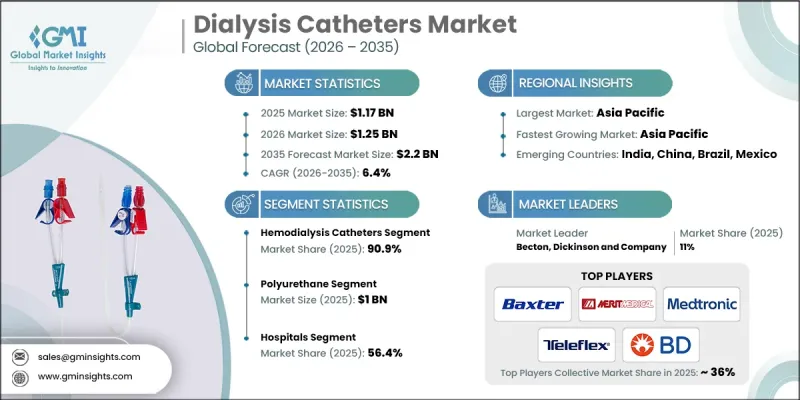
이 시장은 만성 신장 질환 및 말기 신부전증의 유병률 증가와 더불어 신장 대체 요법에 대한 의존도가 높아지면서 시장이 확대되고 있습니다. 당뇨병과 고혈압 증가도 효과적인 투석 솔루션에 대한 수요를 더욱 촉진하고 있습니다. 투석 카테터는 신장 기능이 저하되었을 때 혈액 내 노폐물과 과도한 수분을 제거할 수 있게 해주는 중요한 의료기기입니다. 이들 장치는 크게 혈액투석용 카테터와 복막투석용 카테터로 분류되며, 모두 치료 수행에 필수적인 역할을 담당하고 있습니다. 환자들이 점점 더 편리하고 접근하기 쉬운 치료법을 요구함에 따라 재택의료로의 전환이 시장 역학에 큰 영향을 미치고 있습니다. 내구성 향상과 감염 위험 감소 등 카테터 설계의 지속적인 발전으로 장기적인 사용성이 향상되고 있습니다. 또한, 의료 지원과 협력 체계 강화로 인프라와 접근성이 향상되어 시장 성장을 더욱 촉진하고 있습니다.
| 시장 범위 | |
|---|---|
| 개시 연도 | 2025년 |
| 예측 기간 | 2026-2035년 |
| 개시 시점 시장 규모 | 11억 7,000만 달러 |
| 예측액 | 22억 달러 |
| CAGR | 6.4% |
2025년 기준, 혈액투석 카테터 부문은 90.9%의 점유율을 차지하며 혈액투석을 필요로 하는 환자 수가 증가함에 따라 시장을 주도하고 있습니다. 치료의 효율성과 환자의 안전을 보장하기 위해 신뢰할 수 있는 혈관 접근 솔루션에 대한 수요는 여전히 필수적입니다. 이 카테터는 합병증을 최소화하면서 안정적인 성능을 발휘하도록 설계되어 의료시설에서 채택이 확대되고 있습니다. 혈액투석에 따른 정기적인 치료 일정은 지속적인 수요의 요인이 되고 있습니다. 환자들은 반복 사용이 가능하고 치료의 연속성을 유지할 수 있는 신뢰할 수 있는 접근 장치가 필요하기 때문입니다.
폴리우레탄 부문은 임상적 성능을 뒷받침하는 우수한 재료 특성에 힘입어 2025년 10억 달러 시장 규모를 기록할 것으로 예측됩니다. 폴리우레탄 카테터는 유연성과 구조적 강도로 인해 사용 중 굴곡, 막힘 등의 문제를 방지할 수 있어 널리 선호되고 있습니다. 매끄러운 표면은 전반적인 기능을 향상시키고, 합병증 발생 확률을 낮출 수 있으며, 장기적인 사용 적합성을 지원합니다. 이 부문은 장기 치료 환경에서 환자의 편안함과 기기의 신뢰성을 향상시키기 위한 지속적인 재료 혁신의 혜택을 계속 누리고 있습니다.
미국 투석 카테터 시장은 2025년 4억 2,500만 달러에 달할 것으로 예상되며, 이 지역에서 꾸준한 성장세를 보이고 있습니다. 시장 확대는 유리한 상환 제도와 치료 접근성을 향상시키는 투석 센터 증가에 의해 뒷받침되고 있습니다. 이 지역에서는 의료 기술에 대한 강력한 투자가 이루어지고 있으며, 카테터 설계 및 성능에 대한 혁신을 촉진하고 있습니다. 재료, 코팅, 구조 설계의 지속적인 개선이 환자의 치료 성과 향상과 제품 보급 확대에 기여하고 있습니다. 또한, 보험 적용은 저렴한 가격을 보장하고 의료시설 전체에서 투석 관련 제품의 광범위한 사용을 촉진하는 데 중요한 역할을 하고 있습니다.
자주 묻는 질문
목차
제1장 조사 방법
제2장 주요 요약
제3장 업계 인사이트
제4장 경쟁 구도
제5장 시장 추산 및 예측 : 유형별, 2022-2035
제6장 시장 추산 및 예측 : 재료별, 2022-2035
제7장 시장 추산 및 예측 : 최종 용도별, 2022-2035
제8장 시장 추산 및 예측 : 지역별, 2022-2035
제9장 기업 개요
LSH 26.05.08The Global Dialysis Catheters Market was valued at USD 1.17 billion in 2025 and is estimated to grow at a CAGR of 6.4% to reach USD 2.2 billion by 2035.
The market is expanding due to the rising incidence of chronic kidney conditions and end-stage renal disease, along with a growing reliance on renal replacement therapies. Increasing cases of diabetes and hypertension are further contributing to the demand for effective dialysis solutions. Dialysis catheters serve as critical medical devices that enable the removal of waste and excess fluids from the bloodstream when kidney function is impaired. These devices are broadly categorized into hemodialysis and peritoneal dialysis catheters, both of which play essential roles in treatment delivery. The shift toward home-based healthcare is significantly influencing market dynamics, as patients increasingly seek convenient and accessible treatment options. Continuous advancements in catheter design, including enhanced durability and reduced risk of infection, are improving long-term usability. Additionally, supportive healthcare initiatives and collaborative efforts are strengthening infrastructure and accessibility, further driving market growth.
| Market Scope | |
|---|---|
| Start Year | 2025 |
| Forecast Year | 2026-2035 |
| Start Value | $1.17 Billion |
| Forecast Value | $2.2 Billion |
| CAGR | 6.4% |
The hemodialysis catheters segment held a 90.9% share in 2025 and continues to lead the market due to the growing patient population requiring hemodialysis procedures. The need for dependable vascular access solutions remains critical to ensure treatment efficiency and patient safety. These catheters are designed to provide consistent performance while minimizing complications, which increases their adoption across healthcare facilities. Regular treatment schedules associated with hemodialysis contribute to sustained demand, as patients require reliable access devices that support repeated use and maintain treatment continuity.
The polyurethane segment generated USD 1 billion in 2025, driven by its favorable material characteristics that support clinical performance. Polyurethane-based catheters are widely preferred due to their flexibility and structural strength, which help prevent issues such as bending or blockage during use. Their smooth surface enhances overall functionality and may reduce the likelihood of complications, supporting their suitability for extended use. The segment continues to benefit from ongoing material innovations aimed at improving patient comfort and device reliability in long-term treatment settings.
U.S. Dialysis Catheters Market was valued at USD 425 million in 2025, highlighting consistent growth within the region. Market expansion is supported by favorable reimbursement structures and the increasing number of dialysis centers, which enhance treatment accessibility. The region demonstrates strong investment in healthcare technologies, driving innovation in catheter design and performance. Continuous improvements in materials, coatings, and structural design are contributing to better patient outcomes and increased product adoption. In addition, supportive insurance coverage plays a key role in ensuring affordability and encouraging wider use of dialysis-related products across healthcare facilities.
Key players operating in the Global Dialysis Catheters Market include Amecath Medical Technologies, Angiplast, B Braun, Baxter International, Becton, Dickinson and Company, Cook Medical, Medtronic, Merit Medical Systems, PFM Medical, Inc., Poly Medicure, Teleflex, and Vygon. Companies in the dialysis catheters market are strengthening their competitive position through continuous innovation, strategic partnerships, and expansion of production capabilities. Manufacturers are investing in advanced materials and improved catheter designs to enhance safety, durability, and patient comfort. Collaborations with healthcare providers and research institutions are enabling the development of more efficient and clinically effective solutions. Firms are also focusing on expanding their geographic footprint to tap into emerging markets with growing healthcare infrastructure. In addition, companies are optimizing supply chains and investing in quality assurance processes to ensure consistent product performance. Emphasis on regulatory compliance and product differentiation is further helping organizations maintain a strong presence in a competitive landscape.
Table of Contents
Chapter 1 Research Methodology
- 1.1 Research approach
- 1.2 Quality commitments
- 1.2.1 GMI AI policy & data integrity commitment
- 1.2.1.1 Source consistency protocol
- 1.2.1 GMI AI policy & data integrity commitment
- 1.3 Research trail & confidence scoring
- 1.3.1 Research trail components
- 1.3.2 Scoring components
- 1.4 Data collection
- 1.4.1 Partial list of primary sources
- 1.5 Data mining sources
- 1.5.1 Paid sources
- 1.5.1.1 Sources, by region
- 1.5.1 Paid sources
- 1.6 Base estimates and calculations
- 1.6.1 Base year calculation
- 1.7 Forecast model
- 1.7.1 Quantified market impact analysis
- 1.7.1.1 Mathematical impact of growth parameters on forecast
- 1.7.1 Quantified market impact analysis
- 1.8 Research transparency addendum
- 1.8.1 Source attribution framework
- 1.8.2 Quality assurance metrics
- 1.8.3 Our commitment to trust
Chapter 2 Executive Summary
- 2.1 Industry 360° synopsis
- 2.2 Key market trends
- 2.2.1 Regional trends
- 2.2.2 Type trends
- 2.2.3 Material trends
- 2.2.4 End use trends
- 2.3 CXO perspectives: Strategic imperatives
Chapter 3 Industry Insights
- 3.1 Industry ecosystem analysis
- 3.2 Industry impact forces
- 3.2.1 Growth drivers
- 3.2.1.1 Increasing prevalence of chronic kidney disorders & end-stage renal disease
- 3.2.1.2 Rising number of renal replacement therapy
- 3.2.1.3 Growing trend of treatments in homecare settings
- 3.2.1.4 Shortage of kidney donors globally
- 3.2.2 Industry pitfalls and challenges
- 3.2.2.1 Growing preference for fistulas and grafts over catheters
- 3.2.2.2 Complications associated with dialysis catheters
- 3.2.3 Opportunities
- 3.2.3.1 Development of antimicrobial and infection-resistant catheters
- 3.2.3.2 Growth of home hemodialysis adoption
- 3.2.1 Growth drivers
- 3.3 Growth potential analysis
- 3.4 Regulatory landscape (Driven by Primary Research)
- 3.4.1 North America
- 3.4.2 Europe
- 3.4.3 Asia Pacific
- 3.5 Technology and innovation landscape
- 3.5.1 Current technological trends
- 3.5.2 Emerging technologies (Driven by Primary Research)
- 3.6 Future market trends (Driven by Primary Research)
- 3.7 Reimbursement scenario
- 3.8 Impact of AI & generative AI on the market (Driven by Primary Research)
- 3.8.1 AI-Driven disruption of existing business models
- 3.8.2 GenAI use cases & adoption roadmap by segment
- 3.9 Price trends, by type, 2025 (Driven by Primary Research)
- 3.10 Gap analysis
- 3.11 Porter's analysis
- 3.12 PESTEL analysis
Chapter 4 Competitive Landscape, 2025
- 4.1 Introduction
- 4.2 Company matrix analysis
- 4.3 Company market share analysis
- 4.3.1 Global
- 4.3.2 North America
- 4.3.3 Europe
- 4.3.4 Asia Pacific
- 4.3.5 Latin America
- 4.3.6 MEA
- 4.4 Competitive analysis of major market players
- 4.5 Competitive positioning matrix
- 4.6 Key developments
- 4.6.1 Mergers & acquisitions
- 4.6.2 Partnerships & collaborations
- 4.6.3 New product launches
- 4.6.4 Expansion plans
Chapter 5 Market Estimates and Forecast, By Type, 2022 - 2035 ($ Mn & Units)
- 5.1 Key trends
- 5.2 Hemodialysis catheters
- 5.2.1 Short-term hemodialysis catheters
- 5.2.2 Long-term hemodialysis catheters
- 5.3 Peritoneal catheters
Chapter 6 Market Estimates and Forecast, By Material, 2022 - 2035 ($ Mn)
- 6.1 Key trends
- 6.2 Silicone
- 6.3 Polyurethane
Chapter 7 Market Estimates and Forecast, By End Use, 2022 - 2035 ($ Mn)
- 7.1 Key trends
- 7.2 Hospitals
- 7.3 Ambulatory surgical centers
- 7.4 Homecare settings
- 7.5 Other end-users
Chapter 8 Market Estimates and Forecast, By Region, 2022 - 2035 ($ Mn & Units)
- 8.1 Key trends
- 8.2 North America
- 8.2.1 U.S.
- 8.2.2 Canada
- 8.3 Europe
- 8.3.1 Germany
- 8.3.2 UK
- 8.3.3 France
- 8.3.4 Spain
- 8.3.5 Italy
- 8.3.6 Netherlands
- 8.4 Asia Pacific
- 8.4.1 China
- 8.4.2 Japan
- 8.4.3 India
- 8.4.4 Australia
- 8.4.5 South Korea
- 8.5 Latin America
- 8.5.1 Brazil
- 8.5.2 Mexico
- 8.5.3 Argentina
- 8.6 MEA
- 8.6.1 South Africa
- 8.6.2 Saudi Arabia
- 8.6.3 UAE
Chapter 9 Company Profiles
- 9.1 Amecath Medical Technologies
- 9.2 Angiplast
- 9.3 B Braun
- 9.4 Baxter International
- 9.5 Becton, Dickinson and Company
- 9.6 Cook Medical
- 9.7 Medtronic
- 9.8 Merit Medical Systems
- 9.9 PFM Medical, Inc.
- 9.10 Poly Medicure
- 9.11 Teleflex
- 9.12 Vygon


