
|
시장보고서
상품코드
2019246
대형 자율주행 차량 시장 비즈니스 기회, 성장요인, 업계 동향 분석 및 예측(2026-2035년)Heavy-Duty Autonomous Vehicle Market Opportunity, Growth Drivers, Industry Trend Analysis, and Forecast 2026 - 2035 |
||||||

세계의 대형 자율주행 차량 시장은 2025년에 458억 달러로 평가되었고, 2035년까지 연평균 복합 성장률(CAGR) 15.7%로 성장하여 1,815억 달러에 이를 것으로 추정되고 있습니다.
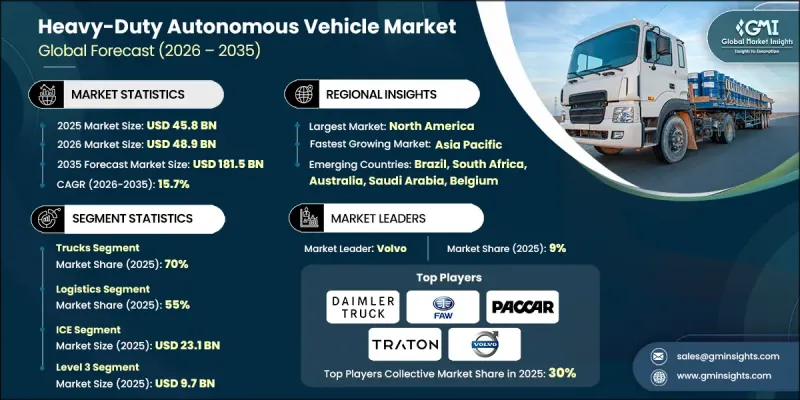
첨단 안전 시스템에 대한 수요 증가와 자율주행 기술에 대한 관심이 높아짐에 따라 운송 산업의 양상이 변화하고 있으며, 대형 자율주행차 산업은 강한 추진력을 보이고 있습니다. 첨단 차량에는 주변 상황을 실시간으로 분석하고 신속한 운전 판단을 내릴 수 있는 첨단 센서와 지능형 소프트웨어가 점점 더 많이 탑재되고 있습니다. 이러한 기능을 통해 사고의 대폭적인 감소, 부상자 및 사망자 감소, 인프라 및 차량 손상 최소화, 궁극적으로 운영 비용 절감 및 도로 안전성 향상으로 이어질 것으로 예측됩니다. 시장 확대는 자동화 기술의 지속적인 혁신과 스마트 모빌리티 솔루션의 통합으로 더욱 가속화되고 있습니다. 도입이 진행됨에 따라 시장은 대형 운송 용도의 안전과 운영상의 문제를 모두 해결할 수 있는 보다 안정적이고 효율적이며 확장 가능한 자율주행 시스템으로 진화하고 있습니다.
| 시장 범위 | |
|---|---|
| 개시 연도 | 2025 |
| 예측 기간 | 2026-2035년 |
| 개시 연도 시장 규모 | 458억 달러 |
| 예측액 | 1,815억 달러 |
| CAGR | 15.7% |
대형 자율주행차 시장은 증가하는 상업적 수요를 뒷받침하기 위한 강력한 업계 협력과 파트너십의 필요성에 영향을 받고 있습니다. 코로나19 팬데믹은 업계에 과제와 기회를 동시에 가져왔습니다. 2020년 초, 봉쇄 조치, 공급망 혼란, 반도체 부족으로 인해 개발 활동이 둔화되어 첨단 자율주행차 및 전기자동차 솔루션의 도입이 늦어지고 있습니다. 또한, 물류사업자들이 신기술에 대한 투자보다 필수 업무의 유지와 인력 부족에 대한 대응을 우선시하면서 많은 실증 실험이 일시적으로 중단된 바 있습니다.
트럭 부문은 2025년 70%의 점유율을 차지할 것으로 예상되며, 2026년부터 2035년까지 연평균 복합 성장률(CAGR) 14.8%로 성장할 것으로 전망됩니다. 이러한 우위는 물류, 산업, 자원 관련 분야에서 트럭이 광범위하게 활용되고 있기 때문입니다. 트럭 운송의 자동화는 인력 부족, 높은 운영 비용, 안전 문제 등 중요한 문제를 해결해 줄 수 있습니다. 자율주행 트럭은 연속 운행, 연비 효율 향상, 배송 주기 단축을 실현하여 생산성 향상에 기여하고 있습니다. 또한, 센서 시스템 및 지능형 내비게이션 기술의 발전으로 정비된 도로 환경에서의 운전 정확도와 운영 신뢰성이 향상되고 있습니다.
내연기관(ICE) 부문은 2025년 231억 달러에 달할 것으로 예측됩니다. 내연기관차는 초기 비용이 저렴하고, 주유 인프라가 잘 구축되어 있어 여전히 널리 사용되고 있으며, 이는 다양한 환경에서의 시험 및 도입을 뒷받침하고 있습니다. 또한, 긴 항속거리로 장거리 운행 및 다양한 테스트 시나리오에 적합하여 자율주행차 분야의 지속적인 발전을 뒷받침하고 있습니다.
2025년 미국의 대형 자율주행차 시장은 127억 달러 규모에 달할 것으로 예측됩니다. 이러한 성장은 자율주행차 시험 및 도입에 대한 규제 당국의 관심이 높아지면서 안전하고 효율적인 도입을 위한 정부 프레임워크가 마련되고 있는 데 따른 것입니다. 안전과 편의성에 대한 소비자의 기대가 높아진 데다, 보다 효율적인 운송 시스템의 필요성도 시장 확대에 기여하고 있습니다. 또한, 이러한 차량은 도로의 혼잡을 완화하고 전반적인 교통 안전을 향상시킬 수 있는 잠재적인 해결책으로 인식되고 있습니다.
자주 묻는 질문
목차
제1장 조사 방법과 범위
제2장 주요 요약
제3장 업계 인사이트
제4장 경쟁 구도
제5장 시장 추산 및 예측 : 차종별, 2022-2035
제6장 시장 추산 및 예측 : 자율주행 레벨별, 2022-2035
제7장 시장 추산 및 예측 : 추진 방식별, 2022-2035
제8장 시장 추산 및 예측 : 용도별, 2022-2035
제9장 시장 추산 및 예측 : 최종 용도별, 2022-2035
제10장 시장 추산 및 예측 : 지역별, 2022-2035
제11장 기업 개요
LSHThe Global Heavy-Duty Autonomous Vehicle Market was valued at USD 45.8 billion in 2025 and is estimated to grow at a CAGR of 15.7% to reach USD 181.5 billion by 2035.
The heavy-duty autonomous vehicle industry is gaining strong momentum as demand for enhanced safety systems and growing interest in self-driving technologies reshape the transportation landscape. Advanced vehicles are increasingly equipped with sophisticated sensors and intelligent software that can analyze their surroundings in real-time and make rapid driving decisions. These capabilities are expected to significantly reduce accidents, lower the number of injuries and fatalities, and minimize damage to infrastructure and vehicles, ultimately leading to reduced operational costs and improved road safety. Market expansion is further supported by continuous innovation in automation technologies and the integration of smart mobility solutions. As adoption increases, the market is evolving toward more reliable, efficient, and scalable autonomous systems that address both safety and operational challenges across heavy-duty transport applications.
| Market Scope | |
|---|---|
| Start Year | 2025 |
| Forecast Year | 2026-2035 |
| Start Value | $45.8 Billion |
| Forecast Value | $181.5 Billion |
| CAGR | 15.7% |
The heavy-duty autonomous vehicle market is also influenced by the need for strong industry collaboration and partnerships to support rising commercial demand. The COVID-19 pandemic created both challenges and opportunities for the industry. During the early stages of 2020, lockdown measures, supply chain disruptions, and semiconductor shortages slowed development activities and delayed the introduction of advanced autonomous and electric vehicle solutions. In addition, many pilot programs were temporarily halted as logistics providers prioritized maintaining essential operations and managing workforce constraints, rather than investing in new technology initiatives.
The trucks segment held a 70% share in 2025 and is projected to grow at a CAGR of 14.8% from 2026 to 2035. This dominance is driven by the extensive use of trucks across logistics, industrial, and resource-based sectors. Automation in trucking addresses critical challenges such as labor shortages, high operating expenses, and safety concerns. Autonomous trucks offer continuous operation, improved fuel efficiency, and faster delivery cycles, contributing to higher productivity. Advancements in sensor systems and intelligent navigation technologies are also improving driving precision and operational reliability under structured road conditions.
The ICE segment reached USD 23.1 billion in 2025. Internal combustion engine vehicles remain widely used due to their lower initial cost and well-established refueling infrastructure, which supports testing and deployment across multiple environments. Their extended driving range also makes them suitable for long-distance operations and diverse testing scenarios, supporting ongoing development in the autonomous vehicle space.
U.S. Heavy-Duty Autonomous Vehicle Market generated USD 12.7 billion in 2025. Growth is supported by increasing regulatory focus on autonomous vehicle testing and deployment, with government frameworks aimed at enabling safe and efficient adoption. Rising consumer expectations for safety and convenience, along with the need for more efficient transportation systems, are contributing to market expansion. Additionally, these vehicles are being recognized as a potential solution for reducing road congestion and improving overall traffic safety.
Key players operating in the Global Heavy-Duty Autonomous Vehicle Market include PACCAR, Volvo, Daimler Truck, TRATON, FAW, SAIC, JAC, Baidu, Waymo, and ZF Friedrichshafen. Companies in the Heavy-Duty Autonomous Vehicle Market are strengthening their market position through continuous technological advancement and strategic collaboration. They are investing in research and development to enhance autonomous driving capabilities, sensor accuracy, and system reliability. Partnerships with technology providers and logistics companies are enabling faster innovation and real-world deployment. Businesses are also focusing on scalable vehicle platforms and software integration to improve operational efficiency and reduce costs. Expanding testing programs and improving regulatory alignment are key priorities to accelerate commercialization. In addition, companies are enhancing production capabilities and optimizing supply chains to meet growing demand, while aligning product offerings with evolving industry requirements to maintain a competitive edge.
Table of Contents
Chapter 1 Methodology & Scope
- 1.1 Research approach
- 1.2 Quality Commitments
- 1.2.1 GMI AI policy & data integrity commitment
- 1.2.1.1 Source consistency protocol
- 1.2.1 GMI AI policy & data integrity commitment
- 1.3 Research Trail & Confidence Scoring
- 1.3.1 Research Trail Components
- 1.3.2 Scoring Components
- 1.4 Data Collection
- 1.4.1 Partial list of primary sources
- 1.5 Data mining sources
- 1.5.1 Paid sources
- 1.5.1.1 Sources, by region
- 1.5.1 Paid sources
- 1.6 Base estimates and calculations
- 1.6.1 Base year calculation for any one approach
- 1.7 Forecast
- 1.7.1 Quantified market impact analysis
- 1.7.1.1 Mathematical impact of growth parameters on forecast
- 1.7.1 Quantified market impact analysis
- 1.8 Research transparency addendum
- 1.8.1 Source attribution framework
- 1.8.2 Quality assurance metrics
- 1.8.3 Our commitment to trust
Chapter 2 Executive Summary
- 2.1 Industry 360° synopsis
- 2.2 Key market trends
- 2.2.1 Regional
- 2.2.2 Vehicle
- 2.2.3 Propulsion
- 2.2.4 Level of Autonomy
- 2.2.5 Application
- 2.2.6 End Use
- 2.3 TAM Analysis, 2026-2035
- 2.4 CXO perspectives: Strategic imperatives
Chapter 3 Industry Insights
- 3.1 Industry ecosystem analysis
- 3.1.1 Supplier landscape
- 3.1.1.1 Sensor & Perception Suppliers
- 3.1.1.2 Autonomous Driving Software & AI Stack
- 3.1.1.3 Connectivity & Telematics Providers
- 3.1.1.4 Retrofit & Integration Suppliers
- 3.1.2 Cost structure
- 3.1.3 Profit margin
- 3.1.4 Value addition at each stage
- 3.1.5 Vertical integration trends
- 3.1.6 Disruptors
- 3.1.1 Supplier landscape
- 3.2 Impact on forces
- 3.2.1 Growth drivers
- 3.2.1.1 Expansion of 5G and high-speed connectivity
- 3.2.1.2 Growing demand for vehicle safety and telematics
- 3.2.1.3 Government mandates for vehicle connectivity
- 3.2.1.4 Rising adoption of smart mobility and digital services
- 3.2.2 Industry pitfalls & challenges
- 3.2.2.1 Cybersecurity and data privacy concerns
- 3.2.2.2 High cost of connectivity hardware and integration
- 3.2.3 Market opportunities
- 3.2.3.1 Over-the-air (OTA) software updates expansion
- 3.2.3.2 Integration of V2X communication technologies
- 3.2.3.3 Growth of data-driven mobility platforms
- 3.2.3.4 Integration of AI and cloud platforms in vehicles
- 3.2.1 Growth drivers
- 3.3 Technology trends & innovation ecosystem
- 3.3.1 Current technologies
- 3.3.2 Emerging technologies
- 3.4 Growth potential analysis
- 3.5 Regulatory landscape
- 3.5.1 North America
- 3.5.2 Europe
- 3.5.3 Asia Pacific
- 3.5.4 Latin America
- 3.5.5 MEA
- 3.6 Porter's analysis
- 3.7 PESTEL analysis
- 3.8 Patent analysis (Driven by Primary Research)
- 3.9 Pricing Analysis (Driven by Primary Research)
- 3.9.1 Historical Price Trend Analysis
- 3.9.2 Pricing Strategy by Player Type
- 3.10 Production statistics
- 3.10.1 Production hubs
- 3.10.2 Consumption hubs
- 3.10.3 Export and import
- 3.11 Trade Data Analysis (Driven by Paid Database)
- 3.11.1 Import/Export Volume & Value Trends
- 3.11.2 Key Trade Corridors & Tariff Impact
- 3.12 Sustainability and environmental aspects
- 3.12.1 Sustainable practices
- 3.12.2 Waste reduction strategies
- 3.12.3 Energy efficiency in production
- 3.12.4 Eco-friendly initiatives
- 3.12.5 Carbon footprint considerations
- 3.13 Impact of AI & generative AI on the market
- 3.13.1 AI-driven disruption of existing business models
- 3.13.1.1 Predictive Maintenance & Operations Optimization
- 3.13.1.2 Automated design optimization
- 3.13.1.3 Supply chain AI for demand forecasting
- 3.13.1.4 GenAI use cases & adoption roadmap by segment
- 3.13.1.4.1 Tread pattern design generation
- 3.13.1.4.2 Customer service chatbots & technical support
- 3.13.1.4.3 Marketing content creation
- 3.13.1.4.4 Risks, limitations & regulatory considerations
- 3.13.1.4.4.1 Data privacy in IoT-enabled smart products
- 3.13.1.4.4.2 AI algorithm transparency requirements
- 3.13.1.4.4.3 Liability in AI-driven product failures
- 3.13.1 AI-driven disruption of existing business models
- 3.14 Forecast assumptions & scenario analysis (Driven by Primary Research)
- 3.14.1 Base Case - key macro & industry variables driving CAGR
- 3.14.2 Optimistic Scenarios - Favorable Macro and Industry Tailwinds
- 3.14.3 Pessimistic Scenario - Macroeconomic slowdown or industry headwinds
Chapter 4 Competitive Landscape, 2025
- 4.1 Introduction
- 4.2 Company market share analysis
- 4.2.1 North America
- 4.2.2 Europe
- 4.2.3 Asia Pacific
- 4.2.4 Latin America
- 4.2.5 MEA
- 4.3 Competitive analysis of major market players
- 4.4 Competitive positioning matrix
- 4.5 Company Tier Benchmarking
- 4.5.1 Tier Classification Criteria & Qualifying Thresholds
- 4.5.2 Tier Positioning Matrix by Revenue, Geography & Innovation
- 4.6 Key developments
- 4.6.1 Mergers & acquisitions
- 4.6.2 Partnerships & collaborations
- 4.6.3 New product launches
- 4.6.4 Expansion plans and funding
Chapter 5 Market Estimates & Forecast, By Vehicle, 2022 - 2035 ($ Bn, Units)
- 5.1 Key trends
- 5.2 Trucks
- 5.2.1 Class 7
- 5.2.2 Class 8
- 5.3 Buses
Chapter 6 Market Estimates & Forecast, By Level of Autonomy, 2022 - 2035 ($ Bn, Units)
- 6.1 Key trends
- 6.2 Level 1
- 6.3 Level 2
- 6.4 Level 3
- 6.5 Level 4
Chapter 7 Market Estimates & Forecast, By Propulsion, 2022 - 2035 ($ Bn, Units)
- 7.1 Key trends
- 7.2 ICE
- 7.3 Electric vehicle
- 7.4 Hybrid vehicle
Chapter 8 Market Estimates & Forecast, By Application, 2022 - 2035 ($ Bn, Units)
- 8.1 Key trends
- 8.2 Logistics
- 8.3 Construction & Mining
- 8.4 Transportation
- 8.5 Others
Chapter 9 Market Estimates & Forecast By End use, 2022 - 2035 ($ Bn, Units)
- 9.1 Key trends
- 9.2 OEM
- 9.3 Aftermarket
Chapter 10 Market Estimates & Forecast, By Region, 2022 - 2035 ($ Bn, Units)
- 10.1 Key trends
- 10.2 North America
- 10.2.1 US
- 10.2.2 Canada
- 10.3 Europe
- 10.3.1 UK
- 10.3.2 Germany
- 10.3.3 France
- 10.3.4 Italy
- 10.3.5 Spain
- 10.3.6 Belgium
- 10.3.7 Netherlands
- 10.3.8 Nordic
- 10.4 Asia Pacific
- 10.4.1 China
- 10.4.2 India
- 10.4.3 Japan
- 10.4.4 Australia
- 10.4.5 Singapore
- 10.4.6 South Korea
- 10.4.7 Southeast Asia
- 10.5 Latin America
- 10.5.1 Brazil
- 10.5.2 Mexico
- 10.5.3 Argentina
- 10.6 Middle East & Africa
- 10.6.1 UAE
- 10.6.2 Saudi Arabia
- 10.6.3 South Africa
Chapter 11 Company Profiles
- 11.1 Global players
- 11.1.1 Baidu
- 11.1.2 Scania
- 11.1.3 Daimler Truck
- 11.1.4 Einride
- 11.1.5 PACCAR
- 11.1.6 TRATON
- 11.1.7 Volvo
- 11.1.8 ZF Friedrichshafen
- 11.1.9 Waymo
- 11.2 Regional players
- 11.2.1 2getthere
- 11.2.2 Navya ARMA
- 11.2.3 New Flyer
- 11.2.4 FAW
- 11.2.5 Aurora
- 11.2.6 Embark Trucks
- 11.3 Emerging players
- 11.3.1 Kodiak Robotics
- 11.3.2 Oxa Autonomy
- 11.3.3 Torc Robotics
- 11.3.4 TuSimple
- 11.3.5 Zoox