|
시장보고서
상품코드
2019247
심장혈관 기기 시장 비즈니스 기회, 성장요인, 업계 동향 분석 및 예측(2026-2035년)Cardiovascular Devices Market Opportunity, Growth Drivers, Industry Trend Analysis, and Forecast 2026 - 2035 |
||||||

세계의 심장혈관 기기 시장은 2025년에 740억 달러로 평가되었고, CAGR 7.5%로 성장하여 2035년까지 1,520억 달러에 이를 것으로 추정되고 있습니다.
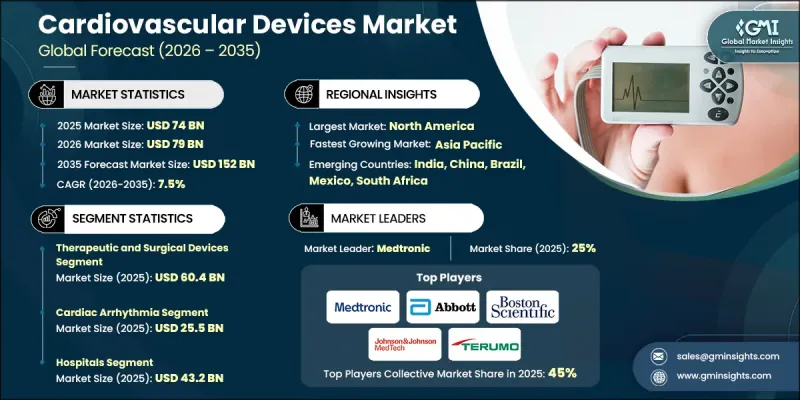
심혈관 질환의 유병률 증가, 세계 인구의 고령화, 정부의 의료 정책 강화, 저침습적 치료에 대한 수요 증가 등이 이러한 성장세를 견인하고 있습니다. 심혈관 의료기기는 심장과 혈관의 기능을 모니터링, 지원 또는 회복시키기 위한 이식형, 체외형, 진단용 시스템을 포함합니다. 이들은 이상 감지, 순환 개선, 심장 박동 리듬 조절, 혈류 촉진, 장기적인 질병 관리를 돕습니다. 기기 기술의 발전, 소형화, 혁신적인 소재, 디지털 통합으로 임상적 정확성, 안전성 및 사용 편의성이 향상되었습니다. 첨단 스텐트, 전기생리학적 솔루션, 영상 진단 도구 등의 혁신 기술은 조기 발견과 보다 효과적인 치료를 가능하게 하며, 의사들의 채택을 촉진하고 있습니다. 경 카테터 심장판막 치환술과 로봇 보조 시스템을 포함한 최소 침습 수술은 수술 부담을 줄이고 입원 기간을 단축하며 치료비를 절감하기 위해 병원과 심장병 센터는 최첨단 정밀 유도형 장치를 우선적으로 도입하고 있습니다.
| 시장 범위 | |
|---|---|
| 개시 연도 | 2025년 |
| 예측 기간 | 2026-2035년 |
| 개시 연도 시장 규모 | 740억 달러 |
| 예측액 | 1,520억 달러 |
| CAGR | 7.5% |
치료 및 수술용 의료기기 부문은 2025년 604억 달러에 달할 것으로 예측됩니다. 이 부문에는 카테터, 관상동맥 중재시술용 장치, 심장 리듬 관리 시스템, 구조적 심장 질환용 장치, 수술용 기구 등 필수 심혈관 장비가 포함됩니다. 이 장비들은 심장 기능의 회복과 대체에 매우 중요한 역할을 하며, 중재적 심장학 및 심장 수술의 핵심적인 역할을 하고 있습니다. 이 부문이 시장을 주도하는 이유는 긴급하거나 생명을 위협하는 심장 질환에 필요한 근본적인 치료법을 제공하기 때문입니다. 저침습 카테터, 차세대 스텐트, 보다 진보된 부정맥 관리 장치, 내구성이 뛰어난 인공심장판막 등 지속적인 제품 혁신을 통해 치료 결과를 개선하고, 입원 기간을 단축하며, 고위험군 환자의 적응 범위를 넓히고 있습니다.
부정맥 부문은 2025년 255억 달러 시장 규모를 기록할 것으로 예측됩니다. 심방세동, 빈맥, 서맥 등 부정맥의 유병률이 증가함에 따라 부정맥 치료에 특화된 기기가 시장의 대부분을 차지하고 있습니다. 고령화, 비만, 고혈압, 당뇨병과 같은 생활습관 관련 위험요인과 지속적인 모니터링에 대한 수요 증가가 지속적인 수요를 견인하고 있습니다. 첨단 모니터링 시스템, 이식형 장치 등 부정맥을 감지하고 치료하는 기술 발전은 이 분야 시장 지위를 강화하고 장기적인 성장을 뒷받침하고 있습니다.
2025년 북미 순환기 기기 시장은 41.8%의 점유율을 차지했습니다. 좌식 생활, 비만, 고혈압으로 인한 이 지역의 높은 질병 부담은 고급 진단 및 치료 솔루션에 대한 강력한 수요를 촉진하고 있습니다. 병원과 전문 의료센터에서는 늘어나는 환자들을 치료하기 위해 스텐트, 심박조율기, 제세동기, 모니터링 시스템 등 저침습적 심장 장치 도입이 점점 더 많이 이루어지고 있습니다. 심혈관 질환(CVD) 관련 입원 건수 증가로 인해 혁신적인 중재시술 기기의 도입이 가속화되고 있으며, 심장병학 기기의 지속적인 개선은 이 지역의 의료 수요와 규제 기준에 부합하고 있습니다.
자주 묻는 질문
목차
제1장 조사 방법
제2장 주요 요약
제3장 업계 인사이트
제4장 경쟁 구도
제5장 시장 추산 및 예측 : 유형별, 2022-2035
제6장 시장 추산 및 예측 : 용도별, 2022-2035
제7장 시장 추산 및 예측 : 최종 용도별, 2022-2035
제8장 시장 추산 및 예측 : 지역별, 2022-2035
제9장 기업 개요
LSH 26.05.08The Global Cardiovascular Devices Market was valued at USD 74 billion in 2025 and is estimated to grow at a CAGR of 7.5% to reach USD 152 billion by 2035.
The expansion is fueled by the rising prevalence of cardiovascular diseases, an aging global population, increased government healthcare initiatives, and growing demand for minimally invasive interventions. Cardiovascular devices include implantable, external, and diagnostic systems that monitor, support, or restore heart and vascular function. They help detect irregularities, improve circulation, regulate heart rhythms, enhance blood flow, and assist in long-term disease management. Advancements in device technology, miniaturization, innovative materials, and digital integration have improved clinical precision, safety, and usability. Innovations like advanced stents, electrophysiology solutions, and imaging tools enable earlier detection and more effective treatment, encouraging physician adoption. Minimally invasive procedures, including transcatheter heart valves and robotic-assisted systems, reduce surgical trauma, shorten hospital stays, and lower treatment costs, prompting hospitals and cardiology centers to prioritize cutting-edge, precision-guided devices.
| Market Scope | |
|---|---|
| Start Year | 2025 |
| Forecast Year | 2026-2035 |
| Start Value | $74 Billion |
| Forecast Value | $152 Billion |
| CAGR | 7.5% |
The therapeutic and surgical devices segment reached USD 60.4 billion in 2025. This segment encompasses essential cardiovascular tools such as catheters, coronary intervention devices, cardiac rhythm management systems, structural heart devices, and surgical instruments. These devices play a critical role in restoring or replacing heart function and are central to interventional cardiology and cardiac surgery. The segment dominates due to its provision of definitive treatments, often necessary for urgent or life-threatening cardiac conditions. Continuous product innovations, including minimally invasive catheters, next-generation stents, smarter rhythm management devices, and durable heart valves, enhance procedural outcomes, reduce hospital stays, and expand eligibility for high-risk patients.
The cardiac arrhythmia segment generated USD 25.5 billion in 2025. Arrhythmia-focused devices hold a major share because of the increasing prevalence of irregular heart rhythms such as atrial fibrillation, tachycardia, and bradycardia. Aging populations, lifestyle-related risk factors like obesity, hypertension, and diabetes, and the rising need for continuous monitoring drive sustained demand. Technological progress in arrhythmia detection and therapy, including advanced monitoring systems and implantable devices, strengthens the segment's market position and supports long-term growth.
North America Cardiovascular Devices Market accounted for 41.8% share in 2025. The region's high disease burden, driven by sedentary lifestyles, obesity, and hypertension, fuels strong demand for advanced diagnostic and therapeutic solutions. Hospitals and specialty centers increasingly adopt minimally invasive cardiac devices, such as stents, pacemakers, defibrillators, and monitoring systems, to treat a growing patient population. Rising CVD-related hospitalizations accelerate the adoption of innovative interventional devices, while continuous improvements in cardiology equipment align with the region's healthcare needs and regulatory standards.
Key players in the Global Cardiovascular Devices Market include Abbott Laboratories, Boston Scientific, Biotronik, Johnson & Johnson MedTech, Terumo, AngioDynamics, Olympus, Medtronic, Meril Life Sciences, Penumbra, Sahajanand Medical Technologies, Koninklijke Philips, Translumina Therapeutics, Relisys Medical Devices, and MicroPort Scientific. Companies in the Global Cardiovascular Devices Market strengthen their position by prioritizing innovation and expanding their product portfolios to include advanced, minimally invasive, and digitally integrated devices. Firms invest heavily in R&D to develop next-generation stents, rhythm management systems, structural heart devices, and robotic-assisted technologies. Strategic partnerships with hospitals and research institutions accelerate clinical adoption and market penetration. Global expansion into emerging markets and targeted collaborations with distributors ensure wider geographic reach. Companies also focus on regulatory compliance, quality assurance, and physician training programs to build trust and drive adoption.
Table of Contents
Chapter 1 Research Methodology
- 1.1 Research approach
- 1.2 Quality commitments
- 1.2.1 GMI AI policy & data integrity commitment
- 1.2.1.1 Source consistency protocol
- 1.2.1 GMI AI policy & data integrity commitment
- 1.3 Research trail & confidence scoring
- 1.3.1 Research trail components
- 1.3.2 Scoring components
- 1.4 Data collection
- 1.4.1 Partial list of primary sources
- 1.5 Data mining sources
- 1.5.1 Paid sources
- 1.5.1.1 Sources, by region
- 1.5.1 Paid sources
- 1.6 Base estimates and calculations
- 1.6.1 Base year calculation for any one approach
- 1.7 Forecast model
- 1.7.1 Quantified market impact analysis
- 1.7.1.1 Mathematical impact of growth parameters on forecast
- 1.7.1 Quantified market impact analysis
- 1.8 Research transparency addendum
- 1.8.1 Source attribution framework
- 1.8.2 Quality assurance metrics
- 1.8.3 Our commitment to trust
Chapter 2 Executive Summary
- 2.1 Industry 3600 synopsis
- 2.2 Key market trends
- 2.2.1 Device type trends
- 2.2.2 Application trends
- 2.2.3 End use trends
- 2.2.4 Regional trends
- 2.3 CXO perspectives: Strategic imperatives
Chapter 3 Industry Insights
- 3.1 Industry ecosystem analysis
- 3.2 Industry impact forces
- 3.2.1 Growth drivers
- 3.2.1.1 Increasing number of patients suffering from cardiovascular diseases
- 3.2.1.2 Expanding geriatric population
- 3.2.1.3 Rising government initiatives
- 3.2.1.4 Technological advancements in cardiovascular devices
- 3.2.1.5 Rising demand for minimally invasive procedures
- 3.2.2 Industry pitfalls and challenges
- 3.2.2.1 High risk associated with cardiac procedures
- 3.2.2.2 Stringent regulatory scenario
- 3.2.3 Market opportunities
- 3.2.3.1 Increasing applications of AI in cardiovascular diseases
- 3.2.1 Growth drivers
- 3.3 Growth potential analysis
- 3.4 Regulatory landscape (Driven by primary research)
- 3.4.1 North America
- 3.4.2 Europe
- 3.4.3 Asia Pacific
- 3.4.4 Latin America
- 3.4.5 Middle East and Africa
- 3.5 Technology landscape (Driven by primary research)
- 3.5.1 Current technological trends
- 3.5.1.1 Advanced imaging and sensing systems for real-time cardiovascular diagnostics
- 3.5.1.2 AI-integrated cardiovascular devices for automated detection and risk stratification
- 3.5.2 Emerging technologies
- 3.5.2.1 Bioengineered and adaptive materials for next-generation cardiovascular implants and stents
- 3.5.2.2 Ultra-high-speed 3D visualization and digital twin technologies for dynamic cardiovascular assessment
- 3.5.1 Current technological trends
- 3.6 Future market trends (Driven by primary research)
- 3.7 Pricing analysis, 2025
- 3.8 Impact of AI and Generative AI on the market
- 3.9 Porter's analysis
- 3.10 PESTEL analysis
Chapter 4 Competitive Landscape, 2025
- 4.1 Introduction
- 4.2 Company market share analysis
- 4.2.1 Global
- 4.2.2 North America
- 4.2.3 Europe
- 4.2.4 Asia Pacific
- 4.3 Company matrix analysis
- 4.4 Competitive analysis of major market players
- 4.5 Competitive positioning matrix
- 4.6 Key developments
- 4.6.1 Mergers and acquisitions
- 4.6.2 Partnerships and collaborations
- 4.6.3 New product launches
- 4.6.4 Expansion plans
Chapter 5 Market Estimates and Forecast, By Type, 2022 - 2035 ($ Mn)
- 5.1 Key trends
- 5.2 Diagnostic and monitoring devices
- 5.2.1 Electrocardiogram systems
- 5.2.2 Holter and event monitors
- 5.2.3 Remote cardiac monitoring devices
- 5.2.4 Cardiac diagnostic ultrasound
- 5.2.5 Other diagnostic and monitoring devices
- 5.3 Therapeutic and surgical devices
- 5.3.1 Catheters
- 5.3.1.1 Electrophysiology ablation catheters
- 5.3.1.2 Electrophysiology diagnostic and mapping catheters
- 5.3.1.3 Interventional catheters
- 5.3.2 Coronary intervention devices
- 5.3.2.1 Drug eluting stents
- 5.3.2.2 Bare metal stents
- 5.3.2.3 Bioresorbable scaffolds
- 5.3.2.4 PTCA balloons
- 5.3.2.5 Atherectomy devices
- 5.3.2.6 Guidewires
- 5.3.2.7 Embolic protection devices
- 5.3.2.8 Other coronary intervention devices
- 5.3.3 Cardiac rhythm management (CRM) devices
- 5.3.3.1 Pacemakers
- 5.3.3.2 Implantable cardioverter defibrillators
- 5.3.3.3 Cardiac resynchronization therapy devices
- 5.3.3.4 Implantable loop recorders
- 5.3.3.5 Other cardiac rhythm management devices
- 5.3.4 Structural heart devices
- 5.3.4.1 LAA closure devices
- 5.3.4.2 Heart valves
- 5.3.5 Cardiac surgery devices
- 5.3.5.1 Coronary artery bypass graft (CABG) surgical tools
- 5.3.5.2 Other cardiac surgical devices
- 5.3.6 Ventricular assist devices
- 5.3.1 Catheters
Chapter 6 Market Estimates and Forecast, By Application, 2022 - 2035 ($ Mn)
- 6.1 Key trends
- 6.2 Coronary artery disease
- 6.3 Cardiac arrhythmia
- 6.4 Heart failure
- 6.5 Other applications
Chapter 7 Market Estimates and Forecast, By End Use, 2022 - 2035 ($ Mn)
- 7.1 Key trends
- 7.2 Hospitals
- 7.3 Ambulatory surgical centers
- 7.4 Cardiac centers
- 7.5 Other end users
Chapter 8 Market Estimates and Forecast, By Region, 2022 - 2035 ($ Mn)
- 8.1 Key trends
- 8.2 North America
- 8.2.1 U.S.
- 8.2.2 Canada
- 8.3 Europe
- 8.3.1 Germany
- 8.3.2 UK
- 8.3.3 France
- 8.3.4 Spain
- 8.3.5 Italy
- 8.3.6 Netherlands
- 8.4 Asia Pacific
- 8.4.1 China
- 8.4.2 Japan
- 8.4.3 India
- 8.4.4 Australia
- 8.4.5 South Korea
- 8.5 Latin America
- 8.5.1 Brazil
- 8.5.2 Mexico
- 8.5.3 Argentina
- 8.6 Middle East and Africa
- 8.6.1 South Africa
- 8.6.2 Saudi Arabia
- 8.6.3 UAE
Chapter 9 Company Profiles
- 9.1 Abbott Laboratories
- 9.2 AngioDynamics
- 9.3 Biotronik
- 9.4 Boston Scientific
- 9.5 Johnson & Johnson MedTech
- 9.6 Koninklijke Philips
- 9.7 Medtronic
- 9.8 Meril Life Sciences
- 9.9 MicroPort Scientific
- 9.10 Olympus
- 9.11 Penumbra
- 9.12 Relisys Medical Devices
- 9.13 Sahajanand Medical Technologies
- 9.14 Terumo
- 9.15 Translumina Therapeutics