|
시장보고서
상품코드
2027487
석유 및 가스용 외장 케이블 : 시장 기회, 성장 촉진요인, 업계 동향 분석 및 예측(2026-2035년)Oil and Gas Armored Cable Market Opportunity, Growth Drivers, Industry Trend Analysis, and Forecast 2026 - 2035 |
||||||

세계의 석유 및 가스용 외장 케이블 시장은 2025년에 147억 달러로 평가되었고 CAGR 6.2%를 나타내 2035년까지 275억 달러에 이를 것으로 추정되고 있습니다.
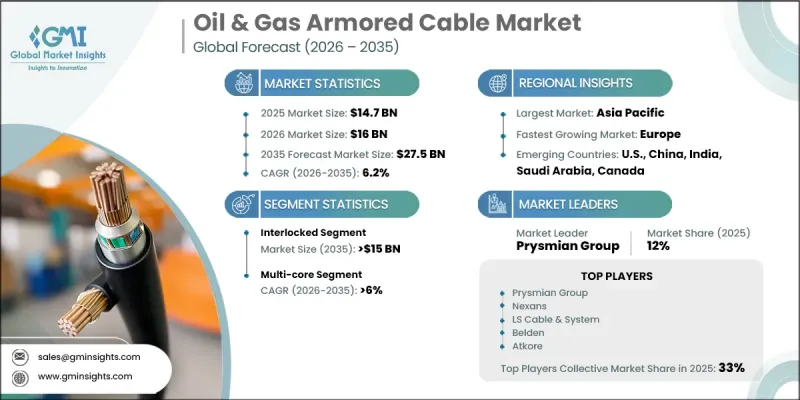
시장 성장은 석유 및 가스 사업 전반에 걸쳐 신뢰성과 내구성이 뛰어난 송전 시스템에 대한 수요가 증가함에 따라 주도되고 있습니다. 외장 케이블은 도체를 기계적 손상, 환경 노출 및 작동 스트레스로부터 보호하는 보호 층으로 특별히 설계되어 가혹한 조건에서도 안정적인 성능을 보장합니다. 이 케이블은 중단 없는 전력 공급의 유지가 매우 중요한 석유 및 가스 사업의 다양한 단계에서 널리 사용되고 있습니다. 인프라 개발 및 기존 시설의 현대화를 위한 투자 증가는 수요를 더욱 가속화시키고 있습니다. 에너지 사업 전반에 걸친 첨단 기술 및 자동화 시스템 도입으로 인해 신뢰성 높은 케이블 솔루션에 대한 수요도 증가하고 있습니다. 운영의 안전과 효율성에 대한 관심이 높아지면서 고성능 외장 케이블의 채택이 증가하고 있습니다. 또한, 특히 가혹한 환경에서의 탐사 및 생산 활동의 확대로 인해 장기적인 신뢰성과 안정성을 유지하면서 가혹한 조건을 견딜 수 있는 케이블의 중요성이 더욱 커지고 있습니다.
| 시장 범위 | |
|---|---|
| 시작 연도 | 2025년 |
| 예측 기간 | 2026-2035년 |
| 개시 연도 시장 규모 | 147억 달러 |
| 예측액 | 275억 달러 |
| CAGR | 6.2% |
석유 및 가스 산업에서 외장 케이블 시장은 첨단 모니터링 및 제어 기술을 지원하기 위해 전기 시스템이 업데이트됨에 따라 지속적으로 확대되고 있습니다. 복잡한 환경에서 업무 연속성을 보장해야 할 필요성으로 인해 내구성과 효율성이 뛰어난 케이블 솔루션에 대한 수요가 증가하고 있습니다. 에너지 인프라의 자동화 및 디지털화로의 전환은 첨단 케이블 시스템의 도입을 더욱 촉진하고 있습니다. 탐사 활동의 활성화와 인프라의 갱신으로 인해 가혹한 조건에서 운용할 수 있는 고성능 솔루션에 대한 수요가 생겨나면서 시장의 꾸준한 성장을 뒷받침하고 있습니다.
연동형 부문은 강력한 기계적 보호 성능과 유연성을 바탕으로 2035년까지 150억 달러에 달할 것으로 예측됩니다. 이 유형의 케이블은 외부 충격 및 환경적 요인에 대한 내성이 강화되어 가혹한 용도에 적합합니다. 내구성과 긴 수명은 다양한 산업 분야에서 폭넓게 사용되고 있으며, 이는 이 부문의 지속적인 성장을 뒷받침하고 있습니다.
멀티코어 부문은 2035년까지 연평균 복합 성장률(CAGR) 6%를 나타낼 것으로 예측됩니다. 여러 회로를 효율적으로 처리할 수 있는 케이블에 대한 수요가 증가함에 따라 케이블의 채택이 증가하고 있습니다. 이러한 솔루션은 높은 안전 기준과 운영 신뢰성을 유지하면서 설치 프로세스를 간소화합니다. 가혹한 조건에서도 효과적으로 작동할 수 있는 능력으로 인해 전체 에너지 인프라에서 그 중요성이 점점 더 커지고 있습니다.
미국의 석유 및 가스용 외장 케이블 시장은 안정적인 전력 및 통신 시스템에 대한 수요 증가에 힘입어 2035년까지 42억 달러에 달할 것으로 예측됩니다. 보다 복잡한 환경에서의 사업 확장에 따라 가혹한 조건을 견딜 수 있는 케이블에 대한 요구가 증가하고 있습니다. 인프라 업그레이드 및 현대화를 위한 지속적인 투자가 시장 성장을 더욱 촉진하고 있으며, 고급 외장 케이블 솔루션에 대한 안정적인 수요를 보장하고 있습니다.
자주 묻는 질문
목차
제1장 조사 방법과 범위
제2장 주요 요약
제3장 업계 인사이트
제4장 경쟁 구도
제5장 시장 규모와 예측 : 외장 유형별(2022-2035년)
제6장 시장 규모와 예측 : 코어 유형별(2022-2035년)
제7장 시장 규모와 예측 : 지역별(2022-2035년)
제8장 기업 개요
KTHThe Global Oil & Gas Armored Cable Market was valued at USD 14.7 billion in 2025 and is estimated to grow at a CAGR of 6.2% to reach USD 27.5 billion by 2035.
Market growth is driven by the increasing need for reliable and durable power transmission systems across oil and gas operations. Armored cables are specifically designed with protective layers that shield electrical conductors from mechanical damage, environmental exposure, and operational stress, ensuring consistent performance in demanding conditions. These cables are widely utilized across various stages of oil and gas activities, where maintaining uninterrupted power supply is critical. Rising investments in infrastructure development and modernization of existing facilities are further accelerating demand. The integration of advanced technologies and automated systems across energy operations is also increasing the need for dependable cabling solutions. Growing focus on operational safety and efficiency is encouraging the adoption of high-performance armored cables. Additionally, expanding exploration and production activities, particularly in challenging environments, are reinforcing the importance of cables that can withstand harsh conditions while maintaining long-term reliability and stability.
| Market Scope | |
|---|---|
| Start Year | 2025 |
| Forecast Year | 2026-2035 |
| Start Value | $14.7 Billion |
| Forecast Value | $27.5 Billion |
| CAGR | 6.2% |
The oil & gas armored cable market continues to expand as industries upgrade their electrical systems to support advanced monitoring and control technologies. Increasing demand for durable and efficient cabling solutions is driven by the need to ensure operational continuity in complex environments. The shift toward automation and digitalization in energy infrastructure is further strengthening the adoption of advanced cable systems. Growing exploration activities and infrastructure upgrades are creating opportunities for high-performance solutions designed to operate under extreme conditions, supporting steady market growth.
The interlocked segment is expected to reach USD 15 billion by 2035, driven by its strong mechanical protection and flexibility. This type of cable offers enhanced resistance to external impacts and environmental factors, making it suitable for demanding applications. Its durability and long service life contribute to its widespread use across multiple industries, supporting continued growth in the segment.
The multi-core segment is anticipated to grow at a CAGR of 6% through 2035. Increasing demand for cables capable of handling multiple circuits efficiently is driving adoption. These solutions simplify installation processes while maintaining high safety standards and operational reliability. Their ability to perform effectively under challenging conditions continues to support their growing importance across energy infrastructure.
U.S. Oil & Gas Armored Cable Market is expected to reach USD 4.2 billion by 2035, supported by increasing demand for reliable power and communication systems. Expanding operations in more complex environments are driving the need for cables that can withstand extreme conditions. Ongoing investments in infrastructure upgrades and modernization are further contributing to market growth, ensuring steady demand for advanced armored cable solutions.
Key players operating in the Oil & Gas Armored Cable Market include Prysmian, Nexans, Southwire, Belden, Sumitomo Electric, LS Cable & System, Furukawa Electric, Leoni Cables, Polycab, RR Kabel, KEI Industries, Havells, Riyadh Cables, Omni Cables, Helukabel, Finolex, NKT, Atkore, Anixter, and AT&T. Companies in the Oil & Gas Armored Cable Market are strengthening their market position through innovation and strategic expansion. They are investing in advanced materials and manufacturing technologies to improve product durability and performance. Expanding production capacity and enhancing supply chain efficiency are key priorities to meet growing demand. Companies are also focusing on developing customized solutions tailored to specific operational requirements. Strategic partnerships and collaborations are helping businesses expand their global footprint and access new markets. Additionally, firms are emphasizing compliance with safety and environmental standards while integrating advanced technologies to improve product performance and reliability, ensuring sustained growth and competitive advantage.
Table of Contents
Chapter 1 Methodology & Scope
- 1.1 Research design
- 1.2 Quality commitment
- 1.2.1 GMI AI policy & data integrity commitment
- 1.2.1.1 Source consistency protocol
- 1.2.1 GMI AI policy & data integrity commitment
- 1.3 Research Trail & Confidence Scoring
- 1.3.1 Research Trail Components
- 1.3.2 Scoring Components
- 1.4 Data Collection
- 1.4.1 Partial list of primary sources
- 1.5 Data mining sources
- 1.5.1 Paid sources
- 1.5.1.1 Sources, by region
- 1.5.1 Paid sources
- 1.6 Base estimates and calculations
- 1.6.1 Base year calculation for any one approach
- 1.7 Forecast model
- 1.8 Research transparency addendum
- 1.8.1 Source attribution framework
- 1.8.2 Quality assurance metrics
- 1.8.3 Our commitment to trust
- 1.9 Market definitions
Chapter 2 Executive Summary
- 2.1 Industry synopsis, 2022 - 2035
- 2.2 Business trends
- 2.3 Armor type trends
- 2.4 Core type trends
- 2.5 Regional trends
Chapter 3 Industry Insights
- 3.1 Industry ecosystem
- 3.1.1 Raw material availability & sourcing analysis
- 3.1.2 Supply chain resilience & risk factors
- 3.1.3 Distribution network analysis
- 3.2 Regulatory landscape
- 3.3 Industry impact forces
- 3.3.1 Growth drivers
- 3.3.2 Industry pitfalls & challenges
- 3.4 Growth potential analysis
- 3.5 Porter's analysis
- 3.5.1 Bargaining power of suppliers
- 3.5.2 Bargaining power of buyers
- 3.5.3 Threat of new entrants
- 3.5.4 Threat of substitutes
- 3.6 PESTEL analysis
- 3.6.1 Political factors
- 3.6.2 Economic factors
- 3.6.3 Social factors
- 3.6.4 Technological factors
- 3.6.5 Legal factors
- 3.6.6 Environmental factors
- 3.7 Cost structure analysis
- 3.8 Price trend analysis, 2022-2035
- 3.8.1 By armor type
- 3.8.2 By region
- 3.9 Emerging opportunities & trends
- 3.9.1 Digitalization & IoT integration
- 3.10 Investment analysis & future outlook
Chapter 4 Competitive landscape, 2026
- 4.1 Introduction
- 4.2 Company market share analysis, by region, 2025
- 4.2.1 North America
- 4.2.2 Europe
- 4.2.3 Asia Pacific
- 4.2.4 Middle East & Africa
- 4.2.5 Latin America
- 4.3 Competitive positioning matrix
- 4.4 Key developments
- 4.4.1 Mergers & acquisitions
- 4.4.2 Partnerships & collaborations
- 4.4.3 New product launches
- 4.4.4 Expansion plans & funding
Chapter 5 Market Size and Forecast, By Armor type, 2022 - 2035 (USD Million & ‘000 Tonnes)
- 5.1 Key trends
- 5.2 Interlocked
- 5.3 Continuously Corrugated Welded
Chapter 6 Market Size and Forecast, By Core Type, 2022 - 2035 (USD Million & ‘000 Tonnes)
- 6.1 Key trends
- 6.2 Single Core
- 6.3 Multi Core
Chapter 7 Market Size and Forecast, By Region, 2022 - 2035 (USD Million & ‘000 Tonnes)
- 7.1 Key trends
- 7.2 North America
- 7.2.1 U.S.
- 7.2.2 Canada
- 7.2.3 Mexico
- 7.3 Europe
- 7.3.1 UK
- 7.3.2 France
- 7.3.3 Germany
- 7.3.4 Italy
- 7.3.5 Russia
- 7.3.6 Spain
- 7.4 Asia Pacific
- 7.4.1 China
- 7.4.2 Australia
- 7.4.3 India
- 7.4.4 Japan
- 7.4.5 South Korea
- 7.5 Middle East & Africa
- 7.5.1 Saudi Arabia
- 7.5.2 UAE
- 7.5.3 Turkey
- 7.5.4 South Africa
- 7.5.5 Egypt
- 7.6 Latin America
- 7.6.1 Brazil
- 7.6.2 Argentina
Chapter 8 Company Profiles
- 8.1 Anixter
- 8.2 AT&T
- 8.3 Atkore
- 8.4 Belden
- 8.5 Finolex
- 8.6 Furukawa Electric
- 8.7 Havells
- 8.8 Helukabel
- 8.9 KEI Industries
- 8.10 Leoni Cables
- 8.11 LS Cable & System
- 8.12 Nexans
- 8.13 NKT
- 8.14 Omni Cables
- 8.15 Polycab
- 8.16 Prysmian
- 8.17 Riyadh Cables
- 8.18 RR Kabel
- 8.19 Southwire
- 8.20 Sumitomo Electric