
|
시장보고서
상품코드
2027661
멀티 코어 외장 케이블 : 시장 기회, 성장 촉진요인, 업계 동향 분석 및 예측(2026-2035년)Multi Core Armored Cable Market Opportunity, Growth Drivers, Industry Trend Analysis, and Forecast 2026 - 2035 |
||||||

세계의 멀티 코어 외장 케이블 시장은 2025년에 406억 달러로 평가되었고 CAGR 6.9%를 나타내 2035년까지 818억 달러에 이를 것으로 추정되고 있습니다.
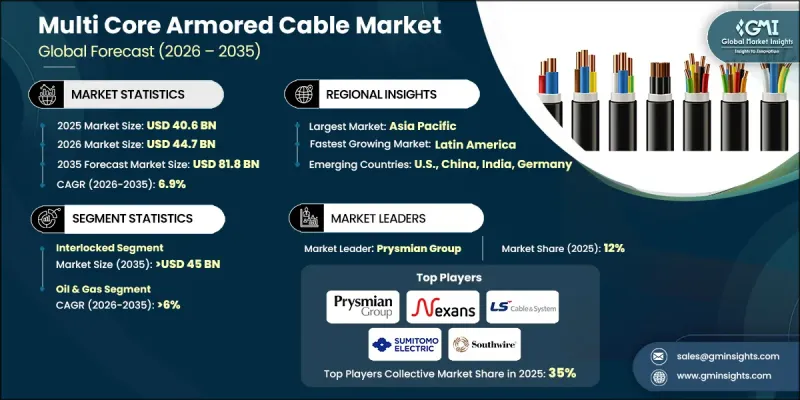
시장 성장은 통신, 석유 및 가스, 건설, 산업 자동화 등 산업 전반에 걸쳐 안전하고 빠르고 안정적인 데이터 전송에 대한 수요가 증가함에 따라 주도되고 있습니다. 이러한 케이블은 기계적 스트레스, 환경 노출 및 물리적 손상에 대한 높은 내성을 가지고 있어 장기적인 작동 신뢰성을 보장할 수 있어 점점 더 선호되고 있습니다. 스마트 기기, IoT 지원 시스템 및 첨단 통신 네트워크의 도입 확대로 인해 견고한 케이블 인프라에 대한 요구가 더욱 커지고 있습니다. 특히 신흥국의 급속한 도시개발과 대규모 인프라 프로젝트는 더 많은 성장 기회를 창출하고 있습니다. 케이블의 설계, 절연 재료, 제조 기술의 지속적인 발전으로 성능, 내구성, 안전 기준이 향상되고 있습니다. 전기 안전과 보안 통신 시스템에 대한 규제 당국의 관심이 높아지고 있는 것도 시장 확대를 뒷받침하고 있습니다. 또한, 5G의 확산과 차세대 통신 인프라에 대한 투자 증가로 인해 복잡한 설치 환경에서도 신호 무결성을 유지할 수 있는 대용량 외장형 케이블 시스템에 대한 수요가 증가하고 있습니다.
| 시장 범위 | |
|---|---|
| 시작 연도 | 2025년 |
| 예측 기간 | 2026-2035년 |
| 개시 연도 시장 규모 | 406억 달러 |
| 예측액 | 818억 달러 |
| CAGR | 6.9% |
인터록 케이블 시장은 2035년까지 450억 달러에 달할 것으로 예측됩니다. 이 시장은 유연성, 간소화된 설치 프로세스, 공간 제약이 일반적인 복잡한 산업 레이아웃에 대한 적합성으로 인해 주목을 받고 있습니다. 외부로부터의 손상에 대한 내성과 설치 시간과 비용을 절감할 수 있다는 점이 도입을 촉진하는 주요 요인으로 작용하고 있습니다. 각 산업 분야는 열악한 환경에서도 안정적인 성능을 발휘하는 내구성 있고 효율적인 케이블 시스템으로 전환하고 있으며, 이는 여러 응용 분야에서 인터록 케이블 솔루션에 대한 수요를 더욱 촉진하고 있습니다.
석유 및 가스 응용 분야는 2035년까지 연평균 복합 성장률(CAGR) 6%를 나타낼 것으로 예측됩니다. 이 부문의 성장은 안전과 신뢰성이 필수적인 중요한 운영 환경에서 전력 및 신호 전송의 중단을 허용하지 않으려는 요구에 의해 뒷받침되고 있습니다. 멀티 코어 외장 케이블은 단일 구조물 내에서 여러 개의 전력 및 신호 회로를 지원할 수 있어 자동화 및 실시간 모니터링 시스템의 효율화에 기여하여 널리 활용되고 있습니다. 내구성과 공간 절약형 설계로 가혹한 환경에서 높은 내구성을 갖춘 케이블 인프라가 요구되는 해저 파이프라인, 해양 시추 장비, 부유식 생산 설비 등에 적합합니다.
미국의 멀티 코어 외장 케이블 시장은 건설 및 통신 부문의 인프라 개발 확대에 힘입어 2035년까지 105억 달러에 달할 것으로 예측됩니다. 안정적이고 안전한 전력 및 데이터 전송 시스템에 대한 수요 증가는 시장 성장을 더욱 촉진하고 있습니다. 또한, 유틸리티 네트워크의 지속적인 현대화와 디지털 연결 인프라에 대한 투자 증가는 산업 및 상업용 용도의 채택을 촉진하고 있습니다.
자주 묻는 질문
목차
제1장 조사 방법과 범위
제2장 주요 요약
제3장 업계 인사이트
제4장 경쟁 구도
제5장 시장 규모와 예측 : 외장 유형별(2022-2035년)
제6장 시장 규모와 예측 : 최종 사용자별(2022-2035년)
제7장 시장 규모와 예측 : 지역별(2022-2035년)
제8장 기업 개요
KTHThe Global Multi Core Armored Cable Market was valued at USD 40.6 billion in 2025 and is estimated to grow at a CAGR of 6.9% to reach USD 81.8 billion by 2035.
Market growth is driven by rising demand for secure, high-speed, and reliable data transmission across industries such as telecommunications, oil and gas, construction, and industrial automation. These cables are increasingly preferred due to their strong resistance to mechanical stress, environmental exposure, and physical damage, which ensures long-term operational reliability. The growing deployment of smart devices, IoT-enabled systems, and advanced communication networks is further strengthening the need for robust cabling infrastructure. Rapid urban development and large-scale infrastructure projects, especially in emerging economies, are creating additional growth opportunities. Continuous advancements in cable design, insulation materials, and manufacturing technologies are improving performance, durability, and safety standards. Increasing regulatory focus on electrical safety and secure communication systems is also supporting market expansion. In addition, rising investments in 5G deployment and next-generation telecom infrastructure are accelerating demand for high-capacity armored cable systems capable of maintaining signal integrity across complex installations.
| Market Scope | |
|---|---|
| Start Year | 2025 |
| Forecast Year | 2026-2035 |
| Start Value | $40.6 Billion |
| Forecast Value | $81.8 Billion |
| CAGR | 6.9% |
The interlocked cable segment is expected to reach USD 45 billion by 2035. This segment is gaining traction due to its flexibility, simplified installation process, and suitability for complex industrial layouts where space constraints are common. Its resistance to external damage and ability to reduce installation time and cost are key factors supporting adoption. Industries are increasingly shifting toward durable and efficient cabling systems that offer consistent performance in demanding environments, which is further strengthening demand for interlocked cable solutions across multiple applications.
The oil & gas application segment is projected to grow at a 6% CAGR by 2035. Growth in this segment is supported by the need for uninterrupted power and signal transmission in critical operational environments, where safety and reliability are essential. Multi core armored cables are widely used due to their ability to support multiple power and signal circuits within a single structure, enhancing efficiency in automation and real-time monitoring systems. Their durability and space-saving design make them suitable for subsea pipelines, offshore rigs, and floating production systems, where harsh conditions require highly resilient cable infrastructure.
U.S. Multi Core Armored Cable Market is projected to reach USD 10.5 billion by 2035, driven by expanding infrastructure development across the construction and telecommunications sectors. Increasing demand for stable and secure power and data transmission systems is further supporting market growth. Ongoing modernization of utility networks and rising investments in digital connectivity infrastructure are also strengthening adoption across industrial and commercial applications.
Key companies operating in the Global Multi Core Armored Cable Market include Prysmian, Nexans, Belden, LS Cable & System, Southwire, Sumitomo Electric, Atkore, KEI Industries, RR Kabel, Polycab, Finolex, Leoni Cables, Furukawa Electric, Havells, Helukabel, NKT, Okonite, Omni Cables, Riyadh Cables, Anixter, and AT&T. Companies in the Multi Core Armored Cable Market are focusing on strengthening their market position through product innovation, expansion of production capacity, and advancements in cable materials and design technologies. They are investing heavily in research and development to improve durability, fire resistance, and data transmission efficiency. Strategic partnerships with telecom, energy, and construction companies are helping expand application reach and accelerate deployment in large-scale projects. Manufacturers are also emphasizing automation in production processes to enhance consistency and reduce costs. Expansion into emerging markets with growing infrastructure needs is further supporting revenue growth. Additionally, companies are aligning with regulatory standards and sustainability goals by developing environmentally friendly and energy-efficient cable solutions.
Table of Contents
Chapter 1 Methodology & Scope
- 1.1 Research design
- 1.2 Quality commitment
- 1.2.1 GMI AI policy & data integrity commitment
- 1.2.1.1 Source consistency protocol
- 1.2.1 GMI AI policy & data integrity commitment
- 1.3 Research Trail & Confidence Scoring
- 1.3.1 Research Trail Components
- 1.3.2 Scoring Components
- 1.4 Data Collection
- 1.4.1 Partial list of primary sources
- 1.5 Data mining sources
- 1.5.1 Paid sources
- 1.5.1.1 Sources, by region
- 1.5.1 Paid sources
- 1.6 Base estimates and calculations
- 1.6.1 Base year calculation for any one approach
- 1.7 Forecast model
- 1.8 Research transparency addendum
- 1.8.1 Source attribution framework
- 1.8.2 Quality assurance metrics
- 1.8.3 Our commitment to trust
- 1.9 Market definitions
Chapter 2 Executive Summary
- 2.1 Industry synopsis, 2022 - 2035
- 2.2 Business trends
- 2.3 Armor type trends
- 2.4 End User trends
- 2.5 Regional trends
Chapter 3 Industry Insights
- 3.1 Industry ecosystem
- 3.1.1 Raw material availability & sourcing analysis
- 3.1.2 Supply chain resilience & risk factors
- 3.1.3 Distribution network analysis
- 3.2 Regulatory landscape
- 3.3 Industry impact forces
- 3.3.1 Growth drivers
- 3.3.2 Industry pitfalls & challenges
- 3.4 Growth potential analysis
- 3.5 Porter's analysis
- 3.5.1 Bargaining power of suppliers
- 3.5.2 Bargaining power of buyers
- 3.5.3 Threat of new entrants
- 3.5.4 Threat of substitutes
- 3.6 PESTEL analysis
- 3.6.1 Political factors
- 3.6.2 Economic factors
- 3.6.3 Social factors
- 3.6.4 Technological factors
- 3.6.5 Legal factors
- 3.6.6 Environmental factors
- 3.7 Cost structure analysis
- 3.8 Price trend analysis, 2022-2035
- 3.8.1 By Armor type
- 3.8.2 By Region
- 3.9 Emerging opportunities & trends
- 3.9.1 Digitalization & IoT integration
- 3.10 Investment analysis & future outlook
Chapter 4 Competitive landscape, 2026
- 4.1 Introduction
- 4.2 Company market share analysis, by region, 2025
- 4.2.1 North America
- 4.2.2 Europe
- 4.2.3 Asia Pacific
- 4.2.4 Middle East & Africa
- 4.2.5 Latin America
- 4.3 Competitive positioning matrix
- 4.4 Key developments
- 4.4.1 Mergers & acquisitions
- 4.4.2 Partnerships & collaborations
- 4.4.3 New product launches
- 4.4.4 Expansion plans & funding
Chapter 5 Market Size and Forecast, By Armor type, 2022 - 2035 (USD Million & '000 Tonnes)
- 5.1 Key trends
- 5.2 Interlocked
- 5.3 Continuously Corrugated Welded
Chapter 6 Market Size and Forecast, By End User, 2022 - 2035 (USD Million & '000 Tonnes)
- 6.1 Key trends
- 6.2 Oil & Gas
- 6.3 Manufacturing
- 6.4 Mining
- 6.5 Construction
- 6.6 Others
Chapter 7 Market Size and Forecast, By Region, 2022 - 2035 (USD Million & '000 Tonnes)
- 7.1 Key trends
- 7.2 North America
- 7.2.1 U.S.
- 7.2.2 Canada
- 7.2.3 Mexico
- 7.3 Europe
- 7.3.1 UK
- 7.3.2 France
- 7.3.3 Germany
- 7.3.4 Italy
- 7.3.5 Russia
- 7.3.6 Spain
- 7.4 Asia Pacific
- 7.4.1 China
- 7.4.2 Australia
- 7.4.3 India
- 7.4.4 Japan
- 7.4.5 South Korea
- 7.5 Middle East & Africa
- 7.5.1 Saudi Arabia
- 7.5.2 UAE
- 7.5.3 Turkey
- 7.5.4 South Africa
- 7.5.5 Egypt
- 7.6 Latin America
- 7.6.1 Brazil
- 7.6.2 Argentina
Chapter 8 Company Profiles
- 8.1 Anixter
- 8.2 AT&T
- 8.3 Atkore
- 8.4 Belden
- 8.5 Finolex
- 8.6 Furukawa Electric
- 8.7 Havells
- 8.8 Helukabel
- 8.9 KEI Industries
- 8.10 Leoni Cables
- 8.11 LS Cable & System
- 8.12 Nexans
- 8.13 NKT
- 8.14 Okonite
- 8.15 Omni Cables
- 8.16 Polycab
- 8.17 Prysmian
- 8.18 Riyadh Cables
- 8.19 RR Kabel
- 8.20 Southwire
- 8.21 Sumitomo Electric