

|
시장보고서
상품코드
2027490
농업용 페로몬 : 시장 기회, 성장 촉진요인, 업계 동향 분석 및 예측(2026-2035년)Agriculture Pheromones Market Opportunity, Growth Drivers, Industry Trend Analysis, and Forecast 2026 - 2035 |
||||||

세계의 농업용 페로몬 시장은 2025년에 52억 달러로 평가되었고, 2035년까지 연평균 복합 성장률(CAGR) 15.7%를 나타내 228억 달러에 이를 것으로 추정되고 있습니다.
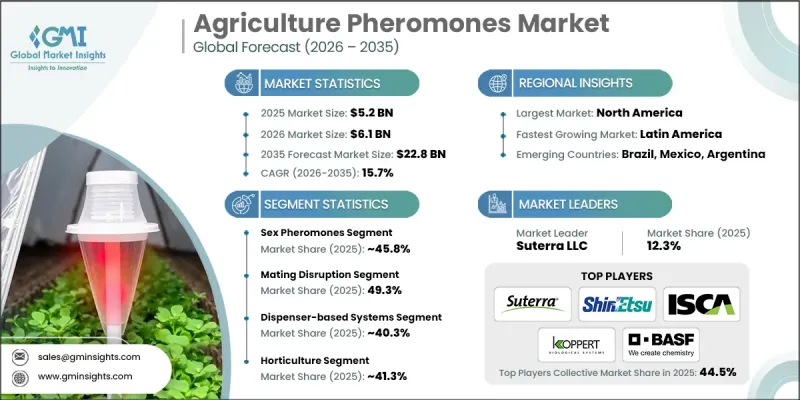
이 시장의 성장은 농부들 사이에서 친환경적이고 지속 가능한 해충 방제 솔루션에 대한 수요가 증가함에 따라 성장세를 보이고 있습니다. 페로몬은 특정 해충을 유인하거나 쫓아내는 화학적 신호로 작용하여 기존의 화학 농약에 대한 환경적으로 안전한 대안을 제공합니다. 이러한 천연 유래 솔루션은 곤충 포획, 교미 패턴 억제 및 활동 상황 모니터링에 도움을 주어 과일, 채소, 곡물 등의 작물을 보호합니다. 시장 확대는 주로 유기농업의 실천과 종합적 해충관리(IPM) 시스템의 도입 확대에 의해 주도되고 있습니다. 소비자와 농가 모두 무농약 농산물을 원하고 있으며, 페로몬 기반 솔루션에 대한 관심이 높아지고 있습니다. 페로몬 제제 기술의 발전과 비용 효율적인 제품 개발도 시장 성장을 더욱 촉진하고 있습니다. 지속적인 혁신, 지속 가능한 농업을 촉진하는 규제적 지원, 그리고 스마트 트랩, 자동 디스펜서, IoT 통합과 같은 새로운 기술도 도입을 가속화하여 보다 정밀한 해충 관리를 가능하게 하고 있습니다.
| 시장 범위 | |
|---|---|
| 시작 연도 | 2025년 |
| 예측 기간 | 2026-2035년 |
| 개시 연도 시장 규모 | 52억 달러 |
| 예측액 | 228억 달러 |
| CAGR | 15.7% |
성 페로몬 부문은 2025년 45.8%의 점유율을 차지했으며, 2035년까지 연평균 복합 성장률(CAGR) 15.8%를 나타낼 것으로 예측됩니다. 농부들은 유해한 화학물질을 사용하지 않고도 해충의 번식을 막고 개체수 증가를 억제할 수 있다는 성페로몬의 효과 때문에 계속해서 성페로몬에 의존하고 있습니다. 이 접근 방식은 지속 가능한 농업 관행을 도입하려는 전 세계 목표에 부합하며, 유기 농업 방식을 장려하는 것입니다.
짝짓기 억제 부문은 49.3%의 점유율을 차지하고 있으며, 2026년부터 2035년까지 연평균 복합 성장률(CAGR) 15.9%를 나타낼 것으로 예측됩니다. 이 방법은 환경과 비표적 종을 보호하면서 해충의 번식 주기를 방해하여 작물을 효과적으로 보호할 수 있기 때문에 여전히 선호되고 있습니다. 또한, 곤충을 유인하여 포획함으로써 해충의 개체수를 억제하는 대량 트랩도 주목받고 있으며, 고부가가치 작물에 대한 효율적인 솔루션을 제공합니다.
북미의 농업용 페로몬 시장은 2025년 33.7%의 점유율을 차지했습니다. 미국과 캐나다의 농부들은 농약 규제를 준수하고 지속 가능한 농업 관행을 유지하기 위해 페로몬에 대한 의존도를 높이고 있습니다. 이 지역의 성장은 혁신적인 해충 방제 솔루션 개발을 위한 광범위한 R&D 활동, IPM(종합적 해충 관리)의 보급, IoT 지원 페로몬 살포기의 활용으로 뒷받침되고 있습니다. 유기농 과일, 채소 및 특수 작물에 대한 수요가 지속적으로 증가하고 있으며, 이는 이 지역 시장 확대를 더욱 촉진하고 있습니다.
자주 묻는 질문
목차
제1장 조사 방법과 범위
제2장 주요 요약
제3장 업계 인사이트
제4장 경쟁 구도
제5장 시장 추산 및 예측 : 유형별(2022-2035년)
제6장 시장 추산 및 예측 : 적용 방법별(2022-2035년)
제7장 시장 추산 및 예측 : 제제 유형별(2022-2035년)
제8장 시장 추산 및 예측 : 최종 용도별(2022-2035년)
제9장 시장 추산 및 예측 : 지역별(2022-2035년)
제10장 기업 개요
KTH 26.05.20The Global Agriculture Pheromones Market was valued at USD 5.2 billion in 2025 and is estimated to grow at a CAGR of 15.7% to reach USD 22.8 billion by 2035.
Growth in this market is fueled by the rising need for eco-friendly and sustainable pest control solutions among farmers. Pheromones act as chemical signals that attract or repel specific pests, providing an environmentally safe alternative to traditional chemical pesticides. These natural solutions help capture insects, disrupt their mating patterns, and monitor their activity, protecting crops such as fruits, vegetables, and grains. The market's expansion is largely driven by increasing adoption of organic farming practices and integrated pest management (IPM) systems. Consumers and farmers alike are demanding pesticide-free produce, boosting the appeal of pheromone-based solutions. Advances in pheromone formulation technology and cost-effective product development further support market growth. Continuous innovation, regulatory support promoting sustainable agriculture, and new technologies like smart traps, automated dispensers, and IoT integration are also accelerating adoption and enabling more precise pest management.
| Market Scope | |
|---|---|
| Start Year | 2025 |
| Forecast Year | 2026-2035 |
| Start Value | $5.2 Billion |
| Forecast Value | $22.8 Billion |
| CAGR | 15.7% |
The sex pheromones segment accounted for 45.8% share in 2025 and is projected to grow at a CAGR of 15.8% through 2035. Farmers continue to rely on sex pheromones due to their effectiveness in halting pest reproduction, which reduces population growth without the use of harmful chemicals. This approach aligns with global objectives to implement sustainable agricultural practices and promotes organic farming methods.
The mating disruption segment held a 49.3% share and is expected to grow at a CAGR of 15.9% from 2026 to 2035. This method remains preferred because it effectively protects crops by interfering with pest reproductive cycles while safeguarding the environment and non-target species. Mass trapping is also gaining traction, as it controls pest populations by attracting and capturing insects, offering an efficient solution for high-value crops.
North America Agriculture Pheromones Market held a 33.7% share in 2025. Farmers in the United States and Canada increasingly rely on pheromones to comply with pesticide restrictions and maintain sustainable farming practices. Regional growth is supported by extensive R&D efforts to develop innovative pest control solutions, wider adoption of IPM, and the use of IoT-enabled pheromone dispensers. The demand for organic fruits, vegetables, and specialized crops continues to rise, further boosting market expansion in this region.
Key players driving the Global Agriculture Pheromones Market include BASF SE, Bedoukian Research Inc., Biobest Group NV, Hercon Environmental, ISCA Technologies, Koppert Biological Systems, Pacific Biocontrol Corporation, Pherobank, Provivi Inc., Russell IPM Ltd, Scentry Biologicals Inc., SEDQ Healthy Crops S.L., Shin-Etsu Chemical Co., Ltd., and Suterra LLC. Leading companies in the Agriculture Pheromones Market employ several strategies to strengthen their presence and market position. They invest heavily in R&D to develop next-generation pheromone solutions, including automated dispensers and IoT-enabled monitoring systems. Strategic partnerships with agricultural technology firms enhance product innovation and expand distribution networks. Companies focus on cost-effective manufacturing while maintaining high-quality standards to attract a broader customer base. Additionally, marketing campaigns emphasize the environmental benefits of pheromone-based pest control and the alignment with organic farming practices, targeting both large-scale commercial farms and smaller, eco-conscious growers. Continuous regulatory compliance and participation in sustainable agriculture initiatives further strengthen their competitive foothold.
Table of Contents
Chapter 1 Methodology & Scope
- 1.1 Market scope and definition
- 1.2 Research design
- 1.2.1 Research approach
- 1.2.2 Data collection methods
- 1.3 Data mining sources
- 1.3.1 Global
- 1.3.2 Regional/Country
- 1.4 Base estimates and calculations
- 1.4.1 Base year calculation
- 1.4.2 Key trends for market estimation
- 1.5 Primary research and validation
- 1.5.1 Primary sources
- 1.6 Forecast model
- 1.7 Research assumptions and limitations
Chapter 2 Executive Summary
- 2.1 Industry 360° synopsis
- 2.2 Key market trends
- 2.2.1 Regional
- 2.2.2 Type
- 2.2.3 Mode of application
- 2.2.4 Formulation type
- 2.2.5 End use
- 2.3 TAM Analysis, 2026-2035
- 2.4 CXO perspectives: Strategic imperatives
- 2.4.1 Executive decision points
Chapter 3 Industry Insights
- 3.1 Industry ecosystem analysis
- 3.1.1 Supplier landscape
- 3.1.2 Profit margin
- 3.1.3 Value addition at each stage
- 3.1.4 Factor affecting the value chain
- 3.1.5 Disruptions
- 3.2 Industry impact forces
- 3.2.1 Growth drivers
- 3.2.2 Industry pitfalls and challenges
- 3.2.3 Market opportunities
- 3.3 Growth potential analysis
- 3.4 Regulatory landscape
- 3.4.1 North America
- 3.4.2 Europe
- 3.4.3 Asia Pacific
- 3.4.4 Latin America
- 3.4.5 Middle East & Africa
- 3.5 Porter’s analysis
- 3.6 PESTEL analysis
- 3.7 Price trends
- 3.7.1 By region
- 3.7.2 By type
- 3.8 Future market trends
- 3.9 Technology and Innovation landscape
- 3.9.1 Current technological trends
- 3.9.2 Emerging technologies
- 3.10 Patent Landscape
- 3.11 Trade statistics (HS code)
- 3.11.1 Major importing countries
- 3.11.2 Major exporting countries
- 3.12 Sustainability and environmental aspects
- 3.12.1 Sustainable practices
- 3.12.2 Waste reduction strategies
- 3.12.3 Energy efficiency in production
- 3.12.4 Eco-friendly initiatives
- 3.13 Carbon footprint consideration
Chapter 4 Competitive Landscape, 2025
- 4.1 Introduction
- 4.2 Company market share analysis
- 4.2.1 By region
- 4.2.1.1 North America
- 4.2.1.2 Europe
- 4.2.1.3 Asia Pacific
- 4.2.1.4 LATAM
- 4.2.1.5 MEA
- 4.2.1 By region
- 4.3 Company matrix analysis
- 4.4 Competitive analysis of major market players
- 4.5 Competitive positioning matrix
- 4.6 Key developments
- 4.6.1 Mergers & acquisitions
- 4.6.2 Partnerships & collaborations
- 4.6.3 New Product Launches
- 4.6.4 Expansion Plans
Chapter 5 Market Estimates and Forecast, By Type, 2022-2035 (USD Billion) (Kilo Tons)
- 5.1 Key trends
- 5.2 Sex pheromones
- 5.3 Aggregation pheromones
- 5.4 Alarm pheromones
- 5.5 Trail pheromones
- 5.6 Others
Chapter 6 Market Estimates and Forecast, By Mode of Application, 2022-2035 (USD Billion) (Kilo Tons)
- 6.1 Key trends
- 6.2 Mating disruption
- 6.3 Mass trapping
- 6.4 Attract-and-kill
- 6.5 Monitoring and detection
- 6.6 Others
Chapter 7 Market Estimates and Forecast, By Formulation Type, 2022-2035 (USD Billion) (Kilo Tons)
- 7.1 Key trends
- 7.2 Dispenser-based systems
- 7.3 Trap-integrated formulations
- 7.4 Spray & liquid formulations
- 7.5 Microencapsulated formulations
- 7.6 Others
Chapter 8 Market Estimates and Forecast, By End Use, 2022-2035 (USD Billion) (Kilo Tons)
- 8.1 Key trends
- 8.2 Horticulture
- 8.2.1 Fruits & Nuts
- 8.2.2 Vegetables
- 8.2.3 Ornamentals & Floriculture
- 8.2.4 Viticulture (Grapes/Wine Production)
- 8.3 Field Crops
- 8.3.1 Cereals & Grains
- 8.3.2 Oilseeds
- 8.3.3 Fiber Crops
- 8.3.4 Pulses & Legumes
- 8.4 Others
Chapter 9 Market Estimates and Forecast, By Region, 2022-2035 (USD Billion) (Kilo Tons)
- 9.1 Key trends
- 9.2 North America
- 9.2.1 U.S.
- 9.2.2 Canada
- 9.3 Europe
- 9.3.1 Germany
- 9.3.2 UK
- 9.3.3 France
- 9.3.4 Spain
- 9.3.5 Italy
- 9.3.6 Rest of Europe
- 9.4 Asia Pacific
- 9.4.1 China
- 9.4.2 India
- 9.4.3 Japan
- 9.4.4 Australia
- 9.4.5 South Korea
- 9.4.6 Rest of Asia Pacific
- 9.5 Latin America
- 9.5.1 Brazil
- 9.5.2 Mexico
- 9.5.3 Argentina
- 9.5.4 Rest of Latin America
- 9.6 Middle East and Africa
- 9.6.1 Saudi Arabia
- 9.6.2 South Africa
- 9.6.3 UAE
- 9.6.4 Rest of Middle East and Africa
Chapter 10 Company Profiles
- 10.1 BASF SE
- 10.2 Bedoukian Research Inc.
- 10.3 Biobest Group NV
- 10.4 Hercon Environmental
- 10.5 ISCA Technologies
- 10.6 Koppert Biological Systems
- 10.7 Pacific Biocontrol Corporation
- 10.8 Pherobank
- 10.9 Provivi Inc.
- 10.10 Russell IPM Ltd
- 10.11 Scentry Biologicals Inc.
- 10.12 SEDQ Healthy Crops S.L.
- 10.13 Shin-Etsu Chemical Co., Ltd.
- 10.14 Suterra LLC


