
|
시장보고서
상품코드
2027569
수용성 필름 : 시장 기회, 성장 촉진요인, 업계 동향 분석 및 예측(2026-2035년)Water Soluble Films Market Opportunity, Growth Drivers, Industry Trend Analysis, and Forecast 2026 - 2035 |
||||||

세계의 수용성 필름 시장은 2025년에 6억 1,740만 달러로 평가되었고 CAGR 6.4%를 나타내 2035년까지 11억 달러에 이를 것으로 추정되고 있습니다.
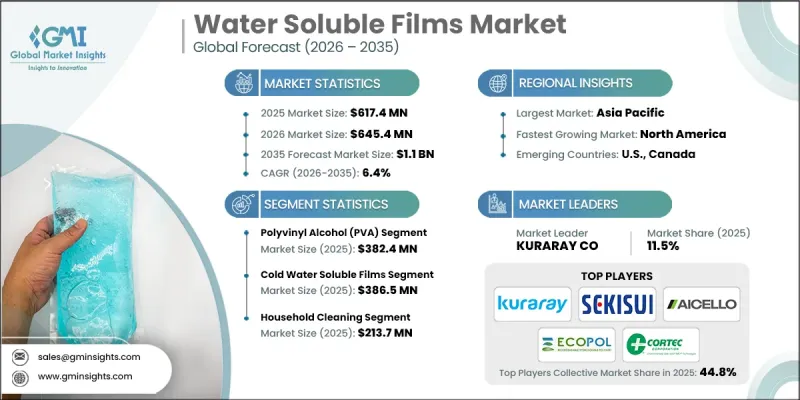
시장 성장은 안전성, 효율성 및 환경적 성능을 향상시키는 첨단 포장재에 대한 수요 증가에 힘입어 성장하고 있습니다. 수용성 필름은 물에 닿으면 용해되거나 분해되도록 설계된 얇은 고분자계 소재로 다양한 물질을 제어된 형태로 편리하게 공급할 수 있습니다. 주로 폴리비닐 알코올을 주성분으로 하는 이 필름은 화학물질에 대한 직접적인 취급을 최소화하면서 정확한 투여를 가능하게 하여 사용자의 안전성을 높이고 재료의 낭비를 줄인다는 점에서 널리 인정받고 있습니다. 포장, 세제, 농업, 제약, 산업 분야 등 다양한 산업 분야에서 채택이 확대되고 있습니다. 자동화 및 위생적인 취급 시스템에 대한 수요가 증가함에 따라 일회용(일회용) 포장 형태에서 이러한 필름의 사용이 더욱 증가하고 있습니다. 제조업체들은 다양한 수온과 환경 조건에서 효과적으로 작동할 수 있는 용해 특성을 제어한 필름 개발에 점점 더 집중하고 있습니다. 압출 및 캐스트 성형 기술의 지속적인 개선으로 더 얇고 내구성이 뛰어난 필름을 생산할 수 있게 되었으며, 재료 과학의 발전으로 저장 안정성, 운송 효율성 및 전체 제품 성능이 향상되었습니다.
| 시장 범위 | |
|---|---|
| 시작 연도 | 2025년 |
| 예측 기간 | 2026-2035년 |
| 개시 연도 시장 규모 | 6억 1,740만 달러 |
| 예측액 | 11억 달러 |
| CAGR | 6.4% |
2025년 기준, 냉수용성 필름 부문은 3억 8,650만 달러를 차지했습니다. 이 부문은 저온에서도 효율적으로 용해되는 특성으로 인해 가열이 어려운 용도에 매우 적합하여 시장을 선도하고 있습니다. 이 필름은 빠른 용해와 사용 편의성이 필수적인 세정제 및 가정용 케어 제품 배합에 널리 사용되고 있습니다. 보관 및 취급 시 높은 구조적 안정성과 물에 대한 빠른 분산성을 겸비하고 있어 성능과 편의성을 모두 원하는 제조업체에게 최적의 솔루션입니다.
가정용 세정제 응용 분야는 2025년 2억 1,370만 달러 시장 규모를 기록했습니다. 수용성 필름은 가정용 세정, 농업, 섬유, 식음료 가공, 화장품, 퍼스널케어 등 다양한 최종 사용 산업에서 활용되고 있습니다. 유해물질에 대한 노출을 최소화하면서 정확한 용량을 공급할 수 있는 특성으로 인해 그 채택이 크게 증가하고 있습니다. 이 필름은 작업의 안전성을 높이고 제품 사용을 단순화하며, 효과적인 성능을 발휘하기 위해 통제된 취급과 정확한 측정이 필수적인 환경에서 특히 유용하게 활용되고 있습니다.
북미의 수용성 필름 시장은 2025년 1억 970만 달러에서 2035년까지 1억 9,220만 달러로 성장할 것으로 예상되며, 예측 기간 동안 꾸준한 성장세를 나타낼 것으로 예측됩니다. 이 지역의 성장은 자동화와 안전한 취급 방법의 중요성이 증가하고 있는 가정용 청소, 산업용 화학 처리, 농업 분야에서의 채택 확대에 힘입어 성장하고 있습니다. 또한, 주거용 및 상업용 용도 모두에서 편의성을 높이고 폐기물을 줄이는 1회용 포장 형태의 사용이 증가하면서 수요를 견인하고 있습니다. 포장의 효율성과 안전 기준 준수에 대한 강한 강조가 지역 시장의 발전을 지속적으로 뒷받침하고 있습니다.
자주 묻는 질문
목차
제1장 조사 방법과 범위
제2장 주요 요약
제3장 업계 인사이트
제4장 경쟁 구도
제5장 시장 추산 및 예측 : 소재 유형별(2022-2035년)
제6장 시장 추산 및 예측 : 유형별(2022-2035년)
제7장 시장 추산 및 예측 : 최종 이용 산업별(2022-2035년)
제8장 시장 추산 및 예측 : 지역별(2022-2035년)
제9장 기업 개요
KTH 26.05.20The Global Water Soluble Films Market was valued at USD 617.4 million in 2025 and is estimated to grow at a CAGR of 6.4% to reach USD 1.1 billion by 2035.
Market growth is driven by the increasing demand for advanced packaging materials that improve safety, efficiency, and environmental performance. Water soluble films are thin polymer-based materials designed to dissolve or disintegrate upon contact with water, offering controlled and convenient delivery of various substances. These films, primarily based on polyvinyl alcohol, are widely recognized for enabling precise dosing while minimizing direct handling of chemicals, thereby enhancing user safety and reducing material waste. Their adoption is expanding across multiple industries, including packaging, detergents, agriculture, pharmaceuticals, and industrial applications. The growing need for automated and hygienic handling systems is further strengthening their use in single-use packaging formats. Manufacturers are increasingly focusing on developing films with controlled solubility characteristics that perform effectively across different water temperatures and environmental conditions. Continuous improvements in extrusion and casting technologies are enabling the production of thinner, more durable films, while advancements in material science are enhancing storage stability, transport efficiency, and overall product performance.
| Market Scope | |
|---|---|
| Start Year | 2025 |
| Forecast Year | 2026-2035 |
| Start Value | $617.4 Million |
| Forecast Value | $1.1 Billion |
| CAGR | 6.4% |
The cold water soluble films segment accounted for USD 386.5 million in 2025. This segment continues to dominate due to its ability to dissolve efficiently at low temperatures, making it highly suitable for applications where heating is not practical. These films are widely used in cleaning and household care formulations where rapid dissolution and ease of use are essential. Their strong structural integrity during storage and handling, combined with quick dispersibility in water, makes them a preferred solution for manufacturers seeking both performance and convenience.
The household cleaning application segment generated USD 213.7 million in 2025. Water soluble films are utilized across a diverse range of end-use industries, including household cleaning, agriculture, textiles, food and beverage processing, cosmetics, and personal care. Their ability to deliver precise dosage while minimizing exposure to hazardous substances has significantly increased their adoption. These films enhance operational safety and simplify product usage, making them particularly valuable in environments where controlled handling and accurate measurement are critical for effective performance.
North America Water Soluble Films Market is projected to grow from USD 109.7 million in 2025 to USD 192.2 million by 2035, reflecting steady expansion over the forecast period. Growth in the region is supported by increasing adoption across household cleaning, industrial chemical processing, and agriculture, where automation and safe handling practices are gaining importance. Demand is also being driven by the rising use of unit-dose packaging formats that improve convenience and reduce waste in both residential and commercial applications. Strong emphasis on packaging efficiency and safety compliance continues to support regional market development.
Key companies operating in the Global Water Soluble Films Market include Watersol Films, AICELLO CORPORATION, AMC (UK) Limited, Arrow GreenTech, Cortec Corporation, Ecopol S.p.A, KURARAY CO, Aquapak Polymers Limited, POLYVA, and SEKISUI CHEMICAL CO. Companies in the Water Soluble Films Market are strengthening their competitive position through continuous product innovation, material advancements, and expansion of application areas. They are investing in research and development to enhance film performance, improve dissolution control, and increase mechanical strength under varying conditions. Strategic partnerships with end-use industries are helping manufacturers expand adoption across packaging, agriculture, and cleaning applications. Many players are also focusing on sustainable production methods and bio-based material development to align with environmental regulations and consumer preferences. Expansion of production capacities and optimization of supply chains are further supporting cost efficiency and global distribution. Additionally, companies are customizing product solutions to meet specific industry requirements, improving their market reach and long-term growth potential.
Table of Contents
Chapter 1 Methodology & Scope
- 1.1 Market scope and definition
- 1.2 Research design
- 1.2.1 Research approach
- 1.2.2 Data collection methods
- 1.3 Data mining sources
- 1.3.1 Global
- 1.3.2 Regional/Country
- 1.4 Base estimates and calculations
- 1.4.1 Base year calculation
- 1.4.2 Key trends for market estimation
- 1.5 Primary research and validation
- 1.5.1 Primary sources
- 1.6 Forecast model
- 1.7 Research assumptions and limitations
Chapter 2 Executive Summary
- 2.1 Industry 360° synopsis
- 2.2 Key market trends
- 2.2.1 Material Type
- 2.2.2 Type
- 2.2.3 End Use Industry
- 2.2.4 Regional
- 2.3 TAM Analysis, 2026-2035
- 2.4 CXO perspectives: Strategic imperatives
- 2.5 Future outlook and strategic recommendations
Chapter 3 Industry Insights
- 3.1 Industry ecosystem analysis
- 3.1.1 Supplier landscape
- 3.1.2 Profit margin
- 3.1.3 Value addition at each stage
- 3.1.4 Factor affecting the value chain
- 3.1.5 Disruptions
- 3.2 Industry impact forces
- 3.2.1 Growth drivers
- 3.2.1.1 Expanding electronics healthcare demand requires stable silicone performance
- 3.2.1.2 Preference for materials offering thermal resistance flexibility consistently
- 3.2.1.3 Wider adoption in industrial processing and protective applications
- 3.2.2 Pitfalls/challenge
- 3.2.2.1 Higher production costs influencing pricing and profitability margins
- 3.2.2.2 Volatility in raw material supply affecting production stability
- 3.2.3 Opportunities
- 3.2.3.1 Customization of films for application specific performance requirements
- 3.2.3.2 Growing evaluation of water soluble films in emerging sectors
- 3.2.1 Growth drivers
- 3.3 Growth potential analysis
- 3.4 Regulatory landscape
- 3.4.1 North America
- 3.4.2 Europe
- 3.4.3 Asia Pacific
- 3.4.4 Latin America
- 3.4.5 Middle East & Africa
- 3.5 Porter’s analysis
- 3.6 PESTEL analysis
- 3.7 Technology and innovation landscape
- 3.7.1 Current technological trends
- 3.7.2 Emerging technologies
- 3.8 Price trends
- 3.8.1 By region
- 3.8.2 By material type
- 3.9 Future market trends
- 3.10 Technology and innovation landscape
- 3.10.1 Current technological trends
- 3.10.2 Emerging technologies
- 3.11 Patent landscape
- 3.12 Trade statistics (HS code)
- 3.12.1 Major importing countries
- 3.12.2 Major exporting countries
- 3.13 Sustainability and environmental aspects
- 3.13.1 Sustainable practices
- 3.13.2 Waste reduction strategies
- 3.13.3 Energy efficiency in production
- 3.13.4 Eco-friendly initiatives
- 3.14 Carbon footprint consideration
Chapter 4 Competitive Landscape, 2025
- 4.1 Introduction
- 4.2 Company market share analysis
- 4.2.1 By region
- 4.2.1.1 North America
- 4.2.1.2 Europe
- 4.2.1.3 Asia Pacific
- 4.2.1.4 LATAM
- 4.2.1.5 MEA
- 4.2.1 By region
- 4.3 Company matrix analysis
- 4.4 Competitive analysis of major market players
- 4.5 Competitive positioning matrix
- 4.6 Key developments
- 4.6.1 Mergers & acquisitions
- 4.6.2 Partnerships & collaborations
- 4.6.3 New product launches
- 4.6.4 Expansion plans
Chapter 5 Market Estimates and Forecast, By Material Type, 2022-2035 (USD Million) (Kilo Tons)
- 5.1 Key trends
- 5.2 Polyvinyl alcohol (PVA)
- 5.3 Starch based films
- 5.4 Polyethylene oxide (PEO)
- 5.5 Other
Chapter 6 Market Estimates and Forecast, By Type, 2022-2035 (USD Million) (Kilo Tons)
- 6.1 Key trends
- 6.2 Cold water soluble films
- 6.3 Hot water soluble films
Chapter 7 Market Estimates and Forecast, By End Use Industry, 2022-2035 (USD Million) (Kilo Tons)
- 7.1 Key trends
- 7.2 Household cleaning
- 7.3 Agriculture
- 7.4 Textiles
- 7.5 Food & beverage
- 7.6 Cosmetics and personal care
- 7.7 Others
Chapter 8 Market Estimates and Forecast, By Region, 2022-2035 (USD Million) (Kilo Tons)
- 8.1 Key trends
- 8.2 North America
- 8.2.1 U.S.
- 8.2.2 Canada
- 8.3 Europe
- 8.3.1 Germany
- 8.3.2 UK
- 8.3.3 France
- 8.3.4 Spain
- 8.3.5 Italy
- 8.3.6 Rest of Europe
- 8.4 Asia Pacific
- 8.4.1 China
- 8.4.2 India
- 8.4.3 Japan
- 8.4.4 Australia
- 8.4.5 South Korea
- 8.4.6 Rest of Asia Pacific
- 8.5 Latin America
- 8.5.1 Brazil
- 8.5.2 Mexico
- 8.5.3 Argentina
- 8.5.4 Rest of Latin America
- 8.6 Middle East and Africa
- 8.6.1 Saudi Arabia
- 8.6.2 South Africa
- 8.6.3 UAE
- 8.6.4 Rest of Middle East and Africa
Chapter 9 Company Profiles
- 9.1 Watersol Films
- 9.2 AICELLO CORPORATION
- 9.3 AMC (UK) Limited
- 9.4 Arrow GreenTech
- 9.5 Cortec Corporation
- 9.6 Ecopol S.p.A
- 9.7 KURARAY CO
- 9.8 Aquapak Polymers Limited
- 9.9 POLYVA
- 9.10 SEKISUI CHEMICAL CO