|
시장보고서
상품코드
2027640
카사바 가루 : 시장 기회, 성장 촉진요인, 업계 동향 분석 및 예측(2026-2035년)Cassava Flour Market Opportunity, Growth Drivers, Industry Trend Analysis, and Forecast 2026 - 2035 |
||||||

세계의 카사바 가루 시장은 2025년에 555억 달러로 평가되었고 CAGR 6.2%를 나타내 2035년까지 1,008억 달러에 이를 것으로 추정되고 있습니다.
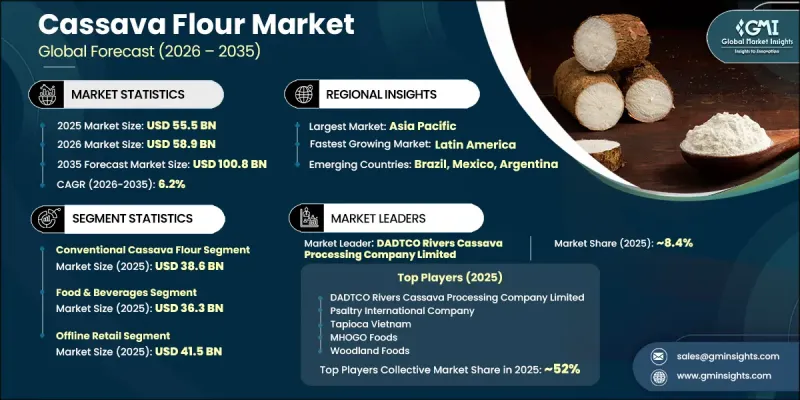
시장 성장은 글루텐 불내증 증가와 글루텐 프리 식단에 대한 소비자의 선호도 변화에 힘입어 성장하고 있습니다. 식습관이 변화하는 가운데 카사바 가루는 기존의 밀 기반 제품을 대체할 수 있는 좋은 대안으로 주목받고 있습니다. 이 원료는 다재다능함과 현대 식품 트렌드와의 적합성으로 인해 식품 가공 산업 전반에 걸쳐 널리 채택되고 있습니다. 식물성 원료에 대한 관심이 높아지면서 카사바 가루은 비건 및 클린 라벨 제품 배합에 적합하다는 점도 수요를 더욱 증가시키고 있습니다. 건강한 식품 선택에 대한 인식이 높아짐에 따라 소비자들은 영양학적 이점이 있다고 인식되는 최소한의 가공만 거친 원료를 선택하게 되었습니다. 이러한 변화는 제조업체들이 생산 규모를 확대하고, 소매 및 산업 분야 모두에서 용도를 다양화하도록 유도하고 있습니다. 지속적인 제품 혁신과 대체 분말에 대한 수용성 증가는 장기적인 시장 확대를 촉진하고 있으며, 선진국 시장 전반 수요 증가는 전체 산업의 가치를 지속적으로 높이고 있습니다.
| 시장 범위 | |
|---|---|
| 시작 연도 | 2025년 |
| 예측 기간 | 2026-2035년 |
| 개시 연도 시장 규모 | 555억 달러 |
| 예측액 | 1,008억 달러 |
| CAGR | 6.2% |
전통적인 카사바 가루 부문은 저렴한 가격과 광범위한 가용성으로 인해 2025년 386억 달러에 달했으며, 견고한 입지를 유지하고 있습니다. 잘 구축된 유통망과 효율적인 공급망은 대규모 응용 분야에서 광범위한 채택을 지원하고 있습니다. 이 부문은 확장성과 경쟁력 있는 가격의 혜택을 계속 누리고 있으며, 대량 소비 및 산업용도에 적합합니다. 이러한 장점은 안정적인 수요를 유지하는 동시에 더 넓은 제품 카테고리로 단계적으로 확장하는 데 도움이 됩니다.
음료 및 식품 부문은 2025년 363억 달러를 차지하며 카사바 가루 시장의 주요 응용 분야로 자리매김했습니다. 이 부문의 성장은 가공 식품에서 카사바 가루의 사용 확대에 의해 주도되고 있습니다. 카사바 가루의 기능성 특성은 제품 배합을 향상시킵니다. 중립적인 맛과 적응성으로 인해 제조업체는 카사바 가루를 다양한 제품에 사용할 수 있습니다. 클린 라벨과 식물성 원료에 대한 소비자 수요 증가는 제품 개발에 카사바 가루의 채택을 더욱 촉진하고 있으며, 이는 이 부문의 지속적인 성장을 뒷받침하고 있습니다.
북미의 카사바 가루 시장은 2025년 108억 달러 규모에 달했습니다. 미국은 글루텐 프리 및 클린 라벨 식품에 대한 소비자 선호도가 높아지면서 지역 내 수요를 주도하고 있습니다. 고도로 발달한 식품 가공 부문과 대체 원료에 대한 관심이 높아지면서 카사바 가루의 채택이 가속화되고 있습니다. 건강 의식 증가와 식생활 트렌드의 변화도 소비 확대에 기여하고 있으며, 특수 식품 및 기능성 식품에 대한 수요 증가는 지역 전체 시장 성장을 더욱 견고하게 하고 있습니다.
자주 묻는 질문
목차
제1장 조사 방법과 범위
제2장 주요 요약
제3장 업계 인사이트
제4장 경쟁 구도
제5장 시장 추산 및 예측 : 제품 유형별(2022-2035년)
제6장 시장 추산 및 예측 : 용도별(2022-2035년)
제7장 시장 추산 및 예측 : 유통 채널별(2022-2035년)
제8장 시장 추산 및 예측 : 지역별(2022-2035년)
제9장 기업 개요
KTHThe Global Cassava Flour Market was valued at USD 55.5 billion in 2025 and is estimated to grow at a CAGR of 6.2% to reach USD 100.8 billion by 2035.
Market growth is fueled by the increasing prevalence of gluten intolerance and shifting consumer preferences toward gluten-free diets. As dietary habits evolve, cassava flour is gaining traction as a preferred alternative to traditional wheat-based products. The ingredient is widely incorporated across food processing industries due to its versatility and compatibility with modern dietary trends. Rising interest in plant-based consumption patterns further strengthens demand, as cassava flour aligns well with vegan and clean-label product formulations. Expanding awareness of healthier food choices is also influencing purchasing behavior, with consumers opting for minimally processed ingredients that offer perceived nutritional benefits. This shift is encouraging manufacturers to scale up production and diversify applications across both retail and industrial sectors. Continuous product innovation and growing acceptance of alternative flours are reinforcing long-term market expansion, while increasing demand across developed markets continues to elevate overall industry value.
| Market Scope | |
|---|---|
| Start Year | 2025 |
| Forecast Year | 2026-2035 |
| Start Value | $55.5 Billion |
| Forecast Value | $100.8 Billion |
| CAGR | 6.2% |
The conventional cassava flour segment reached USD 38.6 billion in 2025, maintaining a strong position due to its affordability and extensive availability. Its established distribution networks and efficient supply chains support widespread adoption across large-scale applications. The segment continues to benefit from scalability and competitive pricing, making it suitable for high-volume consumption and industrial usage. These advantages enable consistent demand while also supporting gradual expansion into broader product categories.
The food & beverages segment captured USD 36.3 billion in 2025, positioning it as a key application area within the cassava flour market. Growth in this segment is driven by increasing usage of cassava flour in processed food products, where its functional properties enhance product formulation. Its neutral taste and adaptability allow manufacturers to incorporate it into a wide range of offerings. Rising consumer demand for clean-label and plant-based ingredients is further encouraging its inclusion in product development, supporting continued segment growth.
North America Cassava Flour Market generated USD 10.8 billion in 2025. The United States leads regional demand due to increasing consumer preference for gluten-free and clean-label food options. A well-developed food processing sector, combined with growing interest in alternative ingredients, is accelerating adoption. Expanding health awareness and evolving dietary trends are also contributing to rising consumption, while increasing demand for specialty and functional food products continues to strengthen market growth across the region.
Key players operating in the Global Cassava Flour Market include DADTCO RIVERS CASSAVA PROCESSING COMPANY LIMITED, Vaighai Agro, Psaltry International Company, Woodland Foods, Tapioca Vietnam, MHOGO Foods, Green Hills Natural Foods, Tropical Food Industries, Mocaf Factory, PT Agromoda Solution Indonesia, and Tasuko. Companies in the Cassava Flour Market are enhancing their competitive position through strategic initiatives focused on expansion and innovation. They are investing in advanced processing technologies to improve product quality and production efficiency. Strengthening supply chain networks and securing raw material sourcing are key priorities to ensure consistent output. Businesses are also expanding their product portfolios to cater to evolving consumer preferences, particularly in gluten-free and plant-based segments. Partnerships and collaborations with food manufacturers help increase market reach and application scope. Additionally, companies are emphasizing branding, certification, and clean-label positioning to attract health-conscious consumers, while scaling production capacities to meet rising global demand and maintain long-term growth.
Table of Contents
Chapter 1 Methodology & Scope
- 1.1 Market scope and definition
- 1.2 Research design
- 1.2.1 Research approach
- 1.2.2 Data collection methods
- 1.3 Data mining sources
- 1.3.1 Global
- 1.3.2 Regional/Country
- 1.4 Base estimates and calculations
- 1.4.1 Base year calculation
- 1.4.2 Key trends for market estimation
- 1.5 Primary research and validation
- 1.5.1 Primary sources
- 1.6 Forecast model
- 1.7 Research assumptions and limitations
Chapter 2 Executive Summary
- 2.1 Industry 360° synopsis
- 2.2 Key market trends
- 2.2.1 Regional
- 2.2.2 Product Type
- 2.2.3 Application
- 2.2.4 Distribution Channel
- 2.3 TAM Analysis, 2026-2035
- 2.4 CXO perspectives: Strategic imperatives
- 2.4.1 Executive decision points
- 2.4.2 Critical success factors
- 2.5 Future Outlook and Strategic Recommendations
Chapter 3 Industry Insights
- 3.1 Industry ecosystem analysis
- 3.1.1 Supplier Landscape
- 3.1.2 Profit Margin
- 3.1.3 Value addition at each stage
- 3.1.4 Factor affecting the value chain
- 3.1.5 Disruptions
- 3.2 Industry impact forces
- 3.2.1 Growth drivers
- 3.2.1.1 Rising demand for gluten-free products
- 3.2.1.2 Increasing consumer preference for plant-based diets
- 3.2.1.3 Growing health & wellness awareness
- 3.2.2 Industry pitfalls and challenges
- 3.2.2.1 Limited consumer awareness in emerging regions
- 3.2.2.2 Higher price point compared to traditional wheat flour
- 3.2.3 Market opportunities
- 3.2.3.1 Development of functionally enhanced products
- 3.2.3.2 Clean-label & non-GMO product positioning
- 3.2.1 Growth drivers
- 3.3 Growth potential analysis
- 3.4 Regulatory landscape
- 3.4.1 North America
- 3.4.2 Europe
- 3.4.3 Asia Pacific
- 3.4.4 Latin America
- 3.4.5 Middle East & Africa
- 3.5 Porter's analysis
- 3.6 PESTEL analysis
- 3.7 Price trends
- 3.7.1 By region
- 3.7.2 Product type
- 3.8 Future market trends
- 3.9 Technology and Innovation Landscape
- 3.9.1 Current technological trends
- 3.9.2 Emerging technologies
- 3.10 Patent Landscape
- 3.11 Trade statistics (HS code) (Note: the trade statistics will be provided for key countries only)
- 3.11.1 Major importing countries
- 3.11.2 Major exporting countries
- 3.12 Sustainability and environmental aspects
- 3.12.1 Sustainable practices
- 3.12.2 Waste reduction strategies
- 3.12.3 Energy efficiency in production
- 3.12.4 Eco-friendly initiatives
Chapter 4 Competitive Landscape, 2025
- 4.1 Introduction
- 4.2 Company market share analysis
- 4.2.1 By region
- 4.2.1.1 North America
- 4.2.1.2 Europe
- 4.2.1.3 Asia Pacific
- 4.2.1.4 LATAM
- 4.2.1.5 MEA
- 4.2.1 By region
- 4.3 Company matrix analysis
- 4.4 Competitive analysis of major market players
- 4.5 Competitive positioning matrix
- 4.6 Key developments
- 4.6.1 Mergers & acquisitions
- 4.6.2 Partnerships & collaborations
- 4.6.3 New product launches
- 4.6.4 Expansion plans
Chapter 5 Market Estimates and Forecast, By Product Type, 2022 - 2035 (USD Billion) (Tons)
- 5.1 Key trends
- 5.2 Organic Cassava Flour
- 5.3 Conventional Cassava Flour
Chapter 6 Market Estimates and Forecast, By Application, 2022 - 2035 (USD Billion) (Tons)
- 6.1 Key trends
- 6.2 Food & Beverages
- 6.2.1 Bakery & Confectionery
- 6.2.2 Snacks & Convenience Foods
- 6.2.3 Sauces & Condiments
- 6.2.4 Others
- 6.3 Animal Feed
- 6.4 Pharmaceuticals
- 6.5 Cosmetics & Personal Care
- 6.6 Others
Chapter 7 Market Estimates and Forecast, By Distribution Channel, 2022 - 2035 (USD Billion) (Tons)
- 7.1 Key trends
- 7.2 Online Retail
- 7.3 Offline Retail
- 7.3.1 Supermarkets & Hypermarkets
- 7.3.2 Specialty Stores
- 7.3.3 Convenience Stores
- 7.3.4 Grocery Stores
- 7.3.5 Others
Chapter 8 Market Estimates and Forecast, By Region, 2022 - 2035 (USD Billion) (Tons)
- 8.1 Key trends
- 8.2 North America
- 8.2.1 U.S.
- 8.2.2 Canada
- 8.3 Europe
- 8.3.1 Germany
- 8.3.2 UK
- 8.3.3 France
- 8.3.4 Spain
- 8.3.5 Italy
- 8.3.6 Rest of Europe
- 8.4 Asia Pacific
- 8.4.1 China
- 8.4.2 India
- 8.4.3 Japan
- 8.4.4 Australia
- 8.4.5 South Korea
- 8.4.6 Rest of Asia Pacific
- 8.5 Latin America
- 8.5.1 Brazil
- 8.5.2 Mexico
- 8.5.3 Rest of Latin America
- 8.6 Middle East and Africa
- 8.6.1 Saudi Arabia
- 8.6.2 South Africa
- 8.6.3 UAE
- 8.6.4 Rest of Middle East and Africa
Chapter 9 Company Profiles
- 9.1 Tasuko
- 9.2 DADTCO RIVERS CASSAVA PROCESSING COMPANY LIMITED
- 9.3 Vaighai agro
- 9.4 Psaltry International Company
- 9.5 Woodland Foods
- 9.6 Tapioca Vietnam
- 9.7 MHOGO Foods
- 9.8 Green Hills Natural Foods
- 9.9 Tropical Food Industries
- 9.10 Mocaf Factory
- 9.11 PT Agromoda Solution Indonesia