
|
시장보고서
상품코드
2038317
호퍼 레일카 시장 비즈니스 기회, 성장요인, 업계 동향 분석 및 예측(2026-2035년)Hopper Railcar Market Opportunity, Growth Drivers, Industry Trend Analysis, and Forecast 2026 - 2035 |
||||||

세계의 호퍼 레일카 시장은 2025년에 75억 달러로 평가되었고 CAGR 5.1%로 성장하여 2035년까지 121억 달러에 이를 것으로 추정되고 있습니다.
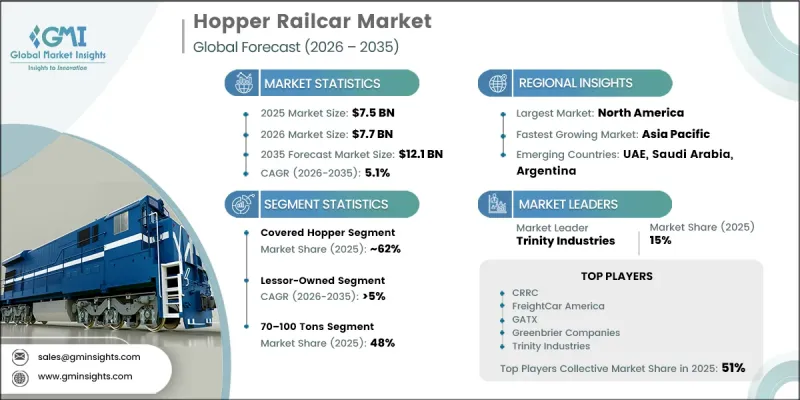
벌크 상품 운송의 견조한 성장은 대량 운송에 특화된 효율적인 철도 솔루션에 대한 수요를 지속적으로 견인하고 있습니다. 호퍼 레일카는 다른 운송수단에 비해 적재 공정의 효율화, 자재 손실 최소화, 운영 사이클 시간 단축이 가능하기 때문에 점점 더 많은 지지를 받고 있습니다. 무역 루트의 확대와 물류 네트워크의 정비도 국제 시장에서 신규 차량 및 갱신용 차량의 꾸준한 조달에 기여하고 있습니다. 경량 소재 채택, 내하중 능력 향상, 디지털 모니터링 시스템 등의 기술적 개선으로 효율성이 향상되고 장기적인 운영비용이 절감되고 있습니다. 리스 모델은 최신 설비를 이용할 수 있는 동시에 재정적 유연성을 제공하기 때문에 널리 보급되고 있습니다. 이와 함께 도로에서 철도로의 모드 전환을 촉진하는 정책 이니셔티브는 환경 지속가능성, 교통 체증 완화 및 비용 효율적인 장거리 운송에 중점을 두어 시장 확대를 지원하고 있습니다. 철도 인프라와 화물 운송 통로에 대한 투자는 공급망 효율성을 더욱 강화하고 산업 분야에서 호퍼 레일카의 광범위한 도입을 촉진하고 있습니다.
| 시장 범위 | |
|---|---|
| 시작 연도 | 2025년 |
| 예측 기간 | 2026-2035년 |
| 시작 연도 시장 규모 | 75억 달러 |
| 예측 규모 | 121억 달러 |
| CAGR | 5.1% |
2025년에는 커버형 호퍼 부문이 시장 점유율의 62%를 차지했고, 2035년까지 연평균 복합 성장률(CAGR) 4.5%를 나타낼 것으로 예측됩니다. 섬세한 벌크 재료의 운송 수요가 증가함에 따라 환경 노출 및 오염으로부터 보호하는 밀폐형 철도 차량에 대한 요구가 증가하고 있습니다. 가공품 및 수출화물을 취급하는 업계에서는 운송 중 제품의 품질 유지가 점점 더 중요시되고 있습니다. 또한, 통제된 환경을 필요로 하는 건조 산업용 원료의 운송도 커버형 호퍼 설계의 지속적인 채택을 뒷받침하고 있습니다. 이 화물차는 보다 정밀한 하역 메커니즘을 가능하게 하여 자재 낭비와 업무의 비효율성을 줄입니다.
리스 회사 소유 차량 부문은 2025년 47%의 점유율을 차지했고, 2026년부터 2035년까지 연평균 복합 성장률(CAGR) 5%를 나타낼 것으로 예측됩니다. 새로운 철도 차량 구매에는 많은 자본 투자가 필요하기 때문에 많은 사업자들은 보다 유연하고 비용 효율적인 대안으로 리스 계약을 선호하고 있습니다. 리스를 이용하면 초기 비용 없이 최신 설비를 이용할 수 있기 때문에 기업은 유동성을 유지하고 변화하는 시장 상황에 적응할 수 있습니다. 산업 전반 수요 변동은 리스의 매력을 더욱 높이고 있습니다. 리스를 통해 기업은 자산의 유휴 리스크 없이 운영상의 필요에 따라 운송 능력을 조정할 수 있기 때문입니다.
2025년 미국 호퍼 레일카 시장은 24억 달러 시장 규모 중 89%를 차지했습니다. 이 나라의 광범위한 화물 철도 인프라는 벌크 운송 솔루션에 대한 높은 수요를 지속적으로 뒷받침하고 있습니다. 탄탄한 네트워크 연결성을 통해 효율적인 장거리 운송이 가능해짐에 따라 차량 현대화 및 확장에 대한 수요가 지속적으로 증가하고 있습니다. 대규모 농업 생산은 여전히 호퍼 레일카 이용의 주요 요인으로, 반복되는 계절적 주기가 최적화된 운송 능력과 첨단 화물 취급 장비에 대한 지속적인 수요를 견인하고 있습니다.
자주 묻는 질문
목차
제1장 조사 방법
제2장 주요 요약
제3장 업계 인사이트
제4장 경쟁 구도
제5장 시장 추산 및 예측 : 제품별, 2022-2035년
제6장 시장 추산 및 예측 : 적재 용량별, 2022-2035년
제7장 시장 추산 및 예측 : 운송 물자별, 2022-2035년
제8장 시장 추산 및 예측 : 소유 형태별, 2022-2035년
제9장 시장 추산 및 예측 : 용도별, 2022-2035년
제10장 시장 추산 및 예측 : 지역별, 2022-2035년
제11장 기업 개요
JHS 26.05.29The Global Hopper Railcar Market was valued at USD 7.5 billion in 2025 and is estimated to grow at a CAGR of 5.1% to reach USD 12.1 billion by 2035.
Strong growth in bulk commodity movement continues to drive demand for efficient rail solutions tailored for large-volume handling. Hopper railcars are increasingly favored for their ability to streamline loading processes, minimize material loss, and enhance operational turnaround compared to alternative transport modes. Expanding trade routes and logistics networks are contributing to the steady procurement of both new units and replacement fleets across international markets. Technological upgrades, including lighter materials, higher load-bearing capabilities, and digital monitoring systems, are improving efficiency and reducing long-term operating costs. Leasing models are gaining traction as they offer financial flexibility while enabling access to modern equipment. In parallel, policy initiatives encouraging modal shifts from road to rail are supporting market expansion by emphasizing environmental sustainability, reduced congestion, and cost-effective long-haul transportation. Investments in rail infrastructure and freight corridors are further strengthening supply chain efficiency and encouraging broader industrial adoption of hopper railcars.
| Market Scope | |
|---|---|
| Start Year | 2025 |
| Forecast Year | 2026-2035 |
| Start Value | $7.5 Billion |
| Forecast Value | $12.1 Billion |
| CAGR | 5.1% |
The covered hopper segment accounted for 62% share in 2025 and is anticipated to grow at a CAGR of 4.5% through 2035. Increasing demand for transporting sensitive bulk materials has fueled the need for enclosed railcars that protect against environmental exposure and contamination. Industries handling processed goods and export shipments are placing higher emphasis on maintaining product integrity during transit. Additionally, the movement of dry industrial inputs that require controlled environments has supported the continued adoption of covered hopper designs. These railcars also enable more precise unloading mechanisms, reducing material waste and operational inefficiencies.
The lessor-owned fleets segment held 47% share in 2025 and is forecast to grow at a CAGR of 5% between 2026 and 2035. The significant capital investment required for purchasing new railcars has led many operators to prefer leasing arrangements as a more flexible and cost-efficient alternative. Leasing provides access to updated equipment without large upfront expenditures, allowing companies to maintain liquidity and adapt to changing market conditions. Demand fluctuations across industries have further reinforced the appeal of leasing, as it allows businesses to scale capacity based on operational needs without the risk of asset underutilization.
U.S. Hopper Railcar Market accounted for 89% share of USD 2.4 billion in 2025. The country's extensive freight rail infrastructure continues to support high demand for bulk transportation solutions. Strong network connectivity enables efficient long-distance movement, sustaining consistent requirements for fleet modernization and expansion. Large-scale agricultural output remains a key contributor to hopper railcar utilization, with recurring seasonal cycles driving ongoing demand for optimized transport capacity and advanced handling equipment.
Key companies operating in the Global Hopper Railcar Market include BESCO, CRRC, FreightCar America, GATX Corporation, Greenbrier Companies, Jekay International, National Steel Car, Touax Texmaco, Trinity Industries, and VTG. Companies in the Hopper Railcar Market are strengthening their position through a combination of innovation, strategic partnerships, and asset optimization. Manufacturers are focusing on developing lightweight and high-capacity railcars integrated with advanced telematics and predictive maintenance technologies to enhance performance and reduce lifecycle costs. Leasing firms are expanding their fleets to meet rising demand while offering flexible contract structures to attract a broader customer base. Market players are also investing in geographic expansion and collaborations with logistics providers to improve service reach and efficiency. Additionally, continuous upgrades to existing fleets and emphasis on sustainability are helping companies align with regulatory requirements and evolving customer expectations.
Table of Contents
Chapter 1 Methodology
- 1.1 Research approach
- 1.2 Quality Commitments
- 1.2.1 GMI AI policy & data integrity commitment
- 1.2.1.1 Source consistency protocol
- 1.2.1 GMI AI policy & data integrity commitment
- 1.3 Research Trail & Confidence Scoring
- 1.3.1 Research Trail Components
- 1.3.2 Scoring Components
- 1.4 Data Collection
- 1.4.1 Partial list of primary sources
- 1.5 Data mining sources
- 1.5.1 Paid sources
- 1.5.2 Sources, by region
- 1.6 Base estimates and calculations
- 1.6.1 Base year calculation
- 1.7 Forecast model
- 1.7.1 Quantified market impact analysis
- 1.7.1.1 Mathematical impact of growth parameters on forecast
- 1.7.1 Quantified market impact analysis
- 1.8 Research transparency addendum
- 1.8.1 Source attribution framework
- 1.8.2 Quality assurance metrics
- 1.8.3 Our commitment to trust
Chapter 2 Executive Summary
- 2.1 Industry 360° synopsis, 2022 - 2035
- 2.2 Key market trends
- 2.2.1 Regional
- 2.2.2 Product
- 2.2.3 Load Capacity
- 2.2.4 Material Transported
- 2.2.5 Ownership
- 2.2.6 Application
- 2.3 TAM Analysis, 2026-2035
- 2.4 CXO perspectives: Strategic imperatives
Chapter 3 Industry Insights
- 3.1 Industry ecosystem analysis
- 3.1.1 Supplier landscape
- 3.1.2 Profit margin analysis
- 3.1.3 Cost structure
- 3.1.4 Value addition at each stage
- 3.1.5 Factor affecting the value chain
- 3.1.6 Disruptions
- 3.2 Industry impact forces
- 3.2.1 Growth drivers
- 3.2.1.1 Rising demand for bulk commodity transportation
- 3.2.1.2 Expansion of rail freight networks
- 3.2.1.3 Growth in agricultural exports
- 3.2.1.4 Technological advancements in railcar design
- 3.2.2 Industry pitfalls and challenges
- 3.2.2.1 High capital investment
- 3.2.2.2 Volatility in commodity demand
- 3.2.2.3 Maintenance and lifecycle costs
- 3.2.2.4 Competition from alternative transport modes
- 3.2.3 Market opportunities
- 3.2.3.1 Growth in emerging economies
- 3.2.3.2 Modernization of freight rail fleets
- 3.2.3.3 Digitalization and smart railcars
- 3.2.3.4 Expansion of mining and construction sectors
- 3.2.1 Growth drivers
- 3.3 Growth potential analysis
- 3.4 Regulatory landscape
- 3.4.1 North America
- 3.4.1.1 Environmental Protection Agency (EPA) Rail Emission Standards
- 3.4.1.2 Federal Railroad Administration (FRA) Safety Compliance Regulations
- 3.4.1.3 Pipeline and Hazardous Materials Safety Administration (PHMSA) Freight Transport Rules
- 3.4.1.4 Occupational Safety and Health Administration (OSHA) Rail Yard Safety Standards
- 3.4.1.5 Transport Canada Rail Safety Act Requirements
- 3.4.2 Europe
- 3.4.2.1 European Union Railway Safety Directive
- 3.4.2.2 Technical Specifications for Interoperability (TSI) Rail Freight Standards
- 3.4.2.3 European Chemicals Agency (ECHA) Cargo Handling Regulations
- 3.4.2.4 European Railway Agency (ERA) Operational Compliance Framework
- 3.4.2.5 National Rail Freight Certification Requirements
- 3.4.3 Asia Pacific
- 3.4.3.1 China State Railway Group Freight Wagon Standards
- 3.4.3.2 Indian Railways Rolling Stock Safety and Design Codes
- 3.4.3.3 Japan Railway Technical Service Standards (JRTS)
- 3.4.3.4 ASEAN Rail Transport Harmonization Guidelines
- 3.4.3.5 Australian Rail Track Corporation (ARTC) Freight Compliance Standards
- 3.4.4 Latin America
- 3.4.4.1 Brazil National Land Transport Agency (ANTT) Rail Freight Regulations
- 3.4.4.2 Brazilian Rail Safety and Interoperability Standards
- 3.4.4.3 Mexico Federal Railway Transport Agency Norms
- 3.4.4.4 Regional Rail Infrastructure Certification Requirements
- 3.4.4.5 Andean Community Rail Freight Transport Guidelines
- 3.4.5 Middle East & Africa
- 3.4.5.1 GCC Railway Authority Freight Wagon Standards
- 3.4.5.2 Saudi Railway Company (SAR) Operational Regulations
- 3.4.5.3 Saudi Standards, Metrology and Quality Organization (SASO) Rail Compliance
- 3.4.5.4 South African Rail Safety Regulator (RSR) Standards
- 3.4.5.5 African Railway Union Freight Transport Guidelines
- 3.4.1 North America
- 3.5 Porter's analysis
- 3.6 PESTEL analysis
- 3.7 Technology and innovation landscape
- 3.7.1 Current technological trends
- 3.7.2 Emerging technologies
- 3.8 Price analysis (Driven by Primary Research)
- 3.8.1 Historical Price Trend Analysis
- 3.8.2 Pricing Strategy by Player Type (Premium / Value / Cost-plus)
- 3.9 Trade data analysis (Driven by Paid Research)
- 3.9.1 Import/export volume & value trends
- 3.9.2 Key trade corridors & tariff impact
- 3.10 Cost breakdown analysis
- 3.11 Patent analysis (Driven by Primary Research)
- 3.12 Impact of AI & generative AI on the market
- 3.12.1 AI-driven disruption of existing business models
- 3.12.2 GenAI use cases & adoption roadmap by segment
- 3.12.3 Risks, limitations & regulatory considerations
- 3.13 Capacity & production landscape (Driven by Primary Research)
- 3.13.1 Installed capacity by region & key producer
- 3.13.2 Capacity utilization rates & expansion pipelines
- 3.14 Sustainability and environmental aspects
- 3.14.1 Sustainable practices
- 3.14.2 Waste reduction strategies
- 3.14.3 Energy efficiency in production
- 3.14.4 Eco-friendly Initiatives
- 3.14.5 Carbon footprint considerations
- 3.15 Forecast assumptions & scenario analysis (Driven by Primary Research)
- 3.15.1 Base Case - key macro & industry variables driving CAGR
- 3.15.2 Optimistic Scenarios - Favorable macro and industry tailwinds
- 3.15.3 Pessimistic Scenario - Macroeconomic slowdown or industry headwinds
Chapter 4 Competitive Landscape, 2025
- 4.1 Introduction
- 4.2 Company market share analysis
- 4.2.1 North America
- 4.2.2 Europe
- 4.2.3 Asia Pacific
- 4.2.4 LATAM
- 4.2.5 MEA
- 4.3 Competitive analysis of major market players
- 4.4 Competitive positioning matrix
- 4.5 Key developments
- 4.5.1 Mergers & acquisitions
- 4.5.2 Partnerships & collaborations
- 4.5.3 New Product Launches
- 4.5.4 Expansion Plans and funding
- 4.6 Company tier benchmarking
- 4.6.1 Tier classification criteria & qualifying thresholds
- 4.6.2 Tier positioning matrix by revenue, geography & innovation
Chapter 5 Market Estimates & Forecast, By Product, 2022 - 2035 ($Mn, Fleet Size)
- 5.1 Key trends
- 5.2 Covered hopper
- 5.3 Open-top hopper
Chapter 6 Market Estimates & Forecast, By Load Capacity, 2022 - 2035 ($Mn, Fleet Size)
- 6.1 Key trends
- 6.2 Below 70 Tons
- 6.3 70-100 Tons
- 6.4 Above 100 Tons
Chapter 7 Market Estimates & Forecast, By Material Transported, 2022 - 2035 ($Mn, Fleet Size)
- 7.1 Key trends
- 7.2 Coal
- 7.3 Grain
- 7.4 Cement
- 7.5 Aggregates & Sand
- 7.6 Minerals & Ores
- 7.7 Fertilizers
- 7.8 Chemicals
- 7.9 Others
Chapter 8 Market Estimates & Forecast, By Ownership, 2022 - 2035 ($Mn, Fleet Size)
- 8.1 Key trends
- 8.2 Lessor-Owned
- 8.3 Railroad-Owned
- 8.4 Shipper-Owned
- 8.5 Pool/Shared Fleet
Chapter 9 Market Estimates & Forecast, By Application, 2022 - 2035 ($Mn, Fleet Size)
- 9.1 Key trends
- 9.2 Mining
- 9.3 Agriculture
- 9.4 Construction Materials
- 9.5 Industrial Manufacturing
- 9.6 Energy & Utilities
- 9.7 Chemicals & Fertilizers
Chapter 10 Market Estimates & Forecast, By Region, 2022 - 2035 ($Mn, Fleet Size)
- 10.1 Key trends
- 10.2 North America
- 10.2.1 US
- 10.2.2 Canada
- 10.3 Europe
- 10.3.1 UK
- 10.3.2 Germany
- 10.3.3 France
- 10.3.4 Italy
- 10.3.5 Spain
- 10.3.6 Russia
- 10.3.7 Nordics
- 10.4 Asia Pacific
- 10.4.1 China
- 10.4.2 India
- 10.4.3 Japan
- 10.4.4 South Korea
- 10.4.5 Southeast Asia
- 10.4.6 ANZ
- 10.5 Latin America
- 10.5.1 Brazil
- 10.5.2 Argentina
- 10.5.3 Mexico
- 10.6 MEA
- 10.6.1 UAE
- 10.6.2 Saudi Arabia
- 10.6.3 South Africa
Chapter 11 Company Profiles
- 11.1 Global Players
- 11.1.1 CRRC
- 11.1.2 FreightCar America
- 11.1.3 GATX
- 11.1.4 Procor
- 11.1.5 Texmaco Rail & Engineering
- 11.1.6 Greenbrier Companies
- 11.1.7 Touax
- 11.1.8 Trinity Industries
- 11.1.9 VTG
- 11.2 Regional Players
- 11.2.1 BESCO
- 11.2.2 Everest Railcar Services
- 11.2.3 Jekay International
- 11.2.4 National Steel Car
- 11.2.5 Pacific Railcar Leasing
- 11.2.6 Railcar Leasing & Logistics
- 11.2.7 RESIDCO
- 11.2.8 TCIX Rail
- 11.2.9 Union Pacific Railroad
- 11.3 Emerging Players
- 11.3.1 Creative Railcar Marketing Services
- 11.3.2 Rapido Trains
- 11.3.3 Southwest Rail Industries