
|
시장보고서
상품코드
2045776
철도 화물 시장 : 시장 기회, 성장요인, 업계 동향 분석 및 예측(2026-2035년)Rail Freight Market Opportunity, Growth Drivers, Industry Trend Analysis, and Forecast 2026 - 2035 |
||||||

세계의 철도 화물 시장은 2025년에 3,529억 달러로 평가되었고, CAGR 4.6%로 성장할 전망이며, 2035년까지 5,500억 달러에 이를 것으로 추정되고 있습니다.
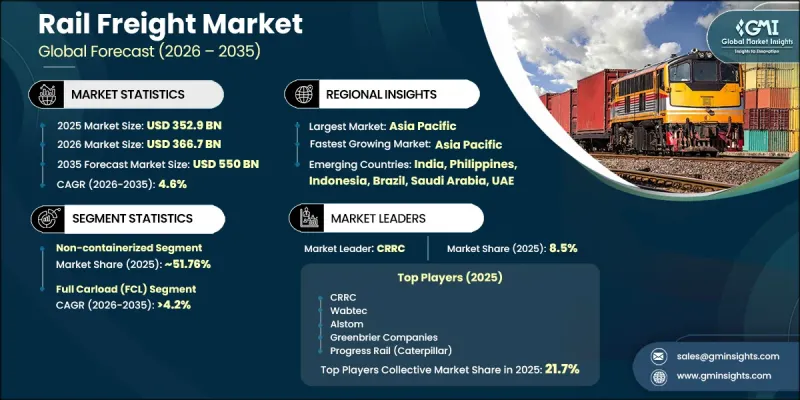
철도 화물 산업 전반의 성장은 국제 무역 네트워크의 급속한 확장과 벌크 화물과 컨테이너 화물의 효율적인 운송을 필요로 하는 점점 더 복잡해지는 산업 공급망에 의해 주도되고 있습니다. 제조업의 활성화와 비용 효율적인 장거리 물류 솔루션에 대한 수요가 증가함에 따라 각 산업계는 철도 기반 운송 시스템으로 전환을 추진하고 있습니다. 철도 화물 서비스는 다른 운송 수단에 비해 대량의 화물을 운송할 수 있을 뿐만 아니라 운송 비용이 저렴하고 환경에 미치는 영향이 적다는 장점으로 인해 점점 더 선호되고 있습니다. 전용 화물 통로에 대한 지속적인 투자, 철도 인프라의 현대화, 항만, 산업단지, 내륙 물류 허브 간의 연결성 향상은 시장 확대를 더욱 촉진하고 있습니다. 또한, 지속 가능한 운송 솔루션에 대한 관심 증가와 탄소 배출 규제 준수에 대한 노력은 다양한 산업 분야에서 철도 화물의 채택을 촉진하고 있습니다. 정부와 기업은 저배출 물류 시스템을 적극적으로 추진하고 있으며, 전기화 철도망과 에너지 효율이 높은 기관차에 대한 투자로 운영 성과가 지속적으로 향상되고 있습니다. 또한, 첨단 모니터링 기술과 표준화된 화물 관리 시스템에 힘입어 산업 제품, 위험물, 고가 화물의 안전하고 신뢰할 수 있는 운송에 대한 수요가 증가함에 따라 시장 성장에 힘을 실어주고 있습니다.
| 시장 범위 | |
|---|---|
| 개시 연도 | 2025년 |
| 예측 기간 | 2026-2035년 |
| 개시 시점 시장 규모 | 3,529억 달러 |
| 예측 시장 규모 | 5,500억 달러 |
| CAGR | 4.6% |
업무 효율성과 운송 비용 최적화에 대한 관심이 높아짐에 따라 철도 화물 시장 경쟁 구도가 변화하고 있습니다. 각 업계에서는 공급망의 신뢰성을 높이고 장기적인 운송 비용을 절감하기 위해 철도 기반 물류 솔루션을 도입하고 있습니다. 철도 화물 시스템은 장거리 중량물 운송에 있어 우수한 연료 효율과 낮은 운영 비용이라는 큰 이점을 제공합니다. 화물 관리 시스템, 디지털 추적 솔루션 및 자동화 운영의 지속적인 기술 발전은 화물의 가시성과 전체 물류의 효율성을 향상시키고 있습니다. 철도 인프라의 업그레이드와 복합 운송 네트워크에 대한 투자 증가는 예측 기간 동안 시장 성장을 더욱 강화할 것으로 예측됩니다.
비컨테이너 화물 부문은 2025년 51.76%의 점유율을 차지했으며, 2035년까지 연평균 3.8%의 성장률을 보일 것으로 전망됩니다. 산업계가 대량의 산업 원자재 및 생필품 운송에 있어 철도망에 크게 의존하고 있기 때문에 벌크 상품 운송에 대한 견조한 수요가 이 부문에서의 우위를 계속 주도하고 있습니다. 철도 운송은 장거리 중량 화물 운송에 있어 여전히 높은 효율성을 유지하고 있으며, 다른 화물 운송 수단에 비해 톤당 비용을 낮게 유지할 수 있습니다. 산업 활동의 확대와 원자재 운송에 대한 세계 수요 증가는 비컨테이너 철도 화물 부문의 성장을 지속적으로 뒷받침할 것으로 예측됩니다.
풀카로드(FCL) 부문은 57.7%의 점유율을 차지했으며, 2026-2035년 연평균 복합 성장률(CAGR) 4.2%를 나타낼 것으로 예측됩니다. FCL 부문의 성장은 개별 고객을 위한 장거리 대량 화물 운송의 효율성에 의해 뒷받침되고 있습니다. 이 운송 모델에서는 전용 화물차 또는 열차 편성이 단일 화주의 화물을 운송하기 때문에 업무 효율성이 향상되고 화물 처리 부담이 줄어듭니다. 이 부문은 예측 가능한 일정, 화물 손상 위험 감소, 단위당 운송 비용 절감, 공급망 관리 개선 등을 실현하기 위해 대량의 물류 수요가 있는 업계에서 널리 선호되고 있습니다. 산업 생산 증가와 효율적인 화물 운송에 대한 수요 증가로 인해 이 부문은 예측 기간 동안 시장 주도권을 유지할 것으로 예측됩니다.
중국의 철도 화물 시장은 64.2%의 점유율을 차지했으며, 2025년에는 999억 달러 규모에 도달할 것으로 예측됩니다. 중국 철도 화물 산업의 강력한 성장은 산업 생산의 확대, 국내 무역 활동의 활성화, 정부의 교통 인프라에 대한 대규모 투자에 의해 주도되고 있습니다. 새로운 물류 통로 건설, 철도망 업그레이드, 복합운송 연결성 향상을 통한 화물 철도 운송 능력 강화를 위한 지속적인 노력은 시장 확대를 크게 촉진하고 있습니다. 산업 원자재에 대한 운송 수요 증가와 지역 간 및 국제 무역 노선에서 화물 운송량 증가도 철도 가동률 향상에 기여하고 있습니다. 또한, 국경 간 화물 운송의 연계 강화를 위한 인프라 개발 노력은 앞으로도 중국 철도 화물 시장의 장기적인 성장을 뒷받침할 것으로 예측됩니다.
자주 묻는 질문
목차
제1장 조사 방법
제2장 주요 요약
제3장 업계 인사이트
제4장 경쟁 구도
제5장 시장 추산 및 예측 : 화물별(2022-2035년)
제6장 시장 추산 및 예측 : 서비스별(2022-2035년)
제7장 시장 추산 및 예측 : 거리별(2022-2035년)
제8장 시장 추산 및 예측 : 최종 용도별(2022-2035년)
제9장 시장 추산 및 예측 : 지역별(2022-2035년)
제10장 기업 개요
AJY 26.06.15The Global Rail Freight Market was valued at USD 352.9 billion in 2025 and is estimated to grow at a CAGR of 4.6% to reach USD 550 billion by 2035.
Growth across the rail freight industry is being fueled by the rapid expansion of international trade networks and increasingly complex industrial supply chains that require efficient transportation of bulk cargo and containerized goods. Rising manufacturing activity and growing demand for cost-effective long-distance logistics solutions are encouraging industries to shift toward rail-based transportation systems. Rail freight services are gaining preference due to their ability to transport high cargo volumes while offering lower transportation costs and reduced environmental impact compared to other freight methods. Ongoing investments in dedicated freight corridors, rail infrastructure modernization, and improved connectivity between ports, industrial centers, and inland logistics hubs are further supporting market expansion. In addition, increasing focus on sustainable transportation solutions and regulatory compliance related to carbon emissions is strengthening the adoption of rail freight across multiple industries. Governments and corporations are actively promoting low-emission logistics systems, while investments in electrified rail networks and energy-efficient locomotives continue to improve operational performance. The market is also benefiting from rising demand for secure and reliable transportation of industrial goods, hazardous materials, and high-value cargo supported by advanced monitoring technologies and standardized freight management systems.
| Market Scope | |
|---|---|
| Start Year | 2025 |
| Forecast Year | 2026-2035 |
| Start Value | $352.9 Billion |
| Forecast Value | $550 Billion |
| CAGR | 4.6% |
Growing emphasis on operational efficiency and transportation cost optimization is reshaping the competitive landscape of the rail freight market. Industries are increasingly adopting rail-based logistics solutions to improve supply chain reliability and reduce long-term transportation expenses. Rail freight systems provide significant advantages in handling heavy cargo over extended distances with enhanced fuel efficiency and lower operational costs. Continuous technological advancements in freight management systems, digital tracking solutions, and automated operations are also improving cargo visibility and overall logistics efficiency. Rising investments in rail infrastructure upgrades and intermodal transportation networks are expected to further strengthen market growth during the forecast period.
The non-containerized segment accounted for 51.76% share in 2025 and is anticipated to grow at a CAGR of 3.8% through 2035. Strong demand for bulk commodity transportation continues to drive dominance within this segment, as industries rely heavily on rail networks for transporting large volumes of industrial raw materials and essential goods. Rail transportation remains highly efficient for moving heavy cargo across long distances while maintaining a lower cost per ton compared to alternative freight methods. Expanding industrial activities and rising global demand for raw material transportation are expected to continue supporting growth within the non-containerized rail freight segment.
The full carload (FCL) segment held a 57.7% share and is expected to grow at a CAGR of 4.2% from 2026 to 2035. Growth of the FCL segment is being supported by its efficiency in transporting large-volume shipments for individual customers over extended distances. This transportation model enables dedicated freight wagons or train units to carry cargo for a single shipper, improving operational efficiency and reducing cargo handling requirements. The segment is widely preferred by industries with high-volume logistics needs because it provides predictable scheduling, reduced risk of cargo damage, lower per-unit transportation costs, and improved supply chain control. Increasing industrial output and rising demand for efficient freight movement are expected to sustain the segment's market leadership throughout the forecast period.
China Rail Freight Market held a 64.2% share, generating USD 99.9 billion in 2025. Strong growth across the Chinese rail freight industry is being driven by expanding industrial production, rising domestic trade activity, and substantial government investments in transportation infrastructure. Ongoing efforts to strengthen freight rail capacity through new logistics corridors, upgraded rail networks, and improved intermodal connectivity are significantly supporting market expansion. Increasing transportation demand for industrial commodities and rising freight movement across regional and international trade routes are also contributing to higher rail utilization rates. In addition, infrastructure development initiatives aimed at enhancing cross-border freight connectivity are expected to continue supporting the long-term growth of the rail freight market in China.
Major companies operating in the Global Rail Freight Market include Alstom, CAF, CRRC, Greenbrier Companies, Hyundai Rotem, Kawasaki Heavy Industries, Progress Rail (Caterpillar), Siemens Mobility, Trinity Industries, and Wabtec. Companies operating in the rail freight industry are implementing several strategic initiatives to strengthen their market position and expand operational capabilities. Leading players are investing heavily in rail infrastructure modernization, energy-efficient locomotives, and advanced freight management technologies to improve transportation efficiency and reduce operational costs. Many companies are also focusing on expanding intermodal logistics solutions and digital freight tracking systems to enhance supply chain visibility and customer service capabilities. Strategic partnerships, mergers, and long-term transportation agreements are helping market participants strengthen regional presence and improve freight network connectivity.
Table of Contents
Chapter 1 Methodology
- 1.1 Research approach
- 1.2 Quality Commitments
- 1.2.1 GMI AI policy & data integrity commitment
- 1.2.1.1 Source consistency protocol
- 1.2.1 GMI AI policy & data integrity commitment
- 1.3 Research Trail & Confidence Scoring
- 1.3.1 Research Trail Components
- 1.3.2 Scoring Components
- 1.4 Data Collection
- 1.4.1 Partial list of primary sources
- 1.5 Data mining sources
- 1.5.1 Paid sources
- 1.5.1.1 Sources, by region
- 1.5.1 Paid sources
- 1.6 Base estimates and calculations
- 1.6.1 Base year calculation
- 1.7 Forecast Model
- 1.7.1 Quantified market impact analysis
- 1.7.1.1 Mathematical impact of growth parameters on forecast
- 1.7.1 Quantified market impact analysis
- 1.8 Research transparency addendum
- 1.8.1 Source attribution framework
- 1.8.2 Quality assurance metrics
- 1.8.3 Our commitment to trust
Chapter 2 Executive Summary
- 2.1 Industry 360° synopsis, 2022 - 2035
- 2.2 Key market trends
- 2.2.1 Regional
- 2.2.2 Cargo
- 2.2.3 Service
- 2.2.4 Distance
- 2.2.5 End Use
- 2.3 TAM Analysis, 2026-2035
- 2.4 CXO perspectives: Strategic imperatives
Chapter 3 Industry Insights
- 3.1 Industry ecosystem analysis
- 3.1.1 Supplier landscape
- 3.1.2 Profit margin analysis
- 3.1.3 Cost structure
- 3.1.4 Value addition at each stage
- 3.1.5 Factor affecting the value chain
- 3.1.6 Disruptions
- 3.2 Industry impact forces
- 3.2.1 Growth drivers
- 3.2.1.1 Rising Demand for Cost-Effective Bulk Transportation
- 3.2.1.2 Increasing Focus on Sustainable and Low-Emission Transport
- 3.2.1.3 Expansion of Intermodal and Cross-Border Trade Corridors
- 3.2.1.4 Digitalization and Smart Rail Technologies
- 3.2.2 Industry pitfalls & challenges
- 3.2.2.1 High Capital Investment and Infrastructure Costs.
- 3.2.2.2 Limited Network Flexibility Compared to Road Transport.
- 3.2.3 Market opportunities
- 3.2.3.1 Growth in E-commerce and Intermodal Logistics.
- 3.2.3.2 Expansion of Dedicated Freight Corridors.
- 3.2.3.3 Adoption of Automation and AI-driven Operations.
- 3.2.3.4 Increasing Transport of Energy and Chemical Products.
- 3.2.3.5 Public-Private Partnerships and Infrastructure Investments
- 3.2.1 Growth drivers
- 3.3 Growth potential analysis
- 3.4 Technology and Innovation landscape
- 3.4.1 Current technological trends
- 3.4.2 Emerging technologies
- 3.5 Pricing Analysis (Driven by Primary Research)
- 3.5.1 Historical Price Trend Analysis
- 3.5.2 Pricing Strategy by Player Type (Premium / Value / Cost-plus)
- 3.6 Regulatory guidline
- 3.6.1 North America
- 3.6.1.1 U.S.: Federal Railroad Safety Act (FRSA)
- 3.6.1.2 Canada: Railway Safety Act
- 3.6.2 Europe
- 3.6.2.1 Germany: Allgemeines Eisenbahngesetz (AEG)
- 3.6.2.2 UK: Code des Transports
- 3.6.2.3 France: Railways Act 1993
- 3.6.3 Asia Pacific
- 3.6.3.1 China: Railway Law of the PRC
- 3.6.3.2 India: Railways Act 1989
- 3.6.3.3 Japan: Railway Business Act
- 3.6.3.4 Australia: Rail Safety National Law (RSNL)
- 3.6.4 Latin America
- 3.6.4.1 Brazil: National Railway Transport Law (Lei de Concessoes Ferroviarias)
- 3.6.4.2 Mexico: Federal Railway Law
- 3.6.4.3 Argentina: Railway Law 27,132
- 3.6.5 MEA
- 3.6.5.1 UAE: Federal Railway Law
- 3.6.5.2 Saudi Arabia: Saudi Railway Law
- 3.6.5.3 South Africa: National Railway Safety Regulator Act
- 3.6.1 North America
- 3.7 Porter's analysis
- 3.8 PESTEL analysis
- 3.9 Trade Data Analysis (Based on Paid Database)
- 3.9.1 Import/Export Volume & Value Trends
- 3.9.2 Key Trade Corridors & Tariff Impact
- 3.10 Impact of AI & Generative AI on the Market (Driven by Primary Research)
- 3.10.1 AI-Driven Disruption of Existing Business Models
- 3.10.2 GenAI Use Cases & Adoption Roadmap by Segment
- 3.10.3 Risks, Limitations & Regulatory Considerations
- 3.11 Capacity & Production Landscape (Driven by Primary Research)
- 3.11.1 Production Capacity by Region & Key Producer
- 3.11.2 Capacity Utilization Rates & Expansion Pipelines
- 3.12 Patent Landscape (Driven by Primary Research)
- 3.13 Sustainability and environmental aspects
- 3.13.1 Sustainable practices
- 3.13.2 Waste reduction strategies
- 3.13.3 Energy efficiency in production
- 3.13.4 Eco-friendly initiatives
- 3.13.5 Carbon footprint considerations
- 3.14 Forecast assumptions & scenario analysis (Driven by Primary Research)
- 3.14.1 Base Case - key macro & industry variables driving CAGR
- 3.14.2 Optimistic Scenarios - Favorable Macro and Industry Tailwinds
- 3.14.3 Pessimistic Scenario - Macroeconomic slowdown or industry headwinds
Chapter 4 Competitive Landscape, 2025
- 4.1 Introduction
- 4.2 Company market share analysis
- 4.2.1 North America
- 4.2.2 Europe
- 4.2.3 Asia Pacific
- 4.2.4 Latin America
- 4.2.5 MEA
- 4.3 Competitive analysis of major market players
- 4.4 Competitive positioning matrix
- 4.5 Key developments
- 4.5.1 Mergers & acquisitions
- 4.5.2 Partnerships & collaborations
- 4.5.3 New Product Launches
- 4.5.4 Expansion Plans and funding
- 4.6 Company Tier Benchmarking
- 4.6.1 Tier Classification Criteria & Qualifying Thresholds
- 4.6.2 Tier Positioning Matrix by Revenue, Geography & Innovation
Chapter 5 Market Estimates & Forecast, By Cargo, 2022 - 2035 ($Bn, bn tkm)
- 5.1 Key trends
- 5.2 Containerized
- 5.3 Non-containerized
- 5.4 Liquid Bulk
Chapter 6 Market Estimates & Forecast, By Service, 2022 - 2035 ($Bn, bn tkm)
- 6.1 Key trends
- 6.2 Full carload (FCL)
- 6.3 Less than carload (LCL)
- 6.4 Intermodal transportation
Chapter 7 Market Estimates & Forecast, By Distance, 2022 - 2035 ($Bn, bn tkm)
- 7.1 Key trends
- 7.2 Short-haul
- 7.3 Medium-haul
- 7.4 Long-haul
Chapter 8 Market Estimates & Forecast, By End Use, 2022 - 2035 ($Bn, bn tkm)
- 8.1 Key trends
- 8.2 Mining
- 8.3 Agriculture
- 8.4 Energy
- 8.5 Manufacturing
- 8.6 Construction
- 8.7 Retail
- 8.8 Automotive
- 8.9 Chemical
- 8.10 Food & beverages
- 8.11 Others
Chapter 9 Market Estimates & Forecast, By Region, 2022 - 2035 ($Bn, bn tkm)
- 9.1 Key trends
- 9.2 North America
- 9.2.1 US
- 9.2.2 Canada
- 9.3 Europe
- 9.3.1 Germany
- 9.3.2 UK
- 9.3.3 France
- 9.3.4 Italy
- 9.3.5 Spain
- 9.3.6 Russia
- 9.3.7 Netherlands
- 9.3.8 Belgium
- 9.4 Asia Pacific
- 9.4.1 China
- 9.4.2 India
- 9.4.3 Japan
- 9.4.4 Australia
- 9.4.5 South Korea
- 9.4.6 Philippines
- 9.4.7 Indonesia
- 9.5 Latin America
- 9.5.1 Brazil
- 9.5.2 Mexico
- 9.5.3 Argentina
- 9.6 MEA
- 9.6.1 South Africa
- 9.6.2 Saudi Arabia
- 9.6.3 UAE
Chapter 10 Company Profiles
- 10.1 Global Players
- 10.1.1 Alstom
- 10.1.2 CRRC
- 10.1.3 Greenbrier Companies
- 10.1.4 Hyundai Rotem
- 10.1.5 Progress Rail (Caterpillar)
- 10.1.6 Siemens Mobility
- 10.1.7 Stadler Rail
- 10.1.8 Transmashholding (TMH)
- 10.1.9 Trinity Industries
- 10.1.10 Wabtec Corporation
- 10.2 Regional Players
- 10.2.1 CAF
- 10.2.2 CZ Loko
- 10.2.3 FreightCar America
- 10.2.4 Kawasaki Heavy Industries
- 10.2.5 National Steel Car
- 10.2.6 Newag
- 10.2.7 Tatravagonka
- 10.2.8 Titagarh Rail Systems
- 10.2.9 Transnet Engineering
- 10.2.10 Vossloh
- 10.3 Emerging Players
- 10.3.1 BEML Limited
- 10.3.2 Pesa Bydgoszcz
- 10.3.3 Texmaco Rail & Engineering
- 10.3.4 Wagon Pars (MAPNA)