

|
시장보고서
상품코드
2038408
정신건강 앱 시장 기회, 성장요인, 업계 동향 분석 및 예측(2026-2035년)Mental Health Apps Market Opportunity, Growth Drivers, Industry Trend Analysis, and Forecast 2026 - 2035 |
||||||

세계의 정신건강 앱 시장은 2025년에 82억 달러로 평가되었고, 2035년까지 연평균 복합 성장률(CAGR) 17.4%로 성장하여 409억 달러에 이를 것으로 추정되고 있습니다.
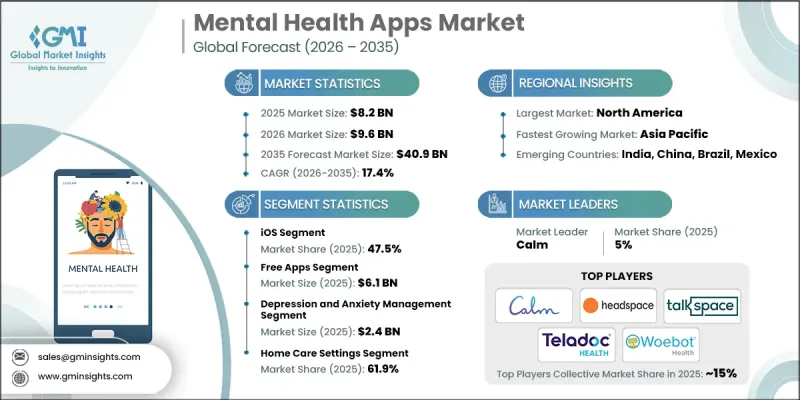
이러한 성장은 정신 건강 질환의 유병률 증가와 가상 치료 솔루션에 대한 수용성 증가에 의해 주도되고 있습니다. 정신건강과 조기 개입의 중요성에 대한 인식이 높아지면서 시장 확대에 더욱 박차를 가하고 있습니다. 디지털 플랫폼을 통해 사용자는 보다 편리하고 확장 가능한 방식으로 치료, 자가 관리 도구, 행동 지원에 접근할 수 있습니다. 인공지능, 대화형 채팅 시스템, 디지털 치료 모델과 같은 첨단 기술의 통합으로 사용자 참여와 개인화가 향상되고 있습니다. 또한, 고용주들은 직원들의 웰빙을 지원하기 위해 디지털 정신건강 도구를 통합한 체계적인 웰니스 프로그램을 점점 더 많이 도입하고 있습니다. 또한, 예방적 치료 접근 방식과 자기 주도적 정신 건강 관행이 주목을 받으면서 다양한 사용자층에서 도입을 더욱 촉진하고 있습니다. 이러한 요인들이 복합적으로 작용하여 정신건강 용도는 현대의 헬스케어 생태계에서 필수적인 요소로 자리매김하고 있습니다.
| 시장 범위 | |
|---|---|
| 시작 연도 | 2025년 |
| 예측 기간 | 2026-2035년 |
| 시작 연도 시장 규모 | 82억 달러 |
| 예측 규모 | 409억 달러 |
| CAGR | 17.4% |
2025년 iOS 부문은 47.5%의 점유율을 차지했습니다. 이러한 선도적 지위는 스마트폰의 높은 보급률과 사용자들의 높은 디지털 참여도가 뒷받침하고 있습니다. 생태계의 안정적인 성능, 강화된 프라이버시 기능, 웨어러블 기기와의 원활한 연동이 높은 보급률에 기여하고 있습니다. 이러한 환경에서는 구독형 모델이 널리 선호되고 있으며, 지속적인 사용자 참여를 유도하고 있습니다. 또한, 개발자들은 이 플랫폼의 일관된 성능 능력과 사용자 경험의 높은 품질로 인해 프리미엄급 웰니스 앱이나 임상 지향적인 앱을 우선적으로 개발하는 경향이 있습니다.
무료 앱 부문은 광범위한 가용성과 광범위한 사용자 기반에 힘입어 2025년 61억 달러의 수익을 창출했습니다. 이러한 용도는 경제적 장벽 없이 정신 건강 지원을 제공하기 때문에 다양한 소득 계층의 사람들이 이용할 수 있습니다. 무료 솔루션의 가용성은 특히 초기 또는 보조적인 정신 건강 지원을 원하는 사용자들 사이에서 더 높은 보급률을 촉진하고 있습니다. 이 저렴한 가격 요소는 시장 전체에 대한 도달 범위를 넓히고 다양한 계층의 사용자 참여를 높이는 데 중요한 역할을 하고 있습니다.
2025년 북미 정신건강 앱 시장은 57.6%의 점유율을 차지했습니다. 이 지역에서는 불안장애, 우울증, 약물 사용 관련 장애와 같은 정신 건강 질환의 발병률이 높으며, 이는 디지털 솔루션에 대한 수요를 견인하고 있습니다. 정신 건강 관리에 대한 인식과 수용도가 높아지면서 시장 확대에 더욱 박차를 가하고 있습니다. 또한, 디지털 헬스케어 도구에 대한 신뢰가 높아지면서 일반 소비자와 의료 전문가 모두 디지털 헬스케어 도구의 사용 확대가 촉진되고 있습니다. 기술을 활용한 의료 서비스 제공으로의 전환은 지역 전체의 정신건강을 지원하는 데 있어 모바일 애플리케이션의 역할을 강화하고 있습니다.
자주 묻는 질문
목차
제1장 조사 방법
제2장 주요 요약
제3장 업계 인사이트
제4장 경쟁 구도
제5장 시장 추산 및 예측 : 플랫폼 유형별, 2022-2035년
제6장 시장 추산 및 예측 : 수익 모델별, 2022-2035년
제7장 시장 추산 및 예측 : 용도별, 2022-2035년
제8장 시장 추산 및 예측 : 최종 용도별, 2022-2035년
제9장 시장 추산 및 예측 : 지역별, 2022-2035년
제10장 기업 개요
JHS 26.05.29The Global Mental Health Apps Market was valued at USD 8.2 billion in 2025 and is estimated to grow at a CAGR of 17.4% to reach USD 40.9 billion by 2035.
Growth is driven by the increasing prevalence of mental health conditions and the rising acceptance of virtual therapy solutions. Greater awareness of mental well-being and the importance of early intervention is further supporting market expansion. Digital platforms enable users to access therapy, self-care tools, and behavioral support in a more convenient and scalable manner. The integration of advanced technologies such as artificial intelligence, conversational chat systems, and digital therapeutic models is improving user engagement and personalization. Employers are also increasingly adopting structured wellness programs that incorporate digital mental health tools to support workforce well-being. Additionally, preventive care approaches and self-guided mental wellness practices are gaining traction, further strengthening adoption across diverse user groups. These combined factors are positioning mental health applications as an essential component of modern healthcare ecosystems.
| Market Scope | |
|---|---|
| Start Year | 2025 |
| Forecast Year | 2026-2035 |
| Start Value | $8.2 Billion |
| Forecast Value | $40.9 Billion |
| CAGR | 17.4% |
The iOS segment held a share of 47.5% in 2025. This leadership is supported by strong smartphone penetration and high digital engagement among users. The ecosystem's stable performance, enhanced privacy features, and seamless integration with wearable devices contribute to its strong adoption. Subscription-based models are widely supported within this environment, encouraging sustained user engagement. Developers also tend to prioritize premium wellness and clinically oriented applications for this platform due to its consistent performance capabilities and user experience quality.
The free apps segment generated USD 6.1 billion in 2025, supported by its wide accessibility and broad user base. These applications provide mental health support without financial barriers, making them accessible to individuals across different income groups. The availability of no-cost solutions encourages higher adoption rates, particularly among users seeking initial or supplementary mental health support. This affordability factor plays a key role in expanding overall market reach and increasing user engagement across diverse populations.
North America Mental Health Apps Market accounted for a 57.6% share in 2025. The region's high incidence of mental health conditions, including anxiety, depression, and substance-related disorders, is driving demand for digital solutions. Increasing awareness and acceptance of mental health care are further supporting market expansion. In addition, growing confidence in digital healthcare tools is encouraging wider adoption among both consumers and healthcare professionals. The shift toward technology-enabled care delivery is reinforcing the role of mobile applications in supporting mental wellness across the region.
Key companies operating in the Global Mental Health Apps Market include Calm, Headspace Inc., Talkspace, Teladoc Health, Inc., Woebot, Wysa, Spring Health, BetterSleep, Fabulous, 7 Cups of Tea, Youper, Inc., Mindscape, Dario Mind, MoodMission Pty Ltd., and rhope. Companies in the Mental Health Apps Market are strengthening their competitive position through technological advancement, strategic partnerships, and user-focused innovation. They are integrating artificial intelligence and machine learning capabilities to enhance personalization and improve user engagement. Many players are expanding their service offerings by introducing subscription-based models and premium wellness features. Collaborations with healthcare providers and corporate organizations are helping increase adoption across institutional channels. In addition, companies are focusing on improving data security and privacy standards to build user trust. Expansion into emerging markets and continuous product updates are further supporting growth, while investment in digital therapeutics and behavioral health solutions is enhancing long-term market positioning.
Table of Contents
Chapter 1 Research Methodology
- 1.1 Research approach
- 1.2 Quality commitments
- 1.2.1 GMI AI policy & data integrity commitment
- 1.2.1.1 Source consistency protocol
- 1.2.1 GMI AI policy & data integrity commitment
- 1.3 Research trail & confidence scoring
- 1.3.1 Research trail components
- 1.3.2 Scoring components
- 1.4 Data collection
- 1.4.1 Partial list of primary sources
- 1.5 Data mining sources
- 1.5.1 Paid sources
- 1.5.1.1 Sources, by region
- 1.5.1 Paid sources
- 1.6 Base estimates and calculations
- 1.6.1 Base year calculation
- 1.7 Forecast model
- 1.7.1 Quantified market impact analysis
- 1.7.1.1 Mathematical impact of growth parameters on forecast
- 1.7.1 Quantified market impact analysis
- 1.8 Research transparency addendum
- 1.8.1 Source attribution framework
- 1.8.2 Quality assurance metrics
- 1.8.3 Our commitment to trust
Chapter 2 Executive Summary
- 2.1 Industry 360° synopsis
- 2.2 Key market trends
- 2.2.1 Regional trends
- 2.2.2 Platform type trends
- 2.2.3 Revenue model trends
- 2.2.4 Application trends
- 2.2.5 End use trends
- 2.3 CXO perspectives: Strategic imperatives
Chapter 3 Industry Insights
- 3.1 Industry ecosystem analysis
- 3.2 Industry impact forces
- 3.2.1 Growth drivers
- 3.2.1.1 Growing adoption of virtual therapy for mental health
- 3.2.1.2 Increasing awareness regarding mental health
- 3.2.1.3 Rise in target population suffering from mental conditions
- 3.2.2 Industry pitfalls and challenges
- 3.2.2.1 Data privacy and connectivity issues
- 3.2.3 Opportunities
- 3.2.3.1 Integration with wearable and biometric data
- 3.2.3.2 Corporate wellness and B2B mental health platforms
- 3.2.1 Growth drivers
- 3.3 Growth potential analysis
- 3.4 Regulatory landscape (Driven by Primary Research)
- 3.4.1 North America
- 3.4.2 Europe
- 3.4.3 Asia Pacific
- 3.5 Technology and innovation landscape
- 3.5.1 Current technological trends
- 3.5.2 Emerging technologies
- 3.6 Future market trends (Driven by Primary Research)
- 3.7 Pricing analysis, 2025 (Driven by Primary Research)
- 3.8 Impact of AI & generative AI on the market (Driven by Primary Research)
- 3.8.1 AI-driven disruption of existing business models
- 3.8.2 GenAI use cases & adoption roadmap by segment
- 3.9 Reimbursement scenario
- 3.10 Start-up scenario
- 3.11 Gap analysis
- 3.12 Porter's analysis
- 3.13 PESTEL analysis
Chapter 4 Competitive Landscape, 2025
- 4.1 Introduction
- 4.2 Company matrix analysis
- 4.3 Company market share analysis (Driven by Primary Research)
- 4.3.1 Global
- 4.3.2 North America
- 4.3.3 Europe
- 4.3.4 Asia Pacific
- 4.4 Competitive analysis of major market players
- 4.5 Competitive positioning matrix
- 4.6 Key developments
- 4.6.1 Mergers & acquisitions
- 4.6.2 Partnerships & collaborations
- 4.6.3 New product launches
- 4.6.4 Expansion plans
Chapter 5 Market Estimates and Forecast, By Platform Type, 2022 - 2035 ($ Mn)
- 5.1 Key trends
- 5.2 iOS
- 5.3 Android
- 5.4 Other platform type
Chapter 6 Market Estimates and Forecast, By Revenue Model, 2022 - 2035 ($ Mn)
- 6.1 Key trends
- 6.2 Free apps
- 6.3 Subscription-based
Chapter 7 Market Estimates and Forecast, By Application, 2022 - 2035 ($ Mn)
- 7.1 Key trends
- 7.2 Depression and anxiety management
- 7.3 Meditation management
- 7.4 Stress management
- 7.5 Wellness management
- 7.6 Other applications
Chapter 8 Market Estimates and Forecast, By End Use, 2022 - 2035 ($ Mn)
- 8.1 Key trends
- 8.2 Home care settings
- 8.3 Mental hospitals
- 8.4 Other end users
Chapter 9 Market Estimates and Forecast, By Region, 2022 - 2035 ($ Mn)
- 9.1 Key trends
- 9.2 North America
- 9.2.1 U.S.
- 9.2.2 Canada
- 9.3 Europe
- 9.3.1 Germany
- 9.3.2 UK
- 9.3.3 France
- 9.3.4 Spain
- 9.3.5 Italy
- 9.3.6 Netherlands
- 9.4 Asia Pacific
- 9.4.1 China
- 9.4.2 Japan
- 9.4.3 India
- 9.4.4 Australia
- 9.4.5 South Korea
- 9.5 Latin America
- 9.5.1 Brazil
- 9.5.2 Mexico
- 9.5.3 Argentina
- 9.6 MEA
- 9.6.1 South Africa
- 9.6.2 Saudi Arabia
- 9.6.3 UAE
Chapter 10 Company Profiles
- 10.1 7 cups of Tea
- 10.2 BetterSleep
- 10.3 Calm
- 10.4 Dario Mind
- 10.5 Fabulous
- 10.6 Headspace Inc.
- 10.7 Mindscape
- 10.8 MoodMission Pty Ltd.
- 10.9 rhope
- 10.10 Spring Health
- 10.11 Talkspace
- 10.12 Teladoc Health, Inc.
- 10.13 Woebot
- 10.14 Wysa
- 10.15 Youper, Inc.


