

|
시장보고서
상품코드
2116487
정신건강 앱 : 시장 점유율 분석, 업계 동향 및 통계, 성장 예측(2026-2031년)Mental Health Apps - Market Share Analysis, Industry Trends & Statistics, Growth Forecasts (2026 - 2031) |
||||||
 Mordor Intelligence
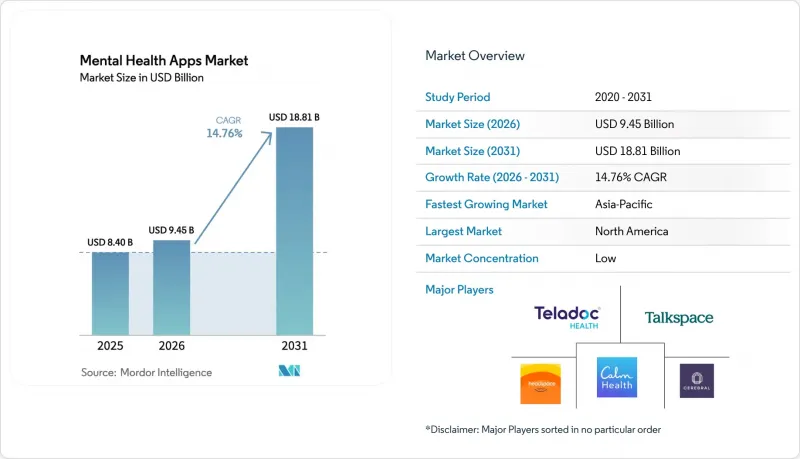
Mordor Intelligence에 의하면, 정신건강 앱 시장 규모는 2025년에 84억 달러로 평가되었습니다. 2026년 94억 5,000만 달러에서 2031년까지 188억 1,000만 달러에 이를 것으로 예상되며, 예측 기간(2026-2031년) CAGR은 14.76%를 나타낼 전망입니다.
본 보고서는 플랫폼(iOS, Android, 크로스 플랫폼/하이브리드, 웨어러블 퍼스트), 용도(우울증·불안 장애 관리 등), 최종 사용자(재택 간호/개인 등),연령대(17세 이하 아동·청소년 등), 구독 모델(프리미엄 등), 지역(북미 등)별로 분류되어 있습니다. 시장 예측은 금액(달러) 기준으로 제시되어 있습니다.
세계의 정신건강 앱 시장 동향 및 인사이트
전 세계적으로 증가하는 불안 및 우울증의 부담
10억 명 이상이 정신 질환을 앓으며 생활하고 있으며, 치료 격차는 여전히 큰 상태입니다. 2024년 미국 조사에 따르면, 성인의 19%가 우울증이나 불안을 호소했으며, 고등학생의 42%가 지속적인 슬픔을 느끼고 있는 것으로 나타났습니다. 미국에서는 8,000개 지역에서 충분한 전문가가 부족하여 1억 6,700만 명의 주민이 적절한 치료를 받지 못하고 있습니다. 현재 경증의 경우, 앱 기반의 인지행동치료(CBT)가 대면 치료와 동등한 효과를 가진다는 것이 입증되었습니다. 검증된 성과에 힘입어 해당 앱은 보험 적용 목록에 추가되었으며, 충족되지 않은 수요가 확대되고 있는 정신건강 앱 시장으로 전환되고 있습니다.
스마트폰 보급률과 앱 스토어 유통 규모
2024년까지 인도의 스마트폰 보유율은 52%, 인도네시아는 68%에 달했습니다. 앱 스토어를 통해 개발자는 최소한의 한계 비용으로 신규 사용자에게 접근할 수 있으며, 매주 업데이트를 통해 기능 개선 주기가 가속화되고 있습니다. ‘Wysa’는 500만 명의 사용자를 확보했으며, 인도의 주요 병원 시스템에 챗봇을 통합했습니다. 일본의 공공 캠페인으로 인해 ‘Awarefy’와 ‘Emol’에 대한 수요가 증가했습니다. 신속한 피드백 루프 덕분에 개별 디지털 컨텐츠의 이탈률이 감소하면서 전 세계 정신건강 앱 시장이 확대되고 있습니다.
규제상 분류의 모호성과 증거 기준
FDA는 정신건강 분야에서 처방전이 필요한 디지털 치료제를 단 2개만 승인했으며, 이들 모두 Pear Therapeutics사의 파산 이후 시장에서 철수했습니다. 독일의 DiGA 디렉토리에는 2024년 말 기준으로 53개의 보험 적용 대상 앱이 등록되어 있었으나, 각 앱은 1년 이내에 무작위 대조 시험을 통해 그 효능을 입증해야 합니다. 규제의 파편화로 인해 여러 국가에 걸쳐 신청을 해야 하는 상황이 발생하고 있으며, 그 비용은 최대 100만 달러에 달하기도 합니다. 소규모 개발자들은 이러한 요건으로 인해 어려움을 겪고 있어, 근거에 기반한 신제품 출시가 지연되고, 정신건강 앱 시장의 성장이 둔화되고 있습니다.
부문별 분석
2025년, iOS는 사용자 1인당 평균 수익이 높고 강력한 개인정보 보호 기능을 갖추고 있어 정신건강 앱 시장에서 52.63%의 점유율을 차지했습니다. 안드로이드는 인도, 인도네시아, 중국이 현재 신규 스마트폰 사용자의 대부분을 차지하고 있기 때문에 연평균 성장률(CAGR) 17.45%로 성장할 전망입니다. 크로스 플랫폼 프레임워크는 구축 비용을 절감해 주지만, 사용자 참여를 높이는 네이티브 기능은 부족합니다. 웨어러블 기기를 우선시한 설계는 여전히 틈새 시장 수준이지만, 수동적 추적의 유효성을 입증하고 있습니다. 이러한 동향들이 맞물리면서 정신건강 앱 시장은 다양화되고 있습니다.
애플의 기기 내 AI는 데이터를 암호화하여 기업의 리스크 관리 팀의 요구 사항을 충족시키기 때문에 기업용 프로그램에서의 채택이 확대되고 있습니다. 구글의 Health Connect 역시 안드로이드용으로 유사한 개인정보 보호 정책을 채택하고 있습니다. 유료 전환율은 여전히 iOS가 더 높지만, 안드로이드에서는 기업의 지원이 그 격차를 메우고 있습니다. 플랫폼 전략이 정신건강 앱 시장 전체의 수익화 방향을 결정하게 될 것입니다.
2025년에는 Sleepio와 Daylight가 FDA의 510(k) 승인을 획득함에 따라, 우울증 및 불안 장애용 도구가 정신건강 앱 시장의 30.13% 점유율을 차지했습니다. 고용주들이 결근률 억제를 목적으로 마음챙김을 도입하는 추세에 따라, 스트레스 관리 앱 시장 규모는 연평균 성장률(CAGR) 16.34%로 확대될 것으로 예측됩니다. 명상 앱은 무료 컨텐츠와의 경쟁에 직면한 반면, 수면 솔루션은 웨어러블 기기의 데이터를 활용하고 있습니다. 약물 남용 및 PTSD를 위한 앱은 여전히 수요가 충족되지 않아, 정신건강 앱 시장에는 미개척 영역이 남아 있습니다.
예방 도구에 대한 고용주 수요로 인해 스트레스 관리 앱은 기존의 명상 앱들을 능가하는 성장세를 보이고 있습니다. Apple Watch나 Fitbit의 수면 점수와의 연동이 사용자 참여의 기반이 되고 있습니다. Pear사의 철수 이후 약물 사용 관리 분야의 파이프라인이 제한적이라는 점은 실적이 입증된 신규 진출기업들에게 인수 기회를 시사하고 있습니다. 섭식 장애 지원과 같은 틈새 분야에서는 행동을 악화시키지 않도록 신중한 설계가 필요하지만, 이러한 분야는 여전히 정신건강 앱 업계 전체의 일부를 차지하고 있습니다.
지역별 분석
북미는 2025년 전 세계 매출의 37.56%를 차지했습니다. 이는 고용주들의 광범위한 도입과, 2025년 CMS 코드가 디지털 치료 세션에 대한 보험 급여를 허용한 데 힘입은 결과입니다. 자가 보험에 가입한 기업들이 보험금 청구를 억제하기 위해 Spring Health와 Lyra Health를 도입한 결과, 미국에서만 이 지역의 매출의 85%를 차지했습니다. 캐나다와 멕시코는 지급 기관의 시스템이 세분화되어 있어 환급 절차가 복잡해지면서 뒤처지고 있지만, Dialogue Health Technologies는 2024년에 캐나다 고용주를 대상으로 한 정신건강 서비스 제공을 확대했습니다. 애플의 개인정보 보호 정책으로 인한 CAC(고객 획득 비용) 상승이 소비자 대상(DTC) 사업의 이익률을 압박한 반면, 기업용 채널이 정신건강 앱 시장의 성장을 뒷받침했습니다.
아시아태평양은 2031년까지 연평균 성장률(CAGR) 17.55%를 기록하며, 지역별로는 가장 빠른 성장세를 보일 것으로 예측됩니다. 스마트폰의 보급과 낙인 해소 캠페인이 인도, 인도네시아, 중국에서의 도입을 촉진하고 있습니다. Wysa는 Apollo 및 Manipal 병원과 제휴하여 챗봇을 임상 치료에 통합하고 있으며, 일본 정부의 이니셔티브로 Awarefy와 Emol의 이용이 촉진되었습니다. 한국에서는 국민건강보험공단을 통한 보험급여 시범 운영이 이루어졌습니다. 익명성은 문화적 편견을 해소하고 이용률을 높여, 정신건강 앱 시장을 확대시키고 있습니다.
유럽에서는 독일의 DiGA 제도가 주도적인 역할을 하고 있으며, 53개의 앱이 보험 적용 대상이 되었습니다. 프랑스의 ‘Forfait Innovation’은 도구에 대한 승인을 진행하고 있지만, 고정 가격 책정이 없어 보급 속도는 둔화되고 있습니다. 영국의 NHS Apps Library는 안전성과 개인정보 보호 기준을 정하고 있으나, 브렉시트 이후 제도의 차이로 인해 중복 현상이 발생하고 있습니다. 북유럽에서는 디지털 문해력이 높아 도입이 가속화되고 있는 반면, 지중해 지역이나 동유럽에서는 진전이 더딘 임베디드니다. 유럽 이외의 지역에서는 브라질과 일부 중동 시장에서 새로운 프로그램이 시작되어 초기 관심을 보이고 있으나, 인프라 격차로 인해 정신건강 앱 시장에 대한 단기적인 기여는 제한적입니다.
기타 혜택 :
- 엑셀 형식 시장 예측(ME) 시트
- 3개월간의 애널리스트 지원
자주 묻는 질문
목차
제1장 서론
제2장 조사 방법
제3장 개요
제4장 시장 구도
제5장 시장 규모 및 성장 예측
제6장 경쟁 구도
제7장 시장 기회 및 향후 전망
KTH 26.08.31According to Mordor Intelligence, the mental health apps market size was valued at USD 8.40 billion in 2025 and is estimated to grow from USD 9.45 billion in 2026 to reach USD 18.81 billion by 2031, at a CAGR of 14.76% during the forecast period (2026-2031).
This report is Segmented by Platform (iOS, Android, Cross-platform/Hybrid, Wearables-First), Application (Depression & Anxiety Management, and More), End User (Homecare/Individuals, and More), Age Group (Children & Adolescents <=17, and More), Subscription Model (Freemium, and More), and Geography (North America, and More). The Market Forecasts are Provided in Terms of Value (USD).
Global Mental Health Apps Market Trends and Insights
Rising Burden Of Anxiety And Depression Globally
More than 1 billion people live with a mental disorder, and treatment gaps stay wide. U.S. surveys in 2024 showed 19% of adults reported depression and anxiety, while 42% of high-school students felt persistently sad. Eight thousand U.S. regions lacked enough professionals, leaving 167 million residents underserved. Evidence now places app-based CBT on par with face-to-face therapy for mild cases. Validated results move apps onto payer formularies, converting unmet need into the expanding mental health apps market.
Smartphone Penetration And App-Store Distribution Scale
Smartphone ownership reached 52% in India and 68% in Indonesia by 2024. App stores let developers reach new users at minimal marginal cost and update weekly, speeding feature iteration. Wysa gained 5 million users and embedded its chatbot in leading Indian hospital systems. Japanese public campaigns raised demand for Awarefy and Emol. Fast feedback loops cut the attrition that plagues stand-alone digital content and enlarge the global mental health apps market.
Regulatory Classification Ambiguity And Evidence Thresholds
The FDA cleared only two prescription digital therapeutics for mental health, and both left the market after Pear Therapeutics' bankruptcy. Germany's DiGA directory contained 53 reimbursable apps by late 2024, each needing randomized trial proof within a year. Fragmented rules force multi-country filings that can cost up to USD 1 million. Small developers struggle with these demands, slowing new evidence-grade launches and tempering growth in the mental health apps market.
Other drivers and restraints analyzed in the detailed report include:
- Employer And Payer Adoption Of Digital Mental Health Benefits
- AI Chatbots And CBT Personalization Improving Access And Outcomes
- Data Privacy And Cybersecurity Risks Erode Trust
For complete list of drivers and restraints, kindly check the Table Of Contents.
Segment Analysis
iOS held 52.63% of mental health apps market share in 2025 due to higher average revenue per user and strong privacy controls. Android is set to grow at a 17.45% CAGR because India, Indonesia, and China now supply most new smartphone users. Cross-platform frameworks cut build costs yet miss native features that deepen engagement. Wearables-first designs stay niche but validate passive tracking. Together these trends diversify the mental health apps market.
Apple's on-device AI encrypts data and satisfies employer risk teams, boosting adoption in corporate programs. Google's Health Connect mirrors this privacy stance for Android. Paid conversion remains stronger on iOS, yet enterprise sponsorship is bridging the gap on Android. Platform strategies will determine monetization pathways across the mental health apps market.
Depression and anxiety tools captured 30.13% of the mental health apps market share in 2025 on the back of FDA 510(k) clearances for Sleepio and Daylight. Stress management apps are projected to rise at a 16.34% CAGR as employers bundle mindfulness to curb absenteeism. Meditation apps face free-content competition, while sleep solutions benefit from wearable data. Substance use and PTSD apps remain underserved, leaving white space within the mental health apps market.
Employer demand for preventive tools helps stress apps outpace legacy meditation catalogs. Integration with Apple Watch and Fitbit sleep scores anchors engagement. The limited pipeline for substance use care after Pear's exit signals an acquisition opportunity for validated newcomers. Niches such as eating disorder support need careful design to avoid triggering behaviors, yet they remain part of the broader mental health apps industry.
Complete Report Scope:
- By Platform Type
- iOS
- Android
- Web/Progressive Web Apps
- Others (Wearable-first, Voice-only)
- By Application
- Depression and Anxiety Management
- Stress Management
- Meditation and Mindfulness
- Sleep and Wellness Improvement
- Substance-Use Disorder Support
- Other Applications
- By End User
- Home-care Settings
- Employers and Corporate Wellness Programs
- Mental Hospitals and Clinics
- Schools and Universities
- Other End Users
- By Age Group
- Children and Adolescents (<=17 yrs)
- Adults (18-64 yrs)
- Geriatric (65+ yrs)
- By Geography
- North America
- United States
- Canada
- Mexico
- Europe
- Germany
- United Kingdom
- France
- Italy
- Spain
- Rest of Europe
- Asia-Pacific
- China
- Japan
- India
- Australia
- South Korea
- Rest of Asia-Pacific
- Middle East and Africa
- GCC
- South Africa
- Rest of Middle East and Africa
- South America
- Brazil
- Argentina
- Rest of South America
- North America
Geography Analysis
North America produced 37.56% of global revenue in 2025, fueled by wide employer adoption and the 2025 CMS codes that reimburse digital therapy sessions. The United States alone delivered 85% of the region's value as self-insured firms adopted Spring Health and Lyra Health to curb claims. Canada and Mexico trail because fragmented payor systems complicate reimbursement, though Dialogue Health Technologies expanded mental health offerings for Canadian employers in 2024. CAC inflation from Apple privacy policies squeezed direct-to-consumer margins, yet enterprise channels kept the mental health apps market growing.
Asia-Pacific is projected to post the fastest regional expansion at a 17.55% CAGR through 2031. Smartphone ownership and destigmatization campaigns push adoption in India, Indonesia, and China. Wysa's partnerships with Apollo and Manipal hospitals integrate chatbots into clinical care, while Japanese government initiatives boosted use of Awarefy and Emol. South Korea piloted reimbursement through the National Health Insurance Service. Anonymity addresses cultural stigma, lifting participation and enlarging the mental health apps market.
Europe is led by Germany's DiGA pathway with 53 reimbursable apps. France's Forfait Innovation approves tools but lacks fixed pricing, slowing roll-out. The U.K. NHS Apps Library sets safety and privacy standards, yet post-Brexit divergence adds duplication. Northern Europe's high digital literacy speeds adoption, while the Mediterranean and Eastern regions advance slowly. Outside Europe, emerging programs in Brazil and select Middle East markets signal early interest, but infrastructure gaps limit near-term contribution to the mental health apps market.
- Calm.com Inc.
- Headspace Health
- BetterHelp (Teladoc Health)
- Talkspace Inc.
- Sanvello Health Inc.
- Wysa Ltd.
- Happify Health
- MoodMission
- Youper
- K Health
- CVS Health (Aetna Inc.)
- Lyra Health
- Spring Health
- Big Health (Sleepio)
- Unmind Ltd.
- Inner Explorer Inc.
- Insight Timer
- MoodTools
- TimelyCare
- MindDoc Health GmbH
- Kintsugi
Additional Benefits:
- The market estimate (ME) sheet in Excel format
- 3 months of analyst support
TABLE OF CONTENTS
1 Introduction
- 1.1 Study Assumptions & Market Definition
- 1.2 Scope of the Study
2 Research Methodology
3 Executive Summary
4 Market Landscape
- 4.1 Market Overview
- 4.2 Market Drivers
- 4.2.1 Rising global prevalence of anxiety, depression & stress disorders
- 4.2.2 Surge in smartphone penetration & 5G connectivity enabling on-demand care
- 4.2.3 Growing clinical & payer acceptance of tele-mental-health solutions
- 4.2.4 Growing Awareness Pertaining to the Importance of Mental Health
- 4.2.5 Expanding corporate wellness and insurance reimbursement programs
- 4.2.6 Technological advancements and AI Integration
- 4.3 Market Restraints
- 4.3.1 Ambiguous regulatory classification & evidence requirements across regions
- 4.3.2 Data-privacy and cybersecurity concerns undermining user trust
- 4.3.3 Market saturation with low-quality apps diluting clinical credibility
- 4.3.4 Low engagement and high dropout rates
- 4.4 Technological Outlook
- 4.5 Porter's Five Forces Analysis
- 4.5.1 Threat of New Entrants
- 4.5.2 Bargaining Power of Buyers/Consumers
- 4.5.3 Bargaining Power of Suppliers
- 4.5.4 Threat of Substitute Products
- 4.5.5 Intensity of Competitive Rivalry
5 Market Size & Growth Forecasts (Value)
- 5.1 By Platform Type
- 5.1.1 iOS
- 5.1.2 Android
- 5.1.3 Web/Progressive Web Apps
- 5.1.4 Others (Wearable-first, Voice-only)
- 5.2 By Application
- 5.2.1 Depression and Anxiety Management
- 5.2.2 Stress Management
- 5.2.3 Meditation and Mindfulness
- 5.2.4 Sleep and Wellness Improvement
- 5.2.5 Substance-Use Disorder Support
- 5.2.6 Other Applications
- 5.3 By End User
- 5.3.1 Home-care Settings
- 5.3.2 Employers and Corporate Wellness Programs
- 5.3.3 Mental Hospitals and Clinics
- 5.3.4 Schools and Universities
- 5.3.5 Other End Users
- 5.4 By Age Group
- 5.4.1 Children and Adolescents (<=17 yrs)
- 5.4.2 Adults (18-64 yrs)
- 5.4.3 Geriatric (65+ yrs)
- 5.5 By Geography
- 5.5.1 North America
- 5.5.1.1 United States
- 5.5.1.2 Canada
- 5.5.1.3 Mexico
- 5.5.2 Europe
- 5.5.2.1 Germany
- 5.5.2.2 United Kingdom
- 5.5.2.3 France
- 5.5.2.4 Italy
- 5.5.2.5 Spain
- 5.5.2.6 Rest of Europe
- 5.5.3 Asia-Pacific
- 5.5.3.1 China
- 5.5.3.2 Japan
- 5.5.3.3 India
- 5.5.3.4 Australia
- 5.5.3.5 South Korea
- 5.5.3.6 Rest of Asia-Pacific
- 5.5.4 Middle East and Africa
- 5.5.4.1 GCC
- 5.5.4.2 South Africa
- 5.5.4.3 Rest of Middle East and Africa
- 5.5.5 South America
- 5.5.5.1 Brazil
- 5.5.5.2 Argentina
- 5.5.5.3 Rest of South America
- 5.5.1 North America
6 Competitive Landscape
- 6.1 Market Concentration
- 6.2 Market Share Analysis
- 6.3 Company profiles (includes Global level Overview, Market level overview, Core Segments, Financials as available, Strategic Information, Market Rank/Share for key companies, Products & Services, and Recent Developments)
- 6.3.1 Calm.com Inc.
- 6.3.2 Headspace Health
- 6.3.3 BetterHelp (Teladoc Health)
- 6.3.4 Talkspace Inc.
- 6.3.5 Sanvello Health Inc.
- 6.3.6 Wysa Ltd.
- 6.3.7 Happify Health
- 6.3.8 MoodMission
- 6.3.9 Youper Inc.
- 6.3.10 K Health Inc.
- 6.3.11 CVS Health (Aetna Inc.)
- 6.3.12 Lyra Health Inc.
- 6.3.13 Spring Health
- 6.3.14 Big Health (Sleepio)
- 6.3.15 Unmind Ltd.
- 6.3.16 Inner Explorer Inc.
- 6.3.17 Insight Timer
- 6.3.18 MoodTools
- 6.3.19 TimelyCare
- 6.3.20 MindDoc Health GmbH
- 6.3.21 Kintsugi
7 Market Opportunities & Future Outlook
- 7.1 White-space & Unmet-Need Assessment


