|
시장보고서
상품코드
2038411
직장 웰니스 시장 기회, 성장요인, 업계 동향 분석 및 예측(2026-2035년)Workplace Wellness Market Opportunity, Growth Drivers, Industry Trend Analysis, and Forecast 2026 - 2035 |
||||||

세계의 직장 웰니스 시장은 2025년에 561억 달러로 평가되었고 CAGR 5.2%로 성장하여 2035년까지 922억 달러에 이를 것으로 추정되고 있습니다.
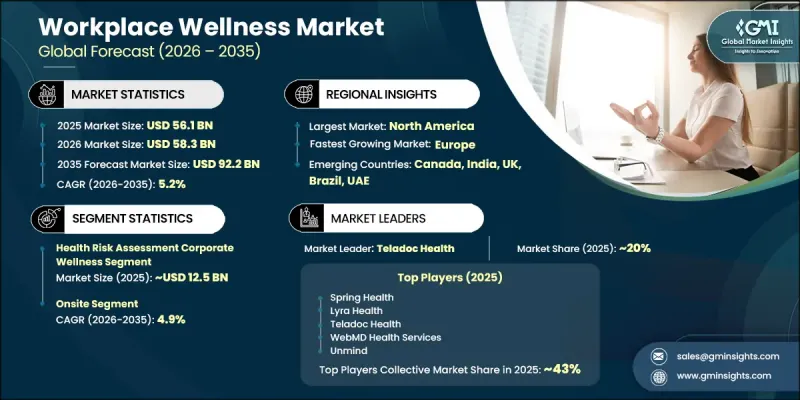
신흥 경제권의 조직들이 사업 규모를 확장하고 점점 더 복잡해지는 노동력의 요구를 충족시키기 위해 노력하는 가운데, 직장 웰니스 산업은 꾸준히 성장하고 있습니다. 기업들은 생산성 유지, 결근, 이직, 의료비 증가에 따른 비용 절감을 위해 직원들의 건강 유지를 더욱 중요하게 여기고 있습니다. 이러한 변화로 인해 기업들은 신체적 건강을 지원하고, 균형 잡힌 라이프스타일을 장려하며, 직원 전체의 웰빙을 강화할 수 있도록 설계된 체계적인 웰니스 정책에 대한 투자를 촉진하고 있습니다. 조직이 확장됨에 따라 회복탄력성과 몰입도를 겸비한 인력 구축에 대한 관심이 높아지면서 웰니스 전략이 기업 문화에 깊숙이 자리 잡게 되었습니다. 이러한 노력은 직원들의 사기 진작과 근속률 향상, 그리고 업무 만족도 향상에 기여하고 있습니다. 동시에, 장시간 근로와 가혹한 업무가 산업을 불문하고 직원의 성과, 집중력, 몰입도에 영향을 미치고 있는 가운데, 직장 내 압박감과 정신건강에 대한 우려는 고용주들의 전략에 영향을 미치고 있습니다.
| 시장 범위 | |
|---|---|
| 시작 연도 | 2025년 |
| 예측 기간 | 2026-2035년 |
| 시작 연도 시장 규모 | 561억 달러 |
| 예측 규모 | 922억 달러 |
| CAGR | 5.2% |
건강 위험 평가 부문은 2025년 125억 달러 시장 규모를 기록했고, 2026년부터 2035년까지 연평균 6.3%의 성장률을 보일 것으로 전망됩니다. 이러한 솔루션을 통해 고용주는 잠재적인 건강 문제를 조기에 발견하고, 측정 가능한 결과를 바탕으로 타겟팅된 웰니스 프로그램을 설계할 수 있습니다. 조직은 의사결정 개선, 투자 배분 최적화, 그리고 웰니스 정책의 구체적인 성과 증명으로 이어지는 데이터 중심의 접근 방식을 점점 더 많이 채택하고 있습니다.
현장 제공 모델은 2025년 53%의 점유율을 차지했고 2035년까지 연평균 복합 성장률(CAGR) 4.9%를 나타낼 것으로 예측됩니다. 이 모델을 통해 직원들은 직장 내에서 편리하게 웰니스 서비스를 이용할 수 있어 참여율과 몰입도를 높일 수 있습니다. 웰니스 활동을 일상 업무에 원활하게 통합함으로써 조직은 일관된 웰빙 문화를 조성하고 장기적인 행동 변화와 직원 만족도를 향상시킬 수 있습니다.
미국 직장 웰니스 시장은 2025년 103억 달러 규모에 달했으며, 2026년부터 2035년까지 연평균 5.9%의 성장률을 보일 것으로 전망됩니다. 시장 성장은 의료비 증가와 장기적인 비용 절감을 위한 예방적 의료 전략에 대한 고용주들의 관심이 높아짐에 따라 주도되고 있습니다. 정신 건강, 생활습관병 및 직원들의 웰빙에 대한 인식이 높아짐에 따라, 조직은 종합적이고 개별화된 지원 시스템을 원하는 직원들의 변화하는 기대에 부응하기 위해 웰빙 프로그램을 광범위하게 도입하고 있습니다.
자주 묻는 질문
목차
제1장 조사 방법과 범위
제2장 주요 요약
제3장 업계 인사이트
제4장 경쟁 구도
제5장 시장 추산 및 예측 : 서비스별, 2022-2035년
제6장 시장 추산 및 예측 : 카테고리별, 2022-2035년
제7장 시장 추산 및 예측 : 최종 사용자별, 2022-2035년
제8장 시장 추산 및 예측 : 제공 형태별, 2022-2035년
제9장 시장 추산 및 예측 : 지역별, 2022-2035년
제10장 기업 개요
JHS 26.05.29The Global Workplace Wellness Market was valued at USD 56.1 billion in 2025 and is estimated to grow at a CAGR of 5.2% to reach USD 92.2 billion by 2035.
The workplace wellness industry is witnessing steady growth as organizations across evolving economies continue to scale operations and manage increasingly complex workforce demands. Businesses are placing greater importance on maintaining employee health to sustain productivity and reduce costs associated with absenteeism, workforce attrition, and rising healthcare expenses. This shift has encouraged companies to invest in structured wellness initiatives designed to support physical health, promote balanced lifestyles, and strengthen overall workforce well-being. As organizations expand, the focus on building a resilient and engaged workforce has intensified, leading to deeper integration of wellness strategies within corporate culture. These initiatives contribute to improved morale, stronger employee retention, and enhanced workplace satisfaction. At the same time, rising workplace pressure and mental health concerns are influencing employer strategies, as prolonged working hours and demanding job roles continue to affect employee performance, focus, and engagement across industries.
| Market Scope | |
|---|---|
| Start Year | 2025 |
| Forecast Year | 2026-2035 |
| Start Value | $56.1 Billion |
| Forecast Value | $92.2 Billion |
| CAGR | 5.2% |
The health risk assessment segment generated USD 12.5 billion in 2025 and is projected to grow at a CAGR of 6.3% between 2026 and 2035. These solutions enable employers to detect potential health concerns at an early stage and design targeted wellness programs based on measurable insights. Organizations are increasingly adopting data-focused approaches that improve decision-making, optimize investment allocation, and demonstrate tangible outcomes from wellness initiatives.
The onsite delivery model held a share of 53% in 2025 and is anticipated to grow at a CAGR of 4.9% through 2035. This model allows employees to conveniently access wellness services within the workplace, improving participation and engagement levels. Seamless integration of wellness activities into daily routines helps organizations cultivate a consistent culture of well-being while encouraging long-term behavioral change and higher employee satisfaction.
U.S. Workplace Wellness Market accounted for USD 10.3 billion in 2025 and is expected to grow at a CAGR of 5.9% from 2026 to 2035. Market growth is driven by rising healthcare expenditures and increasing employer focus on preventive care strategies aimed at lowering long-term costs. Growing awareness around mental health, lifestyle-related conditions, and workforce well-being continues to support widespread adoption of wellness programs, as organizations respond to evolving employee expectations for comprehensive and personalized support systems.
Key players operating in the Workplace Wellness Industry include Aduro, CoreHealth, Headspace, Lyra Health, Modern Health, Sonic Boom Wellness, Spring Health, Teladoc Health, Thrive Global, TotalWellness, Unmind, WebMD Health Services, Wellable, and WellSteps. Companies in the Workplace Wellness Market are strengthening their market position by prioritizing data-driven program design, personalized health solutions, and digital platform integration. Many firms are leveraging advanced analytics to deliver targeted wellness interventions that improve engagement and measurable outcomes. Strategic partnerships with employers and healthcare providers are enabling broader service offerings and deeper market penetration. Organizations are also expanding virtual wellness platforms to support remote and hybrid work environments. Continuous investment in mental health services, preventive care solutions, and user-centric program design is enhancing value propositions.
Table of Contents
Chapter 1 Methodology & Scope
- 1.1 Market scope and definition
- 1.2 Research design
- 1.2.1 Research approach
- 1.2.2 Data collection methods
- 1.3 Data mining sources
- 1.3.1 Global
- 1.3.2 Regional/Country
- 1.4 Base estimates and calculations
- 1.4.1 Base year calculation
- 1.4.2 Key trends for market estimation
- 1.5 Primary research and validation
- 1.5.1 Primary sources
- 1.6 Forecast model
- 1.7 Research assumptions and limitations
Chapter 2 Executive Summary
- 2.1 Industry 360° synopsis
- 2.2 Key market trends
- 2.2.1 Regional
- 2.2.2 Service
- 2.2.3 Category
- 2.2.4 End-user
- 2.2.5 Delivery Mode
Chapter 3 Industry Insights
- 3.1 Industry ecosystem analysis
- 3.1.1 Supplier landscape
- 3.1.2 Profit margin
- 3.1.3 Value addition at each stage
- 3.1.4 Factor affecting the value chain
- 3.2 Industry impact forces
- 3.2.1 Growth drivers
- 3.2.1.1 Rising industrialization & demand for a healthier workforce
- 3.2.1.2 Increasing workplace stress levels
- 3.2.1.3 Growing awareness of preventive healthcare
- 3.2.2 Industry pitfalls & challenges
- 3.2.2.1 Lack of time & administrative overload
- 3.2.2.2 Low employee engagement & participation
- 3.2.1 Growth drivers
- 3.3 Growth potential analysis
- 3.4 Future market trends
- 3.5 Technology and innovation landscape
- 3.5.1 Current technological trends
- 3.5.2 Emerging technologies
- 3.6 Price trends
- 3.6.1 By region
- 3.6.2 By service
- 3.7 Regulatory landscape
- 3.7.1 Standards and compliance requirements
- 3.7.2 Regional regulatory frameworks
- 3.7.3 Certification standards
- 3.8 Porter's analysis
- 3.9 PESTEL analysis
- 3.10 Consumer behavior analysis
- 3.10.1 Purchasing patterns
- 3.10.2 Preference analysis
- 3.10.3 Regional variations in consumer behavior
Chapter 4 Competitive Landscape, 2025
- 4.1 Introduction
- 4.2 Company market share analysis
- 4.2.1 By Region
- 4.2.1.1 North America
- 4.2.1.2 Europe
- 4.2.1.3 Asia Pacific
- 4.2.1.4 Latin America
- 4.2.1.5 Middle East & Africa
- 4.2.1 By Region
- 4.3 Company matrix analysis
- 4.4 Competitive analysis of major market players
- 4.5 Competitive positioning matrix
- 4.6 Key developments
- 4.6.1 Mergers & acquisitions
- 4.6.2 Partnerships & collaborations
- 4.6.3 New product launches
- 4.6.4 Expansion plans
Chapter 5 Market Estimates & Forecast, By Service, 2022 - 2035, (USD Billion)
- 5.1 Key trends
- 5.2 Nutrition and weight management
- 5.3 Fitness services
- 5.4 Health risk assessment corporate wellness
- 5.5 Stress management
- 5.6 Smoking cessation
- 5.7 Health screening
- 5.8 Alcohol and drug abuse services
- 5.9 Health education services
- 5.10 Biometric screening
- 5.11 Others
Chapter 6 Market Estimates & Forecast, By Category, 2022 - 2035, (USD Billion)
- 6.1 Key trends
- 6.2 Fitness and nutrition consultants
- 6.3 Psychological therapists
- 6.4 Organizations
Chapter 7 Market Estimates & Forecast, By End-user, 2022 - 2035, (USD Billion)
- 7.1 Key trends
- 7.2 Small-size private organizations
- 7.3 Mid-size private organizations
- 7.4 Large-size private organizations
- 7.5 Public sector
- 7.6 NGO
Chapter 8 Market Estimates & Forecast, By Delivery mode, 2022 - 2035, (USD Billion)
- 8.1 Key trends
- 8.2 Onsite
- 8.3 Offsite
Chapter 9 Market Estimates & Forecast, By Region, 2022 - 2035, (USD Billion)
- 9.1 Key trends
- 9.2 North America
- 9.2.1 U.S.
- 9.2.2 Canada
- 9.3 Europe
- 9.3.1 Germany
- 9.3.2 UK
- 9.3.3 France
- 9.3.4 Italy
- 9.3.5 Spain
- 9.4 Asia Pacific
- 9.4.1 China
- 9.4.2 India
- 9.4.3 Japan
- 9.4.4 South Korea
- 9.4.5 Australia
- 9.4.6 Indonesia
- 9.4.7 Malaysia
- 9.5 Latin America
- 9.5.1 Brazil
- 9.5.2 Mexico
- 9.5.3 Argentina
- 9.6 MEA
- 9.6.1 Saudi Arabia
- 9.6.2 UAE
- 9.6.3 South Africa
Chapter 10 Company Profiles
- 10.1 Aduro
- 10.2 CoreHealth
- 10.3 Cerner Wellness
- 10.4 Headspace
- 10.5 Lyra Health
- 10.6 Modern Health
- 10.7 Sonic Boom Wellness
- 10.8 Spring Health
- 10.9 Teladoc Health
- 10.10 Thrive Global
- 10.11 TotalWellness
- 10.12 Unmind
- 10.13 WebMD Health Services
- 10.14 Wellable
- 10.15 WellSteps