|
시장보고서
상품코드
2038432
펠라르곤산 시장 기회, 성장요인, 업계 동향 분석 및 예측(2026-2035년)Pelargonic Acid Market Opportunity, Growth Drivers, Industry Trend Analysis, and Forecast 2026 - 2035 |
||||||

세계의 펠라르곤산시장은 2025년에 2억 2,220만 달러로 평가되었고 CAGR 7.1%로 성장하여 2035년까지 4억 4,120만 달러에 이를 것으로 추정되고 있습니다.
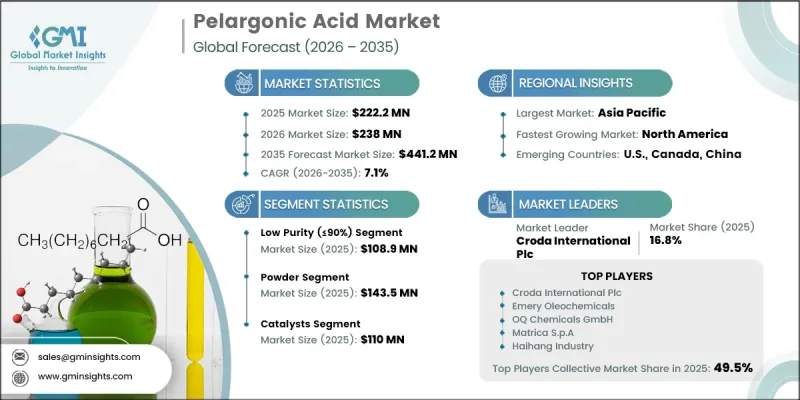
시장 성장은 농업, 퍼스널케어, 제약 및 산업 분야에서 바이오 친환경 화학 물질에 대한 수요가 증가함에 따라 주도되고 있습니다. 펠라르곤산은 식물성 기름에 함유된 천연 유래의 9탄소 포화 지방산으로 생분해성, 저독성 및 광범위한 기능적 다양성으로 널리 평가받고 있습니다. 그 화학적 구조로 인해 제초제 제제, 계면활성제 제조, 특수화학제품 합성 등 다양한 용도로의 응용이 가능합니다. 이 화합물은 식물성 기름의 추출, 올레산의 산화 처리, 석유 유래 원료를 이용한 합성 제조 등 다양한 제조 경로를 통해 생산되고 있습니다. 접촉식 제초제의 유효성분, 의약품 합성의 중간체 및 윤활유, 가소제, 산업용 제제의 첨가제로서 중요한 역할을 하고 있습니다. 지속가능성과 재생 가능 원료에 대한 관심이 높아지면서 산업 전반에 걸쳐 채택이 더욱 확대되고 있습니다. 이 시장은 강력한 석유화학 가공 능력과 통합된 공급망을 갖춘 탄탄한 생산 기지를 바탕으로 특수 화학 및 농자재 생태계 내에서 전개되고 있습니다.
| 시장 범위 | |
|---|---|
| 시작 연도 | 2025년 |
| 예측 기간 | 2026-2035년 |
| 시작 연도 시장 규모 | 2억 2,220만 달러 |
| 예측 규모 | 4억 4,120만 달러 |
| CAGR | 7.1% |
2025년, 저순도(90% 이하) 부문은 1억 890만 달러를 차지했습니다. 이 부문이 선두를 달리고 있는 이유는 고순도보다 비용 효율성이 우선시되는 대규모 응용 분야에서 널리 사용되고 있기 때문입니다. 이 부문은 경쟁력 있는 가격과 기능적 성능이 요구되는 농업용 제초제 제조, 산업용 화학 처리 및 식물 관리 용도로 널리 사용되고 있습니다. 벌크 제형에 대한 견고한 수요는 전체 최종 사용자 산업에서 이 부문의 꾸준한 성장을 뒷받침하고 있습니다.
분말 형태 부문은 2025년에 1억 4,350만 달러에 달했습니다. 분말 형태의 펠라르곤산은 농업, 화장품, 산업용 제제 등 다양한 용도에 적용할 수 있어 널리 선호되고 있습니다. 이를 통해 고체 및 액체 시스템에서 효율적인 혼합, 균일한 분산 및 손쉬운 가공이 가능합니다. 입자 크기 분포 및 유동 특성 등 주요 물리적 특성은 제제의 안정성과 성능에 큰 영향을 미칩니다. 각 제조업체들은 다양한 용도에서 용해도, 취급 효율성, 저장 안정성에 대한 다양한 요구사항을 충족시키기 위해 분말의 사양을 지속적으로 최적화하고 있습니다.
북미 펠라르곤산 시장은 2025년 6,550만 달러에서 2035년까지 1억 2,700만 달러로 성장할 것으로 예측됩니다. 이 지역 시장 확대는 유기농업의 확산, 저위험 농약 사용을 촉진하는 지원적인 규제 프레임워크, 퍼스널케어 및 특수 화학제품 산업 수요 증가에 의해 주도되고 있습니다. 농업 생산 시스템, 도시 식물 관리, 천연물 제조 등 각 분야에서 꾸준한 소비가 이루어지고 있습니다. 규제 당국으로부터 위험성이 최소화된 유효성분으로 인정받아 기존 농약에 대한 규제 없이 보다 폭넓은 용도로 사용할 수 있게 되었습니다. 지속 가능한 식물성 제품에 대한 소비자의 선호도가 높아진 데다, 이미 확립된 석유화학제품 생산 기반이 더해져 이 지역 전체 시장의 발전을 더욱 촉진하고 있습니다.
자주 묻는 질문
목차
제1장 조사 방법과 범위
제2장 주요 요약
제3장 업계 인사이트
제4장 경쟁 구도
제5장 시장 추산 및 예측 : 공급 모드별, 2022-2035년
제6장 시장 추산 및 예측 : 형태별, 2022-2035년
제7장 시장 추산 및 예측 : 유통 채널별, 2022-2035년
제8장 시장 추산 및 예측 : 지역별, 2022-2035년
제9장 기업 개요
JHS 26.05.29The Global Pelargonic Acid Market was valued at USD 222.2 million in 2025 and is estimated to grow at a CAGR of 7.1% to reach USD 441.2 million by 2035.
Market growth is driven by rising demand for bio-based and environmentally compatible chemicals across agriculture, personal care, pharmaceutical, and industrial sectors. Pelargonic acid, also referred to as nonanoic acid, is a naturally derived nine-carbon saturated fatty acid found in vegetable oils and widely valued for its biodegradability, low toxicity, and broad functional versatility. Its chemical structure enables wide-ranging applications, including herbicide formulations, surfactant production, and specialty chemical synthesis. The compound is produced through multiple routes such as plant oil extraction, oxidative processing of oleic acid, and synthetic manufacturing using petroleum-based inputs. It plays a key role as an active ingredient in contact herbicides, an intermediate in pharmaceutical synthesis, and an additive in lubricants, plasticizers, and industrial formulations. Increasing emphasis on sustainability and renewable raw materials is further strengthening its adoption across industries. The market operates within specialty chemicals and agricultural input ecosystems, supported by established production hubs with strong oleochemical processing capabilities and integrated supply chains.
| Market Scope | |
|---|---|
| Start Year | 2025 |
| Forecast Year | 2026-2035 |
| Start Value | $ 222.2 Million |
| Forecast Value | $ 441.2 Million |
| CAGR | 7.1% |
The low purity (<=90%) segment accounted for USD 108.9 million in 2025. This segment leads due to its extensive use in large-scale applications where cost efficiency is prioritized over high purity levels. It is widely utilized in agricultural herbicide production, industrial chemical processing, and vegetation management applications that require functional performance at competitive pricing. Strong demand for bulk formulations continues to support steady growth in this segment across end-use industries.
The powder form segment reached USD 143.5 million in 2025. Powder-based pelargonic acid is widely preferred due to its adaptability across agricultural, cosmetic, and industrial formulations. It enables efficient blending, consistent dispersion, and ease of processing in solid and liquid systems. Key physical properties such as particle size distribution and flow characteristics significantly influence formulation stability and performance. Manufacturers continue to optimize powder specifications to meet diverse requirements related to solubility, handling efficiency, and storage stability across different applications.
North America Pelargonic Acid Market is expected to grow from USD 65.5 million in 2025 to USD 127 million by 2035. Regional expansion is driven by increasing adoption of organic farming practices, supportive regulatory frameworks promoting reduced-risk agricultural chemicals, and rising demand from personal care and specialty chemical industries. Strong consumption is observed across agricultural production systems, municipal vegetation management, and natural product manufacturing. Regulatory recognition as a minimum-risk active ingredient supports wider application without conventional pesticide restrictions. Growing consumer preference for sustainable and plant-based products, combined with a well-established oleochemical manufacturing base, is further enhancing market development across the region.
Key players operating in the Global Pelargonic Acid Market include OQ Chemicals GmbH, Croda International Plc, Emery Oleochemical, Tokyo Chemical Industry Co., Ltd., Matrica S.p.A, Central Drug House, Glentham Life Sciences Limited, Haihang Industry, Kunshan Odowell Co., Ltd, and Zhengzhou Yibang Industry & Commerce Co., Ltd. Companies in the Pelargonic Acid Market are focusing on expanding production capacity, strengthening bio-based sourcing strategies, and enhancing product purity diversification to improve competitiveness. Investments in research and development are supporting the development of more efficient extraction and synthesis processes to reduce production costs and improve yield efficiency. Strategic partnerships with agricultural and chemical industry players are enabling wider application development and market penetration. Manufacturers are also prioritizing sustainability initiatives by increasing reliance on renewable feedstocks and environmentally friendly production methods. Expansion into emerging regional markets and optimization of distribution networks are further strengthening global reach.
Table of Contents
Chapter 1 Methodology & Scope
- 1.1 Market scope and definition
- 1.2 Research design
- 1.2.1 Research approach
- 1.2.2 Data collection methods
- 1.3 Data mining sources
- 1.3.1 Global
- 1.3.2 Regional/Country
- 1.4 Base estimates and calculations
- 1.4.1 Base year calculation
- 1.4.2 Key trends for market estimation
- 1.5 Primary research and validation
- 1.5.1 Primary sources
- 1.6 Forecast model
- 1.7 Research assumptions and limitations
Chapter 2 Executive Summary
- 2.1 Industry 360° synopsis
- 2.2 Key market trends
- 2.2.1 Purity-based
- 2.2.2 Form
- 2.2.3 Application
- 2.2.4 Regional
- 2.3 TAM Analysis, 2026-2035
- 2.4 CXO perspectives: Strategic imperatives
Chapter 3 Industry Insights
- 3.1 Industry ecosystem analysis
- 3.1.1 Supplier landscape
- 3.1.2 Profit margin
- 3.1.3 Value addition at each stage
- 3.1.4 Factor affecting the value chain
- 3.1.5 Disruptions
- 3.2 Industry impact forces
- 3.2.1 Growth drivers
- 3.2.2 Industry pitfalls and challenges
- 3.2.3 Market opportunities
- 3.3 Growth potential analysis
- 3.4 Regulatory landscape
- 3.4.1 North America
- 3.4.2 Europe
- 3.4.3 Asia Pacific
- 3.4.4 Latin America
- 3.4.5 Middle East & Africa
- 3.5 Porter's analysis
- 3.6 PESTEL analysis
- 3.7 Price trends
- 3.7.1 By region
- 3.7.2 By purity-based
- 3.8 Future market trends
- 3.9 Technology and Innovation landscape
- 3.9.1 Current technological trends
- 3.9.2 Emerging technologies
- 3.10 Patent Landscape
- 3.11 Trade statistics (HS code)
- 3.11.1 Major importing countries
- 3.11.2 Major exporting countries
- 3.12 Sustainability and environmental aspects
- 3.12.1 Sustainable practices
- 3.12.2 Waste reduction strategies
- 3.12.3 Energy efficiency in production
- 3.12.4 Eco-friendly initiatives
Chapter 4 Competitive Landscape, 2025
- 4.1 Introduction
- 4.2 Company market share analysis
- 4.2.1 By region
- 4.2.1.1 North America
- 4.2.1.2 Europe
- 4.2.1.3 Asia Pacific
- 4.2.1.4 LATAM
- 4.2.1.5 MEA
- 4.2.1 By region
- 4.3 Competitive analysis of major market players
- 4.4 Competitive positioning matrix
- 4.5 Key developments
- 4.5.1 Mergers & acquisitions
- 4.5.2 Partnerships & collaborations
- 4.5.3 New Product Launches
- 4.5.4 Expansion Plans
Chapter 5 Market Estimates and Forecast, By Supply Mode, 2022-2035 (USD Million) (Kilo Tons)
- 5.1 Key trends
- 5.2 Low Purity (≤90%)
- 5.3 Medium Purity (90%-99%)
- 5.4 High Purity (≥99%)
Chapter 6 Market Estimates and Forecast, By Application, 2022-2035 (USD Million) (Kilo Tons)
- 6.1 Key trends
- 6.2 Powder
- 6.3 Granular
- 6.4 Nanostructured (Nano-grade)
Chapter 7 Market Estimates and Forecast, By Distribution channel, 2022-2035 (USD Million) (Kilo Tons)
- 7.1 Key trends
- 7.2 Catalysts
- 7.3 Electronics & Optics
- 7.4 Energy Storage
- 7.5 Chemicals
- 7.6 Pharmaceuticals & Healthcare
- 7.7 Others
Chapter 8 Market Estimates and Forecast, By Region, 2022-2035 (USD Million) (Kilo Tons)
- 8.1 Key trends
- 8.2 North America
- 8.2.1 U.S.
- 8.2.2 Canada
- 8.3 Europe
- 8.3.1 Germany
- 8.3.2 UK
- 8.3.3 France
- 8.3.4 Spain
- 8.3.5 Italy
- 8.3.6 Rest of Europe
- 8.4 Asia Pacific
- 8.4.1 China
- 8.4.2 India
- 8.4.3 Japan
- 8.4.4 Australia
- 8.4.5 South Korea
- 8.4.6 Rest of Asia Pacific
- 8.5 Latin America
- 8.5.1 Brazil
- 8.5.2 Mexico
- 8.5.3 Argentina
- 8.5.4 Rest of Latin America
- 8.6 Middle East and Africa
- 8.6.1 Saudi Arabia
- 8.6.2 South Africa
- 8.6.3 UAE
- 8.6.4 Rest of Middle East and Africa
Chapter 9 Company Profiles
- 9.1 Central Drug House
- 9.2 Croda International Plc
- 9.3 Emery Oleochemical
- 9.4 Glentham Life Sciences Limited
- 9.5 Haihang Industry
- 9.6 Kunshan Odowell Co., Ltd
- 9.7 Matrica S.p.A
- 9.8 OQ Chemicals GmbH
- 9.9 Tokyo Chemical Industry Co., Ltd.
- 9.10 Zhengzhou Yibang Industry & Commerce Co., Ltd