

|
시장보고서
상품코드
2038435
카테터 인트로듀서 시스 시장 기회, 성장요인, 업계 동향 분석 및 예측(2026-2035년)Catheter Introducer Sheaths Market Opportunity, Growth Drivers, Industry Trend Analysis, and Forecast 2026 - 2035 |
||||||

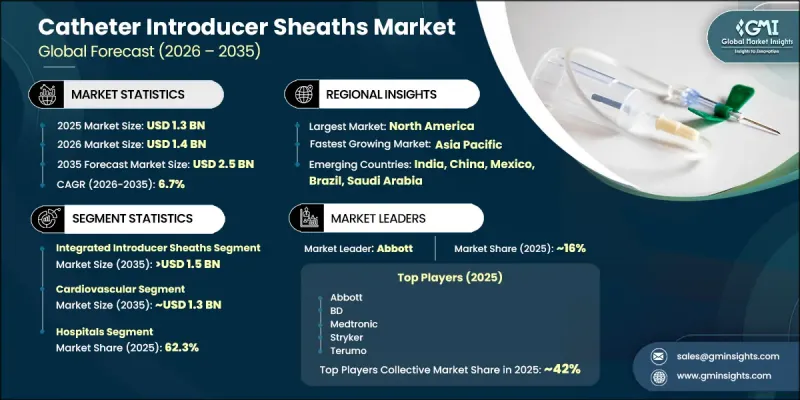
세계의 카테터 인트로듀서 시스 시장은 2025년에 13억 달러로 평가되었고 CAGR 6.7%로 성장하여 2035년까지 25억 달러에 이를 것으로 추정되고 있습니다.
이러한 성장은 정확하고 신뢰할 수 있는 혈관 접근을 필요로 하는 중재적 시술 증가에 의해 주도되고 있습니다. 의료진들은 시술의 효율성을 높이면서 환자의 안전성을 높이는 기술을 점점 더 중요하게 여기고 있습니다. 카테터 인트로듀서 시스는 체내 경로에 대한 통제된 접근을 가능하게 하여 진단 및 치료 용도를 모두 지원하는 데 중요한 역할을 합니다. 저침습적 치료법으로의 전환은 의료 현장 전반에 걸쳐 제품 도입을 더욱 가속화하고 있습니다. 또한, 만성 질환의 유병률 증가는 시술 건수 증가에 기여하고 있으며, 시장 수요를 강화하고 있습니다. 의료진이 정확성을 보장하고 합병증을 줄이며 전반적인 임상 결과를 개선할 수 있는 신뢰할 수 있는 솔루션을 찾고 있는 가운데, 기기 설계의 지속적인 개선과 의료 인프라의 확장으로 시장 성장에 더욱 박차를 가하고 있습니다.
| 시장 범위 | |
|---|---|
| 시작 연도 | 2025년 |
| 예측 기간 | 2026-2035년 |
| 시작 연도 시장 규모 | 13억 달러 |
| 예측 규모 | 25억 달러 |
| CAGR | % |
카테터 인트로듀서 시스는은 카테터를 안전하고 효율적으로 체내로 유도하기 위한 필수적인 의료기구입니다. 이들은 보호용 도관 역할을 하여 삽입 시 조직 손상을 줄이고 체내 경로 내 원활한 이동을 돕습니다. 그 사용은 합병증을 최소화하고 시술 결과를 개선하는 데 기여하고 있습니다. 인터벤션 시술에 대한 수요가 증가함에 따라 정확성과 안전성을 지원하는 신뢰할 수 있는 액세스 장치의 필요성이 증가하고 있습니다. 의료시스템이 저침습적 접근 방식과 외래 진료 모델을 계속 채택함에 따라 효율적이고 사용하기 쉬운 기기의 중요성이 증가하고 있으며, 현대 임상 현장에서 인트로듀서 시스의 역할이 더욱 강화되고 있습니다.
통합형 인트로듀서 시스 시장은 CAGR 7%로 성장하여 2035년까지 15억 달러에 달할 것으로 예측됩니다. 이 부문의 성장은 고급 시술을 지원하는 간소화되고 효율적인 의료기기에 대한 수요 증가에 힘입어 성장세를 보이고 있습니다. 일체형 설계는 취급 절차를 줄여 무균성을 높이고 오염 위험을 줄입니다. 또한, 이러한 시스템은 워크플로우를 간소화하고 시술 시 필요한 부품 수를 줄임으로써 운영상의 이점을 제공하므로 의료 서비스 제공업체에게 비용 효율적인 선택이 될 수 있습니다.
2025년 기준, 병원 부문은 시장 점유율의 62.3%를 차지했습니다. 이러한 시설들은 정밀한 혈관 접근이 필요한 다양하고 복잡한 의료 시술을 수행하는 데 있어 여전히 핵심적인 역할을 하고 있습니다. 압박감이 높은 임상 환경에서 효율적이고 신뢰할 수 있는 도구에 대한 요구가 높아지면서 인트로듀서 시스에 대한 수요가 계속 증가하고 있습니다. 또한, 병원은 신속한 접근과 치료의 정확성이 매우 중요한 응급의료 관리에서도 중요한 역할을 담당하고 있어 시장에서의 우위를 더욱 강화하고 있습니다.
미국의 카테터 인트로듀서 시스 시장은 2025년에 3억 9,750만 달러로 평가되었고, 2026년부터 2035년까지 연평균 4.6% 성장할 것으로 예측됩니다. 시장 확대는 외래 진료로의 전환이 진행되고 있고, 최소 침습 수술에 대한 선호도가 높아짐에 따라 시장 확대가 이루어지고 있습니다. 외래 진료 시설에서 이루어지는 시술 건수 증가는 인트로듀서 시스의 사용 확대에 기여하고 있습니다. 또한, 의료 성과 향상과 조기 진단 및 치료 접근성 확대를 위한 지속적인 노력은 시술 건수 증가를 더욱 부추기며 시장의 지속적인 성장을 뒷받침하고 있습니다.
자주 묻는 질문
목차
제1장 조사 방법
제2장 주요 요약
제3장 업계 인사이트
제4장 경쟁 구도
제5장 시장 추산 및 예측 : 제품별, 2022-2035년
제6장 시장 추산 및 예측 : 용도별, 2022-2035년
제7장 시장 추산 및 예측 : 최종 용도별, 2022-2035년
제8장 시장 추산 및 예측 : 지역별, 2022-2035년
제9장 기업 개요
JHS 26.05.29The Global Catheter Introducer Sheaths Market was valued at USD 1.3 billion in 2025 and is estimated to grow at a CAGR of 6.7% to reach USD 2.5 billion by 2035.
Growth is driven by the growing volume of interventional procedures that require precise and reliable vascular access. Healthcare providers are increasingly prioritizing technologies that improve procedural efficiency while enhancing patient safety. Catheter introducer sheaths play a critical role in enabling controlled access to internal pathways, supporting both diagnostic and therapeutic applications. The shift toward less invasive treatment approaches is further accelerating product adoption across healthcare settings. Additionally, the rising prevalence of chronic conditions is contributing to increased procedural volumes, strengthening market demand. Continuous improvements in device design, along with the expansion of healthcare infrastructure, are further supporting market growth as providers seek reliable solutions that ensure accuracy, reduce complications, and enhance overall clinical outcomes.
| Market Scope | |
|---|---|
| Start Year | 2025 |
| Forecast Year | 2026-2035 |
| Start Value | $1.3 Billion |
| Forecast Value | $2.5 Billion |
| CAGR | % |
Catheter introducer sheaths are essential medical tools that assist in guiding catheters into the body safely and efficiently. They serve as protective conduits that help reduce tissue damage during insertion while supporting smooth navigation within internal pathways. Their use contributes to minimizing complications and improving procedural outcomes. The increasing demand for interventional procedures is driving the need for reliable access devices that support precision and safety. As healthcare systems continue to adopt minimally invasive approaches and outpatient care models, the importance of efficient and easy-to-use devices is growing, reinforcing the role of introducer sheaths in modern clinical practices.
The integrated introducer sheaths segment is expected to grow at a CAGR of 7% and reach USD 1.5 billion by 2035. Growth in this segment is being driven by increasing demand for streamlined and efficient medical devices that support advanced procedures. Integrated designs enhance sterility by reducing handling steps, which lowers the risk of contamination. These systems also offer operational advantages by simplifying workflows and reducing the number of components required during procedures, making them a cost-effective option for healthcare providers.
The hospitals segment accounted for 62.3% share in 2025. These facilities remain central to performing a wide range of complex medical procedures that require precise vascular access. The need for efficient and reliable tools in high-pressure clinical environments continues to support demand for introducer sheaths. Hospitals also play a key role in managing urgent medical conditions, where rapid access and procedural accuracy are critical, further reinforcing their dominance in the market.
United States Catheter Introducer Sheaths Market was valued at USD 397.5 million in 2025 and is projected to grow at a CAGR of 4.6% from 2026 to 2035. Market expansion is being supported by the increasing shift toward outpatient care and the growing preference for minimally invasive procedures. The rising number of procedures performed in ambulatory settings is contributing to higher utilization of introducer sheaths. In addition, ongoing efforts to improve healthcare outcomes and expand access to early diagnosis and treatment are further driving procedural volumes, supporting sustained market growth.
Key companies operating in the Global Catheter Introducer Sheaths Market include Medtronic, Abbott, BD, Terumo, Stryker, B Braun, CONMED, COOK MEDICAL, Cordis, Integer, LEPU MEDICAL, MERIT MEDICAL, and GORE. Companies in the Global Catheter Introducer Sheaths Market are focusing on innovation, product efficiency, and strategic expansion to strengthen their market position. They are investing in research and development to design advanced devices that improve safety, reduce procedural complexity, and enhance clinical outcomes. Many players are introducing integrated and user-friendly solutions that streamline workflows and support infection control. Strategic collaborations and partnerships with healthcare providers are helping companies expand their reach and improve product adoption. Additionally, firms are strengthening their distribution networks and enhancing manufacturing capabilities to meet rising demand. A strong emphasis on regulatory compliance, quality standards, and continuous product improvement is also enabling companies to maintain a competitive edge in the evolving healthcare landscape.
Table of Contents
Chapter 1 Research Methodology
- 1.1 Research approach
- 1.2 Quality commitments
- 1.2.1 GMI AI policy & data integrity commitment
- 1.2.1.1 Source consistency protocol
- 1.2.1 GMI AI policy & data integrity commitment
- 1.3 Research trail & confidence scoring
- 1.3.1 Research trail components
- 1.3.2 Scoring components
- 1.4 Data collection
- 1.4.1 Partial list of primary sources
- 1.5 Data mining sources
- 1.5.1 Paid sources
- 1.5.1.1 Sources, by region
- 1.5.1 Paid sources
- 1.6 Base estimates and calculations
- 1.6.1 Base year calculation for any one approach
- 1.7 Forecast model
- 1.7.1 Quantified market impact analysis
- 1.7.1.1 Mathematical impact of growth parameters on forecast
- 1.7.1 Quantified market impact analysis
- 1.8 Research transparency addendum
- 1.8.1 Source attribution framework
- 1.8.2 Quality assurance metrics
- 1.8.3 Our commitment to trust
Chapter 2 Executive Summary
- 2.1 Industry 3600 synopsis
- 2.2 Key market trends
- 2.2.1 Regional trends
- 2.2.2 Product trends
- 2.2.3 Application trends
- 2.2.4 End use trends
- 2.3 CXO perspectives: Strategic imperatives
Chapter 3 Industry Insights
- 3.1 Industry ecosystem analysis
- 3.2 Industry impact forces
- 3.2.1 Growth drivers
- 3.2.1.1 Increasing prevalence of cardiovascular and neurovascular diseases
- 3.2.1.2 Technological advancements in catheter introducer sheaths
- 3.2.1.3 Favorable reimbursement policies in developed economies
- 3.2.1.4 Growing adoption of minimally invasive procedures
- 3.2.2 Industry pitfalls and challenges
- 3.2.2.1 Stringent regulatory requirements for product approval
- 3.2.2.2 High costs of advanced introducer sheaths
- 3.2.3 Market opportunities
- 3.2.3.1 Rapid shift toward percutaneous procedures
- 3.2.1 Growth drivers
- 3.3 Growth potential analysis
- 3.4 Regulatory landscape
- 3.4.1 North America
- 3.4.2 Europe
- 3.4.3 Asia Pacific
- 3.5 Technology landscape
- 3.5.1 Current technological trends
- 3.5.2 Emerging technologies
- 3.6 Future market trends (Driven by Primary Research)
- 3.7 Impact of AI and generative AI on the market
- 3.8 Customer insights (Driven by Primary Research)
- 3.9 Pricing analysis, 2025
- 3.10 Porter's analysis
- 3.11 PESTEL analysis
Chapter 4 Competitive Landscape, 2025
- 4.1 Introduction
- 4.2 Company matrix analysis
- 4.3 Company market share analysis
- 4.3.1 Global
- 4.3.2 North America
- 4.3.3 Europe
- 4.3.4 Asia Pacific
- 4.4 Competitive positioning matrix
- 4.5 Competitive analysis of major market players
- 4.6 Key developments
- 4.6.1 Mergers & acquisitions
- 4.6.2 Partnerships & collaborations
- 4.6.3 New product type launches
- 4.6.4 Expansion plans
Chapter 5 Market Estimates and Forecast, By Product, 2022 - 2035 ($ Mn)
- 5.1 Key trends
- 5.2 Integrated introducer sheaths
- 5.3 Separable introducer sheaths
Chapter 6 Market Estimates and Forecast, By Application, 2022 - 2035 ($ Mn)
- 6.1 Key trends
- 6.2 Cardiovascular
- 6.3 Neurovascular
- 6.4 Urological
- 6.5 Gynecological
- 6.6 Other applications
Chapter 7 Market Estimates and Forecast, By End Use, 2022 - 2035 ($ Mn)
- 7.1 Key trends
- 7.2 Hospitals
- 7.3 Ambulatory surgical centers
- 7.4 Other end users
Chapter 8 Market Estimates and Forecast, By Region, 2022 - 2035 ($ Mn)
- 8.1 Key trends
- 8.2 North America
- 8.2.1 U.S.
- 8.2.2 Canada
- 8.3 Europe
- 8.3.1 Germany
- 8.3.2 UK
- 8.3.3 France
- 8.3.4 Spain
- 8.3.5 Italy
- 8.3.6 Netherlands
- 8.4 Asia Pacific
- 8.4.1 China
- 8.4.2 Japan
- 8.4.3 India
- 8.4.4 Australia
- 8.4.5 South Korea
- 8.5 Latin America
- 8.5.1 Brazil
- 8.5.2 Mexico
- 8.5.3 Argentina
- 8.6 Middle East and Africa
- 8.6.1 South Africa
- 8.6.2 Saudi Arabia
- 8.6.3 UAE
Chapter 9 Company Profiles
- 9.1 Abbott
- 9.2 B Braun
- 9.3 BD
- 9.4 CONMED
- 9.5 COOK MEDICAL
- 9.6 Cordis
- 9.7 Integer
- 9.8 LEPU MEDICAL
- 9.9 Medtronic
- 9.10 MERIT MEDICAL
- 9.11 Stryker
- 9.12 Terumo
- 9.13 GORE


