

|
시장보고서
상품코드
2038458
스마트 무기 시장 : 시장 비즈니스 기회, 성장요인, 업계 동향 분석 및 예측(2026-2035년)Smart Weapons Market Opportunity, Growth Drivers, Industry Trend Analysis, and Forecast 2026 - 2035 |
||||||

세계의 스마트 무기 시장은 2025년에 211억 달러로 평가되었고, CAGR 7.4%로 성장할 전망이며, 2035년까지 428억 달러에 이를 것으로 추정되고 있습니다.
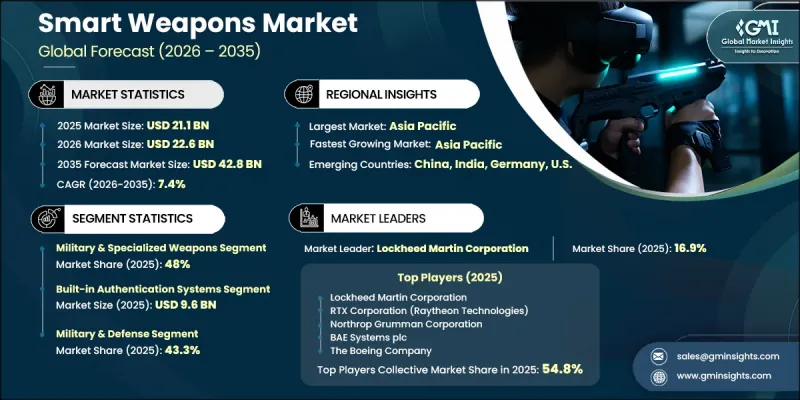
이 시장의 성장은 지정학적 불안정성 증가, 무력 분쟁의 빈번한 발생, 주요 경제권에서의 국방비 증가에 의해 주도되고 있습니다. 현재 진행 중인 군사 현대화 노력은 첨단 무기 시스템의 도입을 가속화하고 있으며, 정밀 공격에 대한 관심이 높아지면서 조달의 우선순위가 재편되고 있습니다. 지능형 유도 기술, 센서 통합 및 목표물 식별 시스템의 지속적인 발전으로 작전의 정확성과 효율성이 향상되고 있습니다. 또한, 다목적 및 플랫폼에 유연하게 대응할 수 있는 무기 시스템에 대한 수요가 증가함에 따라 전 세계 국방 분야에서 차세대 스마트 무기에 대한 수요가 강화되고 있습니다.
| 시장 범위 | |
|---|---|
| 개시 연도 | 2025년 |
| 예측 기간 | 2026-2035년 |
| 개시 연도 시장 규모 | 211억 달러 |
| 예측 시장 규모 | 428억 달러 |
| CAGR | 7.4% |
이 시장은 지정학적 긴장의 고조와 분쟁 환경의 장기화에 큰 영향을 받고 있으며, 이로 인해 정밀 유도 시스템에 대한 의존도가 높아지고 있습니다. 군사 활동이 확대됨에 따라 각국 군는 공격의 정확도를 높이고 부수적인 피해를 줄이는 첨단 무기의 채택을 촉진하고 있습니다. 또한, 주요 방산 시장의 국방 예산 증가와 대규모 현대화 프로그램도 시장 성장을 뒷받침하고 있습니다. 각국 정부는 고도의 전투 준비 태세를 우선시하고 있으며, 이는 기술적으로 강화된 무기 플랫폼의 조달을 가속화하고 있습니다. 또한, 작전상 우위 및 신속한 대응 능력에 대한 관심이 높아지면서 첨단 표적 포착 및 제어 기술을 통합한 지능형 무기체계의 도입이 촉진되고 있습니다.
권총 부문은 2035년까지 연평균 복합 성장률(CAGR) 10.5%를 나타낼 것으로 예측됩니다. 국방, 국토 안보, 법 집행 기관 분야에서 디지털 기술로 강화된 소형 무기에 대한 수요가 증가하면서 이 부문의 성장을 뒷받침하고 있습니다. 생체 인식, 전자 사격 통제 시스템, 추적 기능 등 첨단 기능의 통합이 차세대 권총의 보급을 주도하고 있습니다. 이러한 기술 발전은 운영상의 이용 사례를 확대하고 보안을 중시하는 용도에 대한 수요를 강화하여 이 부문의 지속적인 성장을 뒷받침하고 있습니다.
클라우드 연결 및 IoT 지원 시스템 부문은 2026-2035년 연평균 7.7%의 연평균 복합 성장률(CAGR)을 보일 것으로 예측됩니다. 이 부문의 성장은 원격 감시 기능, 무기 추적 시스템, 수명주기 관리 솔루션의 채택 확대에 의해 주도되고 있습니다. 이러한 플랫폼은 연결된 무기 네트워크 전체에서 실시간 데이터 교환, 성능 분석 및 중앙 집중식 운영 제어를 가능하게 합니다. 디지털 국방 인프라, 향상된 상황 인식, 지휘부 차원의 의사결정 지원에 대한 강조가 높아지면서 국방 작전 전반에 걸쳐 커넥티드 스마트 무기 기술의 통합이 더욱 가속화되고 있습니다.
북미의 스마트 무기 시장은 2025년 31.4%의 점유율을 차지했습니다. 이 지역은 방위 작전의 기술적 진보와 신속한 전개 능력을 중시하는 만큼 지속적으로 성장하고 있습니다. 이 지역의 군는 작전 우위를 유지하기 위해 정밀 유도 시스템, 첨단 미사일 기술 및 통합 타격 플랫폼을 우선순위에 두고 있습니다. 기존 무기체계의 지속적인 현대화와 첨단 지휘통제체계로의 통합이 결합되면서 스마트 무기체계에 대한 수요가 지속되고 있습니다. 고도로 발달한 방위 산업 기반과 차세대 기술의 조기 도입이 이 지역 시장 지배력을 더욱 강화하고 있습니다.
자주 묻는 질문
목차
제1장 조사 방법 및 범위
제2장 주요 요약
제3장 업계 인사이트
제4장 경쟁 구도
제5장 시장 추산 및 예측 : 무기 유형별(2022-2035년)
제6장 시장 추산 및 예측 : 인증 기술별(2022-2035년)
제7장 시장 추산 및 예측 : 통합 레벨별(2022-2035년)
제8장 시장 추산 및 예측 : 최종 사용자별(2022-2035년)
제9장 시장 추산 및 예측 : 지역별(2022-2035년)
제10장 기업 개요
AJY 26.06.11The Global Smart Weapons Market was valued at USD 21.1 billion in 2025 and is estimated to grow at a CAGR of 7.4% to reach USD 42.8 billion by 2035.
The market growth is driven by escalating geopolitical instability, rising frequency of armed conflicts, and increasing defense expenditures across major economies. Ongoing military modernization initiatives are accelerating the adoption of advanced weapon systems, while rising emphasis on precision-based engagement is reshaping procurement priorities. Continuous advancements in intelligent guidance technologies, sensor integration, and target identification systems are enhancing operational accuracy and effectiveness. In addition, the growing requirement for multi-mission, platform-flexible weapon systems is strengthening demand for next-generation smart weapons across defense applications globally.
| Market Scope | |
|---|---|
| Start Year | 2025 |
| Forecast Year | 2026-2035 |
| Start Value | $21.1 Billion |
| Forecast Value | $42.8 Billion |
| CAGR | 7.4% |
The market is strongly influenced by heightened geopolitical tensions and sustained conflict environments, which are increasing reliance on precision-guided systems. Expanding military engagements are encouraging armed forces to adopt advanced munitions that improve strike precision and reduce collateral impact. Growth is also supported by rising defense budgets and large-scale modernization programs across key defense markets. Governments are prioritizing advanced combat readiness, which is accelerating procurement of technologically enhanced weapon platforms. Furthermore, increasing focus on operational superiority and rapid response capability is reinforcing the deployment of intelligent weapon systems integrated with advanced targeting and control technologies.
The handgun segment is projected to grow at a CAGR of 10.5% through 2035. Rising demand for digitally enhanced small arms across defense, homeland security, and law enforcement applications is supporting segment expansion. Integration of advanced features such as biometric authentication, electronic fire control systems, and tracking capabilities is driving the adoption of next-generation handguns. These technological improvements are expanding operational use cases and strengthening demand across security-focused applications, thereby supporting sustained growth in this segment.
The cloud-connected and IoT-enabled systems segment is expected to register a CAGR of 7.7% during 2026 to 2035. Growth in this segment is driven by increasing adoption of remote monitoring capabilities, weapon tracking systems, and lifecycle management solutions. These platforms enable real-time data exchange, performance analytics, and centralized operational control across connected weapon networks. Rising emphasis on digital defense infrastructure, enhanced situational awareness, and command-level decision support is further accelerating the integration of connected smart weapon technologies across defense operations.
North America Smart Weapons Market accounted for 31.4% share in 2025. The region continues to grow due to its strong emphasis on technological advancement and rapid deployment capabilities within defense operations. Military forces in the region prioritize precision-guided systems, advanced missile technologies, and integrated strike platforms to maintain operational superiority. Continuous modernization of existing arsenals, combined with integration into advanced command and control frameworks, is sustaining demand for smart weapon systems. The presence of a highly developed defense industrial base and early adoption of next-generation technologies further reinforces regional market strength.
Prominent players operating in the Global Smart Weapons Industry include Saab AB, RTX Corporation (Raytheon Technologies), Northrop Grumman Corporation, MBDA, Lockheed Martin Corporation, Thales Group, General Dynamics Corporation, BAE Systems plc, Israel Aerospace Industries Ltd., Rafael Advanced Defense Systems Ltd., Textron Inc., Leonardo S.p.A., L3Harris Technologies Inc., The Boeing Company, and Rheinmetall AG. Key strategies adopted by companies in the Smart Weapons Market include heavy investment in research and development to enhance precision guidance, targeting accuracy, and sensor fusion capabilities. Defense manufacturers are strengthening partnerships with governments and military agencies to secure long-term procurement contracts and accelerate deployment programs. Firms are increasingly focusing on modular weapon designs that allow multi-platform compatibility and mission flexibility. Integration of artificial intelligence, advanced analytics, and autonomous control systems is being prioritized to improve decision-making and operational efficiency. Companies are also expanding production capabilities through joint ventures and strategic collaborations to meet rising demand. Additionally, emphasis on cybersecurity integration, lifecycle support services, and system upgrade programs is helping players maintain long-term competitiveness and strengthen their market positioning.
Table of Contents
Chapter 1 Methodology and Scope
- 1.1 Market scope and definition
- 1.2 Research design
- 1.2.1 Research approach
- 1.2.2 Data collection methods
- 1.3 Data mining sources
- 1.3.1 Global
- 1.3.2 Regional/Country
- 1.4 Base estimates and calculations
- 1.4.1 Base year calculation
- 1.4.2 Key trends for market estimation
- 1.5 Primary research and validation
- 1.5.1 Primary sources
- 1.6 Forecast model
- 1.7 Research assumptions and limitations
Chapter 2 Executive Summary
- 2.1 Industry 360° synopsis, 2022 - 2035
- 2.2 Key market trends
- 2.2.1 Weapon type trends
- 2.2.2 Authentication technology trends
- 2.2.3 Integration level trends
- 2.2.4 End-User trends
- 2.2.5 Regional trends
- 2.3 TAM Analysis, 2026-2035
- 2.4 CXO perspectives: Strategic imperatives
Chapter 3 Industry Insights
- 3.1 Industry ecosystem analysis
- 3.1.1 Supplier Landscape
- 3.1.2 Profit Margin
- 3.1.3 Cost structure
- 3.1.4 Value addition at each stage
- 3.1.5 Factor affecting the value chain
- 3.1.6 Disruptions
- 3.2 Industry impact forces
- 3.2.1 Growth drivers
- 3.2.1.1 Rising geopolitical tensions and conflicts
- 3.2.1.2 Growing defense budgets and modernization programs
- 3.2.1.3 Increasing preference for precision-based military operations
- 3.2.1.4 Advancements in AI, sensors, and guidance technologies
- 3.2.1.5 Demand for weapons usable across multiple missions and platforms
- 3.2.2 Industry pitfalls and challenges
- 3.2.2.1 High unit cost and affordability constraints of smart weapon systems
- 3.2.2.2 Regulatory, export control, and political approval complexities
- 3.2.3 Market opportunities
- 3.2.3.1 Rising demand for smart weapons in homeland security and border protection applications
- 3.2.3.2 Expansion of smart weapons adoption among mid-tier and emerging defense forces
- 3.2.1 Growth drivers
- 3.3 Growth potential analysis
- 3.4 Regulatory landscape
- 3.4.1 North America
- 3.4.2 Europe
- 3.4.3 Asia Pacific
- 3.4.4 Latin America
- 3.4.5 Middle East & Africa
- 3.5 Porter's analysis
- 3.6 PESTEL analysis
- 3.7 Technology and Innovation landscape
- 3.7.1 Current technological trends
- 3.7.2 Emerging technologies
- 3.8 Price trends
- 3.8.1 By region
- 3.8.2 By product
- 3.9 Pricing Strategies
- 3.10 Emerging Business Models
- 3.11 Compliance Requirements
- 3.12 Patent and IP analysis
Chapter 4 Competitive Landscape, 2025
- 4.1 Introduction
- 4.2 Company market share analysis
- 4.2.1 By region
- 4.2.1.1 North America
- 4.2.1.2 Europe
- 4.2.1.3 Asia Pacific
- 4.2.1.4 Latin America
- 4.2.1.5 Middle East & Africa
- 4.2.2 Market concentration analysis
- 4.2.1 By region
- 4.3 Competitive benchmarking of key players
- 4.3.1 Financial performance comparison
- 4.3.1.1 Revenue
- 4.3.1.2 Profit margin
- 4.3.1.3 R&D
- 4.3.2 Product portfolio comparison
- 4.3.2.1 Product range breadth
- 4.3.2.2 Technology
- 4.3.2.3 Innovation
- 4.3.3 Geographic presence comparison
- 4.3.3.1 Global footprint analysis
- 4.3.3.2 Service network coverage
- 4.3.3.3 Market penetration by region
- 4.3.4 Competitive positioning matrix
- 4.3.4.1 Leaders
- 4.3.4.2 Challengers
- 4.3.4.3 Followers
- 4.3.4.4 Niche players
- 4.3.5 Strategic outlook matrix
- 4.3.1 Financial performance comparison
- 4.4 Key developments
- 4.4.1 Mergers and acquisitions
- 4.4.2 Partnerships and collaborations
- 4.4.3 Technological advancements
- 4.4.4 Expansion and investment strategies
- 4.4.5 Digital transformation initiatives
- 4.5 Emerging/ startup competitors landscape
Chapter 5 Market Estimates and Forecast, By Weapon Type, 2022 - 2035 (USD Million)
- 5.1 Key trends
- 5.2 Handgun
- 5.3 Rifle & long gun
- 5.4 Shotgun
- 5.5 Military & specialized weapons
Chapter 6 Market Estimates and Forecast, By Authentication Technology, 2022 - 2035 (USD Million)
- 6.1 Key trends
- 6.2 Biometric systems
- 6.2.1 Fingerprint recognition systems
- 6.2.2 Facial recognition technology
- 6.2.3 Palm print and multi-modal biometrics
- 6.3 RFID/NFC technology
- 6.4 Dynamic grip recognition systems
- 6.5 Voice recognition & audio authentication
- 6.6 Multi-factor authentication solutions
- 6.7 Others
Chapter 7 Market Estimates and Forecast, By Integration Level, 2022 - 2035 (USD Million)
- 7.1 Key trends
- 7.2 Built-in authentication systems
- 7.3 Retrofit & add-on solutions
- 7.4 Cloud-connected & IoT-enabled systems
Chapter 8 Market Estimates and Forecast, By End-User, 2022 - 2035 (USD Million)
- 8.1 Key trends
- 8.2 Military & defense
- 8.3 Law enforcement
- 8.4 Civilian & personal defense
- 8.5 Private security firms
- 8.6 Government & institutional
Chapter 9 Market Estimates and Forecast, By Region, 2022 - 2035 (USD Million)
- 9.1 Key trends
- 9.2 North America
- 9.2.1 U.S.
- 9.2.2 Canada
- 9.3 Europe
- 9.3.1 Germany
- 9.3.2 UK
- 9.3.3 France
- 9.3.4 Spain
- 9.3.5 Italy
- 9.3.6 Russia
- 9.4 Asia Pacific
- 9.4.1 China
- 9.4.2 India
- 9.4.3 Japan
- 9.4.4 Australia
- 9.4.5 South Korea
- 9.5 Latin America
- 9.5.1 Brazil
- 9.5.2 Mexico
- 9.5.3 Argentina
- 9.6 Middle East and Africa
- 9.6.1 South Africa
- 9.6.2 Saudi Arabia
- 9.6.3 UAE
Chapter 10 Company Profiles
- 10.1 Global Key Players
- 10.1.1 Lockheed Martin Corporation
- 10.1.2 RTX Corporation (Raytheon Technologies)
- 10.1.3 Northrop Grumman Corporation
- 10.1.4 BAE Systems plc
- 10.1.5 The Boeing Company
- 10.2 Regional key players
- 10.2.1 North America
- 10.2.1.1 General Dynamics Corporation
- 10.2.1.2 L3Harris Technologies Inc.
- 10.2.1.3 Textron Inc.
- 10.2.2 Asia Pacific
- 10.2.2.1 Israel Aerospace Industries Ltd.
- 10.2.3 Europe
- 10.2.3.1 Thales Group
- 10.2.3.2 Saab AB
- 10.2.3.3 MBDA
- 10.2.3.4 Rheinmetall AG
- 10.2.3.5 Leonardo S.p.A.
- 10.2.4 Middle East & Africa
- 10.2.4.1 Rafael Advanced Defense Systems Ltd.
- 10.2.1 North America


