

|
시장보고서
상품코드
2044119
스마트 무기 : 시장 점유율 분석, 업계 동향 및 통계, 성장 예측(2026-2031년)Smart Weapons - Market Share Analysis, Industry Trends & Statistics, Growth Forecasts (2026 - 2031) |
||||||
 Mordor Intelligence
2026년 스마트 무기 시장 규모는 222억 6,000만 달러에 달할 것으로 추정됩니다. 2025년 207억 2,000만 달러에서 확대해, 2031년에는 318억 9,000만 달러에 이를 것으로 예측됩니다.
2026년부터 2031년까지 연평균 복합 성장률(CAGR) 7.45%를 나타낼 것으로 예상됩니다.
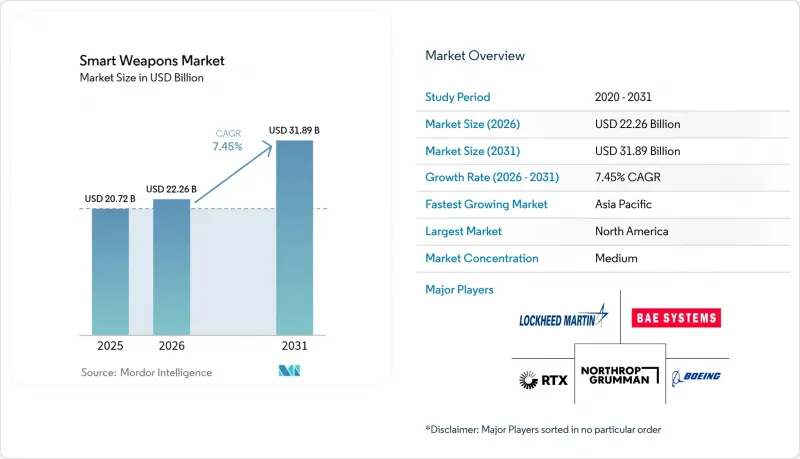
국방 예산의 확대, 대량 화력보다 정밀성을 중시하는 작전 교리로의 전환, 진화하는 방공 및 전자전 위협을 무력화하기 위한 경쟁이 이러한 확대를 뒷받침하고 있습니다. NATO의 GDP 대비 2% 국방비 목표 달성을 위한 공동 노력과 유럽연합(EU)의 8,000억 유로(9,377억 2,000만 달러) 규모의 'ReArm Europe' 프로그램은 다년간의 수주 잔고를 확보하여 계약업체들이 단기적인 예산 사이클의 영향을 받지 않도록 하고 있습니다. 단기적인 예산 사이클의 영향을 피할 수 있습니다. 동시에 일본의 레일건 계획부터 필리핀의 350억 달러 규모의 현대화 계획까지 아시아태평양의 재군비화는 수요처를 다변화하고 수출 규제 대상 하위 시스템을 둘러싼 경쟁을 심화시키고 있습니다. 인플레이션 연동형 계약 가격 조정, 반도체 부족, 원자재 가격 급등은 원가 플러스 방식의 조달 모델에 시련을 안겨주고 있습니다. 그러나 동시에 업그레이드 주기를 단축하는 모듈식 설계와 이중 사용(군용 및 민수용) 센서의 생태계를 촉진하고 있습니다. 모든 지역에서 도심 전투에서 부수적 피해를 최소화해야 한다는 정치적 요구가 높아지면서 멀티 모드 유도 기술과 AI를 활용한 표적 식별 기술의 배치가 가속화되고 있으며, 정밀유도탄은 미래 부대 구성 계획에 필수적인 요소로 자리 잡고 있습니다.
세계의 스마트 무기 시장 동향과 인사이트
주요국의 국방비 증가
NATO 회원국들은 냉전 이후 처음으로 GDP 대비 2%의 국방비 기준치를 넘어섰으며, 스마트 무기 시장에서 정밀유도무기 재고에 대한 전년 대비 수요를 끌어올리고 있습니다. 독일의 885억 달러의 예산 증액과 그리스의 270억 달러 재군비 계획은 스마트 미사일, 활공 폭탄, 대치 능력에 많은 예산을 배정하고 있습니다. EU의 'ReArm Europe' 이니셔티브는 여러 국가에서 생산량을 확대하여 단가를 낮추는 공동 조달 로트를 지원하고 있습니다. 이러한 협력적 지출을 통해 주요 계약업체는 주기적 생산에서 대량 생산 체제로 전환할 수 있으며, 리드 타임을 단축하고 새로운 생산용 금형에 대한 상각 부담을 줄일 수 있습니다. 반면, 생산 능력에 대한 부담이 발생하고 있습니다. 여러 동맹국 프로그램에서 유사한 서브시스템에 대한 동시 발주가 이루어짐에 따라 고체 탐색기 공급망과 추진제 배합에 병목현상이 발생하여 스마트 무기 시장에서 납기 지연의 위험이 증가하고 있습니다.
부수적 피해를 최소화하기 위한 정밀 타격에 중점을 둡니다.
최근 분쟁에서 도시전투의 특징은 무차별 사격에 심각한 타격을 입혀 지휘관들을 스마트 무기 시장에서 HIMARS, GMLRS 로켓 등의 시스템이 제공하는 90% 이상의 단발 명중률로 이끌고 있습니다. 정밀성에 대한 요구는 단순한 정확도에 그치지 않고 중거리 재표적 설정과 비행 중 중단 기능까지 확대되고 있으며, 민간인이 공격 지역에 재진입할 경우 조준점을 변경하는 MBDA의 'Spear 3' 공동 표적 유도 미사일이 그 좋은 예입니다. 정치적 반발을 피하기 위해 계획 담당자들은 더 작고 살상력이 높은 탄두와 광범위한 지역에 대한 포화 공격이 아닌 폭발을 집중시킬 수 있도록 최적화된 신관 프로파일을 지정하고 있습니다. 이러한 윤리적, 작전적 융합을 통해 분대용 공격 발사 장치에서 장거리 극초음속 무기에 이르기까지 모든 계층에 정밀유도탄이 내장되어 있습니다.
수출 규제 강화와 ITAR 준수에 대한 장애물
미국의 '국제무기거래규제(ITAR)'는 시커 알고리즘과 AI 소프트웨어의 라이선스 기간이 최대 18개월에 달하기 때문에 납품이 지연되고 해외 구매자에게는 보관 비용이 급증하고 있습니다. 스위스의 F-35A 조달에서 컴플라이언스 관련 제반 비용으로 인한 추가 비용으로 6억 5,000만 달러가 발생했습니다. 유럽 OEM 업체들은 주권적 업그레이드 권리를 확보하고 재수출 제약을 피하기 위해 ITAR의 적용을 받지 않는 제품군(MBDA의 네트워크형 활공무기 '오케스트라 스트라이크'가 대표적인 예이다)을 개발하기 위해 연구개발을 분리하고 있습니다. 이러한 규제의 부담은 내수용과 수출용 구성으로 이중 설계를 강요함으로써 스마트 무기 시장을 분열시키고 규모의 경제를 제한하고 있습니다.
부문 분석
스마트 미사일은 공대공, 대지 공격, 대함 공격 등 다양한 역할에 대한 적응성으로 인해 2025년 스마트 무기 시장의 41.62%를 차지했습니다. RTX의 AIM-9X 사이드와인더와 록히드마틴의 JASSM-ER은 양산 체제를 유지하는 연속 발주 프로그램의 좋은 예입니다. 전투 후 사후 보고서에 따르면, 최신 시커와 함께 사용하면 명중률이 지속적으로 90%를 초과하는 것으로 나타나 예산 배분의 우선순위를 뒷받침하고 있습니다. 스마트 폭탄은 부수적 피해의 허용 범위가 엄격한 근접 항공지원에서 여전히 중요성이 유지되고 있으며, 유도 로켓은 대량 발사를 통한 제압 사격의 요구를 충족시키고 있습니다. 또한, 회전탄약은 ISR(정보, 감시, 정찰)과 즉각적인 공격의 가교 역할을 하며, 센서에서 사수까지의 지연 시간을 단축하고 있습니다.
지향성 에너지 무기는 2031년까지 연평균 복합 성장률(CAGR) 9.66%로 가장 높은 성장률을 기록하고 있습니다. '드래곤 파이어' 레이저의 시험에서 수 킬로미터 거리에서 5cm 미만의 추적 정확도가 입증되었으며, 배치되면 한 발당 비용이 거의 제로에 가까워집니다. 미 해군 플랫폼에서 시험된 고출력 마이크로파 포드는 실탄을 소모하지 않고 드론 무리를 무력화시켜 다층적이고 소모적이지 않은 방어 체제로의 교리 전환을 암시합니다. 선상 통합 전력 시스템이 성숙함에 따라 주로 전력 밀도 및 열 관리와 같은 산업화 장벽이 후퇴하고 있습니다.
위성/GNSS 유도는 세계 커버리지와 스마트 무기 시장에서 키트당 낮은 추가 비용으로 인해 2025년 기준 32.12%의 점유율을 유지했습니다. 좋은 조건에서 3m 미만의 CEP(원형 오차)를 실현하기 때문에 적의 간섭이 없는 상황에서의 교전에서 여전히 매력적입니다. 레이저 유도는 표적 지시 장치가 풍부한 환경에서 틈새 적합성을 유지하고 있으며, 레이더 탐색기는 해군 및 공격 임무에서 전천후 성능을 지원하고 있습니다. 적외선 이미징은 열을 방출하는 표적에 대한 수동적 종단 호밍에서 여전히 매우 중요합니다.
AI를 통합한 멀티 모드 유도 시스템은 2031년까지 연평균 복합 성장률(CAGR) 10.05%를 나타낼 것으로 예측됩니다. Saab의 AI 탑재 그리펜 전투기의 출격 실적은 신경 에이전트가 적외선(IR), mm파(MMW) 레이더, 광학 흐름을 수 밀리초 단위로 융합하여 GNSS를 사용할 수 없는 상황에서도 록온을 유지하는 모습을 보여주고 있습니다. MEMS IMU와 저 SWaP-C RF 칩이 이러한 융합을 촉진하고 있으며, 이를 통해 포탄용 글라이드 키트는 순항미사일 수준의 자율성을 발휘할 수 있습니다. 여러 탄약이 탄착 순서를 조정하고, 일제 사격의 규모를 축소하고, 협동 표적 포획 프로토콜을 채택하여 협동 사격 궤도를 통해 방어망을 포화시키는 협동 표적 포획 프로토콜을 채택하고 있습니다.
지역별 분석
2025년 북미는 스마트 무기 시장 점유율의 36.35%를 차지했습니다. 이는 미국이 정밀타격 미사일 생산라인에 49억 4,000만 달러, 소구경 폭탄 생산라인에 69억 달러를 지원한 데 따른 것입니다. 캐나다가 다국적 미사일 계획에 참여하고 있는 점과 캐나다의 '교착상태 무기 최적화 프로젝트'도 북미 대륙 수요를 더욱 뒷받침하고 있습니다. 시커 제조공장에서 탄두 주조공장에 이르는 수직적 통합을 특징으로 하는 성숙한 산업 기반이 이 지역을 최악공급망 혼란으로부터 보호하고 있지만, 반도체 부족으로 인해 전략적 비축이 진행되고 있습니다.
우크라이나 사태 이후 유럽의 성장 궤도는 가파른 상승곡선을 그리고 있습니다. 독일 예산이 180% 증가한 885억 달러로 확대된 것과 EU 차원의 'ReArm Europe' 기금은 MBDA와 Saab의 최종 조립 공장 확장을 뒷받침하고 있습니다. 프랑스와 독일의 FC/ASW(대공/대잠) 개발이나 BAE 주도의 레이저 실증기에서 볼 수 있듯이 유럽이 기술주권을 중시하는 태도는 미국의 수출 라이선싱에 대한 의존도를 낮추고 있습니다. 동구권 동맹국들은 정밀 로켓포 주문에 박차를 가하고 있으며, 폴란드에서 발트해 연안 국가들까지 분산 생산에 의한 오프셋이 생겨나고 있습니다.
아시아태평양은 스마트 무기 시장에서 2031년까지 연평균 복합 성장률(CAGR) 9.12%로 가장 높은 성장률을 나타낼 것으로 예측됩니다. 중국의 A2/AD(접근 저지 및 영역 거부) 능력 강화, 일본의 레일건 및 극초음속 무기 대응, 인도의 QRSAM(근거리 방공 미사일) 배치, 그리고 350억 달러 규모의 계획에 따른 필리핀의 미사일 구매를 촉진하고 있습니다. 대만은 AIM-120D 및 국산 '스카이소드2'의 파생형 발주를 빠르게 진행하고 있습니다. 동시에 호주의 AUKUS 구상은 미국 및 영국과의 장거리 타격 협력 체제를 확고히 하고 있습니다. 한국의 KF-21 전투기 및 정밀 활공폭탄 수출은 경쟁력을 높이고 공급망 다변화를 촉진하고 있습니다. 한화의 호주 유도 로켓 공장 투자 등 지역적 산업 파트너십은 스마트 무기 시장에서 현지 공동 생산으로의 전환을 시사하고 있습니다.
기타 혜택 :
- 엑셀 형식 시장 예측(ME) 시트
- 3개월간 애널리스트 지원
자주 묻는 질문
목차
제1장 서론
제2장 조사 방법
제3장 주요 요약
제4장 시장 구도
제5장 시장 규모와 성장 예측
제6장 경쟁 구도
제7장 시장 기회와 향후 전망
KTH 26.05.29Smart weapons market size in 2026 is estimated at USD 22.26 billion, growing from 2025 value of USD 20.72 billion with 2031 projections showing USD 31.89 billion, growing at 7.45% CAGR over 2026-2031.
Escalating defense budgets, shifting operational doctrines favoring precision over mass firepower, and the race to neutralize evolving air-defense and electronic-warfare threats are sustaining this expansion. NATO's collective push to exceed the 2% of GDP spending benchmark and the European Union's EUR 800 billion (USD 937.72 billion) ReArm Europe program are securing multi-year order backlogs that shield contractors from short-term budget cycles. Simultaneously, Asia-Pacific rearmament-spanning Japan's railgun program to the Philippines' USD 35 billion modernization plan-is diversifying demand sources and sharpening competition for export-controlled subsystems. Inflation-linked contract escalations, semiconductor shortages, and raw-material price surges are testing cost-plus procurement models. Yet, they also stimulate modular designs and dual-use sensor ecosystems that shorten upgrade cycles. Across all regions, the political premium on minimizing collateral damage in urban combat zones is accelerating the fielding of multi-mode guidance and AI-enabled target-discrimination technologies, locking precision-guided munitions into future force-structure planning.
Global Smart Weapons Market Trends and Insights
Rising Defense Expenditures Across Leading Economies
NATO members surpassed the 2% of GDP defense-spending benchmark for the first time since the Cold War, propelling year-on-year demand for precision-guided inventories in the smart weapons market. Germany's USD 88.5 billion budget increase and Greece's USD 27 billion rearmament plan are directing sizeable allocations toward smart missiles, glide bombs, and standoff capabilities. The EU's ReArm Europe initiative is underwriting joint procurement lots that cut unit prices by scaling production volumes across multiple states. This synchronized spending allows prime contractors to shift from cyclical to line-rate manufacturing, trimming lead times and easing amortization of new production tooling. The flip side is capacity stress: parallel orders for similar subsystems from several allied programs create pinch points in solid-state seeker supply chains and propellant mixes, raising the risk of schedule overruns in the smart weapons market.
Emphasis on Precision Strike to Minimize Collateral Damage
The urban character of recent conflicts has severely punished indiscriminate fires, steering commanders toward more than 90% single-round hit probabilities delivered by systems such as HIMARS and GMLRS rockets in the smart weapons market. Precision requirements have expanded beyond accuracy, encompassing mid-course retargeting and in-flight abort features, as highlighted by MBDA's Spear 3 collaborative targeting missile that shifts aimpoints if civilians re-enter the strike zone. To avoid political fallout, planners specify smaller, more lethal warheads and fuzing profiles optimized for blast focusing rather than area saturation. This ethical-operational convergence embeds precision-guided munitions at every echelon from squad assault launchers to long-range hypersonic weapons.
Restrictive Export Regulations and ITAR Compliance Barriers
The US International Traffic in Arms Regulations extends licensing phases up to 18 months for seeker algorithms and AI software, delaying deliveries and inflating holding costs for overseas buyers. Switzerland's F-35A procurement saw USD 650 million in additional expenses tied partly to compliance overheads. European OEMs are ring-fencing R&D to create ITAR-free product lines-a prime example of MBDA's Orchestrike networked glide weapons-to secure sovereign upgrade rights and bypass re-export constraints. The regulatory drag fragments the smart weapons market by forcing dual designs for domestic and export configurations, limiting economies of scale.
Other drivers and restraints analyzed in the detailed report include:
- Modernization to Counter Peer and Near-Peer Adversaries
- Breakthroughs in Multi-Mode Guidance Technologies
- High Development Costs and Expensive Unit Acquisition
For complete list of drivers and restraints, kindly check the Table Of Contents.
Segment Analysis
Smart missiles commanded 41.62% of the smart weapons market in 2025 through their adaptability across air-to-air, land-attack, and anti-ship roles. RTX's AIM-9X Sidewinder and Lockheed Martin's JASSM-ER exemplify repeat-order programs that sustain line-rate production. Combat after-action reports reveal consistently more than 90% PK rates when paired with modern seekers, reinforcing budget prioritization. Smart bombs maintain relevance for close-air-support where collateral-damage thresholds are tight, while guided rockets satisfy high-volume suppression fires; loitering munitions bridge ISR and immediate strike, reducing sensor-to-shooter latency.
Directed-energy weapons are registering the fastest 9.66% CAGR to 2031. DragonFire laser trials demonstrated sub-5 cm tracking precision at multi-kilometer ranges, offering near-zero cost per shot once deployed. High-power microwave pods tested aboard US Navy platforms neutralized drone swarms without expending kinetic rounds, signaling a doctrinal shift toward layered, non-depletable defenses. Industrialization hurdles-chiefly power density and thermal management-are receding as shipboard integrated power systems mature.
Satellite/GNSS guidance retained a 32.12% share in 2025, due to global coverage and low incremental cost per kit in the smart weapons market. CEPs below 3 m under benign conditions keep it attractive for uncontested engagements. Laser guidance upholds niche suitability for designator-rich environments, while radar seekers underpin all-weather performance in naval and strike roles. Infrared imaging remains crucial for passive terminal homing against heat-rich targets.
Multi-mode guidance integrating AI exhibits a 10.05% CAGR to 2031. Saab's AI-empowered Gripen sorties illustrate how neural agents blend IR, MMW radar, and optical flows in milliseconds, sustaining lock amidst GNSS outages. MEMS IMUs and low-SWaP-C RF chips drive this convergence, allowing artillery glide kits to exhibit cruise-missile-level autonomy. Cooperative targeting protocols, where multiple munitions negotiate impact sequencing, cut salvo size, and saturate defenses through pincer trajectories.
The Smart Weapons Market Report is Segmented by Product (Smart Missiles, Smart Bombs, Guided Rockets and Projectiles, Loitering Munitions, and Directed Energy Weapons), Technology (Satellite/GNSS Guidance, Laser Guidance, and More), Platform (Land, Airborne, and Naval), End-User (Military and Homeland Security), and Geography (North America, Europe, and More). The Market Forecasts are Provided in Terms of Value (USD).
Geography Analysis
North America captured 36.35% of the smart weapons market share in 2025 as the US obligated USD 4.94 billion to Precision Strike Missile and USD 6.9 billion to Small Diameter Bomb production lines. Canada's involvement in multinational missile programs and its Stand-Off Weapons Optimization Project further anchors continental demand. A mature industrial base featuring vertical integration from seeker fabs to warhead foundries shields the region from the worst supply-chain shocks, yet semiconductor scarcity is prompting strategic stockpiles.
Europe's trajectory is steepening post-Ukraine. Germany's 180% budget hike to USD 88.5 billion and the union-level ReArm Europe fund are underwriting expanded final-assembly halls for MBDA and Saab. The continent's focus on technological sovereignty, epitomized by Franco-German FC/ASW development and BAE-led laser demonstrators, is diluting reliance on US export licensing. Eastern-flank allies are accelerating orders for precision rocket artillery, creating distributed production offsets from Poland to the Baltic.
Asia-Pacific posts the fastest 9.12% CAGR to 2031 in the smart weapons market. China's A2/AD escalation is catalyzing Japanese railgun and hypersonic counters, Indian QRSAM rollouts, and Philippine missile purchases under a USD 35 billion plan. Taiwan is expediting orders for AIM-120D and indigenous Sky Sword-2 variants. At the same time, Australia's AUKUS pillar ensures long-range strike cooperation with the US and UK. South Korea's exports of the KF-21 fighter and precision glide bombs are adding competitive pressure and supply-chain diversification. Regional industrial partnerships-such as Hanwha's investment in Australian guided-rocket plants-signal a shift toward local co-production in the smart weapons market.
- Lockheed Martin Corporation
- RTX Corporation
- The Boeing Company
- BAE Systems plc
- Northrop Grumman Corporation
- Israel Aerospace Industries Ltd.
- Rafael Advanced Defense Systems Ltd.
- Rheinmetall AG
- MBDA
- Safran SA
- Thales Group
- Saab AB
- L3Harris Technologies, Inc.
- Elbit Systems Ltd.
- Hanwha System (Hanwha Corporation)
- AeroVironment, Inc.
Additional Benefits:
- The market estimate (ME) sheet in Excel format
- 3 months of analyst support
TABLE OF CONTENTS
1 INTRODUCTION
- 1.1 Study Assumptions and Market Definition
- 1.2 Scope of the Study
2 RESEARCH METHODOLOGY
3 EXECUTIVE SUMMARY
4 MARKET LANDSCAPE
- 4.1 Market Overview
- 4.2 Market Drivers
- 4.2.1 Rising defense expenditures across leading economies
- 4.2.2 Emphasis on precision strike to minimize collateral damage
- 4.2.3 Modernization to counter-peer and near-peer adversaries
- 4.2.4 Breakthroughs in multi-mode guidance technologies
- 4.2.5 Emergence of 5G-enabled cooperative swarming munitions
- 4.2.6 Miniaturization via MEMS sensors enabling cost-efficient scale-up
- 4.3 Market Restraints
- 4.3.1 Restrictive export regulations and ITAR compliance barriers
- 4.3.2 High development costs and expensive unit acquisition
- 4.3.3 Susceptibility to GNSS spoofing and electronic warfare disruption
- 4.3.4 Growing ethical and legal scrutiny of autonomous lethal systems
- 4.4 Value Chain Analysis
- 4.5 Regulatory Landscape
- 4.6 Technological Outlook
- 4.7 Porter's Five Forces Analysis
- 4.7.1 Bargaining Power of Buyers
- 4.7.2 Bargaining Power of Suppliers
- 4.7.3 Threat of New Entrants
- 4.7.4 Threat of Substitute Products
- 4.7.5 Intensity of Competitive Rivalry
5 MARKET SIZE AND GROWTH FORECASTS (VALUE)
- 5.1 By Product
- 5.1.1 Smart Missiles
- 5.1.2 Smart Bombs
- 5.1.3 Guided Rockets and Projectiles
- 5.1.4 Loitering Munitions
- 5.1.5 Directed Energy Weapons
- 5.2 By Technology
- 5.2.1 Satellite/GNSS Guidance
- 5.2.2 Laser Guidance
- 5.2.3 Radar Guidance
- 5.2.4 Infra-Red/Imaging Guidance
- 5.2.5 Multi-mode and AI-enabled Guidance
- 5.3 By Platform
- 5.3.1 Land
- 5.3.2 Airborne
- 5.3.3 Naval
- 5.4 By End-User
- 5.4.1 Military
- 5.4.2 Homeland Security
- 5.5 By Geography
- 5.5.1 North America
- 5.5.1.1 United States
- 5.5.1.2 Canada
- 5.5.1.3 Mexico
- 5.5.2 Europe
- 5.5.2.1 United Kingdom
- 5.5.2.2 Germany
- 5.5.2.3 France
- 5.5.2.4 Rest of Europe
- 5.5.3 Asia-Pacific
- 5.5.3.1 China
- 5.5.3.2 India
- 5.5.3.3 Japan
- 5.5.3.4 South Korea
- 5.5.3.5 Rest of Asia-Pacific
- 5.5.4 South America
- 5.5.4.1 Brazil
- 5.5.4.2 Rest of South America
- 5.5.5 Middle East and Africa
- 5.5.5.1 Middle East
- 5.5.5.1.1 Saudi Arabia
- 5.5.5.1.2 United Arab Emirates
- 5.5.5.1.3 Rest of Middle East
- 5.5.5.2 Africa
- 5.5.5.2.1 South Africa
- 5.5.5.2.2 Rest of Africa
- 5.5.5.1 Middle East
- 5.5.1 North America
6 COMPETITIVE LANDSCAPE
- 6.1 Market Concentration
- 6.2 Strategic Moves
- 6.3 Market Share Analysis
- 6.4 Company Profiles (includes Global level Overview, Market level overview, Core Segments, Financials as available, Strategic Information, Market Rank/Share for key companies, Products and Services, and Recent Developments)
- 6.4.1 Lockheed Martin Corporation
- 6.4.2 RTX Corporation
- 6.4.3 The Boeing Company
- 6.4.4 BAE Systems plc
- 6.4.5 Northrop Grumman Corporation
- 6.4.6 Israel Aerospace Industries Ltd.
- 6.4.7 Rafael Advanced Defense Systems Ltd.
- 6.4.8 Rheinmetall AG
- 6.4.9 MBDA
- 6.4.10 Safran SA
- 6.4.11 Thales Group
- 6.4.12 Saab AB
- 6.4.13 L3Harris Technologies, Inc.
- 6.4.14 Elbit Systems Ltd.
- 6.4.15 Hanwha System (Hanwha Corporation)
- 6.4.16 AeroVironment, Inc.
7 MARKET OPPORTUNITIES AND FUTURE OUTLOOK
- 7.1 White-space and Unmet-Need Assessment


