

|
시장보고서
상품코드
2038466
철도 차량 시장 : 시장 비즈니스 기회, 성장요인, 업계 동향 분석 및 예측(2026-2035년)Rolling Stock Market Opportunity, Growth Drivers, Industry Trend Analysis, and Forecast 2026 - 2035 |
||||||

세계의 철도 차량 시장은 2025년에 645억 달러로 평가되었고, CAGR 3.9%로 성장할 전망이며, 2035년까지 948억 달러에 이를 것으로 추정되고 있습니다.
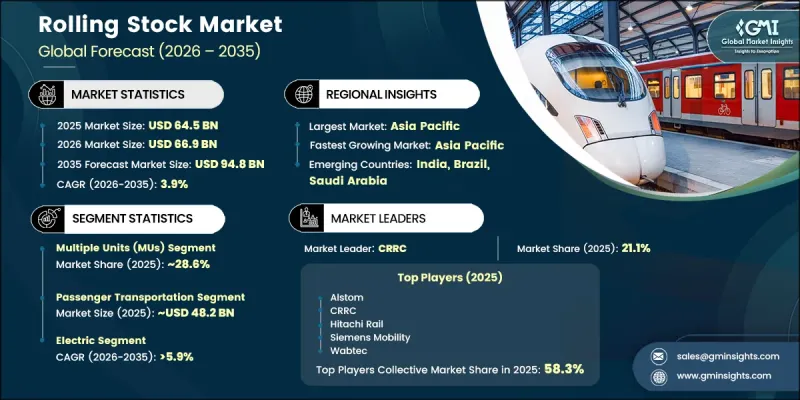
세계 각국이 경제 성장을 뒷받침하기 위해 교통 인프라를 강화하는 가운데, 세계 철도 네트워크의 확장은 기관차, 여객 및 화물 차량에 대한 꾸준한 수요를 지속적으로 자극하고 있습니다. 특히 해운과 항공 연결이 제한된 지역에서는 운송 위험과 비용이 증가함에 따라 화물 운송과 여객 운송 모두에서 철도의 중요성이 점점 더 커지고 있습니다. 국경 간 무역이 활발해짐에 따라 각국 정부는 철도 시스템에 크게 의존하는 장기적인 물류 전략을 우선시하고 있습니다. 이에 따라 중량 화물 운송과 안정적인 도시 교통을 지원할 수 있는 첨단 철도 차량에 대한 수요가 증가하고 있습니다. 급속한 도시화로 인해 교통 시스템에 대한 투자도 증가하고 있으며, 인구 증가에 따라 효율적인 교통 솔루션이 요구되고 있습니다. 많은 국가들이 기존 차량 교체, 고속철도 노선 확장, 새로운 지하철 및 경전철의 용량 증설을 추진하고 있습니다. 지속가능성에 대한 노력이 진전되고 철도 운송이 대규모 이동을 위한 저배출 옵션으로 부상함에 따라 이 시장은 향후 10년간 꾸준한 성장세를 유지할 것으로 예측됩니다.
| 시장 범위 | |
|---|---|
| 개시 연도 | 2025년 |
| 예측 기간 | 2026-2035년 |
| 개시 연도 시장 규모 | 645억 달러 |
| 예측 시장 규모 | 948억 달러 |
| CAGR | 3.9% |
2025년에는 다연식 차량(MU) 부문이 약 28.6%의 점유율을 차지했고, 약 185억 달러의 매출을 창출하며 시장을 주도했습니다. 다연식 차량은 여전히 가장 널리 도입된 카테고리로, 특히 철도 전철화가 널리 진행되고 있는 지역에서 가장 널리 도입된 카테고리입니다. 이러한 열차 시스템은 주로 전철 및 교외 철도망에서 활용되고 있으며, 철도 전기화 인프라 확충에 초점을 맞춘 정부의 지속적인 노력에 의해 뒷받침되고 있습니다. MU는 전력망을 동력원으로 하는 현대 철도 운송 시스템의 중요한 구성 요소입니다. 전기식 다연결 차량(EMU)은 특히 유럽과 아시아에서 널리 보급되고 있으며, 높은 운영 효율성, 배기가스 배출 감소 및 고빈도 여객 운송 서비스에 대한 적합성으로 인해 선호되고 있습니다.
여객 차량 부문은 2025년 74.7%의 점유율을 차지했습니다. 신뢰할 수 있는 도시 교통에 대한 수요가 증가함에 따라 지하철 시스템, 통근 열차 및 다연결 차량에 대한 도입이 계속 증가하고 있습니다. 이는 도시가 현대식 철도 확장 및 차량 업데이트를 통해 교통 체증을 관리하고 일상적인 이동 수단을 개선하기 위함입니다.
미국의 철도 차량 시장은 2025년 74억 달러 규모에 달했습니다. 미국 전역의 성장은 지속적인 인프라 개선, 노후화된 차량의 현대화, 화물 운송량 증가로 뒷받침되고 있습니다. 북미 주요 도시에서는 새로운 교통 노선이 개발되고 있으며, 화물 철도 사업자들은 운영 효율성을 향상시키는 기술에 투자하고 있습니다.
자주 묻는 질문
목차
제1장 조사 방법
제2장 주요 요약
제3장 업계 인사이트
제4장 경쟁 구도
제5장 시장 추산 및 예측 : 제품별(2022-2035년)
제6장 시장 추산 및 예측 : 추진 방식별(2022-2035년)
제7장 시장 추산 및 예측 : 용도별(2022-2035년)
제8장 시장 추산 및 예측 : 지역별(2022-2035년)
제9장 기업 개요
AJY 26.06.11The Global Rolling Stock Market was valued at USD 64.5 billion in 2025 and is estimated to grow at a CAGR of 3.9% to reach USD 94.8 billion by 2035.
The expansion of rail networks worldwide continues to stimulate steady demand for locomotives, passenger vehicles, and freight units as nations strengthen transportation infrastructure to support economic growth. Railways are becoming increasingly important for both freight and passenger movement, especially in regions where limited sea or air connectivity raises transportation risks and costs. As cross-border trade intensifies, governments are prioritizing long-term logistics strategies that depend heavily on rail-based systems. This fuels the need for advanced rolling stock capable of supporting heavy-duty freight movement and reliable urban mobility. Rapid urbanization also drives investments in transit systems, as growing populations require efficient transportation solutions. Many countries are upgrading their existing train fleets, expanding high-speed corridors, and adding new metro and light rail capacity. With sustainability commitments evolving and rail transport emerging as a low-emission choice for large-scale movement, the market is likely to maintain consistent growth throughout the next decade.
| Market Scope | |
|---|---|
| Start Year | 2025 |
| Forecast Year | 2026-2035 |
| Start Value | $64.5 Billion |
| Forecast Value | $94.8 Billion |
| CAGR | 3.9% |
The multiple units (MUs) segment led the market with an approximate share of 28.6% and generated revenue of around USD 18.5 billion in 2025. Multiple-unit rolling stock remains the most widely deployed category, particularly in regions where railway electrification is extensively implemented. These train systems are predominantly utilized in electrified and suburban rail networks, supported by ongoing government initiatives focused on expanding rail electrification infrastructure. MUs are a key component of modern rail transit systems powered by electricity-based networks. Electric multiple units (EMUs) are especially prevalent across Europe and Asia, where they are favored for their operational efficiency, lower emissions, and suitability for high-frequency passenger transport services.
The passenger-related rolling stock segment held a 74.7% share in 2025. Increasing demand for dependable urban travel continues to drive the adoption of metro systems, commuter trains, and multiple-unit vehicles, as cities look for ways to manage congestion and improve daily mobility through modern rail expansions and fleet upgrades.
U.S. Rolling Stock Market generated USD 7.4 billion in 2025. Growth across the country is supported by ongoing infrastructure enhancements, modernization of older vehicles, and rising freight movement. Major cities across North America are advancing new transit lines while freight rail operators invest in technologies that improve operational efficiency.
Key companies participating in the Global Rolling Stock Market include Alstom, Stadler Rail, Kawasaki Heavy Industries, Wabtec, Hyundai Rotem, The Greenbrier Companies, Hitachi Rail, CRRC, Siemens, and CAF. Companies in the Global Rolling Stock Market are adopting strategies that strengthen their competitive position across both passenger and freight markets. Many are expanding manufacturing capabilities and focusing on modular platforms that support easier customization for different regions. Firms are investing in energy-efficient propulsion systems, digital monitoring tools, and automation technologies to improve performance and reduce operational costs. Strategic partnerships with governments and transit agencies allow companies to secure long-term contracts for fleet renewal and major rail expansions. Global players are also increasing their presence in emerging markets by forming joint ventures and establishing local production units to meet regional demand.
Table of Contents
Chapter 1 Methodology
- 1.1 Research approach
- 1.2 Quality Commitments
- 1.2.1 GMI AI policy & data integrity commitment
- 1.3 Research Trail & Confidence Scoring
- 1.3.1 Research Trail Components
- 1.3.2 Scoring Components
- 1.4 Data Collection
- 1.5 Data mining sources
- 1.5.1 Paid sources
- 1.6 Base estimates and calculations
- 1.6.1 Base year calculation for any one approach
- 1.7 Forecast
- 1.7.1 Quantified market impact analysis
- 1.8 Research transparency addendum
- 1.8.1 Source attribution framework
- 1.8.2 Quality assurance metrics
- 1.8.3 Our commitment to trust
Chapter 2 Executive Summary
- 2.1 Industry 360° synopsis
- 2.2 Key market trends
- 2.2.1 Regional
- 2.2.2 Product
- 2.2.3 Propulsion
- 2.2.4 Application
- 2.3 TAM analysis, 2026-2035
- 2.4 CXO perspectives: Strategic imperatives
Chapter 3 Industry Insights
- 3.1 Industry ecosystem analysis
- 3.1.1 Supplier landscape
- 3.1.2 Profit margin analysis
- 3.1.3 Cost structure
- 3.1.4 Value addition at each stage
- 3.1.5 Factor affecting the value chain
- 3.1.6 Disruptions
- 3.2 Industry Impact forces
- 3.2.1 Growth drivers
- 3.2.1.1 Rising urbanization & public transit demand
- 3.2.1.2 Government infrastructure investment programs
- 3.2.1.3 Rail network expansion & modernization initiatives
- 3.2.1.4 Industry 4.0 & smart manufacturing adoption
- 3.2.2 Industry pitfalls & challenges
- 3.2.2.1 Long project development & procurement cycles
- 3.2.2.2 Geopolitical tensions & trade restrictions
- 3.2.3 Market opportunities
- 3.2.3.1 Electrification & green propulsion technologies
- 3.2.3.2 Emerging markets & developing economies transit development
- 3.2.3.3 Fleet modernization & retrofitting services
- 3.2.1 Growth drivers
- 3.3 Technology trends & innovation ecosystem
- 3.3.1 Current technologies
- 3.3.1.1 Regenerative Braking Systems
- 3.3.1.2 Distributed Traction Systems
- 3.3.1.3 Condition-Based Maintenance (CBM)
- 3.3.2 Emerging technologies
- 3.3.2.1 Automatic Train Operation (ATO)
- 3.3.2.2 Hydrogen Fuel Cell Propulsion
- 3.3.2.3 Battery-Electric Multiple Units (BEMU)
- 3.3.2.4 Digital Twins for Rolling Stock
- 3.3.1 Current technologies
- 3.4 Growth potential analysis
- 3.5 Pricing Analysis (Driven by Primary Research)
- 3.5.1 Historical Price Trend Analysis
- 3.5.2 Pricing Strategy by Player Type (Premium / Value / Cost-plus)
- 3.6 Regulatory landscape
- 3.6.1 North America
- 3.6.1.1 US - Federal Railroad Administration (FRA)
- 3.6.1.2 Canada - Canadian Standards Association
- 3.6.2 Europe
- 3.6.2.1 EU - European Union Agency for Railways (ERA)
- 3.6.2.2 France - UIC (International Union of Railways)
- 3.6.3 Asia Pacific
- 3.6.3.1 India - Ministry of Railways / Indian Railways
- 3.6.3.2 China - China Railway Corporation
- 3.6.4 Latin America
- 3.6.4.1 Brazil - Agencia Nacional de Transporte Ferroviario (ANTF)
- 3.6.4.2 Mexico - Agencia Reguladora del Transporte Ferroviario
- 3.6.4.3 de Mexico (ARTF)
- 3.6.5 Middle East & Africa
- 3.6.5.1 UAE - Ministry of Energy and Infrastructure (MEI)
- 3.6.5.2 Saudi Arabia - Saudi Rail Authority
- 3.6.1 North America
- 3.7 Porter's analysis
- 3.8 PESTEL analysis
- 3.9 Patent analysis (Driven by Primary Research)
- 3.10 Trade Data Analysis (Driven by Paid Database)
- 3.10.1 Import/Export Volume & Value Trends
- 3.10.2 Key Trade Corridors & Tariff Impact
- 3.11 Capacity & Production Landscape (Driven by Primary Research)
- 3.11.1 Installed Capacity by Region & Key Producer
- 3.11.2 Capacity Utilization Rates & Expansion Pipelines
- 3.12 Cost breakdown analysis
- 3.13 Rail connectivity & IoT ecosystem
- 3.13.1 IoT integration in rolling stock operations
- 3.13.2 Predictive maintenance & asset management systems
- 3.13.3 Real-time monitoring & data analytics platforms
- 3.13.4 Connectivity standards & interoperability challenges
- 3.14 Urban transit & smart city integration
- 3.14.1 Smart city initiatives & transit integration
- 3.14.2 Multimodal transportation networks
- 3.14.3 Passenger experience & digital services
- 3.14.4 Energy efficiency & sustainability in urban transit
- 3.15 Impact of AI & Generative AI on the Market
- 3.15.1 Generative AI in Test Equipment Development
- 3.15.2 AI for Vehicle Performance Simulation
- 3.15.3 Emissions Testing and Compliance
- 3.16 Forecast assumptions & scenario analysis (Driven by Primary Research)
- 3.16.1 Base Case - key macro & industry variables driving CAGR
- 3.16.2 Optimistic Scenarios - Favorable macro and industry tailwinds
- 3.16.3 Pessimistic Scenario - Macroeconomic slowdown or industry headwinds
Chapter 4 Competitive Landscape, 2025
- 4.1 Introduction
- 4.2 Company market share analysis
- 4.2.1 North America
- 4.2.2 Europe
- 4.2.3 Asia Pacific
- 4.2.4 LATAM
- 4.2.5 MEA
- 4.3 Competitive analysis of major market players
- 4.4 Competitive positioning matrix
- 4.5 Key developments
- 4.5.1 Mergers & acquisitions
- 4.5.2 Partnerships & collaborations
- 4.5.3 New product launches
- 4.5.4 Expansion plans and funding
- 4.6 Company tier benchmarking
- 4.6.1 Tier classification criteria & qualifying thresholds
- 4.6.2 Tier positioning matrix by revenue, geography & innovation
Chapter 5 Market Estimates & Forecast, By Product, 2022 - 2035 ($Mn, Units)
- 5.1 Key trends
- 5.2 Locomotives
- 5.2.1 Diesel locomotives
- 5.2.2 Electric locomotives
- 5.2.3 Electro-diesel locomotives
- 5.2.4 Others
- 5.3 Wagons
- 5.4 Multiple Units (MUs)
- 5.5 Metro Vehicles
- 5.6 Light Rail Vehicles
- 5.7 People Movers & Monorail
- 5.8 High-Speed Trains
- 5.9 Others
Chapter 6 Market Estimates & Forecast, By Propulsion, 2022 - 2035 ($Mn, Units)
- 6.1 Key trends
- 6.2 Diesel
- 6.3 Electric
- 6.4 Electro-diesel
- 6.5 Others
Chapter 7 Market Estimates & Forecast, By Application, 2022 - 2035 ($Mn, Units)
- 7.1 Key trends
- 7.2 Passenger transportation
- 7.3 Freight transportation
Chapter 8 Market Estimates & Forecast, By Region, 2022 - 2035 ($Mn, Units)
- 8.1 Key trends
- 8.2 North America
- 8.2.1 US
- 8.2.2 Canada
- 8.3 Europe
- 8.3.1 Germany
- 8.3.2 UK
- 8.3.3 France
- 8.3.4 Italy
- 8.3.5 Spain
- 8.3.6 Russia
- 8.3.7 Switzerland
- 8.3.8 Netherlands
- 8.3.9 Poland
- 8.4 Asia Pacific
- 8.4.1 China
- 8.4.2 India
- 8.4.3 Japan
- 8.4.4 South Korea
- 8.4.5 Australia
- 8.4.6 Indonesia
- 8.4.7 Malaysia
- 8.4.8 Vietnam
- 8.4.9 Philippines
- 8.5 Latin America
- 8.5.1 Brazil
- 8.5.2 Mexico
- 8.5.3 Argentina
- 8.5.4 Chile
- 8.6 MEA
- 8.6.1 South Africa
- 8.6.2 Saudi Arabia
- 8.6.3 UAE
Chapter 9 Company Profiles
- 9.1 Global players
- 9.1.1 CRRC
- 9.1.2 Alstom
- 9.1.3 Siemens Mobility
- 9.1.4 Stadler Rail
- 9.1.5 Kawasaki Heavy Industries
- 9.1.6 Hitachi Rail
- 9.1.7 CAF
- 9.1.8 Hyundai Rotem
- 9.1.9 Wabtec
- 9.1.10 Talgo
- 9.2 Regional players
- 9.2.1 Skoda Transportation
- 9.2.2 BEML
- 9.2.3 Titagarh Rail Systems
- 9.2.4 Mitsubishi Heavy Industries
- 9.2.5 Nippon Sharyo
- 9.2.6 Progress Rail
- 9.3 Emerging players
- 9.3.1 Trinity Rail
- 9.3.2 Greenbrier Companies
- 9.3.3 Vossloh
- 9.3.4 HEIL India


