

|
시장보고서
상품코드
2038636
왁스 시장 : 시장 기회, 성장요인, 업계 동향 분석 및 예측(2026-2035년)Wax Market Opportunity, Growth Drivers, Industry Trend Analysis, and Forecast 2026 - 2035 |
||||||

세계의 왁스 시장은 2025년에 112억 달러로 평가되었고, 2035년까지 연평균 복합 성장률(CAGR) 3.6%로 성장할 전망이며, 160억 달러에 이를 것으로 추정되고 있습니다.
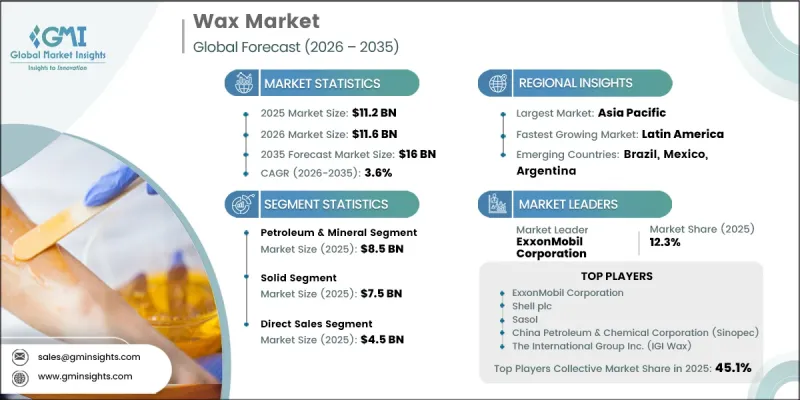
시장 성장은 포장, 퍼스널케어, 산업 제조 및 소비재 부문의 안정적인 수요에 힘입어 성장하고 있습니다. 왁스 재료는 고체 또는 반고체 형태의 광범위한 유기 물질 범주에 속하며, 비교적 낮은 온도에서 연화 또는 용융되며, 내습성, 윤활성, 구조적 보강성 등의 특성으로 평가받고 있습니다. 이러한 재료는 석유 정제, 식물 및 동물과 같은 천연 자원에서 추출하고 특정 성능 특성을 달성하도록 설계된 합성 제조 공정을 통해 생산됩니다. 내구성을 향상시키고, 표면 외관을 개선하며, 방습층으로 작용하는 보호 코팅을 형성하는 능력으로 인해 이러한 재료는 광범위한 산업 분야에서 널리 응용되고 있습니다. 포장재, 화장품, 접착제 및 산업 가공 분야의 소비 증가는 안정적인 수요를 더욱 뒷받침하고 있습니다. 제조 활동의 확대와 지속적인 제품 혁신이 시장의 안정성을 강화하는 한편, 지속 가능하고 고성능 소재에 대한 선호도 변화가 조달 패턴을 형성하고 있습니다. 공급망이 진화하는 용도 요구사항에 적응하는 가운데, 최종 사용 산업 전반에 걸친 지속적인 수요는 기존 생산업체와 신규 진입업체 모두에게 꾸준한 성장을 보장합니다.
| 시장 범위 | |
|---|---|
| 개시 연도 | 2025년 |
| 예측 기간 | 2026-2035년 |
| 개시 연도 시장 규모 | 112억 달러 |
| 예측 시장 규모 | 160억 달러 |
| CAGR | 3.6% |
2025년 석유 및 광물성 왁스 부문은 85억 달러를 차지했습니다. 이 부문은 정제 생산량의 변동이 공급량에 영향을 미치는 반면, 포장, 고무 가공 및 산업용 코팅 용도 분야의 견조한 수요가 지속되고 있기 때문에 계속 발전하고 있습니다. 다양한 용도 분야는 일관된 성능 특성과 여러 산업 공정에서 수년간의 통합을 통해 뒷받침됩니다.
양초 부문은 2025년 38억 달러에 달했습니다. 양초, 포장재, 목재 가공 제품, 장작용 코팅, 접착제 및 고무 용도 분야에서 광범위하게 사용되어 수요가 안정적입니다. 장벽 보호, 접착력 향상, 구조적 안정성과 같은 기능적 특성은 산업에서 그 중요성을 계속 유지하고 있습니다.
북미의 왁스 시장은 2025년 22억 달러로 평가되었고, 2035년까지 34억 달러로 성장할 것으로 예측됩니다. 이 지역의 성장은 활발한 제조 활동과 지속 가능한 소재에 대한 관심 증가에 힘입어 포장, 화장품 및 산업 분야의 꾸준한 수요에 힘입어 성장하고 있습니다. 미국은 품질 표준을 유지하는 데 중요한 역할을 하고 있으며, 퍼스널케어 및 특수 용도의 바이오 왁스 대체품의 채택 확대를 촉진하고 있습니다.
자주 묻는 질문
목차
제1장 조사 방법 및 범위
제2장 주요 요약
제3장 업계 인사이트
제4장 경쟁 구도
제5장 시장 추산 및 예측 : 제품별(2022-2035년)
제6장 시장 추산 및 예측 : 형태별(2022-2035년)
제7장 시장 추산 및 예측 : 용도별(2022-2035년)
제8장 시장 추산 및 예측 : 유통 채널별(2022-2035년)
제9장 시장 추산 및 예측 : 지역별(2022-2035년)
제10장 기업 개요
AJY 26.06.11The Global Wax Market was valued at USD 11.2 billion in 2025 and is estimated to grow at a CAGR of 3.6% to reach USD 16 billion by 2035.
Market growth is supported by steady demand from packaging, personal care, industrial manufacturing, and consumer goods sectors. Wax materials, which include a broad category of organic substances in solid or semi-solid form, soften or melt at relatively low temperatures and are valued for properties such as moisture resistance, lubrication, and structural reinforcement. These materials are produced through petroleum refining, extraction from natural sources such as plants and animals, and synthetic manufacturing processes designed to achieve specific performance characteristics. Their ability to form protective coatings that improve durability, enhance surface appearance, and act as moisture barriers makes them widely applicable across industries. Rising consumption in packaging materials, cosmetics, adhesives, and industrial processing is further supporting consistent demand. Expanding manufacturing activity and ongoing product innovation are reinforcing market stability, while shifting preferences toward sustainable and high-performance materials are shaping procurement patterns. Continuous demand across end-use industries is ensuring steady growth for both established producers and new market entrants as supply chains adapt to evolving application requirements.
| Market Scope | |
|---|---|
| Start Year | 2025 |
| Forecast Year | 2026-2035 |
| Start Value | $11.2 Billion |
| Forecast Value | $16 Billion |
| CAGR | 3.6% |
The petroleum and mineral wax segment accounted for USD 8.5 billion in 2025. This segment continues to evolve as refining output patterns influence availability, while strong demand persists from packaging, rubber processing, and industrial coating applications. Its widespread use is supported by consistent performance characteristics and long-established integration across multiple industrial processes.
The candle segment reached USD 3.8 billion in 2025. Demand remains stable due to its extensive use in candles, packaging materials, wood treatment products, fire-log coatings, and adhesive and rubber applications. Its functional properties, including barrier protection, adhesion support, and structural stability, continue to sustain its industrial relevance.
North America Wax Market is expected to grow from USD 2.2 billion in 2025 to USD 3.4 billion by 2035. Growth in the region is driven by steady demand from packaging, cosmetics, and industrial applications, supported by strong manufacturing activity and rising interest in sustainable materials. The United States plays a key role in maintaining quality standards and encouraging increased adoption of bio-based wax alternatives in personal care and specialty applications.
Key players operating in the Wax Industry include ExxonMobil Corporation, Shell plc, TotalEnergies SE, BASF SE, Sasol, PetroChina (CNPC), Sinopec, Lukoil, Petrobras, The International Group Inc. (IGI Wax), Numaligarh Refinery Limited (NRL), Blayson Group Limited, and HCI Wax. Companies in the wax market are focusing on expanding production capabilities and optimizing refining processes to ensure stable supply and cost efficiency. Strategic investments in bio-based and sustainable wax solutions are being prioritized to align with environmental regulations and shifting consumer preferences. Manufacturers are strengthening supply chain integration through long-term sourcing agreements and regional production facilities. Product innovation efforts are centered on improving performance characteristics such as durability, thermal stability, and application flexibility across industries. Firms are also enhancing collaborations with end-use sectors like packaging and personal care to develop customized wax formulations.
Table of Contents
Chapter 1 Methodology & Scope
- 1.1 Market scope and definition
- 1.2 Research design
- 1.2.1 Research approach
- 1.2.2 Data collection methods
- 1.3 Data mining sources
- 1.3.1 Global
- 1.3.2 Regional/Country
- 1.4 Base estimates and calculations
- 1.4.1 Base year calculation
- 1.4.2 Key trends for market estimation
- 1.5 Primary research and validation
- 1.5.1 Primary sources
- 1.6 Forecast model
- 1.7 Research assumptions and limitations
Chapter 2 Executive Summary
- 2.1 Industry 360° synopsis
- 2.2 Key market trends
- 2.2.1 Product
- 2.2.2 Form
- 2.2.3 Application
- 2.2.4 Distribution Channel
- 2.2.5 Regional
- 2.3 TAM Analysis, 2026-2035
- 2.4 CXO perspectives: Strategic imperatives
- 2.5 Future outlook and strategic recommendations
Chapter 3 Industry Insights
- 3.1 Industry ecosystem analysis
- 3.1.1 Supplier landscape
- 3.1.2 Profit margin
- 3.1.3 Value addition at each stage
- 3.1.4 Factor affecting the value chain
- 3.1.5 Disruptions
- 3.2 Industry impact forces
- 3.2.1 Growth drivers
- 3.2.1.1 Growing demand for protective and moisture-resistant packaging solutions.
- 3.2.1.2 Increasing use of waxes in cosmetics and personal care formulations.
- 3.2.1.3 Rising adoption of sustainable and bio-based wax alternatives.
- 3.2.2 Pitfalls/challenge
- 3.2.2.1 Volatility in crude oil and natural feedstock prices affecting production costs.
- 3.2.2.2 Regulatory pressures limiting conventional wax types in certain applications
- 3.2.3 Opportunities
- 3.2.3.1 Expansion of natural and synthetic wax applications in emerging markets.
- 3.2.3.2 Development of high-performance waxes for specialized industrial uses
- 3.2.1 Growth drivers
- 3.3 Growth potential analysis
- 3.4 Regulatory landscape
- 3.4.1 North America
- 3.4.2 Europe
- 3.4.3 Asia Pacific
- 3.4.4 Latin America
- 3.4.5 Middle East & Africa
- 3.5 Porter's analysis
- 3.6 PESTEL analysis
- 3.7 Technology and innovation landscape
- 3.7.1 Current technological trends
- 3.7.2 Emerging technologies
- 3.8 Price trends
- 3.8.1 By region
- 3.8.2 By product
- 3.9 Future market trends
- 3.10 Patent landscape
- 3.11 Trade statistics (HS code)
- 3.11.1 Major importing countries
- 3.11.2 Major exporting countries
- 3.12 Sustainability and environmental aspects
- 3.12.1 Sustainable practices
- 3.12.2 Waste reduction strategies
- 3.12.3 Energy efficiency in production
- 3.12.4 Eco-friendly initiatives
- 3.13 Carbon footprint consideration
Chapter 4 Competitive Landscape, 2025
- 4.1 Introduction
- 4.2 Company market share analysis
- 4.2.1 By region
- 4.2.1.1 North America
- 4.2.1.2 Europe
- 4.2.1.3 Asia Pacific
- 4.2.1.4 LATAM
- 4.2.1.5 MEA
- 4.2.1 By region
- 4.3 Company matrix analysis
- 4.4 Competitive analysis of major market players
- 4.5 Competitive positioning matrix
- 4.6 Key developments
- 4.6.1 Mergers & acquisitions
- 4.6.2 Partnerships & collaborations
- 4.6.3 New product launches
- 4.6.4 Expansion plans
Chapter 5 Market Estimates and Forecast, By Product, 2022-2035 (USD Billion) (Kilo Tons)
- 5.1 Key trends
- 5.2 Petroleum & mineral
- 5.2.1 Paraffin
- 5.2.2 Microcrystalline
- 5.2.3 Petrolatum
- 5.3 Synthetic
- 5.3.1 GTL waxes
- 5.3.2 Polymer waxes
- 5.4 Natural
- 5.4.1 Beeswax
- 5.4.2 Vegetable wax
Chapter 6 Market Estimates and Forecast, By Form, 2022-2035 (USD Billion) (Kilo Tons)
- 6.1 Key trends
- 6.2 Solid
- 6.3 Liquid
- 6.4 Powder
- 6.5 Emulsion
Chapter 7 Market Estimates and Forecast, By Application, 2022-2035 (USD Billion) (Kilo Tons)
- 7.1 Key trends
- 7.2 Candles
- 7.3 Packaging
- 7.4 Wood & fire-logs
- 7.5 Rubber & adhesives
- 7.6 Cosmetics
- 7.7 Pharmaceuticals
- 7.8 Plastic
- 7.9 Other
Chapter 8 Market Estimates and Forecast, By Distribution Channel, 2022-2035 (USD Billion) (Kilo Tons)
- 8.1 Key trends
- 8.2 Direct sales
- 8.3 Distributors & wholesalers
- 8.4 Online/E-commerce platforms
- 8.5 Others
Chapter 9 Market Estimates and Forecast, By Region, 2022-2035 (USD Billion) (Kilo Tons)
- 9.1 Key trends
- 9.2 North America
- 9.2.1 U.S.
- 9.2.2 Canada
- 9.3 Europe
- 9.3.1 Germany
- 9.3.2 UK
- 9.3.3 France
- 9.3.4 Spain
- 9.3.5 Italy
- 9.3.6 Rest of Europe
- 9.4 Asia Pacific
- 9.4.1 China
- 9.4.2 India
- 9.4.3 Japan
- 9.4.4 Australia
- 9.4.5 South Korea
- 9.4.6 Rest of Asia Pacific
- 9.5 Latin America
- 9.5.1 Brazil
- 9.5.2 Mexico
- 9.5.3 Argentina
- 9.5.4 Rest of Latin America
- 9.6 Middle East and Africa
- 9.6.1 Saudi Arabia
- 9.6.2 South Africa
- 9.6.3 UAE
- 9.6.4 Rest of Middle East and Africa
Chapter 10 Company Profiles
- 10.1 ExxonMobil Corporation
- 10.2 China Petroleum & Chemical Corporation (Sinopec)
- 10.3 Shell plc
- 10.4 Sasol
- 10.5 The International Group Inc. (IGI Wax)
- 10.6 Petroleo Brasileiro S.A. (Petrobras)
- 10.7 China National Petroleum Corporation (CNPC)
- 10.8 Lukoil
- 10.9 TotalEnergies SE
- 10.10 Numaligarh Refinery Limited (NRL)
- 10.11 HCI Wax
- 10.12 Blayson Group Limited
- 10.13 BASF SE


