|
시장보고서
상품코드
2038645
2축 태양광 추적기 시장 : 시장 기회, 성장 요인, 업계 동향 분석 및 예측(2026-2035년)Dual Axis Solar Tracker Market Opportunity, Growth Drivers, Industry Trend Analysis, and Forecast 2026 - 2035 |
||||||

세계의 2축 태양광 추적기 시장은 2025년에 212억 달러로 평가되었고, CAGR 9.8%로 성장할 전망이며, 2035년까지 541억 달러에 이를 것으로 예측됩니다.
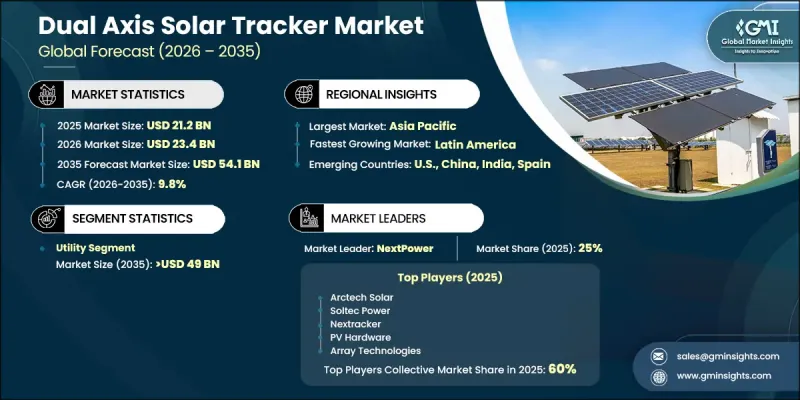
태양광 발전 효율 향상에 대한 수요 증가, 대규모 태양광 발전소 도입 확대, 스마트 추적 기술의 지속적인 발전이 시장 성장을 견인하고 있습니다. 2축 태양광 추적기는 수평면과 수직면을 따라 패널의 방향을 조정하여 태양광 발전의 성능을 향상시켜 하루 종일, 계절 변화에 따라 최적의 일사량을 보장합니다. 인공지능(AI), 사물인터넷(IoT) 연결 및 원격 모니터링 시스템의 통합으로 운영 효율성과 시스템 지능화가 더욱 강화되고 있습니다. 또한, 모듈식 및 단순화된 설치 설계로 설치의 복잡성을 줄이고 대규모 태양광 발전 프로젝트에서 확장성을 향상시킵니다. 에너지 수율 극대화에 대한 관심이 높아지면서, 특히 일사량이 많은 지역에서 태양광 발전의 보급이 확대되고 있습니다. 재생에너지 목표, 순계량제, 인센티브 프로그램 등 지원적인 규제 프레임워크가 시장 침투를 더욱 가속화하고 있습니다. 청정 에너지로의 전환과 탈탄소화 목표에 대한 전 세계의 관심이 높아지면서 고효율 태양광 기술에 대한 투자도 증가하고 있습니다. 정부와 민간 개발업체들이 토지 이용의 최적화와 설치당 에너지 생산량 증가를 우선시하는 가운데, 2축 태양광 추적기는 대규모 재생에너지 확대 전략에서 점점 더 중요한 역할을 하게 될 것입니다.
| 시장 범위 | |
|---|---|
| 개시 연도 | 2025년 |
| 예측 기간 | 2026-2035년 |
| 개시 연도 시장 규모 | 212억 달러 |
| 예측 기간 시장 규모 | 541억 달러 |
| CAGR | 9.8% |
유틸리티 규모 부문은 2035년까지 490억 달러에 달할 것으로 예측됩니다. 시장 확대는 민관 이해관계자들의 투자 증가와 더불어 추적 시스템의 성능과 신뢰성이 지속적으로 향상되고 있기 때문입니다. 태양광 발전 개발업체와 정부기관과의 협력 강화로 프로젝트 실행력과 도입 효율이 향상되고 있습니다. 또한, 안전 기준, 구조적 요건, 설치 가이드라인 등을 포괄하는 규제 프레임워크가 정비되어 체계적인 시장 발전을 지원하고 유틸리티 규모의 태양광 발전 프로젝트에서 대규모 도입을 촉진하고 있습니다.
미국의 2축 태양광 추적기 시장은 2035년까지 6억 2,000만 달러에 달할 것으로 예측됩니다. 이 지역의 성장은 태양광 부품의 가격 하락과 태양광, 풍력 등 재생에너지의 도입 확대에 힘입어 성장세를 보이고 있습니다. 추적기 설계의 기술적 진보로 인해 운영 효율성, 내구성 및 성능 안정성이 향상되어 시장 수용성 확대에 기여하고 있습니다. 또한, 토지 이용 효율의 향상과 설치당 발전 밀도 증가가 도입을 촉진하고 있으며, 특히 토지 확보가 어려운 지역에서 두드러지게 나타나고 있습니다.
자주 묻는 질문
목차
제1장 조사 방법 및 범위
제2장 주요 요약
제3장 업계 인사이트
제4장 경쟁 구도
제5장 시장 규모 및 예측 : 용도별(2022-2035년)
제6장 시장 규모 및 예측 : 지역별(2022-2035년)
제7장 기업 개요
AJY 26.05.28The Global Dual Axis Solar Tracker Market was valued at USD 21.2 billion in 2025 and is estimated to grow at a CAGR of 9.8% to reach USD 54.1 billion by 2035.
Market growth is driven by the rising demand for higher solar energy efficiency, increasing deployment of utility-scale solar farms, and continuous advancements in smart tracking technologies. Dual-axis solar trackers enhance photovoltaic performance by adjusting panel orientation along both horizontal and vertical planes, enabling optimal solar exposure throughout the day and across seasonal variations. The integration of artificial intelligence, Internet of Things connectivity, and remote monitoring systems is further strengthening operational efficiency and system intelligence. Additionally, modular and simplified installation designs are reducing deployment complexity and improving scalability for large solar projects. Growing emphasis on maximizing energy yield is encouraging wider adoption, particularly in regions with high solar irradiance. Supportive regulatory frameworks, including renewable energy targets, net metering structures, and incentive programs, are further accelerating market penetration. Increasing global focus on clean energy transition and decarbonization goals is also reinforcing investment in high-efficiency solar technologies. As governments and private developers prioritize optimized land utilization and higher energy output per installation, dual-axis solar trackers are becoming increasingly relevant in large-scale renewable energy expansion strategies.
| Market Scope | |
|---|---|
| Start Year | 2025 |
| Forecast Year | 2026-2035 |
| Start Value | $21.2 Billion |
| Forecast Value | $54.1 Billion |
| CAGR | 9.8% |
The utility-scale segment is expected to reach USD 49 billion by 2035. Market expansion is being driven by rising investments from both public and private stakeholders, along with continuous improvements in tracking system performance and reliability. Increasing collaboration between solar developers and government-backed entities is strengthening project execution and deployment efficiency. Additionally, evolving regulatory frameworks covering safety standards, structural requirements, and installation guidelines are supporting structured market development and encouraging large-scale adoption across utility solar projects.
U.S. Dual Axis Solar Tracker Market is projected to reach USD 0.62 billion by 2035. Growth in the region is supported by declining costs of solar components and expanding adoption of renewable energy sources such as solar and wind. Technological improvements in tracker design have enhanced operational efficiency, durability, and performance consistency, contributing to broader market acceptance. Furthermore, improved land utilization and higher energy generation density per installation are driving adoption, especially in regions where land availability is limited.
Key companies operating in the Global Dual Axis Solar Tracker Industry include Arctech Solar, Array Technologies, Ideematec, PV Hardware, Mechatron Solar, Scorpius Trackers, Soltec, SunPower Corporation, Degerenergie, Abengoa, Convert Italia, Haosolar, NextPower, AllEarth Renewables, PARU, Stracker Incorporated, Sun Action Trackers, Suntactics, Solar CenTex, and Targray. Companies in the dual axis solar tracker market are focusing on advanced technology integration such as AI-based tracking optimization, IoT-enabled remote monitoring, and predictive maintenance systems to improve efficiency and reliability. They are investing in modular and lightweight designs to reduce installation time and project costs while improving scalability for large solar installations. Strategic partnerships with utility developers and energy providers are being strengthened to secure long-term project pipelines. Manufacturers are also expanding their global presence through mergers, acquisitions, and regional collaborations. Continuous research and development efforts are focused on improving durability, structural stability, and energy yield performance.
Table of Contents
Chapter 1 Methodology & Scope
- 1.1 Market design
- 1.2 Quality commitment
- 1.2.1 GMI AI policy & data integrity commitment
- 1.2.1.1 Source consistency protocol
- 1.2.1 GMI AI policy & data integrity commitment
- 1.3 Research trail & Confidence Scoring
- 1.3.1 Research trail components
- 1.3.2 Scoring components
- 1.4 Data Collection
- 1.4.1 Partial list of primary sources
- 1.5 Data mining sources
- 1.5.1 Paid sources
- 1.5.1.1 Sources, by region
- 1.5.1 Paid sources
- 1.6 Base estimates and calculations
- 1.6.1 Base year calculation for any one approach
- 1.7 Forecast model
- 1.8 Research transparency addendum
- 1.8.1 Source attribution framework
- 1.8.2 Quality assurance metrics
- 1.8.3 Our commitment to trust
- 1.9 Market definitions
Chapter 2 Executive Summary
- 2.1 Industry synopsis, 2022 - 2035
- 2.2 Business trends
- 2.3 Application trends
- 2.4 Regional trends
Chapter 3 Industry Insights
- 3.1 Industry ecosystem
- 3.2 Regulatory landscape
- 3.3 Industry impact forces
- 3.3.1 Growth drivers
- 3.3.2 Industry pitfalls & challenges
- 3.4 Growth potential analysis
- 3.5 Porter's analysis
- 3.5.1 Bargaining power of suppliers
- 3.5.2 Bargaining power of buyers
- 3.5.3 Threat of new entrants
- 3.5.4 Threat of substitutes
- 3.6 PESTEL Analysis
- 3.6.1 Political factors
- 3.6.2 Economic factors
- 3.6.3 Social factors
- 3.6.4 Technological factors
- 3.6.5 Legal factors
- 3.6.6 Environmental factors
- 3.7 Cost structure analysis
- 3.8 Price trend analysis, 2022-2035
- 3.8.1 By Application
- 3.8.2 By Region
- 3.9 Emerging opportunities & trends
- 3.9.1 Digitalization & IoT integration
- 3.9.2 Investment analysis & future outlook
Chapter 4 Competitive landscape, 2026
- 4.1 Introduction
- 4.2 Company market share analysis, by region, 2025
- 4.2.1 North America
- 4.2.2 Europe
- 4.2.3 Asia Pacific
- 4.2.4 Middle East
- 4.2.5 Africa
- 4.2.6 Latin America
- 4.3 Competitive positioning matrix
- 4.4 Key developments
- 4.4.1 Mergers & acquisitions
- 4.4.2 Partnerships & collaborations
- 4.4.3 New product launches
- 4.4.4 Expansion plans & funding
Chapter 5 Market Size and Forecast, By Application, 2022 - 2035 (USD Million & MW)
- 5.1 Key trends
- 5.2 Residential
- 5.3 Commercial & Industrial
- 5.4 Utility
Chapter 6 Market Size and Forecast, By Region, 2022 - 2035 (USD Million & MW)
- 6.1 Key trends
- 6.2 North America
- 6.2.1 U.S.
- 6.2.2 Canada
- 6.2.3 Mexico
- 6.3 Europe
- 6.3.1 UK
- 6.3.2 France
- 6.3.3 Netherlands
- 6.3.4 Germany
- 6.3.5 Sweden
- 6.3.6 Spain
- 6.3.7 Austria
- 6.4 Asia Pacific
- 6.4.1 China
- 6.4.2 Australia
- 6.4.3 India
- 6.4.4 Japan
- 6.4.5 South Korea
- 6.5 Middle East
- 6.5.1 Saudi Arabia
- 6.5.2 UAE
- 6.5.3 Jordan
- 6.5.4 Israel
- 6.6 Africa
- 6.6.1 South Africa
- 6.6.2 Egypt
- 6.6.3 Algeria
- 6.6.4 Nigeria
- 6.6.5 Morocco
- 6.7 Latin America
- 6.7.1 Brazil
- 6.7.2 Chile
Chapter 7 Company Profiles
- 7.1 Abengoa
- 7.2 Arctech Solar
- 7.3 AllEarth Renewables
- 7.4 Array Technologies
- 7.5 Convert Italia
- 7.6 Degerenergie
- 7.7 Haosolar
- 7.8 Ideematec
- 7.9 Mechatron Solar
- 7.10 NextPower
- 7.11 PARU
- 7.12 PV Hardware
- 7.13 Scorpius Trackers
- 7.14 Solar CenTex
- 7.15 Soltec
- 7.16 SunPower Corporation
- 7.17 Stracker Incorporated
- 7.18 Sun Action Trackers
- 7.19 Suntactics
- 7.20 Targray