|
시장보고서
상품코드
2038415
주택용 솔라 트래커 시장 기회, 성장요인, 업계 동향 분석 및 예측(2026-2035년)Residential Solar Tracker Market Opportunity, Growth Drivers, Industry Trend Analysis, and Forecast 2026 - 2035 |
||||||

세계의 주택용 솔라 트래커 시장은 2025년에 11억 달러로 평가되었고 CAGR 11.5%로 성장하여 2035년까지 34억 달러에 이를 것으로 예측됩니다.
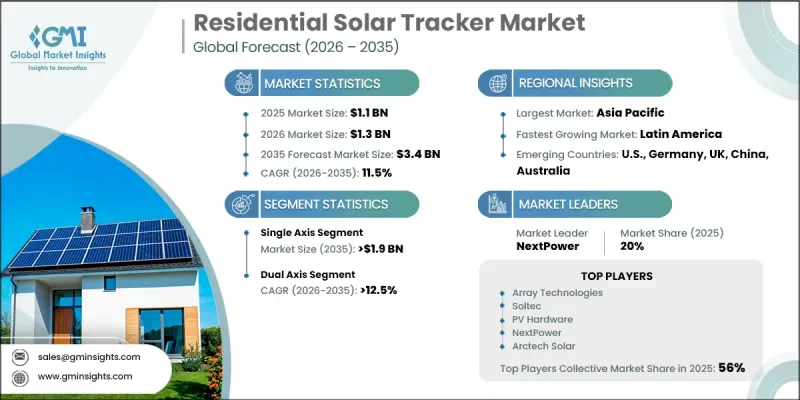
주택용 태양광 발전의 보급이 확대되고 주택 소유자가 더 높은 발전량과 시스템 효율을 중시함에 따라 이 시장은 강한 추진력을 보이고 있습니다. 태양의 움직임에 따라 태양광 패널과 거울의 방향을 자동으로 조정하는 솔라 트래커는 태양광 발전의 성능 향상에 중요한 요소로 자리 잡고 있습니다. 하루 종일 일사량을 최적화하는 능력은 전체 시스템의 효율성을 높이고 장기적으로 발전량을 증가시킵니다. 유리한 정책 프레임워크와 인센티브 프로그램에 힘입어 재생에너지 발전 도입에 대한 관심이 높아지면서 시장 확대에 크게 기여하고 있습니다. 기계 설계의 개선, 재료의 개선, 첨단 제어 시스템 등 추적 시스템의 기술적 진보로 인해 설치의 복잡성과 운영 비용이 감소하고 있습니다. 인공지능 및 IoT 기반 모니터링과 같은 디지털 기술의 통합으로 추적 정확도, 시스템 신뢰성 및 에너지 최적화가 더욱 향상되고 있습니다. 비용 효율적이고 고성능의 태양광 발전 솔루션에 대한 수요가 증가하면서 주택용 태양광 발전의 도입이 확대되고 있으며, 이는 전체 시장 전망을 더욱 견고하게 하고 있습니다.
| 시장 범위 | |
|---|---|
| 시작 연도 | 2025년 |
| 예측 기간 | 2026-2035년 |
| 시작 연도 시장 규모 | 11억 달러 |
| 예측 규모 | 34억 달러 |
| CAGR | 11.5% |
단축 추적 시스템 시장은 비용 효율성과 성능의 균형이 필수적인 태양광 발전 설비에서 도입이 확대되고 있는 것을 배경으로 2035년까지 19억 달러에 달할 것으로 예측됩니다. 이 유형의 트래커는 설치 비용이 상대적으로 낮고, 필요한 자재가 적고, 설치 과정이 간단하기 때문에 널리 선호되고 있습니다. 또한, 이러한 구조는 유지보수의 필요성과 기계적 복잡성을 최소화하여 장기적인 운영비용을 절감할 수 있습니다. 이러한 장점은 시스템의 복잡성이나 비용을 크게 증가시키지 않으면서도 효율을 향상시켜야 하는 주거용 및 대규모 발전소용 용도에서 실용적인 선택이 될 수 있습니다.
미국의 주거용 솔라 트래커 시장은 추적 기술의 급속한 발전과 지능형 에너지 관리 시스템의 보급에 힘입어 2035년까지 2억 달러에 달할 것으로 예측됩니다. IoT와 인공지능의 통합이 진행됨에 따라 실시간 모니터링이 향상되고 시스템 성능이 최적화되어 제품 수요를 더욱 촉진하고 있습니다. 에너지 소비 증가 추세와 더불어 지속 가능하고 재생 가능한 에너지원에 대한 관심이 높아짐에 따라 태양광 발전 솔루션에 대한 의존도가 높아지고 있습니다. 이러한 변화는 주택용 설치에서 태양광 추적 시스템의 도입 확대에 기여하고 있으며, 장기적으로 시장 확대를 견인하고 있습니다.
자주 묻는 질문
목차
제1장 조사 방법과 범위
제2장 주요 요약
제3장 업계 인사이트
제4장 경쟁 구도
제5장 시장 규모와 예측 : 제품별, 2022-2035년
제6장 시장 규모와 예측 : 지역별, 2022-2035년
제7장 기업 개요
JHS 26.05.29The Global Residential Solar Tracker Market was valued at USD 1.1 billion in 2025 and is estimated to grow at a CAGR of 11.5% to reach USD 3.4 billion by 2035.
The market is gaining strong traction as residential solar adoption expands and homeowners increasingly prioritize higher energy output and system efficiency. Solar trackers, which automatically adjust the orientation of solar panels or mirrors to follow the sun's movement, are becoming an important component in improving solar energy generation performance. Their ability to optimize sunlight exposure throughout the day enhances overall system efficiency and boosts long-term energy yields. Growing interest in renewable energy adoption, supported by favorable policy frameworks and incentive programs, is significantly contributing to market expansion. Technological improvements in tracking systems, including enhanced mechanical designs, improved materials, and advanced control systems, are reducing installation complexity and operational costs. The integration of digital technologies such as artificial intelligence and IoT-based monitoring is further improving tracking precision, system reliability, and energy optimization. Increasing demand for cost-effective and high-performance solar solutions is also encouraging wider adoption in residential applications, strengthening the overall market outlook.
| Market Scope | |
|---|---|
| Start Year | 2025 |
| Forecast Year | 2026-2035 |
| Start Value | $1.1 Billion |
| Forecast Value | $3.4 Billion |
| CAGR | 11.5% |
The single axis segment is expected to reach USD 1.9 billion by 2035, driven by its strong adoption in solar installations where cost efficiency and performance balance are essential. This type of tracker is widely preferred due to its relatively lower installation costs, reduced material requirements, and simplified setup process. Its operational structure also minimizes maintenance needs and mechanical complications, resulting in lower long-term operating expenses. These advantages make it a practical choice for residential and utility-scale applications where efficiency gains are required without significantly increasing system complexity or cost.
U.S. Residential Solar Tracker Market is projected to reach USD 200 million by 2035, supported by rapid advancements in tracking technology and increasing adoption of intelligent energy management systems. Enhanced integration of IoT and artificial intelligence is improving real-time monitoring and optimizing system performance, further driving product demand. Rising energy consumption trends, combined with a growing focus on sustainable and renewable energy sources, are encouraging greater reliance on solar-based solutions. This shift is contributing to stronger adoption of solar tracking systems across residential installations, reinforcing long-term market expansion.
Key companies operating in the Global Residential Solar Tracker Market include Array Technologies, Nextracker, Arctech Solar, GameChange Solar, Ideematec, FTC Solar, Soltec Power Holdings, PVHardware, ArcelorMittal, Valmont Industries, Degerenergie, Convert Italia, Mecasolar, Sunfolding, Haosolar, Scorpius Trackers, Powerway Renewable Energy, Sun Action Trackers, All Earth Renewables, and Targray Technology International. Companies in the Residential Solar Tracker Market are actively strengthening their market position through continuous technological innovation and system optimization. Many manufacturers are focusing on developing cost-efficient and high-precision tracking systems that improve energy output while reducing installation complexity. Strategic partnerships with solar developers and energy solution providers are helping expand market reach and accelerate adoption. Firms are increasingly investing in IoT-enabled monitoring systems and AI-driven tracking algorithms to enhance performance accuracy and real-time system control. Expansion of production capabilities and regional manufacturing facilities is also supporting cost reduction and supply chain efficiency.
Table of Contents
Chapter 1 Methodology & Scope
- 1.1 Market design
- 1.2 Quality commitment
- 1.2.1 GMI AI policy & data integrity commitment
- 1.2.1.1 Source consistency protocol
- 1.2.1 GMI AI policy & data integrity commitment
- 1.3 Research trail & confidence scoring
- 1.3.1 Research trail components
- 1.3.2 Scoring components
- 1.4 Data collection
- 1.4.1 Partial list of primary sources
- 1.5 Data mining sources
- 1.5.1 Paid sources
- 1.5.1.1 Sources, by region
- 1.5.1 Paid sources
- 1.6 Base estimates and calculations
- 1.6.1 Base year calculation for any one approach
- 1.7 Forecast model
- 1.8 Research transparency addendum
- 1.8.1 Source attribution framework
- 1.8.2 Quality assurance metrics
- 1.8.3 Our commitment to trust
- 1.9 Market definitions
Chapter 2 Executive Summary
- 2.1 Industry synopsis, 2022 - 2035
- 2.2 Business trends
- 2.3 Product trends
- 2.4 Regional trends
Chapter 3 Industry Insights
- 3.1 Industry ecosystem
- 3.2 Regulatory landscape
- 3.3 Industry impact forces
- 3.3.1 Growth drivers
- 3.3.2 Industry pitfalls & challenges
- 3.4 Growth potential analysis
- 3.5 Porter's analysis
- 3.5.1 Bargaining power of suppliers
- 3.5.2 Bargaining power of buyers
- 3.5.3 Threat of new entrants
- 3.5.4 Threat of substitutes
- 3.6 PESTEL analysis
- 3.6.1 Political factors
- 3.6.2 Economic factors
- 3.6.3 Social factors
- 3.6.4 Technological factors
- 3.6.5 Legal factors
- 3.6.6 Environmental factors
- 3.7 Cost structure analysis
- 3.8 Price trend analysis, 2022-2035
- 3.8.1 By Product
- 3.8.2 By Region
- 3.9 Emerging opportunities & trends
- 3.9.1 Digitalization & IoT integration
- 3.9.2 Investment analysis & future outlook
Chapter 4 Competitive landscape, 2026
- 4.1 Introduction
- 4.2 Company market share analysis, by country, 2025
- 4.2.1 North America
- 4.2.2 Europe
- 4.2.3 Asia Pacific
- 4.2.4 Middle East
- 4.2.5 Africa
- 4.2.6 Latin America
- 4.3 Competitive positioning matrix
- 4.4 Key developments
- 4.4.1 Mergers & acquisitions
- 4.4.2 Partnerships & collaborations
- 4.4.3 New product launches
- 4.4.4 Expansion plans & funding
Chapter 5 Market Size and Forecast, By Product, 2022 - 2035 (USD Million & MW)
- 5.1 Key trends
- 5.2 Single Axis
- 5.3 Dual Axis
Chapter 6 Market Size and Forecast, By Region, 2022 - 2035 (USD Million & MW)
- 6.1 Key trends
- 6.2 North America
- 6.2.1 U.S.
- 6.2.2 Canada
- 6.2.3 Mexico
- 6.3 Europe
- 6.3.1 UK
- 6.3.2 France
- 6.3.3 Netherlands
- 6.3.4 Germany
- 6.3.5 Sweden
- 6.3.6 Spain
- 6.3.7 Austria
- 6.4 Asia Pacific
- 6.4.1 China
- 6.4.2 India
- 6.4.3 Japan
- 6.4.4 South Korea
- 6.4.5 Australia
- 6.5 Middle East
- 6.5.1 Saudi Arabia
- 6.5.2 UAE
- 6.5.3 Jordan
- 6.5.4 Israel
- 6.6 Africa
- 6.6.1 South Africa
- 6.6.2 Egypt
- 6.6.3 Algeria
- 6.6.4 Nigeria
- 6.6.5 Morocco
- 6.7 Latin America
- 6.7.1 Brazil
- 6.7.2 Chile
Chapter 7 Company Profiles
- 7.1 Array Technologies
- 7.2 All Earth Renewables
- 7.3 ArcelorMittal
- 7.4 Arctech Solar
- 7.5 Convert Italia
- 7.6 Degerenergie
- 7.7 FTC Solar
- 7.8 GameChange Solar
- 7.9 Haosolar
- 7.10 Ideematec
- 7.11 Mecasolar
- 7.12 Nextracker
- 7.13 PVHardware
- 7.14 Powerway Renewable Energy
- 7.15 Scorpius Trackers
- 7.16 Soltec Power Holdings
- 7.17 Sun Action Trackers
- 7.18 Sunfolding
- 7.19 Targray Technology International
- 7.20 Valmont Industries