
|
시장보고서
상품코드
2038673
프로젝트 물류 시장 : 시장 기회, 성장요인, 업계 동향 분석 및 예측(2026-2035년)Project Logistics Market Opportunity, Growth Drivers, Industry Trend Analysis, and Forecast 2026 - 2035 |
||||||

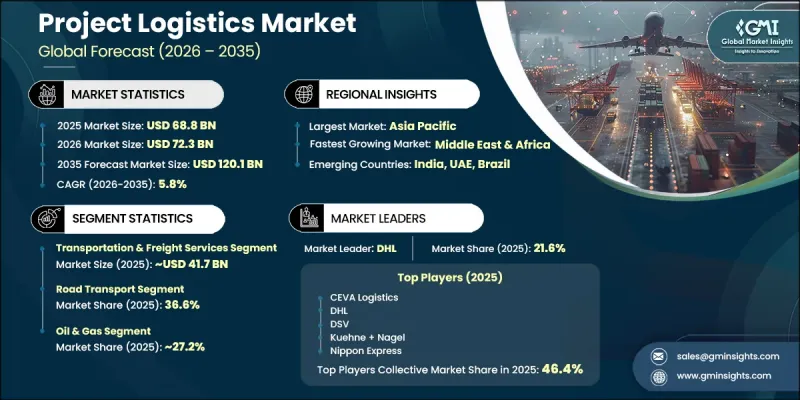
세계의 프로젝트 물류 시장은 2025년에 688억 달러로 평가되었고, CAGR 5.8%로 성장할 전망이며, 2035년까지 1,201억 달러에 이를 것으로 예측됩니다.
시장 역학은 세계 산업 발전의 속도와 규모와 밀접한 관련이 있으며, 점점 더 복잡해지는 인프라 및 에너지 프로젝트에서 고도로 전문화된 물류 솔루션이 요구되고 있습니다. 프로젝트 규모가 확대되고 운영 요구사항이 복잡해짐에 따라 기업들은 운송, 보관, 공급망 실행의 효율적인 조정을 우선순위에 두고 있습니다. 특히 대형 및 고가 장비의 화물 취급이 복잡해짐에 따라 통합적인 물류 계획의 중요성이 더욱 커지고 있습니다. 또한, 대규모 산업 및 에너지 개발의 지속적인 확장은 고급 물류 능력에 대한 수요를 주도하고 있습니다. 시장 진출기업들은 업무 효율성 향상, 리스크 관리 개선, 프로젝트 기한 내 완료 보장에 초점을 맞추었습니다. 이러한 변화는 다양한 지역에서 비용 효율성과 업무의 정확성을 유지하면서 대규모의 다단계 프로젝트를 지원할 수 있는 보다 정교한 물류 프레임워크로의 전환을 반영하고 있습니다.
| 시장 범위 | |
|---|---|
| 개시 연도 | 2025년 |
| 예측 기간 | 2026-2035년 |
| 개시 연도 시장 규모 | 688억 달러 |
| 예측 시장 규모 | 1,201억 달러 |
| CAGR | 5.8% |
합병 및 인수와 같은 전략적 통합 활동은 시장에서의 입지를 강화하고 지리적 범위를 확장하는 데 핵심적인 역할을 하고 있습니다. 기업들은 이러한 전략을 통해 인프라 역량을 강화하고 복잡한 프로젝트를 수행하는 데 필요한 숙련된 전문 지식을 확보할 수 있습니다. 재생에너지 개발 모멘텀이 수요에 크게 기여하고 있으며, 대규모 에너지 이니셔티브에 대한 투자 증가가 이를 뒷받침하고 있습니다. 전 세계 각국 정부는 인프라 및 에너지 프로젝트를 가속화하고 있으며, 이를 위해 고도로 조정된 물류 서비스가 필요합니다. 대규모 설비 도입과 국경을 초월한 개발에 대한 관심이 높아짐에 따라 신뢰할 수 있는 프로젝트 물류 솔루션에 대한 요구가 더욱 높아지고 있습니다. 서비스 제공업체들이 진화하는 산업 요구사항과 세계 프로젝트 확장에 맞추어 역량을 계속 조정하면서 이러한 추세는 장기적인 성장 기회를 창출하고 있습니다.
운송 및 화물 서비스 부문은 60.6%의 점유율을 차지하며, 2025년 417억 달러 시장 규모를 형성했습니다. 이 부문이 선두를 달리고 있는 이유는 중량물 및 대형 화물 운송에는 전문 장비와 운영 노하우가 필요하고, 그 자체로 고비용이 발생하기 때문입니다. 프로젝트 물류의 운송은 복잡한 치수와 중량 요건을 충족하도록 설계된 전용 운송 시스템을 포함한 맞춤형 물류 솔루션을 필요로 합니다. 그 결과, 운송 서비스는 프로젝트 물류 업무의 기반을 형성하고 있습니다. 대규모 산업 프로젝트 증가는 효율적인 물류 처리 솔루션에 대한 수요를 지속적으로 견인하고 있으며, 이 부문에서 시장에서의 선도적 지위를 공고히 하고 있습니다.
2025년 도로 운송 부문은 36.6%의 점유율을 차지했으며, 252억 달러 시장 규모를 창출했습니다. 이 구간은 특히 대체 운송 인프라가 제한적이거나 이용이 불가능한 지역에서 라스트 마일 연결을 보장하는 데 있어 매우 중요한 역할을 합니다. 적응성과 유연성으로 인해 다양한 지형을 가로질러 중량물 및 대형 화물을 운송하는 데 있어 필수적인 존재가 되었습니다. 도로 기반 물류 솔루션은 프로젝트 현장에 직접 접근할 수 있고 원활한 배송 작업을 보장할 수 있기 때문에 널리 사용되고 있습니다. 이 부문의 중요성은 다양한 산업적 용도를 지원할 수 있는 능력으로 인해 더욱 높아졌으며, 전체 프로젝트 물류 생태계에서 중요한 구성 요소로 자리 잡고 있습니다.
미국의 프로젝트 물류 시장은 2025년 94억 달러 규모에 달했으며, 2026-2035년 연평균 5.7%의 성장률을 보일 것으로 전망됩니다. 시장의 성장은 인프라에 대한 지속적인 투자, 산업 확장 및 에너지 개발 이니셔티브에 의해 뒷받침되고 있습니다. 정부 주도의 운송 네트워크 개선을 위한 자금 조달 프로그램은 특히 대규모의 복잡한 화물 운송에 있어 물류 업무의 효율화를 촉진하고 있습니다. 운송 인프라의 지속적인 정비로 대형 화물의 취급이 원활해지고 있으며, 이는 대규모 산업 및 에너지 프로젝트에서 매우 중요한 요소입니다. 이러한 요인들이 복합적으로 작용하여 고급 프로젝트 물류 서비스에 대한 수요가 지속되고 있으며, 예측 기간 동안 시장은 꾸준한 성장세를 보일 것으로 예측됩니다.
자주 묻는 질문
목차
제1장 조사 방법
제2장 주요 요약
제3장 업계 인사이트
제4장 경쟁 구도
제5장 시장 추산 및 예측 : 서비스별(2022-2035년)
제6장 시장 추산 및 예측 : 운송 수단별(2022-2035년)
제7장 시장 추산 및 예측 : 최종 이용 산업별(2022-2035년)
제8장 시장 추산 및 예측 : 지역별(2022-2035년)
제9장 기업 개요
AJY 26.06.11The Global Project Logistics Market was valued at USD 68.8 billion in 2025 and is estimated to grow at a CAGR of 5.8% to reach USD 120.1 billion by 2035.
Market dynamics are closely tied to the pace and scale of global industrial development, where increasingly complex infrastructure and energy projects demand highly specialized logistics solutions. As project sizes grow and operational requirements become more intricate, companies are prioritizing efficient coordination of transportation, storage, and supply chain execution. The rising complexity of cargo handling, particularly for oversized and high-value equipment, is reinforcing the importance of integrated logistics planning. Additionally, the continuous expansion of large-scale industrial and energy developments is driving demand for advanced logistics capabilities. Market participants are focusing on enhancing operational efficiency, improving risk management, and ensuring timely project delivery. This evolving landscape reflects a shift toward more sophisticated logistics frameworks that can support large, multi-phase projects while maintaining cost efficiency and operational precision across diverse geographic regions.
| Market Scope | |
|---|---|
| Start Year | 2025 |
| Forecast Year | 2026-2035 |
| Start Value | $68.8 Billion |
| Forecast Value | $120.1 Billion |
| CAGR | 5.8% |
Strategic consolidation activities such as mergers and acquisitions play a central role in strengthening market presence and expanding geographic reach. Companies are leveraging these strategies to enhance infrastructure capabilities and access skilled expertise required for complex project execution. Strong momentum in renewable energy development is contributing significantly to demand, supported by increasing investments in large-scale energy initiatives. Governments across multiple regions are accelerating infrastructure and energy projects, which require highly coordinated logistics services. The growing emphasis on large-scale installations and cross-border developments is further intensifying the need for reliable project logistics solutions. This trend is fostering long-term growth opportunities, as service providers continue to align their capabilities with evolving industrial requirements and global project expansion.
The transportation and freight services segment held a 60.6% share, generating USD 41.7 billion in 2025. This segment leads due to the inherently high costs associated with transporting heavy and oversized cargo, which requires specialized equipment and operational expertise. The movement of project cargo demands customized logistics solutions, including dedicated transport systems designed to handle complex dimensions and weight requirements. As a result, transportation services form the backbone of project logistics operations. The increasing volume of large-scale industrial projects continues to drive demand for efficient freight handling solutions, reinforcing the segment's leading position in the market.
The road transport segment held a 36.6% share in 2025 generating USD 25.2 billion. This segment plays a critical role in ensuring last-mile connectivity, particularly in areas where alternative transport infrastructure is limited or unavailable. Its adaptability and flexibility make it essential for delivering heavy and oversized cargo across varied terrains. Road-based logistics solutions are widely utilized due to their ability to provide direct access to project sites, ensuring seamless delivery operations. The segment's importance is further amplified by its capability to support diverse industrial applications, making it a key component of the overall project logistics ecosystem.
United States Project Logistics Market accounted for USD 9.4 billion in 2025 and is expected to grow at a CAGR of 5.7% between 2026 and 2035. Market growth is supported by ongoing investments in infrastructure, industrial expansion, and energy development initiatives. Government-led funding programs aimed at improving transportation networks are enhancing the efficiency of logistics operations, particularly for large and complex cargo movements. Continuous development of transport infrastructure is enabling smoother handling of oversized shipments, which is critical for large-scale industrial and energy projects. These factors collectively contribute to sustained demand for advanced project logistics services, positioning the market for steady growth over the forecast period.
Major players operating in the Global Project Logistics Industry include Agility Logistics, C.H. Robinson, CEVA Logistics, DHL, DSV, Geodis, Kuehne + Nagel, Maersk, Nippon Express, and Rhenus Logistics. Companies operating in the Global Project Logistics Market are adopting a range of strategic initiatives to strengthen their competitive position and expand their market footprint. Key approaches include forming strategic partnerships, investing in advanced logistics technologies, and expanding global networks to enhance service capabilities. Businesses are focusing on digital transformation to improve operational visibility, optimize route planning, and enhance real-time tracking systems. In addition, companies are prioritizing capacity expansion through infrastructure development and fleet modernization to handle complex cargo requirements more efficiently. Mergers and acquisitions are widely used to enter new markets and gain access to specialized expertise. Firms are also emphasizing customized service offerings and integrated logistics solutions to meet specific project demands. Sustainability initiatives, including the adoption of energy-efficient transportation methods, are further helping companies differentiate their services and align with evolving industry standards.
Table of Contents
Chapter 1 Methodology
- 1.1 Research approach
- 1.2 Quality Commitments
- 1.2.1 GMI AI policy & data integrity commitment
- 1.3 Research Trail & Confidence Scoring
- 1.3.1 Research Trail Components
- 1.3.2 Scoring Components
- 1.4 Data Collection
- 1.5 Data mining sources
- 1.5.1 Paid sources
- 1.6 Base estimates and calculations
- 1.6.1 Base year calculation for any one approach
- 1.7 Forecast
- 1.7.1 Quantified market impact analysis
- 1.8 Research transparency addendum
- 1.8.1 Source attribution framework
- 1.8.2 Quality assurance metrics
- 1.8.3 Our commitment to trust
Chapter 2 Executive Summary
- 2.1 Industry 360° synopsis
- 2.2 Key market trends
- 2.2.1 Regional
- 2.2.2 Service
- 2.2.3 Transport Mode
- 2.2.4 End Use Industry
- 2.3 TAM analysis, 2026-2035
- 2.4 CXO perspectives: Strategic imperatives
Chapter 3 Industry Insights
- 3.1 Industry ecosystem analysis
- 3.1.1 Supplier landscape
- 3.1.2 Profit margin
- 3.1.3 Cost structure
- 3.1.4 Value addition at each stage
- 3.1.5 Factor affecting the value chain
- 3.1.6 Disruptions
- 3.2 Industry impact forces
- 3.2.1 Growth drivers
- 3.2.1.1 Global infrastructure investment surge & megaproject pipeline growth
- 3.2.1.2 Energy transition projects driving demand for specialized logistics
- 3.2.1.3 Increasing complexity of industrial equipment & modularization trends
- 3.2.1.4 Expansion of renewable energy & offshore wind projects
- 3.2.2 Industry pitfalls and challenges
- 3.2.2.1 High capital requirements for specialized equipment & infrastructure
- 3.2.2.2 Geopolitical uncertainties impacting cross-border projects
- 3.2.3 Market opportunities
- 3.2.3.1 Emerging markets infrastructure development in asia & africa
- 3.2.3.2 Green logistics & sustainable transport solutions adoption
- 3.2.3.3 Decommissioning projects in oil & gas creating reverse logistics demand
- 3.2.1 Growth drivers
- 3.3 Growth potential analysis
- 3.4 Regulatory landscape
- 3.4.1 North America
- 3.4.1.1 U.S. - Federal Motor Carrier Safety Administration
- 3.4.1.2 Canada - Transport Canada
- 3.4.2 Europe
- 3.4.2.1 Germany - Federal Ministry for Digital and Transport
- 3.4.2.2 UK - Driver and Vehicle Standards Agency
- 3.4.3 Asia Pacific
- 3.4.3.1 China - Ministry of Transport of the People's Republic of China
- 3.4.3.2 India - Ministry of Road Transport and Highways
- 3.4.4 Latin America
- 3.4.4.1 Brazil - Agencia Nacional de Transportes Terrestres
- 3.4.4.2 Argentina - Ministerio de Transporte
- 3.4.5 Middle East & Africa
- 3.4.5.1 UAE - Federal Transport Authority - Land and Maritime
- 3.4.5.2 Saudi Arabia - Saudi Ports Authority
- 3.4.1 North America
- 3.5 Porter's analysis
- 3.6 PESTEL analysis
- 3.7 Technology and innovation landscape
- 3.7.1 Current technologies
- 3.7.1.1 Transport Management Systems (TMS)
- 3.7.1.2 Warehouse Management Systems (WMS)
- 3.7.1.3 Global Positioning System (GPS) Tracking
- 3.7.2 Emerging technologies
- 3.7.2.1 Blockchain in Logistics
- 3.7.2.2 Artificial Intelligence (AI) & Machine Learning (ML)
- 3.7.2.3 Digital Twin Technology
- 3.7.1 Current technologies
- 3.8 Pricing analysis (Driven by Primary Research)
- 3.8.1 Historical Price Trend Analysis
- 3.8.2 Pricing Strategy by Player Type (Premium / Value / Cost-plus)
- 3.9 Patent landscape (Driven by Primary Research)
- 3.10 Sustainability and environmental aspects
- 3.10.1 Sustainable practices
- 3.10.2 Waste reduction strategies
- 3.10.3 Energy efficiency in production
- 3.10.4 Eco-friendly Initiatives
- 3.10.5 Carbon footprint considerations
- 3.11 Trade Data Analysis (Driven by Paid Database)
- 3.11.1 Import/Export Volume & Value Trends
- 3.11.2 Key Trade Corridors & Tariff Impact
- 3.12 Impact of AI & Generative AI on the Market
- 3.12.1 AI-driven disruption of existing business models
- 3.12.2 GenAI use cases & adoption roadmap by segment
- 3.12.3 Risks, limitations & regulatory considerations
- 3.13 Cost breakdown analysis
- 3.14 Cross-border operations and international partnerships
- 3.14.1 International trade and customs compliance
- 3.14.2 International partner selection and evaluation
- 3.14.3 Cross-border risk management
- 3.14.4 Multimodal transportation & infrastructure coordination
- 3.15 Forecast assumptions & scenario analysis (Driven by Primary Research)
- 3.15.1 Base Case - key macro & industry variables driving CAGR
- 3.15.2 Optimistic Scenarios - Favorable macro and industry tailwinds
- 3.15.3 Pessimistic Scenario - Macroeconomic slowdown or industry headwinds
Chapter 4 Competitive Landscape, 2025
- 4.1 Introduction
- 4.2 Company market share analysis
- 4.2.1 North America
- 4.2.2 Europe
- 4.2.3 Asia Pacific
- 4.2.4 LATAM
- 4.2.5 MEA
- 4.3 Competitive analysis of major market players
- 4.4 Competitive positioning matrix
- 4.5 Key developments
- 4.5.1 Mergers & acquisitions
- 4.5.2 Partnerships & collaborations
- 4.5.3 New product launches
- 4.5.4 Expansion plans and funding
- 4.6 Company tier benchmarking
- 4.6.1 Tier classification criteria & qualifying thresholds
- 4.6.2 Tier positioning matrix by revenue, geography & innovation
Chapter 5 Market Estimates & Forecast, By Service, 2022 - 2035 ($Mn)
- 5.1 Key trends
- 5.2 Transportation & freight services
- 5.2.1 Heavy lift transportation
- 5.2.2 Breakbulk logistics
- 5.3 Customs & compliance services
- 5.4 Packing, crating & cargo handling
- 5.5 Warehousing & storage solutions
- 5.6 Installation & commissioning support
- 5.7 Project management & coordination
- 5.8 Others
Chapter 6 Market Estimates & Forecast, By Transport Mode, 2022 - 2035 ($Mn, 000, tons)
- 6.1 Key trends
- 6.2 Multimodal
- 6.3 Road transport
- 6.4 Sea freight
- 6.5 Air freight
- 6.6 Rail freight
Chapter 7 Market Estimates & Forecast, By End Use Industry, 2022 - 2035 ($Mn, 000, tons)
- 7.1 Key trends
- 7.2 Oil & gas
- 7.2.1 Upstream projects
- 7.2.2 Midstream infrastructure
- 7.2.3 Downstream facilities
- 7.2.4 LNG & gas processing plants
- 7.3 Power & utilities
- 7.4 Construction & infrastructure
- 7.5 Mining & metals
- 7.6 Manufacturing
- 7.7 Others
Chapter 8 Market Estimates & Forecast, By Region, 2022 - 2035 ($Mn, 000, tons)
- 8.1 Key trends
- 8.2 North America
- 8.2.1 US
- 8.2.2 Canada
- 8.3 Europe
- 8.3.1 Germany
- 8.3.2 UK
- 8.3.3 France
- 8.3.4 Italy
- 8.3.5 Spain
- 8.3.6 Poland
- 8.3.7 Netherlands
- 8.3.8 Norway
- 8.4 Asia Pacific
- 8.4.1 China
- 8.4.2 India
- 8.4.3 Japan
- 8.4.4 South Korea
- 8.4.5 Australia
- 8.4.6 Singapore
- 8.4.7 Malaysia
- 8.4.8 Vietnam
- 8.5 Latin America
- 8.5.1 Brazil
- 8.5.2 Mexico
- 8.5.3 Argentina
- 8.5.4 Colombia
- 8.6 MEA
- 8.6.1 South Africa
- 8.6.2 Saudi Arabia
- 8.6.3 UAE
Chapter 9 Company Profiles
- 9.1 Global players
- 9.1.1 Kuehne + Nagel
- 9.1.2 DHL
- 9.1.3 DSV
- 9.1.4 C.H. Robinson
- 9.1.5 Nippon Express
- 9.1.6 Agility Logistics
- 9.1.7 Maersk
- 9.1.8 Rhenus Logistics
- 9.1.9 CEVA Logistics
- 9.1.10 Geodis
- 9.2 Regional players
- 9.2.1 Mainfreight
- 9.2.2 Kerry Logistics
- 9.2.3 GAC Internationale
- 9.2.4 Sinotrans
- 9.2.5 Yusen Logistics
- 9.2.6 Logwin
- 9.3 Emerging players
- 9.3.1 Ludwig Haberle
- 9.3.2 Fracht
- 9.3.3 Crane Worldwide
- 9.3.4 Deugro