
|
시장보고서
상품코드
2099998
미국의 프로젝트 물류 시장 : 시장 점유율 분석, 업계 동향 및 통계, 성장 예측(2026-2031년)United States Project Logistics - Market Share Analysis, Industry Trends & Statistics, Growth Forecasts (2026 - 2031) |
||||||
 Mordor Intelligence
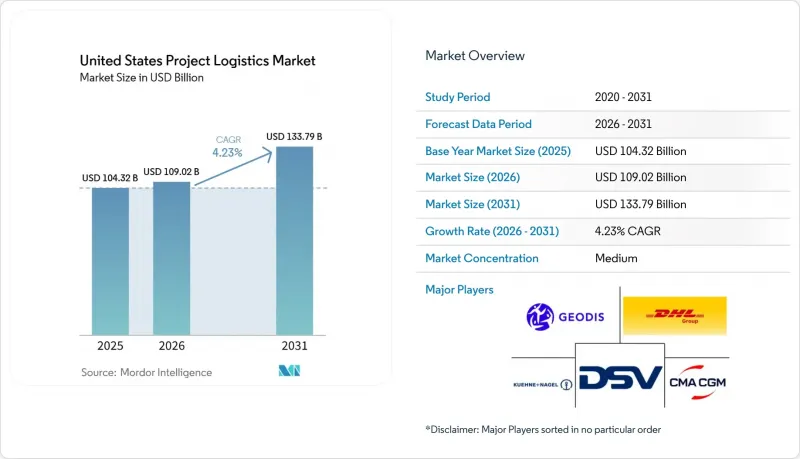
Mordor Intelligence에 의하면, 미국의 프로젝트 물류 시장 규모는 2025년에 1,043억 2,000만 달러로 평가되었고, 2026년 1,090억 2,000만 달러에서 2031년까지 1,337억 9,000만 달러에 이를 것으로 예측되며, 2026-2031년 예측 기간 CAGR은 4.23%를 나타낼 전망입니다.
미국 프로젝트 물류 시장의 성장은 재생에너지, LNG 인프라, 반도체 제조 및 AI 주도형 데이터센터 건설에 대한 설비 투자의 현저한 전환에 의해 주도되고 있습니다. 본 보고서는 서비스별(운송, 창고, 부가가치 서비스, 기타), 화물 유형별(초대형·비규격 화물, 중량물, 벌크 화물, 기타), 최종 사용자 산업별(석유 및 가스, 발전, 건설, 제조, 항공우주 및 방위, 기타), 지역별(북동부, 남서부, 서부, 남동부, 중서부)로 분류되어 있습니다. 시장 전망은 금액(달러) 기준으로 제시됩니다.
미국의 프로젝트 물류 시장 동향 및 인사이트
인플레이션 억제법(IRA)에 힘입은 유틸리티 규모의 재생에너지 프로젝트 급증
대규모 풍력 및 태양광 발전소의 경우, 일반 트럭 운송망으로는 운반할 수 없는 나셀, 변압기 뱅크, 타워 섹션 및 기타 중량 부품을 정해진 기한 내에 납품해야 하므로, 재생에너지 프로젝트는 계속해서 미국 프로젝트 물류 시장에 안정적인 운송 물량을 창출하고 있습니다. 이러한 화물 구성은 허가를 조기에 취득하고, 프로젝트 현장 인근에 장비를 사전 배치하며, 현장 작업이 납품 피크를 맞이하기 전에 호송, 리깅, 크레인 지원 준비를 마칠 수 있는 공급업체에게 유리하게 작용합니다. 랜드스타(Landstar)사는 2025년 4분기 중량물 운송 매출이 약 1억 7,000만 달러에 달하고, 2024년 4분기 대비 23% 증가했다고 보고했으며, 풍력 및 태양광 발전 고객들이 이러한 수요 증가에 기여하고 있습니다. 또한, 재생에너지용 부품의 대형화에 따라 더 많은 프로젝트에서 SPMT(자주식 모듈 운송 차량)를 주력으로 한 운송이나 전문적인 리프팅 계획이 요구되고 있으며, 이로 인해 전문적인 자산이나 경로에 대한 전문 지식을 갖추지 못한 소규모 사업자에게는 진입 장벽이 높아지고 있습니다. 사렌즈(Sarenes)사는 2026년, 버지니아주 연안 해상 풍력 발전 프로젝트의 육상 작업 최종 단계를 완료했습니다. 이 회사는 740건의 SPMT 운용과 382건의 중량물 인양 작업을 수행했으며, 이는 재생에너지 사업이 현재 요구하는 규모가 얼마나 큰지를 보여줍니다. 현장 준비 상황, 송전망 연결, 건설 공정 순서를 둘러싸고 프로젝트 일정이 촉박해지는 가운데, 재생에너지 사업은 미국 프로젝트 물류 시장에서 엔지니어링, 보관, 배송 조정을 일체화한 서비스에 대한 수요를 더욱 높이고 있습니다.
멕시코만 연안의 LNG 수출 터미널 및 석유화학 플랜트 확장
LNG 및 석유화학 플랜트 건설은 중량물, 초대형 화물, 허가 취득에 시간이 많이 소요되는 모듈, 극저온 장비, 압력 용기, 터빈 및 조립 완료된 어셈블리를 미국 프로젝트 물류 시장에 끊임없이 공급하고 있습니다. 미국에서 10번째로 건설된 LNG 수출 터미널인 ‘골든 패스(Golden Pass)’는 2026년 4월 제1 트레인에서 첫 화물을 출하했으나, 제2 및 제3 트레인은 이후 시운전 단계가 예정되어 있었기 때문에 멕시코만 연안 지역의 화물 운송 활동은 높은 수준을 유지했습니다. 셰니에르 에너지(Cheniere Energy)의 코퍼스 크리스티 3단계 프로젝트에서는 2026년 3월에 제5 트레인이 사실상 완공되어, 이를 통해 멕시코만 연안 회랑을 통한 산업용 화물의 지속적인 운송이 뒷받침되었습니다. 또한, 셰니에르 파트너스는 2026년 5월, 사빈 패스 확장 계획의 1단계(트레인 7 및 관련 인프라)에 대해 벡텔사와 일괄 도급 방식의 턴키 EPC 계약을 체결하여, 이를 통해 연간 600만 톤 이상의 추가 LNG 생산 능력을 확보했습니다. 아울러 글렌파른(Glenfarne)의 텍사스 LNG와 키위트(Kiwit)는 2026년 3월, 브라운스빌 항에 연간 400만 톤 규모의 시설 건설에 대해 유사한 EPC 계약을 체결했습니다. 이로 인해 해당 운송 경로에 더욱 대규모 프로젝트가 추가되었습니다. 여러 대규모 건설 프로젝트가 동시에 진행되고 있는 만큼, 미국의 프로젝트 물류 시장에서는 선박 여유 상황이 핍박하고, 노동력 여유가 줄어들며, 멕시코만 연안의 중량물 운송 노선에서 가격 지지세가 강화되고 있습니다.
주별 엄격한 운송 규제와 교량의 중량 제한
50개 주 전체에 걸쳐 특대·중량물 운송에 관한 통일된 전국적 체계가 여전히 부재함에 따라, 주별 허가 취득은 미국 프로젝트 물류 시장에 있어 여전히 주요한 운영상의 제약 요인으로 작용하고 있습니다. 연방 고속도로청은 주간 고속도로에서 차량의 법정 중량 제한을 8만 파운드로 정하고 있습니다. 반면, 많은 프로젝트 화물의 초중량 운송은 이 기준치를 초과하기 때문에 노선별 승인, 기술적 검증 및 특별 지정이 필요합니다. 북동부 및 중서부 일부 지역에서는 교량의 상태가 문제를 더욱 복잡하게 만들고 있습니다. 노후화된 인프라로 인해 가장 무거운 장비를 운송할 수 있는 실용적인 통로 수가 제한적이기 때문입니다. 그 결과, 더 긴 경로를 선택하고, 더 많은 호송 차량을 배치하며, 도로 운송업체, 철도 연결, 현장 팀 간의 협력을 더욱 면밀히 수행해야 하므로 비용이 증가하고 일정상의 위험이 높아집니다. 주마다 다른 치수 규제, 심사 기간, 노선 조건이 적용되기 때문에 사내에 허가 취득에 대한 전문 지식을 갖추지 못한 사업자는 불리한 입장에 놓이게 됩니다. LNG, 재생 에너지, 반도체, 공공 인프라 프로젝트가 동시에 진행될 경우, 미국 프로젝트 물류 시장에서 이용 가능한 노선 네트워크는 더욱 제한될 것입니다.
부문 분석
2025년, 운송 부문은 미국 프로젝트 물류 시장 점유율의 60.12%를 차지했으며, 이는 물리적 운송이 여전히 중량물 및 초대형 화물 프로그램의 주요 수익원임을 뒷받침합니다. 도로를 이용한 중량물 운송이 가장 큰 역할을 하고 있습니다. 이는 제조 야드, 해상 터미널, 복합 운송 환승 거점, 그리고 철도나 바지선으로 최종 구간을 완료할 수 없는 외딴 지역의 건설 현장을 연결하기 위함입니다. 따라서 플랫베드, 다축 트레일러, SPMT(자주식 모듈식 운송기)의 구성은 에너지, 제조, 국방, 인프라 각 화물 흐름에서 계속해서 핵심적인 역할을 수행했습니다. 철도 및 해상·바지선 운송은 교량 제한, 고속도로 높이 제한, 혹은 도심 접근 제약으로 인해 육상 운송의 효율이 떨어지는 장거리 노선에서 여전히 중요한 운송 경로의 이점을 제공합니다. 랜드스타(Landstar)는 2026년 1분기 중량 화물 운송 매출이 전년 동기 대비 18% 증가한 1억 3,400만 달러에 달했다고 보고했으며, 고객층은 데이터센터, 에너지, 정부 기관, 항공우주, 방위 분야에 이릅니다.
부가가치 서비스 및 기타 서비스는 2031년까지 연평균 성장률(CAGR) 5.68%로 확대될 것으로 예측되며, 미국 프로젝트 물류 시장에서 가장 빠르게 성장하는 서비스 분야가 될 전망입니다. 이러한 성장은 동일한 프로젝트를 여러 기업에 위탁하기보다는 실현 가능성 검토, 통관 조정, 리깅 지원, 창고 보관, 화물 가시화를 일원화하여 관리할 수 있는 단일 공급업체를 구매자가 선호하는 경향을 반영하고 있습니다. 또한, 프로젝트 현장에서는 제조 완료부터 현장 사용 준비가 완료되기까지 시간적 간격이 발생하는 경우가 많기 때문에 창고 보관, 유통, 재고 관리의 중요성도 높아지고 있습니다. DHL이 2026년에 북미에서 10곳의 데이터센터 물류 전용 창고를 구축할 계획인 것은 대형 공급업체들이 단순한 운송량뿐만 아니라 스테이징, 하역, 그리고 예정대로의 현장 배송을 중심으로 사업을 구축하고 있음을 보여줍니다. 따라서 미국 프로젝트 물류 시장의 서비스 구성은 엔지니어링 지원 및 일정 관리가 고객 가치를 점점 더 좌우하는 ‘번들형 실행’으로 전환되고 있습니다.
기타 혜택 :
- 엑셀 형식 시장 예측(ME) 시트
- 3개월간의 애널리스트 지원
자주 묻는 질문
목차
제1장 서론
제2장 조사 방법
제3장 주요 요약
제4장 시장 구도
제5장 시장 규모 및 성장 예측
제6장 경쟁 구도
제7장 시장 기회 및 향후 전망
AJYAccording to Mordor Intelligence, the United States project logistics market size was valued at USD 104.32 billion in 2025 and estimated to grow from USD 109.02 billion in 2026 to reach USD 133.79 billion by 2031, at a CAGR of 4.23% during the forecast period 2026-2031.
Growth in the United States project logistics market is being shaped by a visible shift in capital spending toward renewable energy, LNG infrastructure, semiconductor manufacturing, and AI-led data center construction. This report is Segmented by Service (Transportation, Warehousing, Value-Added Services and Others), by Cargo Type (Oversized/Out-of-Gauge, Heavy-Lift, Breakbulk, Others), by End-User Industry (Oil and Gas, Energy Generation, Construction, Manufacturing, Aerospace and Defense, Others), and by Geography (Northeast, Southwest, West, Southeast, Midwest). The Market Forecasts are in Terms of Value (USD).
United States Project Logistics Market Trends and Insights
Surge in Utility-Scale Renewable Energy Projects Supported by the Inflation Reduction Act (IRA)
Renewable energy projects continue to add steady volume to the United States project logistics market because large wind and solar sites depend on timed delivery of nacelles, transformer banks, tower sections, and other heavy components that cannot move through ordinary truckload networks. This cargo mix favors providers that can secure permits early, stage equipment near project sites, and line up escort, rigging, and crane support before field work reaches its peak delivery phase. Landstar reported heavy-haul revenue of nearly USD 170 million in Q4 2025, up 23% from Q4 2024, with wind and solar customers contributing to that acceleration in demand. Larger renewable energy components are also pushing more projects toward SPMT-led transport and engineered lift planning, which raises barriers for smaller operators without specialized assets or route expertise. Sarens completed the final onshore scope for the Coastal Virginia Offshore Wind project in 2026, after carrying out 740 SPMT operations and 382 heavy lifts, demonstrating the scale that renewable energy work now requires. As project schedules tighten around site readiness, grid connection, and construction sequencing, renewable energy work is driving stronger demand for bundled engineering, storage, and delivery coordination across the United States project logistics market.
Expansion of Gulf Coast LNG Export Terminals and Petrochemical Installations
LNG and petrochemical construction is supplying the United States project logistics market with a steady stream of modules, cryogenic equipment, pressure vessels, turbines, and fabricated assemblies that are heavy, oversized, and permit-intensive. Golden Pass, the 10th United States LNG export terminal, shipped its first cargo from Train 1 in April 2026, while Trains 2 and 3 remained scheduled for later commissioning phases, which kept Gulf Coast cargo activity elevated. Cheniere Energy's Corpus Christi Stage 3 project reached substantial completion of Train 5 in March 2026, which supported continued movement of industrial cargo through Gulf Coast corridors. Cheniere Partners also signed a lump-sum, turnkey EPC contract with Bechtel in May 2026 for the first phase of the Sabine Pass expansion, covering Train 7 and supporting infrastructure, providing more than 6 million tons per annum of additional LNG capacity. Glenfarne's Texas LNG and Kiewit executed a similar EPC contract in March 2026 for a 4-million-ton-per-annum facility at the Port of Brownsville, which added another large project to the same corridor. With multiple large builds progressing at once, the United States project logistics market is seeing tighter vessel availability, narrower labor buffers, and stronger pricing support in Gulf Coast heavy-lift lanes.
Stringent State-By-State Transport Regulations and Bridge Weight Limitations
State permitting remains a major operating restraint for the United States project logistics market because oversize and overweight transport still lacks a uniform national framework across all 50 states. The Federal Highway Administration sets an interstate legal vehicle weight limit of 80,000 pounds. At the same time, many project cargo superloads exceed that threshold and require route-specific approvals, engineering checks, and special designations. Bridge conditions in parts of the Northeast and Midwest make the issue harder because older infrastructure reduces the number of viable corridors for the heaviest equipment moves. That often forces longer routes, more escorts, and tighter sequencing between road carriers, rail links, and site teams, which increases costs and schedule risk. Operators without in-house permitting expertise are at a disadvantage because every state can apply different dimensional rules, review times, and routing conditions. When LNG, renewable energy, semiconductor, and public infrastructure projects run concurrently, the available route network within the United States project logistics market becomes even more constrained.
Other drivers and restraints analyzed in the detailed report include:
- Accelerated Construction of Hyperscale Data Centers and AI Infrastructure
- Reshoring Initiatives and Semiconductor Fabrication Plant Construction Under the CHIPS Act
- Persistent Shortages of Specialized Labor and Experienced Heavy-Haul Drivers
For complete list of drivers and restraints, kindly check the Table Of Contents.
Segment Analysis
Transportation held 60.12% of the United States project logistics market share in 2025, confirming that physical movement remains the core revenue engine for heavy and oversized-cargo programs. Road-based heavy haul plays the largest role because it links fabrication yards, marine terminals, intermodal transfer points, and remote construction sites where rail or barge cannot complete the final leg. Flatbeds, multi-axle trailers, and SPMT configurations, therefore, remained central to execution across energy, manufacturing, defense, and infrastructure cargo flows. Rail and sea or barge modes still offered important corridor advantages on longer routes where bridge limits, highway height restrictions, or urban access constraints made over-road transport less efficient. Landstar reported USD 134 million in heavy-haul revenue in Q1 2026, up 18% year over year, with customers spanning data centers, energy, government, aerospace, and defense.
Value-added services and other services are projected to expand at a 5.68% CAGR through 2031, making them the fastest-growing service lines within the United States project logistics market. That growth reflects a buyer preference for a single provider that can manage feasibility reviews, customs coordination, rigging support, warehousing, and cargo visibility, rather than handing the same project to multiple firms. Warehousing, distribution, and inventory management are also becoming more important because project sites often face timing gaps between fabrication completion and field readiness. DHL's 2026 rollout of 10 dedicated North American data center logistics warehouses shows how larger providers are building around staging, handling, and scheduled site delivery rather than only transport volume. The service mix in the United States project logistics market is therefore moving toward bundled execution, where engineering support and schedule control increasingly shape customer value.
Complete Report Scope:
- By Service
- Transportation
- Road
- Rail
- Air
- Sea/Barge
- Warehousing, Distribution and Inventory Management
- Value-added Services and Others
- Transportation
- By Cargo Type
- Oversized (Out-of-Gauge) Cargo
- Heavy-Lift Cargo
- Breakbulk Cargo
- Others
- By End-User Industry
- Oil and Gas, Mining and Quarrying
- Energy Generation and Transmission (Includes Renewable Energy)
- Construction and Infrastructure
- Manufacturing and Industrial Plants
- Aerospace and Defense
- Others (Maritime and Shipbuilding, Telecommunications, etc.)
- By Geography
- Northeast
- Southwest
- West
- Southeast
- Midwest
List of Companies Covered in this Report:
- Kuehne+Nagel
- DHL Group
- DSV A/S
- CMA CGM Group
- GEODIS
- Expeditors International of Washington, Inc.
- C.H. Robinson Worldwide, Inc.
- Crane Worldwide Logistics LLC
- Mammoet USA South Inc.
- Sarens USA Inc.
- BNSF Logistics, LLC
- Anderson Trucking Service, Inc.
- Landstar System, Inc.
- Emmert Industrial Corp.
- deugro (USA) Inc.
- Fagioli Inc.
- Rhenus Logistics
- Hellmann Worldwide Logistics
- NYK Line
- AIT Worldwide Logistics, Inc.
- EMO Trans, Inc.
- FLS Transportation Services, Inc.
- NMT Projects Inc.
- Rohlig Logistics GmbH & Co. KG
- S.F. Holding Co., Ltd. (Including KLN Logistics Group Limited)
Additional Benefits:
- The market estimate (ME) sheet in Excel format
- 3 months of analyst support
TABLE OF CONTENTS
1 Introduction
- 1.1 Study Assumptions and Market Definition
- 1.2 Scope of the Study
2 Research Methodology
3 Executive Summary
4 Market Landscape
- 4.1 Market Overview
- 4.2 Market Drivers
- 4.2.1 Surge in Utility-Scale Renewable Energy Projects Supported by the Inflation Reduction Act (IRA)
- 4.2.2 Expansion of Gulf Coast LNG Export Terminals and Petrochemical Installations
- 4.2.3 Accelerated Construction of Hyperscale Data Centers and AI Infrastructure
- 4.2.4 Federal Infrastructure Investments Upgrading Port, Rail, and Highway Connectivity (IIJA)
- 4.2.5 Reshoring Initiatives and Semiconductor Fabrication Plant (Fab) Construction (CHIPS Act)
- 4.2.6 Increasing Demand for Specialized Multimodal Heavy-Lift Transport Solutions
- 4.3 Market Restraints
- 4.3.1 Stringent State-by-State Transport Regulations and Bridge Weight Limitations
- 4.3.2 Persistent Shortages of Specialized Labor and Experienced Heavy-Haul Drivers
- 4.3.3 High Capital Expenditure and Maintenance Costs for Specialized Heavy-Lift Fleets
- 4.3.4 Volatile Equipment Costs and Coordination Challenges Across Multi-State Jurisdictions
- 4.4 Value / Supply-Chain Analysis
- 4.5 Regulatory Landscape
- 4.6 Technological Outlook
- 4.7 Porter's Five Forces Analysis
- 4.7.1 Bargaining Power of Suppliers
- 4.7.2 Bargaining Power of Buyers
- 4.7.3 Threat of New Entrants
- 4.7.4 Threat of Substitutes
- 4.7.5 Industry Rivalry
- 4.8 Impact of Geopolitical Events on the Market
5 Market Size and Growth Forecasts (Value, USD)
- 5.1 By Service
- 5.1.1 Transportation
- 5.1.1.1 Road
- 5.1.1.2 Rail
- 5.1.1.3 Air
- 5.1.1.4 Sea/Barge
- 5.1.2 Warehousing, Distribution and Inventory Management
- 5.1.3 Value-added Services and Others
- 5.1.1 Transportation
- 5.2 By Cargo Type
- 5.2.1 Oversized (Out-of-Gauge) Cargo
- 5.2.2 Heavy-Lift Cargo
- 5.2.3 Breakbulk Cargo
- 5.2.4 Others
- 5.3 By End-User Industry
- 5.3.1 Oil and Gas, Mining and Quarrying
- 5.3.2 Energy Generation and Transmission (Includes Renewable Energy)
- 5.3.3 Construction and Infrastructure
- 5.3.4 Manufacturing and Industrial Plants
- 5.3.5 Aerospace and Defense
- 5.3.6 Others (Maritime and Shipbuilding, Telecommunications, etc.)
- 5.4 By Geography
- 5.4.1 Northeast
- 5.4.2 Southwest
- 5.4.3 West
- 5.4.4 Southeast
- 5.4.5 Midwest
6 Competitive Landscape
- 6.1 Market Concentration
- 6.2 Strategic Moves
- 6.3 Market Share Analysis
- 6.4 Company Profiles (includes Global Level Overview, Market Level Overview, Core Segments, Financials as available, Strategic Information, Market Rank/Share, Products and Services, Recent Developments)
- 6.4.1 Kuehne+Nagel
- 6.4.2 DHL Group
- 6.4.3 DSV A/S
- 6.4.4 CMA CGM Group
- 6.4.5 GEODIS
- 6.4.6 Expeditors International of Washington, Inc.
- 6.4.7 C.H. Robinson Worldwide, Inc.
- 6.4.8 Crane Worldwide Logistics LLC
- 6.4.9 Mammoet USA South Inc.
- 6.4.10 Sarens USA Inc.
- 6.4.11 BNSF Logistics, LLC
- 6.4.12 Anderson Trucking Service, Inc.
- 6.4.13 Landstar System, Inc.
- 6.4.14 Emmert Industrial Corp.
- 6.4.15 deugro (USA) Inc.
- 6.4.16 Fagioli Inc.
- 6.4.17 Rhenus Logistics
- 6.4.18 Hellmann Worldwide Logistics
- 6.4.19 NYK Line
- 6.4.20 AIT Worldwide Logistics, Inc.
- 6.4.21 EMO Trans, Inc.
- 6.4.22 FLS Transportation Services, Inc.
- 6.4.23 NMT Projects Inc.
- 6.4.24 Rohlig Logistics GmbH & Co. KG
- 6.4.25 S.F. Holding Co., Ltd. (Including KLN Logistics Group Limited)
7 Market Opportunities and Future Outlook
- 7.1 White-Space and Unmet-Need Assessment