

|
시장보고서
상품코드
2038685
레저 보트 시장 : 시장 기회, 성장요인, 업계 동향 분석 및 예측(2026-2035년)Leisure Boats Market Opportunity, Growth Drivers, Industry Trend Analysis, and Forecast 2026 - 2035 |
||||||

세계의 레저 보트 시장은 2025년에 189억 달러로 평가되었고, 2035년까지 연평균 복합 성장률(CAGR) 5.1%로 성장할 전망이며, 303억 달러에 이를 것으로 추정되고 있습니다.
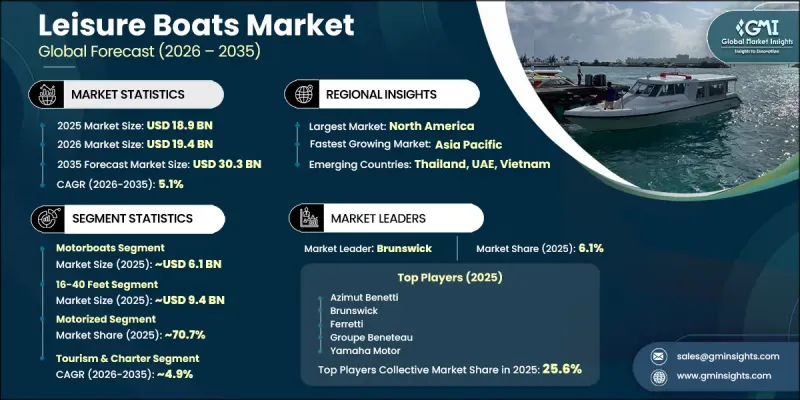
시장 성장은 해안 관광 활동의 확대와 해양 레크리에이션을 촉진하기 위한 해안가 개발 프로젝트에 대한 정부의 투자 증가에 힘입어 성장하고 있습니다. 연안 및 내륙 수역에서의 레크리에이션 보트 활동에 대한 관심이 높아진 것도 꾸준한 수요 증가에 기여하고 있습니다. 어업이 레크리에이션과 레저 활동으로 간주되는 일부 지역에서는 보트 소유율이 증가하고 있으며, 이는 시장 확대를 더욱 촉진하고 있습니다. 기술 및 설계의 발전은 특히 추진 시스템에서 효율성, 중량 대비 출력 성능, 유지보수 용이성을 향상시키며 업계를 변화시키고 있습니다. 모듈식 보트 설계는 교체 가능한 좌석 배치, 변환 가능한 활동 모듈, 단일 선박에서 여러 레크리에이션 용도에 맞게 조정 가능한 적응형 데크 구성을 통해 유연성을 높여주어 큰 호응을 얻고 있습니다. 이러한 다재다능함은 다기능과 맞춤형 레저 경험을 중시하는 젊은 소비자층에게 특히 매력적입니다. 동시에, 현대의 레저 보트는 점점 더 편안함, 안전성, 사용 편의성을 높이기 위해 설계되는 경향이 있으며, 다목적 공간, 풍부한 선상 시설, 개선된 안전 시스템 등의 기능이 내장되어 있습니다. 가족 단위의 보트 체험에 대한 선호도가 높아지면서 제조업체들이 다양한 수상 활동에 대응할 수 있는 유연한 레이아웃에 집중하는 계기가 되었고, 이는 전 세계 시장 전반에 걸쳐 수요를 더욱 강화하는 계기가 되었습니다.
| 시장 범위 | |
|---|---|
| 개시 연도 | 2025년 |
| 예측 기간 | 2026-2035년 |
| 개시 연도 시장 규모 | 189억 달러 |
| 예측 시장 규모 | 303억 달러 |
| CAGR | 5.1% |
모터 보트 부문은 2025년 32.3%의 점유율을 차지했으며, 61억 달러 시장 규모를 창출했습니다. 이 부문은 높은 실용성, 운영 유연성 및 다양한 레크리에이션 용도에 대한 적응성으로 인해 계속해서 시장을 주도하고 있습니다. 모터 보트는 조작의 용이성과 다양한 수상 활동에 대한 적응성을 갖추고 있어 레저 보트 업계에서 여전히 높은 인기를 누리고 있으며, 초보자부터 숙련된 사용자까지 폭넓은 범위의 사용자에게 적합합니다.
2025년에는 16-40피트 부문이 49.7%의 점유율을 차지했으며, 시장 규모가 94억 달러에 달했습니다. 이 사이즈 카테고리는 성능, 편안함, 소유의 실용성을 효과적으로 결합하여 상업적으로 가장 중요한 위치를 차지하고 있습니다. 이 범위의 소형 보트는 운반이 용이하고, 대형 모델은 장시간 레크리에이션에 적합한 넓은 선상 공간을 제공하므로 이 부문은 다양한 소비자층에게 매우 매력적입니다.
미국의 레저 보트 시장은 2025년 69억 달러에 달했으며, 2026-2035년 연평균 4%의 성장률을 보일 것으로 전망됩니다. 이 나라는 전 세계 시장의 36.5%, 북미 점유율의 87.8%를 차지하며 세계 선두를 차지하고 있습니다. 이러한 견고한 시장 동향은 광범위한 해안 접근성, 내륙 수로 및 연중 내내 레저 보트 활동을 가능하게 하는 좋은 기후에 의해 뒷받침되고 있습니다. 또한, 미국은 수백만 척의 등록 선박을 보유한 대규모 레저보트 기반을 보유하고 있으며, 이는 세계 레저보트 산업에서 미국의 우위를 더욱 공고히 하고 있습니다.
Azimut Benetti, Groupe Beneteau, Bavaria Yacht, Brunswick, Sunseeker, Ferretti, Malibu Boats, Yamaha Motor 및 MasterCraft Boat 등이 레저보트 업계를 선도하는 주요 기업입니다. 레저 보트 시장의 각 업체들은 시장에서의 입지를 강화하기 위해 제품 혁신, 커스터마이징 및 선상 경험 향상에 주력하고 있습니다. 제조업체들은 유연한 구성과 다기능 활용이 가능한 모듈식 보트 설계에 대한 투자를 확대하여 보다 폭넓은 고객층을 확보하기 위해 노력하고 있습니다. 또한, 성능 향상과 운영비 절감을 위해 추진 시스템, 연료 효율, 경량화 소재의 기술 혁신이 우선적으로 추진되고 있습니다. 또한, 각 업체들은 편안함을 중시하는 기능과 첨단 안전 시스템을 통합하여 가족 및 레저용 부문의 제품 라인업을 확대되고 있습니다. 관광사업자 및 마리나 개발업체와의 전략적 제휴는 각 사 시장 진출 확대에 기여하고 있습니다. 또한, 디지털 마케팅, 프리미엄 브랜딩, 애프터 서비스 지원에 중점을 두어 고객 충성도를 높이고, 세계의 레저 보트 업계에서 장기적인 경쟁력을 강화하고 있습니다.
자주 묻는 질문
목차
제1장 조사 방법
제2장 주요 요약
제3장 업계 인사이트
제4장 경쟁 구도
제5장 시장 추산 및 예측 : 선 유형별(2022-2035년)
제6장 시장 추산 및 예측 : 추진력별(2022-2035년)
제7장 시장 추산 및 예측 : 사이즈별(2022-2035년)
제8장 시장 추산 및 예측 : 용도별(2022-2035년)
제9장 시장 추산 및 예측 : 지역별(2022-2035년)
제10장 기업 개요
AJY 26.06.11The Global Leisure Boats Market was valued at USD 18.9 billion in 2025 and is estimated to grow at a CAGR of 5.1% to reach USD 30.3 billion by 2035.
Market growth is supported by the expansion of coastal tourism activities and increasing government investments in waterfront development projects aimed at promoting marine-based recreation. Rising interest in recreational boating activities across coastal and inland water regions is also contributing to steady demand growth. In several regions where fishing is considered both a recreational and leisure activity, boat ownership levels are rising, further supporting market expansion. Technological and design advancements are also reshaping the industry, particularly in propulsion systems that offer improved efficiency, weight-to-power performance, and ease of maintenance. Modular boat designs are gaining strong traction as they provide enhanced flexibility through interchangeable seating arrangements, convertible activity modules, and adaptable deck configurations that allow a single vessel to support multiple recreational uses. This versatility is especially appealing to younger consumers who prioritize multifunctional and customizable leisure experiences. At the same time, modern leisure boats are increasingly designed to enhance comfort, safety, and usability, incorporating features such as convertible spaces, enhanced onboard amenities, and improved safety systems. Growing preference for family-oriented boating experiences is also encouraging manufacturers to focus on adaptable layouts that support multiple water-based activities, further strengthening demand across global markets.
| Market Scope | |
|---|---|
| Start Year | 2025 |
| Forecast Year | 2026-2035 |
| Start Value | $18.9 Billion |
| Forecast Value | $30.3 Billion |
| CAGR | 5.1% |
The motorboats segment held a share of 32.3% in 2025, generating USD 6.1 billion. This segment continues to lead the market due to its strong usability, operational flexibility, and suitability across a wide range of recreational applications. Motorboats remain highly preferred in the leisure boating industry as they offer ease of navigation and adaptability for different water-based activities, making them suitable for both new and experienced users.
The 16-40 feet segment accounted for 49.7% share in 2025, valued at USD 9.4 billion. This size category remains the most commercially significant as it effectively balances performance, comfort, and ownership practicality. Smaller boats within this range offer easy transportability, while larger models provide enhanced onboard space suitable for extended recreational use, making this segment highly attractive for a broad consumer base.
United States Leisure Boats Market reached USD 6.9 billion in 2025 and is projected to grow at a CAGR of 4% from 2026 to 2035. The country holds a leading position globally, accounting for 36.5% of the total market and 87.8% of the North American share. Strong market performance is supported by extensive coastal access, inland waterways, and favorable climatic conditions that enable year-round recreational boating activities. The United States also maintains a large recreational boating base with millions of registered vessels, further reinforcing its dominance in the global leisure boating industry.
Azimut Benetti, Groupe Beneteau, Bavaria Yacht, Brunswick, Sunseeker, Ferretti, Malibu Boats, Yamaha Motor, and MasterCraft Boat are among the leading companies operating in the leisure boats industry. Companies in the Leisure Boats Market are focusing on product innovation, customization, and enhanced onboard experiences to strengthen their market position. Manufacturers are increasingly investing in modular boat designs that allow flexible configurations and multifunctional usage to attract a broader consumer base. Technological advancements in propulsion systems, fuel efficiency, and lightweight materials are being prioritized to improve performance and reduce operational costs. Firms are also expanding their offerings in family-oriented and recreational segments by integrating comfort-focused features and advanced safety systems. Strategic partnerships with tourism operators and marina developers are helping companies expand their market reach. Additionally, strong emphasis on digital marketing, premium branding, and after-sales service support is enabling manufacturers to build customer loyalty and enhance long-term competitiveness in the global leisure boating industry.
Table of Contents
Chapter 1 Methodology
- 1.1 Research approach
- 1.2 Quality Commitments
- 1.2.1 GMI AI policy & data integrity commitment
- 1.3 Research Trail & Confidence Scoring
- 1.3.1 Research Trail Components
- 1.3.2 Scoring Components
- 1.4 Data Collection
- 1.5 Data mining sources
- 1.5.1 Paid sources
- 1.6 Base estimates and calculations
- 1.6.1 Base year calculation for any one approach
- 1.7 Forecast
- 1.7.1 Quantified market impact analysis
- 1.8 Research transparency addendum
- 1.8.1 Source attribution framework
- 1.8.2 Quality assurance metrics
- 1.8.3 Our commitment to trust
Chapter 2 Executive Summary
- 2.1 Industry 360° synopsis
- 2.2 Key market trends
- 2.2.1 Regional
- 2.2.2 Boat
- 2.2.3 Propulsion
- 2.2.4 Size
- 2.2.5 Application
- 2.3 TAM analysis, 2026-2035
- 2.4 CXO perspectives: Strategic imperatives
Chapter 3 Industry Insights
- 3.1 Industry ecosystem analysis
- 3.1.1 Supplier landscape
- 3.1.2 Profit margin
- 3.1.3 Cost structure
- 3.1.4 Value addition at each stage
- 3.1.5 Factor affecting the value chain
- 3.1.6 Disruptions
- 3.2 Industry impact forces
- 3.2.1 Growth drivers
- 3.2.1.1 Rising Disposable Income and Luxury Spending
- 3.2.1.2 Growth in Marine and Coastal Tourism
- 3.2.1.3 Increasing Popularity of Recreational Boating Activities
- 3.2.1.4 Development of Marina and Coastal Infrastructure
- 3.2.2 Industry pitfalls and challenges
- 3.2.2.1 High Initial Purchase Cost of Leisure Boats
- 3.2.2.2 Expensive Maintenance and Operating Costs
- 3.2.3 Market opportunities
- 3.2.3.1 Growing Adoption of Electric and Eco-Friendly Boats
- 3.2.3.2 Expansion of Boat Sharing and Fractional Ownership Models
- 3.2.3.3 Rising Popularity of Inland Water Tourism
- 3.2.1 Growth drivers
- 3.3 Technology and innovation landscape
- 3.3.1 Current technologies
- 3.3.1.1 GPS-Based Navigation Systems
- 3.3.1.2 Marine Radar Systems
- 3.3.1.3 Diesel and Petrol Marine Propulsion Systems
- 3.3.2 Emerging technologies
- 3.3.2.1 Electric and Hybrid Propulsion Systems
- 3.3.2.2 Autonomous and AI-Assisted Navigation
- 3.3.2.3 IoT-Enabled Smart Boat Systems
- 3.3.2.4 Advanced Composite Materials for Lightweight Hulls
- 3.3.1 Current technologies
- 3.4 Growth potential analysis
- 3.5 Pricing analysis (Driven by Primary Research)
- 3.5.1 Historical price trend analysis
- 3.5.2 Pricing strategy by player type (Premium / Value / Cost-plus)
- 3.6 Regulatory landscape
- 3.6.1 North America
- 3.6.1.1 US - U.S. Coast Guard
- 3.6.1.2 US - Environmental Protection Agency
- 3.6.2 Europe
- 3.6.2.1 EU - European Commission
- 3.6.2.2 UK - Maritime and Coastguard Agency
- 3.6.3 Asia Pacific
- 3.6.3.1 Australia - Australian Maritime Safety Authority
- 3.6.3.2 China - Ministry of Transport of the People's Republic of China
- 3.6.4 Latin America
- 3.6.4.1 Brazil - Brazilian Navy
- 3.6.4.2 Mexico - Secretariat of the Navy
- 3.6.5 Middle East & Africa
- 3.6.5.1 Saudi Arabia - Saudi Ports Authority
- 3.6.5.2 UAE - Dubai Maritime Authority
- 3.6.1 North America
- 3.7 Porter's analysis
- 3.8 PESTEL analysis
- 3.9 Patent landscape (Driven by Primary Research)
- 3.10 Cost breakdown analysis
- 3.10.1 Raw materials & components costs
- 3.10.2 Labor & assembly costs
- 3.10.3 Engine & propulsion system costs
- 3.10.4 Distribution, logistics, and dealer margins
- 3.10.5 Compliance, testing & certification costs
- 3.11 Trade Data Analysis (Driven by Paid Database)
- 3.11.1 Import/Export Volume & Value Trends
- 3.11.2 Key Trade Corridors & Tariff Impact
- 3.12 Capacity & Production Landscape (Driven by Primary Research)
- 3.12.1 Installed Capacity by Region & Key Producer
- 3.12.2 Capacity Utilization Rates & Expansion Pipelines
- 3.13 Sustainability and environmental aspects
- 3.13.1 Sustainable Practices
- 3.13.2 Waste Reduction Strategies
- 3.13.3 Energy Efficiency in Production
- 3.13.4 Eco-friendly Initiatives
- 3.13.5 Carbon Footprint Considerations
- 3.14 Impact of AI & Generative AI on the Market
- 3.14.1 AI-driven disruption of existing business models
- 3.14.2 GenAI use cases & adoption roadmap by segment
- 3.14.3 Risks, limitations & regulatory considerations
- 3.15 Forecast assumptions & scenario analysis (Driven by Primary Research)
- 3.15.1 Base Case - key macro & industry variables driving CAGR
- 3.15.2 Optimistic Scenarios - Favorable macro and industry tailwinds
- 3.15.3 Pessimistic Scenario - Macroeconomic slowdown or industry headwinds
Chapter 4 Competitive Landscape, 2025
- 4.1 Introduction
- 4.2 Company market share analysis
- 4.2.1 North America
- 4.2.2 Europe
- 4.2.3 Asia Pacific
- 4.2.4 LATAM
- 4.2.5 MEA
- 4.3 Competitive analysis of major market players
- 4.4 Competitive positioning matrix
- 4.5 Key developments
- 4.5.1 Mergers & acquisitions
- 4.5.2 Partnerships & collaborations
- 4.5.3 New product launches
- 4.5.4 Expansion plans and funding
- 4.6 Company tier benchmarking
- 4.6.1 Tier classification criteria & qualifying thresholds
- 4.6.2 Tier positioning matrix by revenue, geography & innovation
Chapter 5 Market Estimates and Forecast, By Boat, 2022 - 2035 ($ Mn, Units)
- 5.1 Key trends
- 5.2 Motorboats
- 5.2.1 Cabin Cruisers
- 5.2.2 Bowriders
- 5.2.3 Center Consoles
- 5.2.4 Pontoon Boats
- 5.3 Sailboats
- 5.4 Yachts
- 5.4.1 Motor Yachts
- 5.4.2 Sailing Yachts
- 5.4.3 Mega Yachts
- 5.5 Personal watercraft
- 5.6 Inflatable boats
- 5.7 Catamarans
- 5.8 Houseboats
- 5.9 Canoes & Kayaks
- 5.10 Others
Chapter 6 Market Estimates and Forecast, By Propulsion, 2022 - 2035 ($ Mn, Units)
- 6.1 Key trends
- 6.2 Motorized
- 6.2.1 Gasoline-Powered
- 6.2.2 Diesel-Powered
- 6.2.3 Electric
- 6.2.4 Hybrid
- 6.3 Non-Motorized
Chapter 7 Market Estimates and Forecast, By Size, 2022 - 2035 ($ Mn, Units)
- 7.1 Key trends
- 7.2 Under 16 Feet
- 7.3 16-40 Feet
- 7.4 Over 40 Feet
Chapter 8 Market Estimates and Forecast, By Application, 2022 - 2035 ($ Mn, Units)
- 8.1 Key trends
- 8.2 Recreational
- 8.3 Sports & Watersports
- 8.4 Fishing
- 8.5 Tourism & Charter
- 8.6 Others
Chapter 9 Market Estimates & Forecast, By Region, 2022 - 2035 ($Mn, Units)
- 9.1 Key trends
- 9.2 North America
- 9.2.1 US
- 9.2.2 Canada
- 9.3 Europe
- 9.3.1 Germany
- 9.3.2 UK
- 9.3.3 France
- 9.3.4 Italy
- 9.3.5 Spain
- 9.3.6 Netherlands
- 9.3.7 Sweden
- 9.3.8 Norway
- 9.3.9 Croatia
- 9.4 Asia Pacific
- 9.4.1 China
- 9.4.2 Japan
- 9.4.3 South Korea
- 9.4.4 India
- 9.4.5 Australia
- 9.4.6 Thailand
- 9.4.7 Indonesia
- 9.4.8 Singapore
- 9.4.9 Vietnam
- 9.5 Latin America
- 9.5.1 Brazil
- 9.5.2 Mexico
- 9.5.3 Argentina
- 9.5.4 Chile
- 9.6 MEA
- 9.6.1 South Africa
- 9.6.2 Saudi Arabia
- 9.6.3 UAE
Chapter 10 Company Profiles
- 10.1 Global players
- 10.1.1 Brunswick
- 10.1.2 Yamaha Motor
- 10.1.3 Groupe Beneteau
- 10.1.4 Azimut Benetti
- 10.1.5 Ferretti
- 10.1.6 Bavaria Yacht
- 10.1.7 MasterCraft Boat
- 10.1.8 Malibu Boats
- 10.1.9 Smoker Craft
- 10.1.10 BRP
- 10.2 Regional players
- 10.2.1 Fairline Yachts
- 10.2.2 Princess Yachts
- 10.2.3 Sunseeker International
- 10.2.4 Absolute Yachts
- 10.2.5 Leopard Catamarans
- 10.2.6 Pursuit Boats
- 10.2.7 Cobalt Boats
- 10.3 Emerging players
- 10.3.1 Arc Boats
- 10.3.2 X Shore
- 10.3.3 Candela Technology


